

Savolture Technical Guide
Fournisseur de batteries LiFePO4 empilables : 5 choses à vérifier avant de comparer les prix | Savolture
Placez deux devis côte à côte. Tous deux indiquent « batterie LiFePO4 empilable », montrent une tour de modules sur un socle et affichent un prix par kWh qui paraît comparable. ...

body.sv-lang-fr { line-height: 1.55; }
.svba-direct-answer{background:#f0f4f8;border-left:5px solid #ff6b35;padding:16px 20px;margin:20px 0;border-radius:4px;font-size:15.5px;line-height:1.65}
.svba-checklist-box{background:#fff8f3;border:1px solid #ffd9c2;border-radius:6px;padding:16px 20px;margin:20px 0}
.svba-checklist-box strong{color:#c2410c}
table.svba-ref{width:100%;border-collapse:collapse;margin:20px 0;font-size:14.5px}
table.svba-ref th,table.svba-ref td{border:1px solid #d4d8de;padding:10px 12px;text-align:left;vertical-align:top}
table.svba-ref th{background:#081827;color:#fff;font-weight:600}
table.svba-ref tr:nth-child(even){background:#f7f9f8}
table.svba-ref td.navy{background:#081827;color:#fff;font-weight:600;text-align:center}
table.svba-ref td.code{font-family:ui-monospace,Menlo,Consolas,monospace;font-weight:700;color:#c2410c;text-align:center}
table.svba-ref td.win{background:#f0f7f2;font-weight:600;color:#1a6b3a}
.svba-protip{background:#081827;color:#eef2f6 !important;padding:16px 20px;border-radius:6px;margin:20px 0;font-size:14.5px}
.svba-protip strong{color:#ff9a6b !important}
.svba-protip em{color:#eef2f6 !important}
.svba-warn{background:#fef2f2;border:1px solid #fecaca;border-left:5px solid #dc2626;padding:16px 20px;margin:20px 0;border-radius:4px;font-size:14.5px}
.svba-warn strong{color:#b91c1c}
.svba-mistakes{border:1px solid #e2e6ea;border-radius:6px;padding:6px 18px;margin:14px 0;background:#fafbfc}
.svba-mistakes h4{margin:14px 0 6px;font-size:16px;color:#081827}
.svba-mistakes .wrong{color:#b91c1c;font-weight:700}
.svba-mistakes .right{color:#1a6b3a;font-weight:700}
.svba-srcnote{font-size:12.5px;color:#777;font-style:italic;margin:-12px 0 18px}
.svba-cta-grid{display:grid;grid-template-columns:repeat(auto-fit,minmax(240px,1fr));gap:14px;margin:24px 0}
.svba-cta-card{background:#1a4d33;color:#fff;padding:18px;border-radius:6px;text-align:center}
.svba-cta-card a{color:#fff;text-decoration:none;font-weight:600;display:block}
.svba-cta-card small{display:block;margin-top:6px;font-weight:400;opacity:.85;font-size:13px}
.svba-faq h3{margin-top:22px;font-size:17px;color:#1a4d33}
.svba-sources{font-size:13.5px;color:#555;background:#fafafa;padding:14px 18px;border-radius:4px;margin-top:30px}
.svba-about{border:1px solid #e2e6ea;border-radius:8px;padding:4px 22px 18px;margin:34px 0 10px;background:#fbfcfd}
.svba-about h2{margin-bottom:4px}
.svba-profile{background:#081827;color:#eef2f6 !important;border-radius:6px;padding:16px 20px;margin:14px 0;font-size:14px;line-height:1.7}
.svba-profile strong{color:#ff9a6b !important}
.svba-faultline{border-left:4px solid #ff6b35;padding:2px 0 2px 18px;margin:28px 0 18px}
.svba-faultline h2{margin-top:6px}
.svba-ask{background:#f0f4f8;border-radius:6px;padding:14px 18px;margin:16px 0;font-size:14.5px}
.svba-ask strong{color:#081827}
Placez deux devis côte à côte. Tous deux indiquent « batterie LiFePO4 empilable », montrent une tour de modules sur un socle et affichent un prix par kWh qui paraît comparable. Pourtant, l’un peut être un système 51,2 V dont les modules sont raccordés en parallèle sur un bus commun, tandis que l’autre est une chaîne de 400 V avec des modules câblés en série et une unité de contrôle en pied de colonne que le devis ne mentionne pas.
Ce ne sont pas des produits concurrents. Ce sont différentes catégories de produits qui partagent un mot marketing.
C’est le problème des décisions d’achat dans cette catégorie, et c’est pourquoi les résultats de recherche pour ce terme sont presque entièrement des catalogues de fournisseurs. Chaque page explique ce que vend ce fournisseur. Presque aucun n’explique comment vérifier si ce qu’ils vendent correspond à ce que vous pensez acheter, ou si l’entreprise derrière cela peut encore prendre en charge le système au cours de la septième année.
Ce guide est l’autre côté de cette conversation : les cinq endroits où « empilable » signifie tranquillement des choses différentes, la question exacte qui expose chacune d’entre elles, et comment distinguer une vraie réponse d’une réponse répétée.
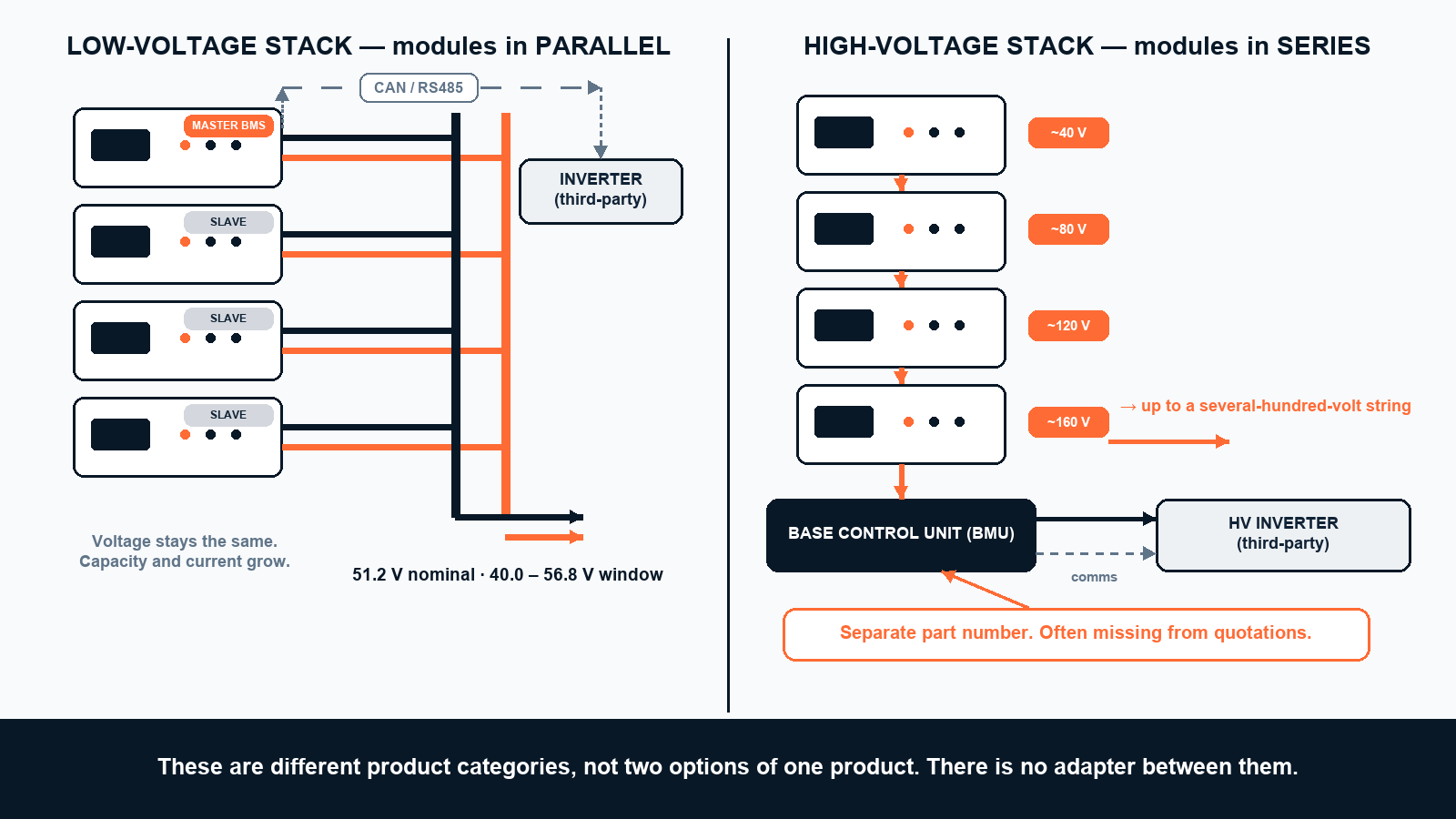
Ligne de faille 1 — Pile parallèle ou pile en série ?
C’est celui qui se transforme en envoi de retour. Deux architectures sont vendues sous le même mot et ne sont interchangeables à aucun moment du système.
Dans une pile basse tension, chaque module est une batterie complète de classe 48 V, généralement 51,2 V nominal, avec son propre BMS. Les empiler les met en parallèle sur un jeu de barres CC partagé. La tension du système ne change jamais ; seules la capacité et le courant disponible augmentent. Un module est désigné maître, les autres lui dépendent.
Dans une pile haute tension, chaque module est une tranche de chaîne. L’empilement les place en séries. Dix modules de 40 V nominal deviennent une chaîne de 400 V. Il existe généralement une unité de contrôle de base distincte (parfois appelée BMU, boîtier de commande ou boîtier haute tension) qui gère la chaîne, gère les contacteurs et communique avec l’onduleur. Cette case est un numéro de pièce distinct, et sur les devis fins, c’est l’article qui disparaît.
La conséquence est brutale. Une pile haute tension ne peut pas être connectée à un onduleur hybride 48 V, et une pile basse tension ne peut pas alimenter l’entrée CC d’un onduleur haute tension. Il n’y a pas d’adaptateur. Si vous avez déjà choisi l’onduleur et que pour la plupart des travaux de rénovation et EPC, l’onduleur est choisi en premier, l’architecture est décidée pour vous avant de consulter une seule fiche technique de batterie.
| Signal | Bonne réponse | Réponse qui devrait vous ralentir |
|---|---|---|
| Architecture | Indique parallèle ou série sans hésitation, donne la fenêtre de tension de fonctionnement (par exemple 40,0–56,8 V pour un pack LFP 16S) | “Les deux sont possibles” sans aucune question complémentaire sur votre onduleur |
| Unité de contrôle | Numéro de pièce nommé, tarifé séparément, avec une note indiquant s’il est requis pour un module ou seulement au-dessus d’un nombre de modules | Non mentionné ; apparaît plus tard comme un “accessoire indispensable” |
| Nombre de modules | Minimum et maximum dans une pile, et si la limite est thermique, mécanique ou adressage BMS | Un nombre maximum unique sans justification |
Si vous êtes encore en train de décider de quel côté de cette ligne se situe votre projet, les compromis sont abordés plus en détail dans notre comparaison des systèmes de batteries domestiques basse tension et haute tension.
Ligne de faille 2 — Pouvez-vous encore l’étendre en 2029 ?
L’extensibilité est tout l’argument commercial en faveur de l’empilage. Commencez à 16 kWh, ajoutez des modules à mesure que la charge augmente. C’est un très bon argument, et c’est celui qui est le plus souvent mis à mal par des éléments que personne n’apporte dans la citation.
Trois mécanismes ferment silencieusement la porte lors d’une expansion ultérieure.
Adressage BMS. Chaque module d’une pile nécessite une adresse unique, définie par un commutateur DIP ou via un logiciel lors de la mise en service. Les schémas d’adressage sont spécifiques au fournisseur et parfois à la révision. Un module d’une révision matérielle ultérieure peut utiliser une carte d’adressage différente, et une incompatibilité apparaît sous la forme d’un module qui s’allume, affiche un état de charge sain sur son propre écran et est invisible pour le maître.
Dérive du firmware. Le firmware du BMS est révisé. Une pile mise en service sur une version de micrologiciel et étendue trois ans plus tard avec des modules expédiés sur une version plus récente peut ne pas parvenir à former un seul pack logique, ou en former un qui signale la capacité de manière incorrecte. Le correctif consiste généralement en un alignement du micrologiciel sur tous les modules, ce qui nécessite l’outil, le fichier et quelqu’un disposé à envoyer les deux.
Inadéquation des lots de cellules et de l’état de santé. La mise en parallèle d’un module vieux de trois ans avec un nouveau signifie que l’ancien module a une résistance interne mesurablement plus élevée. La pile fonctionnera. Cela chargera également davantage le nouveau module lors d’événements à fort courant, et la capacité utilisable du groupe tend vers le membre le plus faible plutôt que vers la moyenne. C’est de la physique, pas un défaut, mais cela change la façon dont vous devez dimensionner l’achat d’origine.
Le langage de la garantie interagit directement avec cela. Un indice de cycle est mesuré dans des conditions de laboratoire à une profondeur de décharge définie, et le chiffre figurant sur la fiche technique ne constitue pas une promesse concernant une pile d’âge mixte. Nous expliquons comment lire ces chiffres par rapport à la durée de vie réelle dans combien de temps durent les batteries LiFePO4.
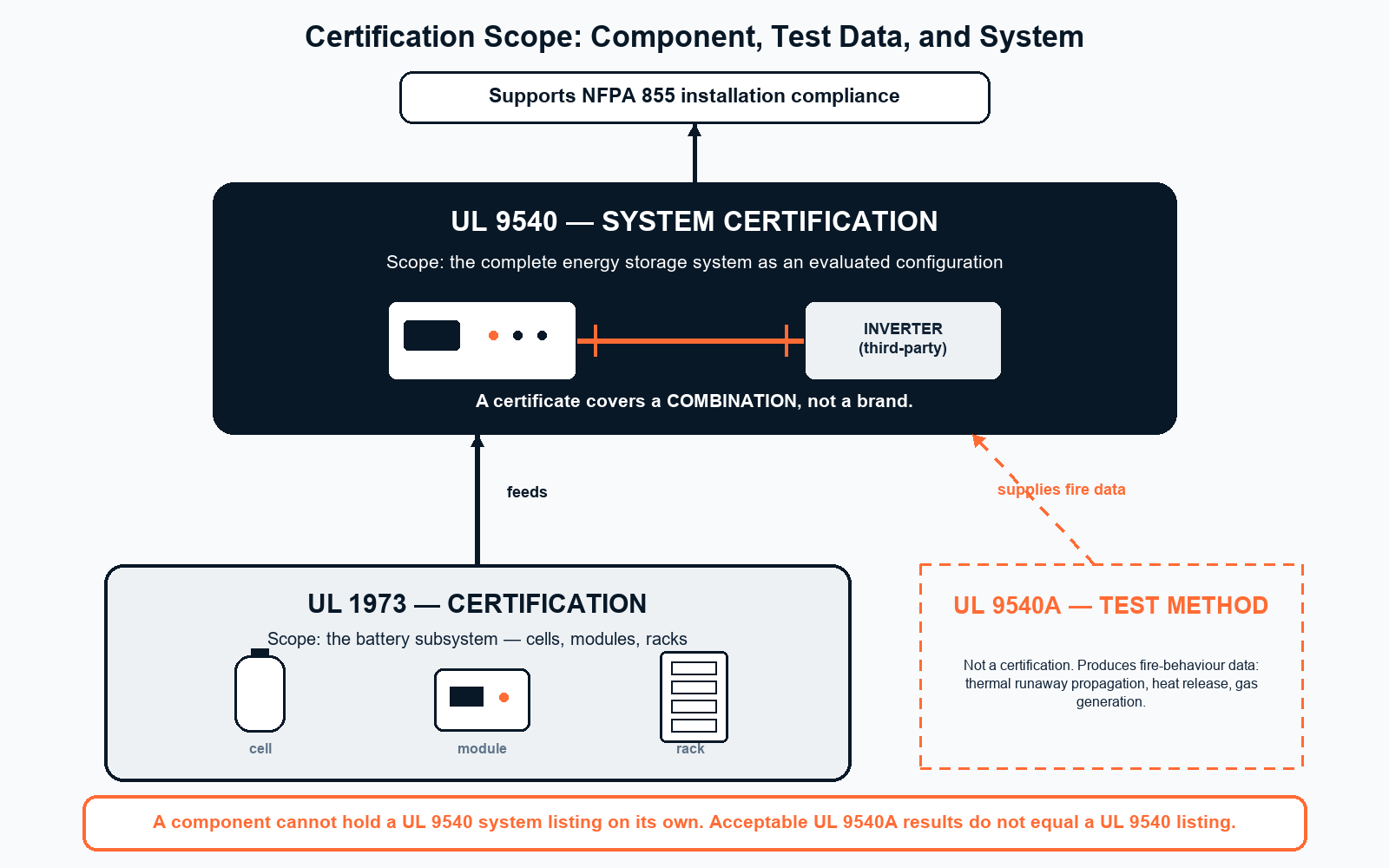
Ligne de faille 3 — À qui appartient le certificat et que couvre-t-il ?
C’est là que les citations sont le plus souvent techniquement vraies et pratiquement trompeuses, et c’est la ligne de faille qui produit des refus de permis plutôt que des problèmes de mise en service.
Trois désignations sont utilisées de manière interchangeable dans les textes marketing. Ils ne sont pas interchangeables.
| Désignation | Qu’est-ce que c’est en réalité | Ce qu’il couvre |
|---|---|---|
| UL1973 | Une norme de certification | Le sous-système batterie (cellules, modules, racks) soumis à des contraintes électriques, mécaniques et thermiques |
| UL9540A | Une méthode de test, pas une certification | Comportement du feu : propagation par emballement thermique, dégagement de chaleur, génération de gaz. Produit des données |
| UL9540 | Une certification au niveau du système | Le système complet de stockage d’énergie en tant que produit intégré, utilisant les données ci-dessus |
Deux conséquences s’ensuivent, et toutes deux sont lourdes pour une demande de permis.
Premièrement, UL 9540 est une liste de systèmes. Les composants individuels ne sont pas répertoriés UL 9540 à eux seuls. La liste est attachée à une configuration évaluée, ce qui en pratique signifie généralement une batterie spécifique associée à un onduleur ou à un équipement de conversion de puissance spécifique. Un certificat existe pour une combinaison, pas pour une marque. Lorsqu’un fournisseur déclare « nos batteries sont UL 9540 », la réponse correcte est la suivante : couvre quelle configuration du système et mon onduleur y figure-t-il ?
Deuxièmement, le fait de détenir des résultats de test UL 9540A acceptables ne signifie pas en soi qu’un produit répond aux exigences d’une liste UL 9540. La méthode de test nourrit la certification ; il ne le remplace pas. Un fournisseur qui envoie un rapport UL 9540A lorsque vous avez demandé un certificat UL 9540 a répondu à une question différente, et il vaut la peine de déterminer s’il s’agissait d’un accident.
La norme NFPA 855, la norme d’installation à partir de laquelle votre AHJ travaille probablement, est la raison pour laquelle cela est important sur le plan commercial : les dispositifs de stockage d’énergie supérieurs à environ 20 kWh sont généralement censés être certifiés selon la norme UL 9540 et testés selon la norme UL 9540A avec des résultats acceptables. L’adoption varie selon la juridiction et l’édition, donc la version utilisée par votre inspecteur est la version qui compte.
Pour le côté pratique, c’est-à-dire ce que les inspecteurs ouvrent réellement sur site et dans quel ordre, consultez ce que les inspecteurs de l’AHJ vérifient sur un permis de batterie UL 9540. La distinction entre la certification et la méthode de test est expliquée plus en détail dans UL 9540 vs UL 9540A, et la structure de la norme dans notre UL Guide de certification 9540 pour les installateurs.
Ligne de faille 4 — « Sur la liste approuvée » n’est pas la même chose que « met en service proprement »
La communication en boucle fermée est ce qui fait qu’une pile moderne se comporte comme une batterie que l’onduleur comprend : l’état de charge, les limites de courant de charge et de décharge, le déclassement de température et les états de défaut passent tous par CAN. Sans cela, l’onduleur fonctionne en boucle ouverte uniquement sur les seuils de tension, ce qui fonctionne, mais supprime l’essentiel de l’utilité du BMS.
L’écart dans lequel se trouvent les acheteurs se situe entre trois affirmations différentes, qui sont toutes résumées dans l’expression « compatible ».
| Réclamation | Ce que cela signifie habituellement | Risque résiduel |
|---|---|---|
| “Prend en charge CAN” | Le port existe et parle un protocole CAN | Élevé – ne dit rien sur votre onduleur |
| “Sur la liste approuvée” | La marque de l’onduleur a certifié certaines configurations | Moyen : les entrées de la liste peuvent être spécifiques à la version et au micrologiciel |
| “Testé sur votre modèle, avec le code setup” | Quelqu’un a commandé exactement ce jumelage | Faible : demandez le paramètre de protocole et la base de référence du micrologiciel |
Les listes approuvées sont utiles et méritent d’être lues attentivement, car leurs entrées sont plus étroites qu’elles ne le paraissent : une correspondance de marque n’est pas une correspondance de modèle, et une correspondance de modèle n’est pas une correspondance de micrologiciel. Nous expliquons comment la liste d’un fabricant est structurée, y compris ce qui se passe hors liste, dans notre analyse de la Liste de compatibilité des batteries Deye.
La question pratique est petite et très révélatrice. Un fournisseur qui a véritablement mis en service votre modèle d’onduleur peut vous donner la valeur de sélection du protocole et la base de référence du micrologiciel en une seule réponse. Celui qui ne l’a pas fait proposera de « vérifier auprès des ingénieurs », ce qui est une réponse parfaitement honnête, et vous indique également que le couplage est nouveau pour eux.
Pour les valeurs de référence lors de la mise en service (tension de repos par rapport à l’état de charge et points de consigne de l’étape de charge que vous programmerez), gardez le tableau de tension LiFePO4 48 V ouvert à côté du manuel.
Ligne de faille 5 — Les conditions commerciales qui déterminent votre coût au débarquement
Le prix du kWh est le chiffre que tout le monde compare et celui qui bouge le moins entre fournisseurs sérieux. Le coût au débarquement évolue beaucoup, et il évolue selon des conditions qui apparaissent rarement sur la première cotation.
Dimensions emballées, et non dimensions du produit. Un module peut mesurer environ 925 × 460 × 245 mm nu. Emballé sur une palette avec de la mousse, une protection des coins et un cadre en bois, il est nettement plus grand, et c’est le chiffre dont votre transitaire a besoin. Le chargement du conteneur est calculé sur les cartons emballés et le poids brut, jamais sur les dimensions de la fiche technique. Demandez la liste de colisage avant de modéliser le conteneur et sachez que les batteries au lithium comportent également des contraintes liées au poids qui peuvent rendre un conteneur cubique ou peser bien avant qu’il ne paraisse plein.
MOQ contre la logique de pile. Une quantité minimale de commande exprimée en unités interagit maladroitement avec un produit conçu pour être vendu en piles de hauteur variable. Si le MOQ est de 20 unités et que votre pipeline est constitué de piles de quatre modules, vous vous engagez sur cinq systèmes complets, et non sur vingt pièces de rechange. Déterminez si le MOQ est par modèle ou par commande, et si les modèles mixtes sont pris en compte.
Pièces de rechange et exécution de la garantie. Une garantie de quinze ans est une déclaration d’intention ; la question essentielle est de savoir qui l’exécute et à quelle vitesse. Dans une pile, un seul module défaillant ne met généralement pas le système hors service, mais il le dégrade, et le remplacement doit être compatible en termes d’adresse et de micrologiciel avec les survivants – ce qui revient directement à la ligne de défaut 2.
Les documents relatifs aux marchandises dangereuses contrôlent l’expédition. Les batteries au lithium sont considérées comme des marchandises dangereuses de classe 9. Un résumé des tests UN 38.3 et une fiche signalétique ne sont pas des extras facultatifs sur une liste de certificats. C’est ce dont votre transitaire a besoin pour réserver le conteneur, et un document manquant ou incompatible arrête l’expédition plutôt que de la retarder. Vérifiez que le résumé UN 38.3 nomme la cellule et le pack réellement expédiés, et non un modèle associé, car cette incompatibilité est la version qui est détectée à l’origine.
Le coût d’installation fait partie du prix. Le dimensionnement des conducteurs au courant de décharge maximum de la pile entraîne un coût matériel réel qui varie selon les architectures. Un indice de décharge continue de 200 A implique des choix de câbles et de protection spécifiques ; notre tableau des tailles des câbles de batterie 48 V couvre la méthode de dimensionnement.
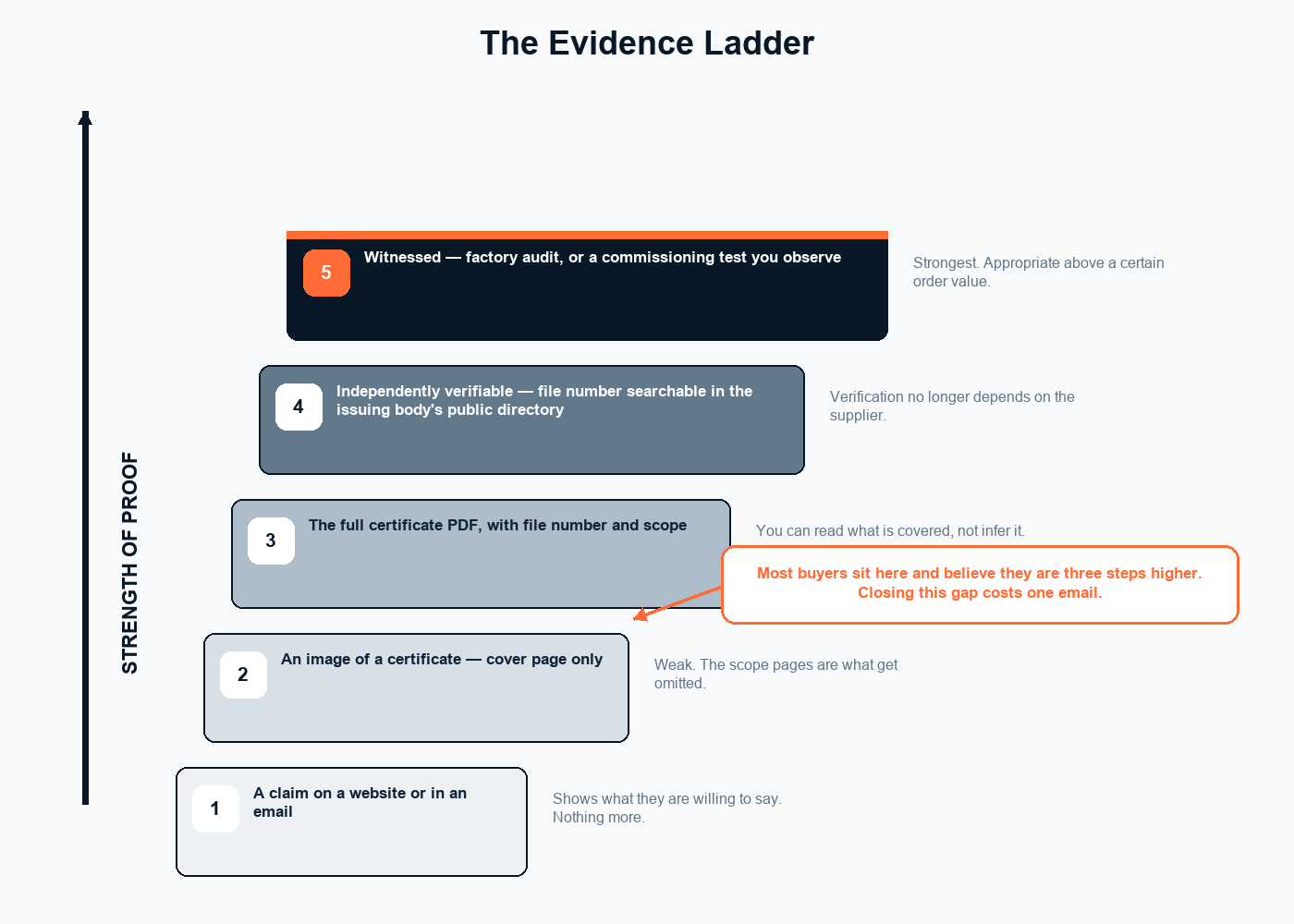
L’échelle des preuves : combien vaut réellement la preuve d’un fournisseur ?
Chaque réponse ci-dessus se présente sous la forme d’une forme de preuve, et les preuves dans cette industrie se présentent sous forme de niveaux. Le trier est plus rapide que d’évaluer chaque réclamation selon ses mérites.
| Niveau | Forme de preuve | Ce que ça vaut |
|---|---|---|
| 1 | Une réclamation sur un site Internet ou dans un email | Établit ce qu’ils sont prêts à dire. Rien de plus |
| 2 | Une image d’un certificat, page de garde uniquement | Faible. Les pages de portée et de configuration sont l’endroit où se trouve le contenu, et c’est ce qui est omis |
| 3 | Le certificat PDF complet, avec numéro de dossier et portée | Raisonnable. Vous pouvez désormais lire ce qui est couvert plutôt que de le déduire |
| 4 | Vérifiable de manière indépendante — numéro de dossier consultable dans l’annuaire public de l’organisme de certification | Fort. La vérification ne dépend pas du fournisseur |
| 5 | Avec témoin : audit d’usine ou test de mise en service que vous ou votre agent observez | Le plus fort. Cher et approprié au-dessus d’une certaine valeur de commande |
La plupart des acheteurs opèrent au niveau 2 et pensent qu’ils sont au niveau 4. Passer de 2 à 3 coûte un e-mail. Passer de 3 à 4 coûte dix minutes. Cela représente une grande amélioration de la certitude pour très peu d’effort, et c’est là que nous mettrions du temps avant une première commande.
Le niveau 5 n’est pas toujours proportionné. Pour un premier conteneur provenant d’un nouveau fournisseur, ou pour un projet où un refus de permis coûterait cher, c’est généralement le cas. Un fournisseur qui accueille favorablement un audit plutôt que de s’en détourner vous a dit quelque chose d’utile avant que l’audit n’ait lieu.
La liste de questions, prête à coller
- Les modules empilés sont-ils en parallèle ou en série, et quelle fenêtre de tension continue le système présente-t-il à l’onduleur ?
- Une unité de contrôle de base est-elle requise et s’agit-il d’un élément distinct dans ce devis ?
- Modules minimum et maximum par pile, et qu’est-ce qui définit le maximum ?
- Comment les adresses des modules sont-elles attribuées et le schéma est-il stable à travers les révisions matérielles ?
- Si je développe dans trois ans un micrologiciel plus récent, quelle est la procédure d’alignement et qui l’effectue ?
- Quelle est la fenêtre de production et de support des pièces de rechange pour ce modèle ?
- Veuillez envoyer des certificats complets et non des résumés. Qui est le titulaire et quelle configuration est concernée ?
- Pour tout certificat système UL 9540 : quels modèles d’onduleurs sont couverts ?
- Puis-je vérifier les numéros de dossier dans le répertoire public de l’organisme de certification ?
- La communication en boucle fermée a-t-elle été testée par rapport au modèle et au micrologiciel de mon onduleur ? Quel paramètre de protocole ?
- Liste de colisage : dimensions du carton, poids net et brut, unités par palette.
- Le MOQ est-il par modèle ou par commande ? Délai de livraison du module de rechange ? Qui exécute la garantie sur mon marché ?
- Envoyez le résumé du test UN 38.3 et la fiche signalétique pour la cellule et le pack exacts expédiés.
Un fournisseur qui répond aux treize réponses en une seule réponse, avec pièces jointes, vous montre sa discipline en matière de documentation. C’est cette discipline que vous achetez réellement, car c’est elle qui détermine l’existence ou non d’un soutien pour la septième année.
Cinq erreurs que nous voyons le plus souvent
1. Choisir la batterie avant de confirmer l’onduleur
Faux : comparez les batteries empilables en termes de prix par kWh, puis trouvez un onduleur qui vous convient. Bien : l’architecture CC de l’onduleur décide si vous achetez une pile parallèle ou une chaîne en série. Corrigez le fait que la première et la moitié du catalogue disparaissent, ce qui est une bonne chose.
2. Lire un certificat de cellule comme certificat système
Faux : traitez UL 1973 sur les cellules comme une preuve que le système obtiendra un permis. Droite : UL 1973 couvre le sous-système de batterie. Une liste UL 9540 au niveau du système couvre une configuration évaluée, et c’est le document qu’une conversation d’autorisation active.
3. Dimensionner la première commande comme si l’expansion était gratuite
Faux : achetez le minimum maintenant car il est empilable. C’est vrai : l’expansion est réelle mais pas gratuite : l’adressage, le micrologiciel et l’inadéquation de l’état de santé s’appliquent tous. Dimensionnez le premier achat en fonction de la charge que vous attendez d’ici environ trois ans et considérez les modules ultérieurs comme une véritable option plutôt que comme une certitude.
4. Accepter « compatible » sans modèle testé
Faux : une marque apparaît sur une liste approuvée, le jumelage est donc réglé. Droit : demandez le modèle, la base de référence du micrologiciel et les paramètres du protocole. La compatibilité au niveau de la marque et la compatibilité des appariements commandés sont des affirmations différentes.
5. Modélisation du conteneur sur les dimensions du produit
Faux : divisez le volume du conteneur par les dimensions de la fiche technique. Bien : demandez les dimensions et le poids brut du carton emballé. Les expéditions de lithium atteignent souvent les limites de poids avant les limites de volume, et la différence se répercute sur vos frais de transport, et non sur ceux du fournisseur.
Questions fréquemment posées
Une batterie empilable est-elle meilleure qu’une batterie montée en rack ?
Ni l’un ni l’autre n’est meilleur en général ; ils résolvent différentes contraintes. Les systèmes empilables conviennent à une croissance progressive de la capacité et aux installations au sol résidentielles ou commerciales légères. Les systèmes montés en rack conviennent aux salles d’équipement où le câblage centralisé et le service à accès frontal comptent plus que l’apparence. Si vos projets sont reproductibles et basés sur des racks, la comparaison dans notre guide des batteries de rack de serveur est la plus adaptée.
Puis-je mélanger des marques de batteries dans une seule pile ?
Généralement non. Les modules d’une pile partagent un schéma de communication BMS, répondant aux attentes en matière de carte et de micrologiciel, dont aucun n’est standardisé entre les fabricants. Même lorsque deux produits sont électriquement similaires, le maître ne reconnaîtra pas un module étranger comme faisant partie du groupe. Traitez une pile comme un fournisseur unique.
Combien de modules puis-je empiler ?
Cela dépend du produit et de ce qui le limite : stabilité mécanique, gestion thermique, courant continu sur le jeu de barres partagé ou encore plage d’adressage BMS. Demandez le maximum et la raison qui le sous-tend. Notre système de 14,34 kWh prend en charge jusqu’à 16 unités en parallèle, pour 229,44 kWh en configuration complète.
UL 1973 signifie-t-il que le système est certifié UL 9540 ?
N° UL 1973 certifie le sous-système batterie : cellules, modules et racks. UL 9540 certifie le système complet de stockage d’énergie en tant que produit intégré et fait référence aux données de la norme UL 1973 et des tests d’incendie UL 9540A. Un composant ne peut pas détenir à lui seul une homologation de système UL 9540.
Qu’est-ce qu’un BMS maître-esclave dans un système empilable ?
Dans une pile parallèle, chaque module possède son propre BMS, mais un seul fait office de maître. Le maître regroupe l’état de charge, les limites de courant et les états de défaut dans l’ensemble du groupe et présente une seule batterie logique à l’onduleur via CAN ou RS485. Les autres lui font rapport. L’adressage est ce qui indique à chaque module quel rôle il joue.
Que dois-je vérifier avant d’ajouter des modules à une pile existante des années plus tard ?
Confirmez que le modèle est toujours produit ou qu’un successeur documenté existe ; vérifier si le schéma d’adressage a changé entre les révisions matérielles ; établir la procédure d’alignement du micrologiciel et qui l’exécute ; et accepter qu’un nouveau module parallèle aux anciens soit limité par le groupe plutôt que de fonctionner selon sa propre classification.
Pour connaître la décision fermée ou ouverte qui sous-tend l’approvisionnement empilable, consultez notre alternative au Tesla Powerwall.
Pourquoi nous avons écrit ceci
Savolture est une marque de stockage d’énergie LiFePO4 directement en usine au service des installateurs, des entrepreneurs EPC et des distributeurs. Nous produisons 48 modules LFP de classe V qui sont mis en parallèle dans des banques plus grandes, jusqu’à 16 unités sur notre système de 14,34 kWh, avec des produits construits selon les exigences UL 9540, UL 9540A et UL 1973. Les audits d’usine sont les bienvenus pour les acheteurs évaluant une première commande.
Nous avons rédigé cette liste parce que nous y répondons constamment. Les questions ci-dessus sont presque textuellement issues des demandes qui nous parviennent des installateurs et des partenaires de distribution, et celles qui arrivent avec la plupart d’entre elles déjà posées sont systématiquement les projets les plus faciles à mettre en service. Publier la liste ne nous coûte rien : si un acheteur l’utilise contre nous et que nous répondons mal, nous ne devrions pas remporter cette commande.
Pour une vision plus large du marché, notre tour d’horizon des fabricants de batteries LiFePO4 pour les installateurs et les distributeurs explique quels niveaux citeront réellement un projet.
Servir : Installers, EPC contractors, distributors and OEM programmes
Courriel : info@savolture.com · Réponse : Quotes and documents within 24 hours
Audits d’usine : Welcome — arranged on request for buyers evaluating a first order
· UL Solutions — Test et certification des systèmes de stockage d’énergie (scope of UL 9540 and its reference to UL 1973)
· NFPA — NFPA 855, Norme pour l’installation de systèmes de stockage d’énergie stationnaires (installation requirements; adopted edition varies by jurisdiction)
· UL Standards — UL 1973, Batteries pour utilisation dans les applications d’alimentation auxiliaire stationnaires et motrices (scope of the battery subsystem standard)
Product figures cited above are from Savolture datasheets available on the linked product pages.
{“@context”:”https://schema.org”,”@graph”:[{“@type”:”BlogPosting”,”@id”:”https://savolture.com/fr/blog/stackable-lifepo4-battery-supplier/#webpage”,”url”:”https://savolture.com/fr/blog/stackable-lifepo4-battery-supplier/”,”name”:”Fournisseur de batteries LiFePO4 empilables : 5 choses à vérifier avant de comparer les prix”,”description”:”Guide technique complet : Fournisseur de batteries LiFePO4 empilables : 5 choses à vérifier avant de comparer les prix. Spécifications, protocoles et conseils d’ingénierie pour professionnels du solaire.”,”inLanguage”:”fr”,”author”:{“@id”:”https://savolture.com/#organization”},”publisher”:{“@id”:”https://savolture.com/#organization”},”headline”:”Fournisseur de batteries LiFePO4 empilables : 5 choses à vérifier avant de comparer les prix”,”mainEntityOfPage”:”https://savolture.com/fr/blog/stackable-lifepo4-battery-supplier/”},{“@type”:”Organization”,”@id”:”https://savolture.com/#organization”,”name”:”Savolture”,”url”:”https://savolture.com/”,”inLanguage”:”fr”}]}
Ready to size your system?
Get a free battery recommendation.
Tell us your load, location, and backup target — we will spec the right 48V LiFePO4 system for you.