

Savolture Technical Guide
Batterie de rack de serveur EG4 (2026) : spécifications, alternatives et test à 4 métriques | Savolture
L'EG4 LL-S est devenue la référence en matière de batteries rack serveur 48V. C'est le pack par rapport auquel la plupart des constructeurs bricoleurs et des petits installateur...
body.sv-lang-fr { line-height: 1.55; }
.svba-direct-answer{background:#f0f4f8;border-left:5px solid #ff6b35;padding:16px 20px;margin:20px 0;border-radius:4px;font-size:15.5px;line-height:1.65}
.svba-checklist-box{background:#fff8f3;border:1px solid #ffd9c2;border-radius:6px;padding:16px 20px;margin:20px 0}
.svba-checklist-box strong{color:#c2410c}
table.svba-ref{width:100%;border-collapse:collapse;margin:20px 0;font-size:14.5px}
table.svba-ref th,table.svba-ref td{border:1px solid #d4d8de;padding:10px 12px;text-align:left;vertical-align:top}
table.svba-ref th{background:#081827;color:#fff;font-weight:600}
table.svba-ref tr:nth-child(even){background:#f7f9f8}
table.svba-ref td.navy{background:#081827;color:#fff;font-weight:600;text-align:center}
table.svba-ref td.win{color:#1a6b3a;font-weight:700}
.svba-protip{background:#081827;color:#eef2f6 !important;padding:16px 20px;border-radius:6px;margin:20px 0;font-size:14.5px}
.svba-protip strong{color:#ff9a6b !important}
.svba-protip em{color:#eef2f6 !important}
.svba-warn{background:#fef2f2;border:1px solid #fecaca;border-left:5px solid #dc2626;padding:16px 20px;margin:20px 0;border-radius:4px;font-size:14.5px}
.svba-warn strong{color:#b91c1c}
.svba-mistakes{border:1px solid #e2e6ea;border-radius:6px;padding:6px 18px;margin:14px 0;background:#fafbfc}
.svba-mistakes h4{margin:14px 0 6px;font-size:16px;color:#081827}
.svba-mistakes .wrong{color:#b91c1c;font-weight:700}
.svba-mistakes .right{color:#1a6b3a;font-weight:700}
.svba-srcnote{font-size:12.5px;color:#777;font-style:italic;margin:-12px 0 18px}
.svba-cta-grid{display:grid;grid-template-columns:repeat(auto-fit,minmax(240px,1fr));gap:14px;margin:24px 0}
.svba-cta-card{background:#1a4d33;color:#fff;padding:18px;border-radius:6px;text-align:center}
.svba-cta-card a{color:#fff;text-decoration:none;font-weight:600;display:block}
.svba-cta-card small{display:block;margin-top:6px;font-weight:400;opacity:.85;font-size:13px}
.svba-faq h3{margin-top:22px;font-size:17px;color:#1a4d33}
.svba-sources{font-size:13.5px;color:#555;background:#fafafa;padding:14px 18px;border-radius:4px;margin-top:30px}
.svba-about{border:1px solid #e2e6ea;border-radius:8px;padding:4px 22px 18px;margin:34px 0 10px;background:#fbfcfd}
.svba-about h2{margin-bottom:4px}
.svba-profile{background:#081827;color:#eef2f6 !important;border-radius:6px;padding:16px 20px;margin:14px 0;font-size:14px;line-height:1.7}
.svba-profile strong{color:#ff9a6b !important}
L’EG4 LL-S est devenue la référence en matière de batteries rack serveur 48V. C’est le pack par rapport auquel la plupart des constructeurs bricoleurs et des petits installateurs mesurent tout le reste, et pour cause. Mais « qu’est-ce qui existe d’autre » est une bonne question, surtout si vous passez des commandes répétées, si vous achetez en dehors du canal de vente au détail américain ou si vous êtes confronté à une rupture de stock à mi-projet. Ce guide fait deux choses : il présente la base de référence des spécifications EG4 LL-S telle qu’elle est réellement, puis vous propose un test à quatre mesures pour juger si une alternative est véritablement équivalente, au lieu d’être simplement moins chère.
Réponse rapide : L’EG4 LL-S est une batterie de rack de serveur 51,2 V, 100 Ah, 5,12 kWh LiFePO4, construite à partir de 16 cellules prismatiques répertoriées UL, évaluées à 7 000 cycles à 80 % DoD, empilable jusqu’à 16 unités en parallèle (environ 81,9 kWh), avec des communications en boucle fermée sélectionnables pour Onduleurs EG4, Schneider, Sol-Ark, Victron et Growatt. Il est répertorié UL 1973 et UL 9540A. Toute alternative digne d’être envisagée doit correspondre à quatre éléments : capacité utilisable, durée de vie nominale, prise en charge du protocole en boucle fermée et coût au débarquement par kWh. Faites correspondre ceux-ci et l’insigne sur le devant n’a plus d’importance ; manquez-en un et un prix inférieur le cache généralement.
Batterie pour rack de serveur EG4 LL-S : la référence des spécifications
Avant de comparer quoi que ce soit, vous avez besoin des chiffres réels. Voici ce que l’EG4 LL-S apporte à un rack 48 V, sur la base des spécifications publiées par son canal de vente au détail.
| Spécification | EG4 LL-S (V2) | Ce que cela signifie en pratique |
|---|---|---|
| Tension nominale | 51,2 V (16S) | LFP standard de classe 48 V — s’associe à n’importe quel onduleur hybride 48 V |
| Capacité | 100 Ah / 5,12 kWh | L’élément de base commun ; mettre à l’échelle en ajoutant des unités |
| Durée de vie | 7 000 cycles à 80 % de DoD | Note forte : c’est le nombre sur lequel les alternatives sont jugées |
| Cellules | 16 × prismatiques 3,2 V homologués UL | Prismatique et non cylindrique : le format utilisé par la plupart des packs rackables |
| Empilage parallèle | Jusqu’à 16 unités (~81,9 kWh) | Assez d’espace libre pour les grandes résidences et les commerces légers |
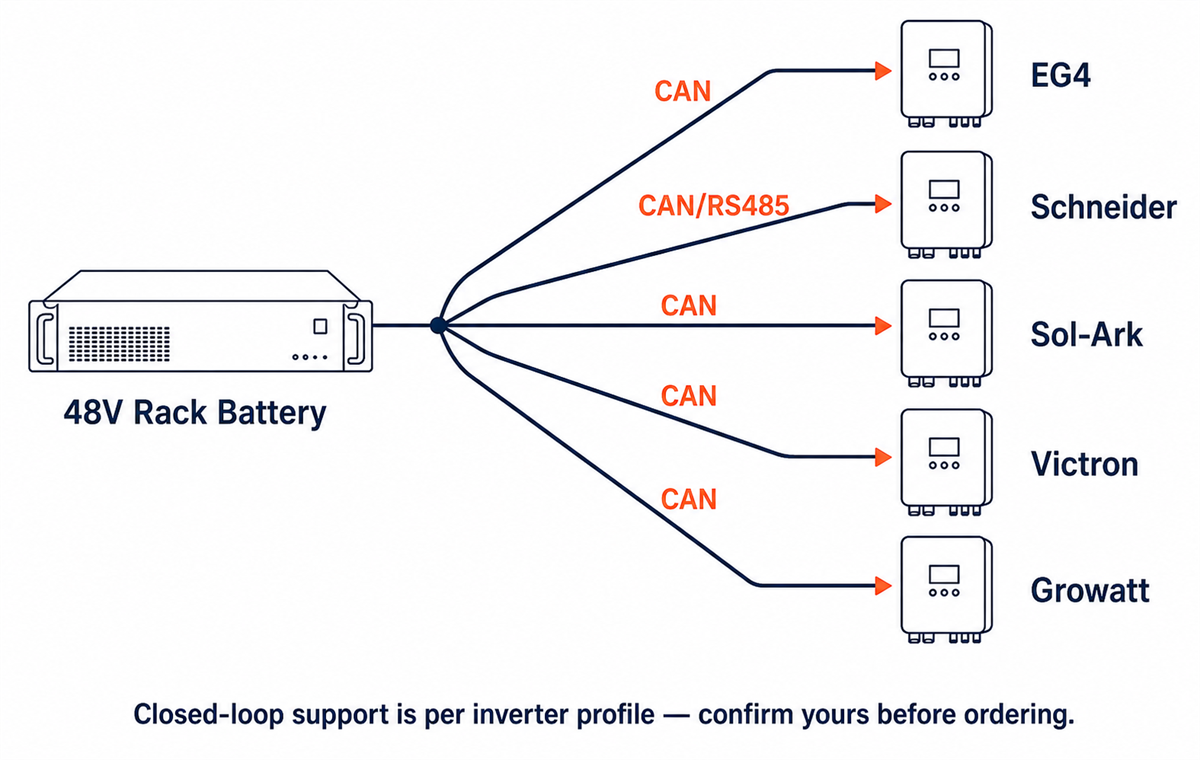
| Communications | Boucle fermée sélectionnable : EG4, Schneider, Sol-Ark, Victron, Growatt | Prise en charge immédiate du protocole multimarque |
| Certifications | UL1973, UL9540A | Documentation de test au niveau des cellules et du système disponible |
| Physique | 19 × 17,4 × 6,1 pouces, 99,6 livres | Largeur de rack standard de 19″ ; levage pour deux personnes |
Spécifications selon la documentation de vente au détail publiée par EG4 LL-S V2, 2026. Les notes et les révisions changent entre les versions du produit — confirmez par rapport à la documentation actuelle pour l’unité exacte qui vous est proposée.
C’est vraiment un bon pack. Rien dans ce guide ne constitue un argument selon lequel ce n’est pas le cas. La question est de savoir ce que signifie « équivalent » lorsque l’on en cherche un autre.
Faites correspondre les spécifications, pas la marque : les quatre paramètres qui décident
La plupart des comparaisons alternatives se déroulent de la même manière : elles alignent les prix des étiquettes et la capacité, puis déclarent un gagnant. Ce sont deux des quatre chiffres qui comptent. Voici le test complet.
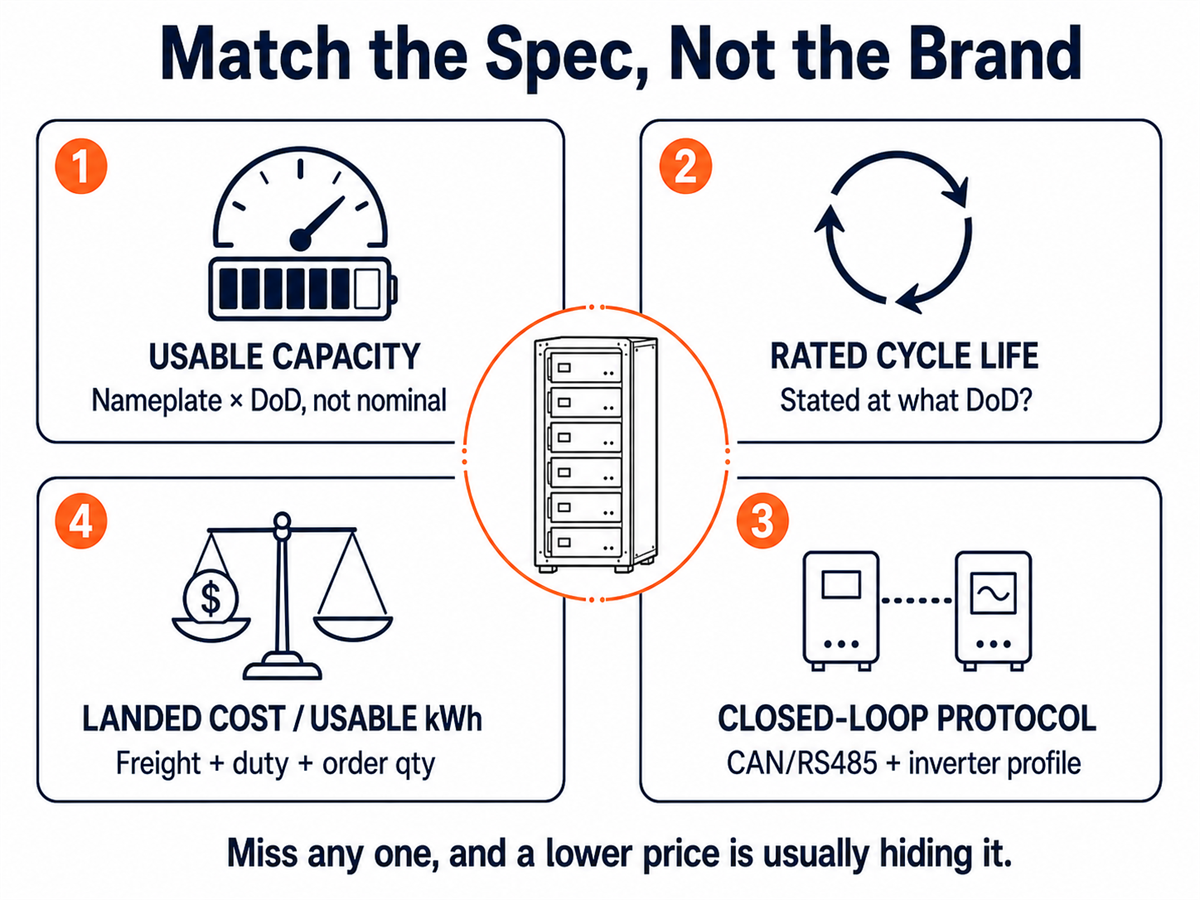
1. Capacité utilisable, et non capacité nominale
Une plaque signalétique de 5,12 kWh ne représente pas 5,12 kWh d’énergie que vous utilisez. Ce qui compte, c’est la plaque signalétique × la profondeur de décharge et si le chiffre du DoD correspond à la fenêtre de fonctionnement quotidienne ou à la limite technique. Un pack évalué à 5,12 kWh à 80 % DoD donne environ 4,1 kWh par cycle. Si une alternative cite la même plaque signalétique mais que son indice de cycle est mesuré à un DoD moins profond, vous ne comparez pas la même chose. Demandez toujours la capacité et le DoD auquel la note a été prise. La tension de repos ne remplace pas ici non plus : la courbe de décharge plate du LFP en fait une mauvaise jauge de carburant, c’est pourquoi le tableau de tension LiFePO4 48 V est une référence plutôt qu’un outil de mesure.
2. Durée de vie nominale – et le DoD auquel il a été évalué
Le cycle de vie est le moment où les alternatives divergent le plus souvent discrètement. L’EG4 LL-S est évalué à 7 000 cycles à 80 % DoD. Nos propres packs LFP 48 V sont évalués à plus de 6 500 cycles avec le même DoD de 80 %, légèrement en dessous du chiffre publié par EG4, et cela vaut la peine de le dire clairement plutôt que de l’enterrer, car la version honnête de cette comparaison vous est plus utile qu’une version flatteuse. À raison d’un cycle par jour, la différence entre 6 500 et 7 000 cycles est d’environ sept mois à l’extrémité d’une vie théorique de dix-sept ans. C’est réel, et ce n’est pas non plus le nombre qui décidera de votre projet. Ce qui déterminera c’est si un pack “10 000 cycles” cité indique son DoD.
3. Prise en charge du protocole en boucle fermée
C’est la métrique qui se transforme en rappel du site lorsqu’elle est erronée. L’EG4 LL-S est livré avec des profils en boucle fermée sélectionnables pour EG4, Schneider, Sol-Ark, Victron et Growatt, ce qui signifie que le BMS peut communiquer correctement avec ces onduleurs, et pas seulement rester là dans un contrôle de tension en boucle ouverte. Toute alternative doit exprimer le protocole attendu par votre onduleur, sur le bon bus. Si vous effectuez un couplage avec un Growatt, cela signifie également définir le bon code de mode Lithium sur l’onduleur, une étape couverte en détail dans notre guide de compatibilité des batteries Growatt, et qui prend plus de jours de mise en service qu’une mauvaise batterie.
4. Coût au débarquement par kWh utilisable – et non le prix autocollant
Le prix de l’autocollant est le moins utile des quatre chiffres, car il exclut les éléments qui varient le plus : le fret, les droits de douane et ce que vous payez réellement en fonction du volume de votre commande. La comparaison qui signifie quelque chose est le coût total au débarquement divisé par le kWh utilisable, sur la durée de vie nominale du pack. Un pack qui coûte 10 % de moins mais fournit 20 % de cycles utilisables en moins est plus cher, et un pack dont le prix est fixé par un seul canal de vente au détail est une proposition commerciale différente d’un pack proposé par conteneur. La même logique de coût à vie s’applique à toutes les chimies ; nos calculs du coût du LiFePO4 par rapport au plomb les analysent avec des chiffres réels.
Remarque concernant l’offre : les installateurs qui achètent en dehors du circuit de vente au détail de bricolage nous disent la même chose. Les spécifications d’EG4 sont solides, mais une chaîne d’approvisionnement à détaillant unique est une véritable contrainte lorsque vous êtes un distributeur qui passe une commande répétée ou un installateur qui a besoin de huit unités supplémentaires le mois prochain plutôt qu’à chaque retour de stock. C’est généralement la raison pour laquelle les gens recherchent un équivalent, et non la fiche technique.
EG4 LL-S par rapport à un équivalent 48 V 100 Ah : à l’identique
Voici la comparaison de même classe : 5,12 kWh contre 5,12 kWh, donc rien n’est caché en comparant différentes capacités.
| Métrique | EG4 LL-S (V2) | Savolture 48V 100Ah |
|---|---|---|
| Capacité nominale | 5,12 kWh/100 Ah | 5,12 kWh/100 Ah |
| Tension nominale | 51,2 V (16S) | 51,2 V (16S) |
| Chimie | LiFePO4, prismatique | LiFePO4, prismatique |
| Durée de vie nominale | 7 000 à 80 % du DoD | Plus de 6 500 à 80 % de DoD |
| Communication | Boucle fermée sélectionnable (EG4, Schneider, Sol-Ark, Victron, Growatt) | BMS CAN / RS485 pour plates-formes ouvertes — couplage vérifié avec Growatt (voir le guide de la liste approuvée), Deye et GoodWe ; Victron et Sol-Ark pris en charge via CAN, confirment le profil lors de la mise en service |
| Documents de certification | Homologué UL 1973, UL 9540A | Construit selon les exigences UL 1973/UL 9540 et CEI 62619 ; documentation sur demande |
| Modèle d’approvisionnement et tarification | Canal de vente au détail aux États-Unis, disponibilité rapide des unités individuelles, prix affiché proche de 265 USD/kWh dans la rue récente | Direct usine, devis par projet ou conteneur, délai d’exécution de devis en 24 heures, coût au débarquement calculé en fonction de la quantité commandée |
Chiffres EG4 selon les spécifications de vente au détail publiées, 2026. Là où EG4 mène sur une ligne, il est marqué comme tel – une comparaison qui ne fait que flatter l’auteur ne vaut pas la peine d’être lue.
Il s’agit du même exercice que nous avons effectué sur le marché des boîtes scellées dans notre Comparaison des alternatives Tesla Powerwall, et pour la gamme 48 V plus large, la page de la plate-forme de batterie 48 V couvre les options de format. La lecture honnête ici : sur l’emballage lui-même, ils sont proches, EG4 a le meilleur numéro de cycle publié, et la différence significative pour la plupart des acheteurs est commerciale plutôt que technique : que vous souhaitiez des unités uniques provenant d’un détaillant américain ou une fourniture en quantité par projet directement depuis l’usine. Si vous achetez une batterie pour une construction personnelle, le canal de vente au détail est véritablement le chemin le plus simple. Si vous passez des commandes répétées, c’est là qu’une ligne directe avec l’usine commence à avoir de l’importance.
Mise à l’échelle d’un rack 48 V : de combien d’unités avez-vous réellement besoin ?
Le format rack de serveur existe pour être empilé, et c’est là que le bloc de construction de 5,12 kWh fait son travail. Quatre unités donnent environ 20,5 kWh nominal – un objectif de sauvegarde courant pour toute la maison. Huit donne environ 41 kWh, dans le territoire des grandes maisons et des commerces légers. L’EG4 LL-S plafonne à 16 unités en parallèle, soit environ 81,9 kWh.
Deux choses à planifier avant de choisir un numéro. Tout d’abord, adaptez-vous aux charges et à l’autonomie dont vous avez réellement besoin plutôt qu’à un nombre rond : notre calculateur de batterie hors réseau transforme une liste de charges en un objectif de kWh utilisable en quelques minutes. Deuxièmement, pour les grandes banques, un seul module de plus grande capacité peut être plus propre que de nombreux petits modules : moins d’interconnexions, moins de nœuds BMS sur le bus, moins de matériel de rack. C’est pour cela que notre module 314 Ah / 16 kWh est conçu, où la même énergie arrive en moins d’unités.
Erreurs courantes lors de l’achat d’alternatives EG4
1. Comparer la durée de vie sans comparer le DoD
Faux : “Celui-ci revendique 10 000 cycles, EG4 en dit 7 000 — il gagne.” Droite : Demandez à quel DoD la note a été mesurée. Un nombre de cycles important dans un DoD peu profond peut fournir moins d’énergie totale au cours de sa durée de vie.
2. Traiter le kWh nominal comme du kWh utilisable
Faux : Budgétiser un pack de 5,12 kWh comme 5,12 kWh de secours nocturne. Droite : Multipliez par votre DoD de travail : environ 4,1 kWh par cycle à 80 %.
3. En supposant que tout LFP 48 V sera en boucle fermée avec votre onduleur
Faux : “C’est 51,2 V, ça va parler à mon hybride.” Droite : Confirmez le protocole et le profil côté onduleur ou le code de configuration avant de commander.
4. Comparaison du prix des autocollants selon différents modèles d’approvisionnement
Faux : Prix de détail unitaire par rapport au devis d’usine comme s’il s’agissait du même numéro. Droite : Comparez le coût au débarquement par kWh utilisable à la quantité réelle de votre commande.
Foire aux questions
Quelles sont les spécifications de la batterie du rack de serveur EG4 LL-S ?
51,2 V nominal, 100 Ah/5,12 kWh, construit à partir de 16 cellules prismatiques LiFePO4 répertoriées UL, évaluées à 7 000 cycles à 80 % DoD, empilables sur 16 unités en parallèle (environ 81,9 kWh), avec communications en boucle fermée sélectionnables pour EG4, Schneider, Sol-Ark, Victron et Growatt. Il est certifié UL 1973 et UL 9540A et mesure 19 × 17,4 × 6,1 pouces pour 99,6 lb.
Existe-t-il un équivalent à la batterie rack serveur EG4 ?
Oui, plusieurs packs rack LFP 48 V 100 Ah correspondent au format et à la capacité. Jugez l’équivalence sur quatre mesures plutôt que sur le badge : capacité utilisable (plaque signalétique × DoD), durée de vie nominale à un DoD indiqué, prise en charge du protocole en boucle fermée pour votre onduleur et coût final par kWh utilisable pour la quantité de votre commande.
De combien de piles EG4 ai-je besoin pour une sauvegarde dans toute la maison ?
À 5,12 kWh par unité, quatre unités représentent environ 20,5 kWh nominal – un objectif typique pour toute la maison – et huit correspondent à environ 41 kWh. Taille à partir de votre liste de charge réelle et de l’autonomie souhaitée plutôt qu’un nombre rond ; un calculateur de dimensionnement vous y amène plus rapidement qu’une règle empirique.
Quels onduleurs fonctionnent avec les batteries de rack de serveur EG4 ?
Le LL-S est livré avec des profils en boucle fermée sélectionnables pour les onduleurs EG4, Schneider, Sol-Ark, Victron et Growatt. Pour tout pack LFP 48 V, confirmez à la fois le bus de communication (CAN ou RS485) et le profil de la batterie côté onduleur avant la mise en service.
Les batteries pour rack de serveur sont-elles meilleures que les batteries pour montage mural ?
Ni l’un ni l’autre n’est meilleur en général – c’est une question de construction. Les packs rack s’empilent dans des boîtiers standard de 19 pouces et évoluent par petits incréments, ce qui convient aux salles d’équipement et à l’expansion progressive. Les unités murales conviennent aux installations résidentielles plus ordonnées et aux modules simples plus grands. Le guide basse et haute tension couvre la décision d’architecture qui vient généralement en premier.
Comparer les écosystèmes scellés de manière plus large ? Notre alternative Powerwall à architecture ouverte présente les mêmes compromis par rapport à Tesla.
Pourquoi nous avons écrit ceci
Recherchez une alternative à l’EG4 et vous obtenez deux types de pages : les sites d’évaluation qui évaluent l’EG4 lui-même et les détaillants qui le vendent. Ni l’une ni l’autre ne répond à la question que les gens se posent réellement, à savoir « qu’est-ce qui rend un autre pack véritablement équivalent, et comment le saurais-je ? » Nous construisons et fournissons des batteries LFP 48 V exactement dans ce format, nous avons donc un intérêt évident ici – c’est pourquoi la comparaison ci-dessus marque les lignes où mène EG4 plutôt que de les omettre discrètement. Notre pack de 100 Ah est évalué à plus de 6 500 cycles contre les 7 000 publiés par EG4, et si vous avez besoin d’un achat au détail d’une seule unité, leur canal est la voie la plus simple. Là où nous sommes les mieux adaptés, c’est l’approvisionnement répété et en quantité projet, directement depuis l’usine qui fabrique les packs. Les systèmes Savolture sont construits dans notre usine automatisée de batteries de 1,8 GWh conformément aux exigences UL 9540, UL 1973 et CEI 62619.
Pays : China | Modèle : B2B wholesale & distribution (LFP home storage)
Courriel : info@savolture.com | Internet : savolture.com
{“@context”:”https://schema.org”,”@graph”:[{“@type”:”BlogPosting”,”@id”:”https://savolture.com/fr/blog/eg4-server-rack-battery-alternatives-2026/#webpage”,”url”:”https://savolture.com/fr/blog/eg4-server-rack-battery-alternatives-2026/”,”name”:”Batterie de rack de serveur EG4 (2026) : spécifications, alternatives et test à 4 métriques”,”description”:”Guide technique complet : Batterie de rack de serveur EG4 (2026) : spécifications, alternatives et test à 4 métriques. Spécifications, protocoles et conseils d’ingénierie pour professionnels du solaire.”,”inLanguage”:”fr”,”author”:{“@id”:”https://savolture.com/#organization”},”publisher”:{“@id”:”https://savolture.com/#organization”},”headline”:”Batterie de rack de serveur EG4 (2026) : spécifications, alternatives et test à 4 métriques”,”mainEntityOfPage”:”https://savolture.com/fr/blog/eg4-server-rack-battery-alternatives-2026/”},{“@type”:”Organization”,”@id”:”https://savolture.com/#organization”,”name”:”Savolture”,”url”:”https://savolture.com/”,”inLanguage”:”fr”}]}
Ready to size your system?
Get a free battery recommendation.
Tell us your load, location, and backup target — we will spec the right 48V LiFePO4 system for you.