

Savolture Technical Guide
Indonesia Rooftop Solar with Battery: Permen ESDM 2/2024 Requirements, Article by Article
Short answer: Grid-connected rooftop solar in Indonesia may use a battery (Permen ESDM No. 2 of 2024, Article 4(3)). The conditions: follow the "with battery" diagram in Appendi...
Short answer: Grid-connected rooftop solar in Indonesia may use a battery (Permen ESDM No. 2 of 2024, Article 4(3)). The conditions: follow the “with battery” diagram in Appendix I, make sure the inverter keeps running seven protection functions (anti-islanding and others) with the battery installed, apply to PLN in January or July, have the system installed by a licensed electrical contractor (Badan Usaha), then obtain an SLO (certificate of operation worthiness) or file a self-declaration backed by documents such as product certificates, a manufacturer warranty, commissioning test results or maintenance documents (Article 25(4)). The 500 kW threshold is measured by inverter capacity, not battery kWh.
Written by Marvin Zhou, Savolture. Translated from our Indonesian version. Every article is cited from the official text at JDIH BPK, checked 9 November 2026. The regulation is published only in Indonesian; English terms below are our working translation, with the Indonesian term in brackets where it matters. This is not legal advice.
4 Questions on Rooftop Solar and Batteries in Indonesia
Can a rooftop solar system in Indonesia use a battery?
Yes. Article 4(3) of Permen ESDM No. 2 of 2024 states that a rooftop solar (PLTS Atap) system may be equipped with a battery or other electrical energy storage, provided electrical safety requirements are still met. Appendix I contains a separate installation diagram for systems with a battery.
Does a rooftop solar battery need SNI certification under Permen ESDM 2/2024?
The standards table in Appendix I does not name an SNI number for batteries. The battery row only requires that a system with a battery keeps operating with the inverter protections (anti-islanding, frequency, voltage, overheat, surge, overcurrent, DC ground fault). Article 6 still requires the installation to follow SNI and/or international standards, and local content (TKDN) rules apply through Article 5(2).
Does battery capacity count toward the 500 kW limit?
Battery kWh does not count. Articles 19 and 27 state that system capacity is determined by total inverter capacity. However, in an AC-coupled system with a separate battery inverter, the regulation does not distinguish PV inverters from battery inverters, and two inverters only meet the “one inverter” condition of Article 25(1)(a) if their total is below 10 kW. Confirm with the licensed installer (Badan Usaha).
Does exported rooftop solar power still reduce the PLN bill?
Not for new systems. Article 13 states that excess energy sent to the grid is not counted in the bill. Older systems already on export-import netting keep it for 10 years from approval (Article 47(1)), but if capacity changes from the original application, for example a larger inverter fitted when adding a battery, the new regulation applies (Article 47(2)). A battery is one way to store midday surplus for self-use.
Since Permen ESDM No. 2 of 2024 took effect, rooftop solar surplus exported to the PLN grid no longer reduces the bill (Article 13). As a result, the question homeowners, building owners and factories ask has shifted from “how much can I export” to “may I add a battery, and what are the conditions”. This guide answers the second question article by article, from application to commissioning, focusing on the parts that touch the battery. Battery sizing for self-consumption is covered separately in our commercial rooftop solar self-consumption and zero-export BESS sizing guide.
Status of the Regulation as of November 2026
Short answer: Permen ESDM No. 2 of 2024 was enacted on 29 January 2024, promulgated on 31 January 2024, and revoked Permen ESDM No. 26 of 2021. The JDIH BPK database, checked on 9 November 2026, records no amendment or revocation. The Director General of New, Renewable Energy and Energy Conservation (EBTKE), quoted by kumparan on 8 August 2026, said a new Ministerial Decree on rooftop solar is being prepared.
| Item | Detail | Source |
|---|---|---|
| Number and title | Permen ESDM No. 2 of 2024 on Rooftop Solar Power Systems Connected to the Electricity Network of IUPTLU Holders (holders of a public electricity supply business licence) | State Gazette 2024 No. 70 |
| In force from | Date of promulgation, 31 January 2024 (Article 52) | Official text |
| Regulation revoked | Permen ESDM No. 26 of 2021 (Article 51) | Official text |
| Status at JDIH BPK | No “amended by” or “revoked by” entry (checked 9 November 2026) | peraturan.bpk.go.id |
| Planned new rule | The Director General of EBTKE said a new Ministerial Decree on rooftop solar is being prepared to align with the 100 GW solar programme (8 August 2026) | kumparan |
Until the new decree is issued, the articles below are what PLN and licensed installers work from. If you read this after a new rule appears, compare each article below with the latest text.
What Permen ESDM 2/2024 Says About Batteries
Short answer: Batteries are named explicitly in Article 4(3) and in Appendix I. The regulation does not set a specific SNI number for batteries; the requirement is that a system with a battery keeps operating with seven inverter protection functions. The general installation standard (PUIL 2020) applies to switches, cables, protection and earthing.
Four articles to read together:
- Article 4(1): a rooftop solar system comprises solar modules, inverter, electrical connection and safety system; paragraph (2) requires an Advanced Meter.
- Article 4(3): the system “may be equipped with a battery or other electrical energy storage media while still meeting electrical safety provisions”.
- Article 4(4): installation follows the diagrams and technical specification standards in Appendix I. Appendix I.A.2 contains a separate diagram, “Rooftop Solar System with Battery”, including a charge controller and DC- and AC-side switching and control devices (PSDK).
- Article 6: installation must follow SNI and/or international standards. Article 5(2): equipment use follows the domestic goods and services rules (TKDN), covered in our SNI and TKDN guide for energy storage batteries (Bahasa Indonesia).
Note: Google’s AI summary for Indonesian-language searches places the battery provision in “Article 3(3)”. In the official text, Article 3 has no paragraphs and only states the purposes of rooftop solar use; the battery provision is in Article 4(3).
Technical specification standards in Appendix I.B, summarised per item:
| No. | Equipment | Standard under Appendix I.B | What it means for a battery system |
|---|---|---|---|
| 1 | Solar modules | SNI IEC 61215-1:2016, SNI IEC 61215-2:2016, SNI IEC 61215-1-1:2016 | No change |
| 2 | Combiner box | SNI 0225:2020 (PUIL 2020) | No change |
| 3 | Inverter | Minimum protection functions: anti-islanding, over/under frequency, over/under voltage, overheat, surge arrester, overcurrent protection, DC ground fault detector | A hybrid inverter must have all seven functions |
| 4–5 | AC and DC conductors | SNI 0225:2020 (PUIL 2020) | Includes the DC cable from battery to inverter |
| 6–7 | Protective devices; switching and control devices | SNI 0225:2020 (PUIL 2020) | Battery-side breakers and switches follow this rule |
| 8 | Battery | “Rooftop solar connected to a battery must still be able to operate with the inverter protection in item 3” | The battery must not disable or bypass inverter protection |
| 9 | System earthing | SNI 0225:2020 (PUIL 2020) | A single earthing system (Article 25(1)(c); Appendix II note: all exposed conductive parts bonded to one equipotential point) |
| 10 | Advanced Meter | Not specified | Supplied by PLN |
Row 8 is the only technical requirement that names the battery specifically. In practice it means the battery choice depends on the hybrid inverter: the battery must sit within the inverter’s voltage range and, for lithium batteries, should communicate with the inverter (CAN or RS485) so the inverter manages charge and discharge while keeping its protections active. How hybrid inverters work is explained in how a hybrid solar inverter works.
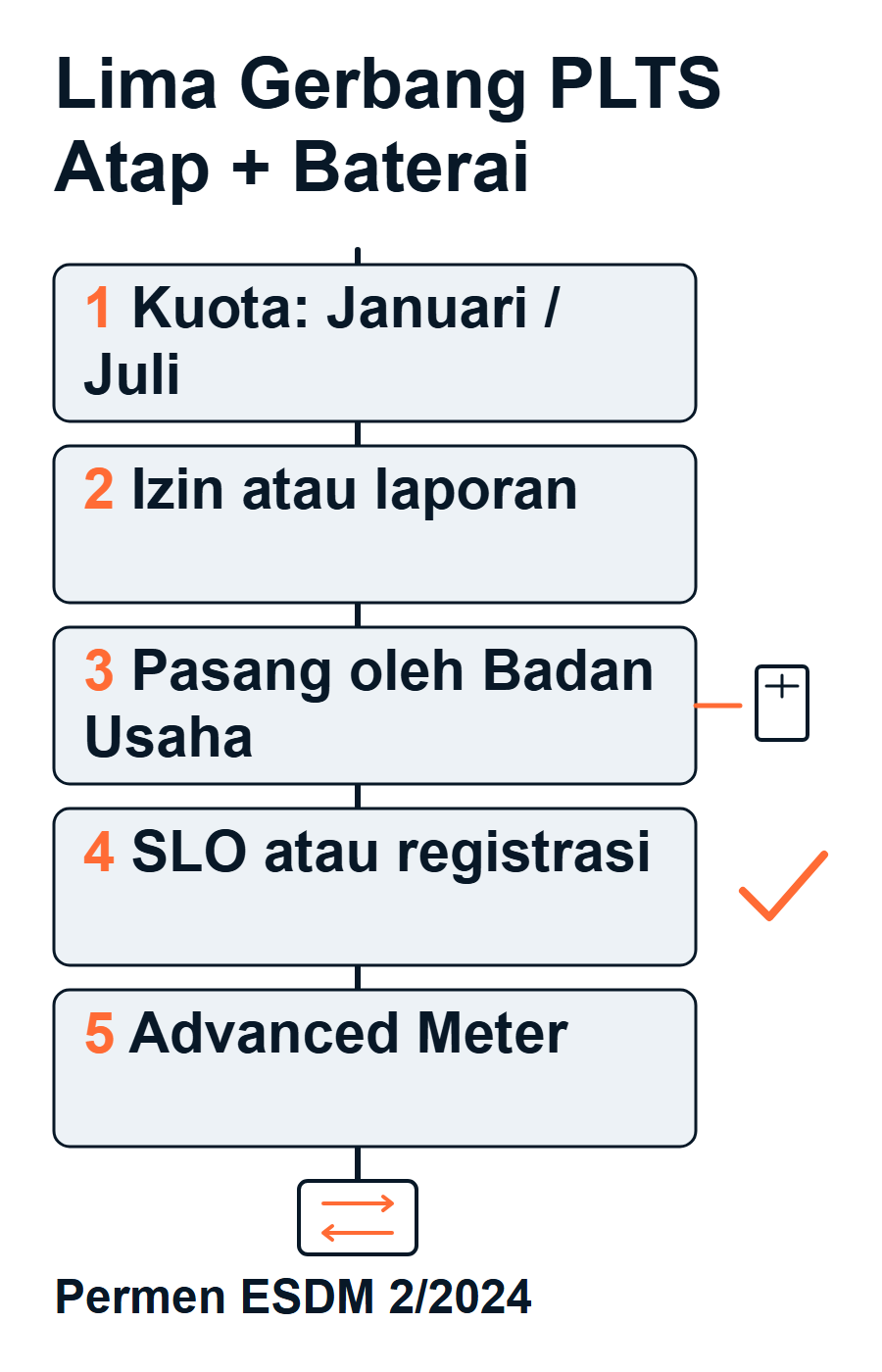
The Five Gates of Rooftop Solar + Battery
Short answer: The order is: (1) quota and application to PLN in January or July; (2) licence or report according to inverter capacity; (3) installation by a licensed Badan Usaha after approval; (4) SLO, or a self-declaration with a registration number; (5) PLN installs the Advanced Meter within 15 working days. The battery is installed at gate 3 and tested at gate 4.
The Five Gates of Rooftop Solar + Battery framework arranges those articles in the order a customer goes through them. The official text uses the term IUPTLU holder; in most areas that is PLN, but in non-PLN business areas the local IUPTLU holder applies.
| Gate | Articles | What happens | Numbers and deadlines |
|---|---|---|---|
| 1. Quota & application | Art. 7, 9, 14, 15 | PLN (or another IUPTLU holder) drafts the quota, the Director General of Electricity sets it, PLN announces the cluster quota; the prospective customer applies with copies to the Directors General of EBTKE and of Electricity | Quota drafted for 5 years, broken down per year; announced within 10 working days of being set; applications in January or July; answer within 30 calendar days after the window closes, no answer = approved; quota used up = waiting list |
| 2. Licensing | Art. 17–20 | Licence for electricity supply for own use (captive power), or a report | >500 kW: licence; ≤500 kW: one-time report before installation; capacity = total inverter |
| 3. Installation | Art. 21–22 | Built and installed by a Badan Usaha holding an electricity business entity certificate | Only after PLN approval; a system already installed may not connect before approval |
| 4. SLO or self-declaration | Art. 24–27, Appendix V | SLO from a technical inspection body, or a self-declaration plus documents for plug-and-play systems | SLO within 6 months; registration number within 3 months of approval, or the approval is cancelled |
| 5. Advanced Meter | Art. 16, 28, 29 | PLN installs a bidirectional meter; prepaid customers move to postpaid | Within 15 working days after the SLO or registration proof is received; meter cost borne by PLN; no parallel operation fee |
Watch the deadlines at gate 4. If the battery and inverter have not arrived when approval comes through, the 6-month or 3-month clock still runs. Confirm the battery delivery date before the January or July application is filed, especially for batteries shipped from China.
Batteries for your rooftop solar project in Indonesia
Send the hybrid inverter model and its capacity. We reply with matching 51.2 V battery options, the communication protocol, and the document list per model.
Path by Inverter Capacity
Short answer: What decides the path is total inverter capacity (Articles 19 and 27), not battery kWh. A system up to 500 kW with an integrated control panel, plug-and-play, and meeting the four conditions of Article 25(1) is deemed to satisfy the SLO obligation, but still needs the pre-installation report (Article 18), a self-declaration and a registration number; a system above 500 kW needs a licence and an SLO; industrial customers above 3 MW must provide weather forecast data for PLN’s SCADA.
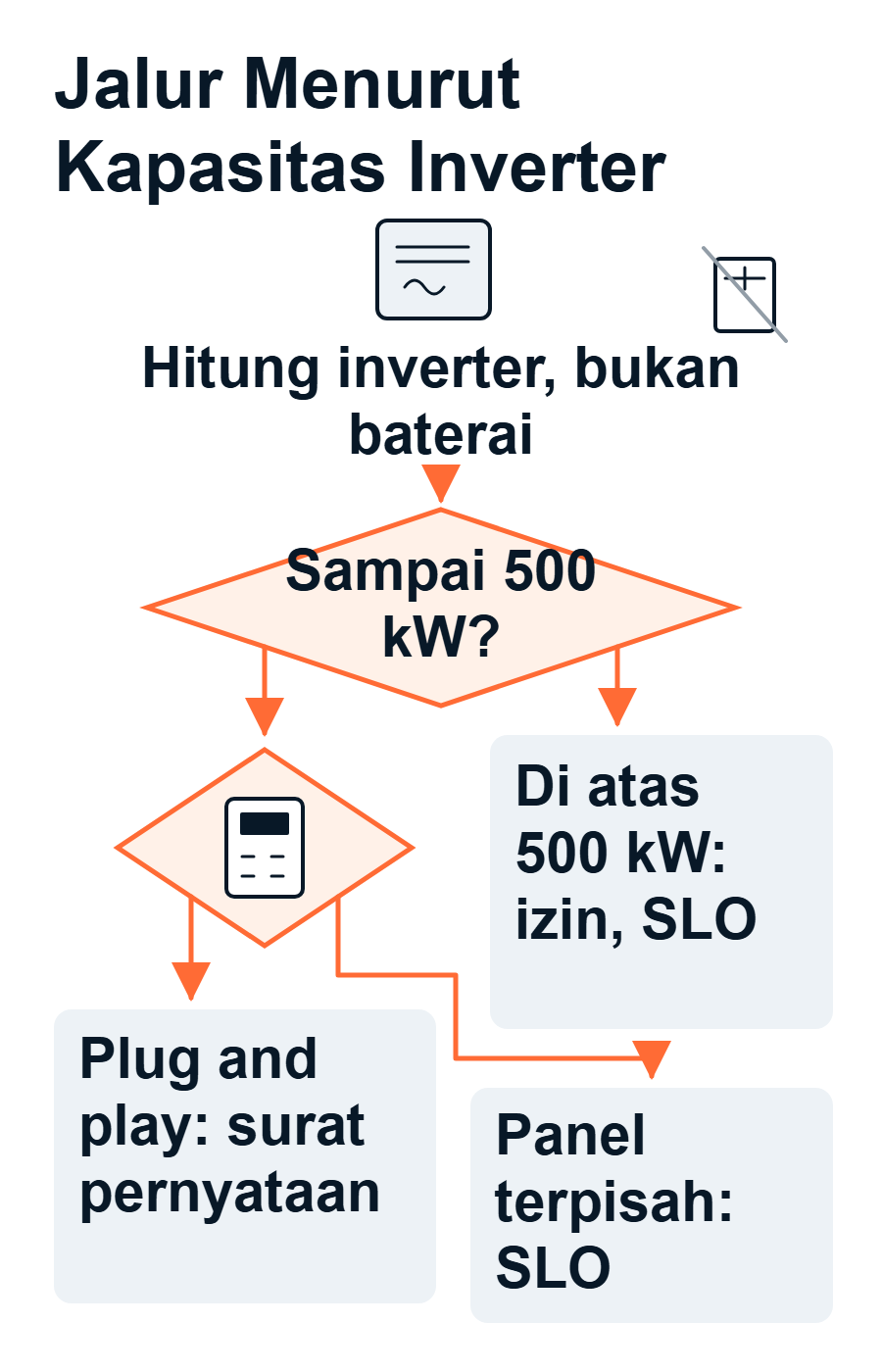
| System condition | Licensing | Operation worthiness | Articles |
|---|---|---|---|
| ≤500 kW, integrated control panel, plug-and-play, and one inverter (or several inverters totalling <10 kW), modules on one building structure, same earthing, serving one installation | Report to the Minister or governor | Deemed to meet the SLO obligation; self-declaration + documents required, then a registration number from the Minister | 18, 25 |
| ≤500 kW, separate control panel | Report to the Minister or governor | SLO required | 18, 24 |
| >500 kW in one installation | Licence for electricity supply for own use | SLO required | 17, 24 |
| Industrial tariff class, >3 MW | As in the rows above | Additional: weather forecast database integrated with PLN SCADA or smart grid | 42 |
Example: a house with one 8 kW hybrid inverter and a 20 kWh battery falls in the first row if its control panel is integrated and the other plug-and-play conditions are met; the battery kWh does not change the path. A factory with 600 kW of total inverter capacity falls in the third row, whatever its battery capacity. Be careful with AC-coupled systems: Appendix II includes a diagram with separate PV and battery inverters, and the regulation does not distinguish the two in total inverter capacity. Two inverters totalling 10 kW or more, with an integrated control panel and capacity up to 500 kW, are not literally covered by either Article 24(1)(b) or Article 25(1); confirm the path with a technical inspection body or the Badan Usaha. For home and small business battery sizing, see 20 kWh battery.
Commissioning Tests That Involve the Battery
Short answer: For plug-and-play systems using a self-declaration, Appendix V requires a function test of switching and overcurrent protection, an anti-islanding and grid synchronisation test, and earthing and insulation resistance tests. Systems that require an SLO are deemed to meet minimum commissioning through the SLO. Because the battery row in Appendix I requires inverter protection to keep working, we recommend running the anti-islanding test with the battery connected.
Appendix V lists the commissioning requirements for systems that meet the SLO obligation through a self-declaration. Items 1–4 apply to the <10, 10–100 and 100–500 kWp categories (in kWp, not inverter capacity):
- Proof of meeting the SLO obligation: a self-declaration with product certificates, a valid manufacturer warranty, commissioning test results, or maintenance documents.
- Function test of switching devices and overcurrent protective devices.
- Anti-islanding test of the rooftop solar system and synchronisation with the grid.
- Earthing resistance and system insulation resistance tests.
- For the 100–500 kWp category only: design conformity check, visual inspection, and equipment and system tests based on the PV installation certification test items.
Systems that require an SLO are deemed to meet the minimum commissioning requirements through the SLO itself. When we prepare a battery quotation, we ask the installer to confirm three things: the hybrid inverter model, the communication protocol in use (CAN or RS485), and whether commissioning will be done with the battery connected. These three decide which module we offer and which communication parameters the installer needs to set; remote technical support is available.
Battery Documents to Prepare
Short answer: Article 25(4) lists product certificates and a valid manufacturer warranty as supporting documents for the self-declaration. The regulation does not specify which certificates apply to batteries. The application form (Appendix II) and the report (Appendix III) also ask for battery data where a battery is installed: brand, type, country of manufacture, year of production, capacity and number of units.
The documents below follow the self-declaration path (Article 25); systems that require an SLO follow whatever the technical inspection body asks for.
| Document | Basis | What to request from the battery supplier |
|---|---|---|
| Battery data on the form | Appendices II and III | Brand, type, country of manufacture, year of production, capacity, number of units; plus the inverter protection and anti-islanding data sheet (Appendix II) |
| Product certificates | Article 25(4)(a) | As the evaluator requests, for example per-model test reports such as UN 38.3 for transport and an IEC 62619 industrial battery safety report where available; the model name must match the installed unit |
| Valid manufacturer warranty | Article 25(4)(b) | A written warranty letter: duration, end-of-warranty capacity threshold, installation conditions (see LiFePO4 battery warranty (Bahasa Indonesia)) |
| Commissioning test results | Article 25(4)(c), Appendix V | Prepared by the Badan Usaha technician; the battery supplier provides BMS parameters and protocol |
| Maintenance documents | Article 25(4)(d) | Maintenance guide and battery operating temperature range |
| Data sheet | Article 4(4), Appendix I | Nominal voltage and range, maximum current, communication protocol for inverter matching |
The modules we supply for rooftop solar are 51.2 V batteries: 100Ah 5.12 kWh, 200Ah 10.24 kWh and 314Ah 16.08 kWh, with CAN and RS485 communication. Warranty is 5 years standard or 10 years as an extended option, and documents are confirmed per model at quotation. Inverters we have already matched are listed in the Deye battery compatibility list.
Penalties and Cancelled Approvals
Short answer: A system connected to the grid before approval must be disconnected and pays a penalty equal to total inverter capacity times 240 hours times the electricity tariff (Article 23). Approval is cancelled if the SLO is not issued within 6 months or the registration number within 3 months (Article 26).
| Total inverter capacity | Penalty basis (kW × 240 h) | Penalty |
|---|---|---|
| 5 kW | 1,200 kWh | 1,200 × your tariff class rate per kWh |
| 10 kW | 2,400 kWh | 2,400 × your tariff class rate per kWh |
| 50 kW | 12,000 kWh | 12,000 × your tariff class rate per kWh |
If the penalty and disconnection are not completed within 1 month of the notice letter, PLN may temporarily disconnect the customer’s service (Article 23(2)). Article 45(1) applies sanctions under electricity regulations for breaches of Article 5(1), Article 6, Article 17(1), Article 18(1), Article 21(1), Article 24(1), Article 25(2) and (5), and Article 41. Article 41 also prohibits selling electricity from a rooftop solar system.
Does Permen ESDM 2/2024 Cover Off-Grid Solar?
Short answer: Article 2 limits the scope of this regulation to rooftop solar systems connected to an IUPTLU holder’s network, whether or not they export power to the grid. Systems fully separated from the grid are outside its scope, but they remain subject to electrical safety rules.
Note the words “whether or not they export”: a zero-export system that stays connected to PLN is still within scope and must go through all five gates. Only systems with no grid connection at all, such as island resorts, remote towers or mines without a PLN connection, fall outside this regulation. Being outside this regulation does not mean no permit is needed: licensing of power generation for own use is governed by other electricity regulations not covered here, so confirm with the Badan Usaha. For such systems, see off-grid solar systems with LiFePO4 batteries and solar batteries in Indonesia (Bahasa Indonesia).
Why I write this: Savolture is a LiFePO4 battery factory in China that supplies 51.2 V modules and BESS directly to installers and EPC contractors in Indonesia. We do not sell solar panels and do not install systems; a hybrid inverter can be included on request. Article 21 requires installation by a local Badan Usaha. I wrote this guide because the question “may I use a battery or not” has a written answer in the official text, and the right battery depends on an inverter that passes its protection requirements.
Send Project Data via WhatsApp or use the contact page. For volume orders, see wholesale LiFePO4 battery supply.
FAQ: Rooftop Solar with Battery in Indonesia
Can a rooftop solar system in Indonesia use a battery?
Yes. Article 4(3) of Permen ESDM No. 2 of 2024 states that a rooftop solar (PLTS Atap) system may be equipped with a battery or other electrical energy storage, provided electrical safety requirements are still met. Appendix I contains a separate installation diagram for systems with a battery.
Does a rooftop solar battery need SNI certification under Permen ESDM 2/2024?
The standards table in Appendix I does not name an SNI number for batteries. The battery row only requires that a system with a battery keeps operating with the inverter protections (anti-islanding, frequency, voltage, overheat, surge, overcurrent, DC ground fault). Article 6 still requires the installation to follow SNI and/or international standards, and local content (TKDN) rules apply through Article 5(2).
Does exported rooftop solar power still reduce the PLN bill?
Not for new systems. Article 13 states that excess energy sent to the grid is not counted in the bill. Older systems already on export-import netting keep it for 10 years from approval (Article 47(1)), but if capacity changes from the original application, for example a larger inverter fitted when adding a battery, the new regulation applies (Article 47(2)). A battery is one way to store midday surplus for self-use.
Does battery capacity count toward the 500 kW limit?
Battery kWh does not count. Articles 19 and 27 state that system capacity is determined by total inverter capacity. However, in an AC-coupled system with a separate battery inverter, the regulation does not distinguish PV inverters from battery inverters, and two inverters only meet the “one inverter” condition of Article 25(1)(a) if their total is below 10 kW. Confirm with the licensed installer (Badan Usaha).
When can a rooftop solar application be submitted to PLN?
Article 14(2): in January or July each year. PLN must respond within 30 calendar days after the application window closes; if it does not respond, the application is deemed approved (Article 15). If the quota is used up, the applicant goes on the waiting list for the next period.
What is the penalty for connecting rooftop solar without PLN approval?
Article 23(1): the system must be disconnected from the grid and the customer pays a penalty equal to total inverter capacity times 240 hours times the electricity tariff. Example: a 10 kW inverter means 2,400 kWh times your tariff class rate. If this is not settled within 1 month, service can be temporarily disconnected.
Does Permen ESDM 2/2024 cover off-grid solar with batteries?
Article 2 limits the scope to rooftop solar systems connected to the network of an IUPTLU holder, such as PLN. A system with no grid connection at all is outside the scope of this regulation, but it remains subject to electrical safety rules. Confirm your system status with the installing Badan Usaha.
References
- Permen ESDM No. 2 of 2024 — official text, JDIH BPK (Articles 2–52, Appendices I and V; in Indonesian).
- Ministry of Energy and Mineral Resources (ESDM): new rooftop solar rule issued (in Indonesian).
- kumparan, 8 August 2026: 937.6 MWp of rooftop solar installed by June 2026, ESDM to revise the rule (in Indonesian).
- SNI 0225:2020 General Requirements for Electrical Installations (PUIL 2020); SNI IEC 61215 for photovoltaic modules.
Name: Marvin Zhou
Brand: Savolture
Country: China (factory) · Serving: Indonesia
Model: B2B Factory-Direct LFP + C&I BESS
WhatsApp: +86 15543662225
Email: marvin@savolture.com
Website: savolture.com
Ready to size your system?
Get a free battery recommendation.
Tell us your load, location, and backup target — we will spec the right 48V LiFePO4 system for you.