

Savolture Technical Guide
UN 38.3 Test Summary: What Buyers Must Check
The supplier attaches a PDF titled “UN 38.3.” It has a lab logo, a table of tests, and a signature. The buyer forwards it to the freight forwarder, the forwarder for...
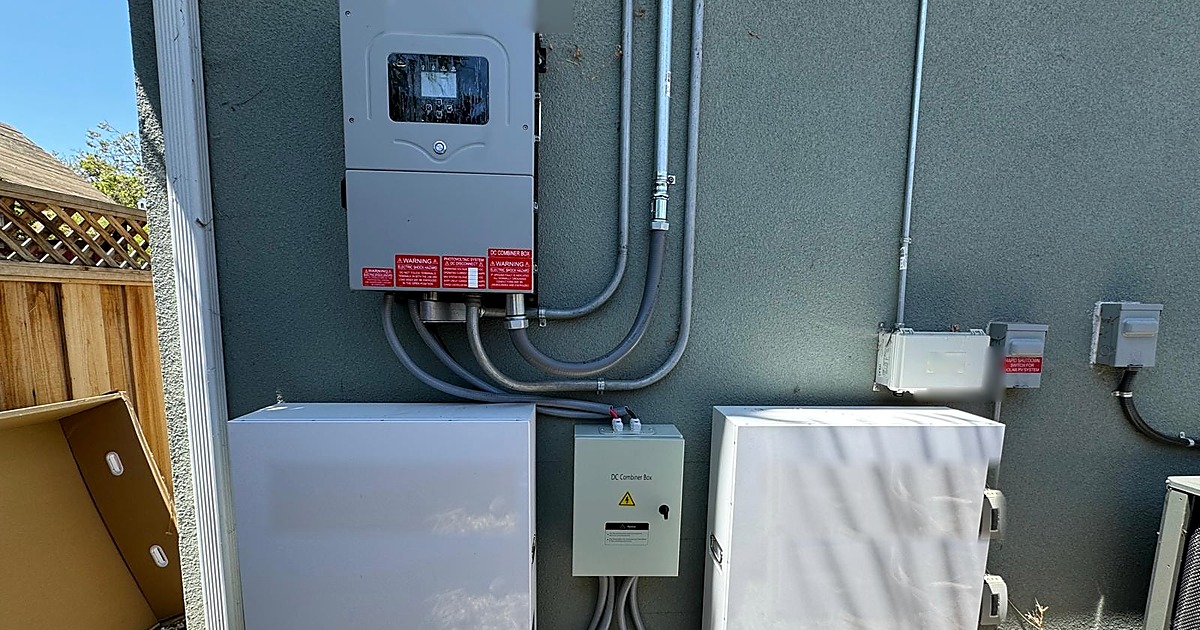
The supplier attaches a PDF titled “UN 38.3.” It has a lab logo, a table of tests, and a signature. The buyer forwards it to the freight forwarder, the forwarder forwards it to the carrier, and everyone assumes someone else has read it.
Then a shipment gets held, and it turns out the summary covers a cell that is no longer in the pack being shipped.
Short answer: A UN 38.3 test summary is a transport document, not a product safety certification. It records that a specific battery design passed the eight tests in section 38.3 of the UN Manual of Tests and Criteria, and since 1 January 2020 manufacturers and distributors have been required to make it available. It decides whether your freight can move. It says nothing about whether an inspector will approve the installation — that is UL 9540 and UL 1973, a separate document set.
This guide is for the person who has to check the paperwork before an order ships: importers, distributors, and installers buying container or pallet quantities. It covers what the summary must contain, how to tell whether it covers the product you are actually buying, and where UN 38.3 stops and other documents begin.
The One-Minute Version
If you are checking a document right now, this table is the article. It covers what UN 38.3 is, what it is not, and the three fields that catch most problems. The sections below explain how to verify each one.
| Question | Answer |
|---|---|
| What is it? | A transport test requirement — UN Manual of Tests and Criteria, section 38.3 |
| What does it gate? | Whether the goods can be shipped, by air, sea or road |
| Is it a safety certification? | No. That is UL 1973 / UL 9540, a different document |
| Is it mandatory? | The tests are required for transport; the summary has been required since 1 Jan 2020 |
| First thing to check | Does the model number on the summary match the model on your PO? |
| Second thing | Which Manual revision it cites — and whether that revision is current |
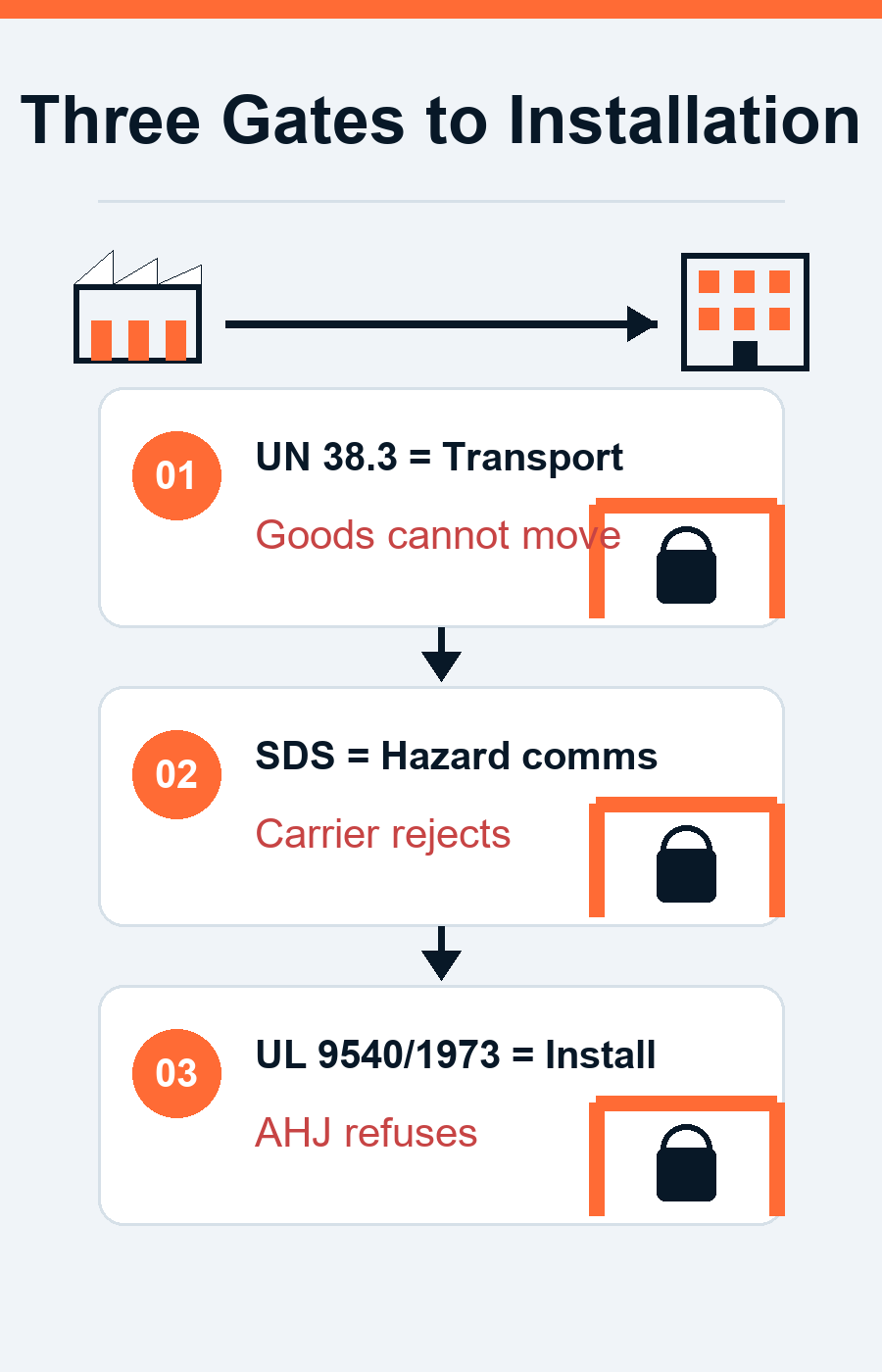
Three Documents, Three Different Gates
The most common and most expensive mistake is treating these three as interchangeable. They are produced by different parties, they answer different questions, and passing one tells you nothing about the others. A pack can have a flawless UN 38.3 summary and still fail inspection on site, because nobody asked for the listing documents.
| Document | Gate it opens | What happens without it |
|---|---|---|
| UN 38.3 test summary | Transport — air, sea, road | Freight refused or held; container does not move |
| SDS (safety data sheet) | Hazard communication — carrier, warehouse, emergency response | Carrier or warehouse declines the consignment |
| UL 1973 / UL 9540 | Installation — the AHJ signing off the system | Inspector fails the install; system cannot be energized |
Rule of thumb: UN 38.3 gets the pallet onto the ship. The listing documents get the system switched on. If a supplier answers a listing question by sending you a UN 38.3 summary, they have either misunderstood the question or are hoping you will not notice the difference.
Where the installation side is concerned, our guides on what UL 9540 actually covers and the five checks that verify a supplier’s listing claims handle that document set in detail. This article stays on the transport side.
What a Real Test Summary Must Contain
Section 38.3.5 of the UN Manual specifies the fields a test summary must include, which makes verification a checklist rather than a judgment call. Work down these ten items against the document in front of you. Anything missing is a reason to go back to the supplier before the goods are booked, not after.
| # | Field | What to look for |
|---|---|---|
| 1 | Cell or battery manufacturer name | The actual maker, not only the trading company |
| 2 | Manufacturer contact details | Reachable address, phone or email |
| 3 | Test laboratory name and address | A named lab, not “in-house” with no identity |
| 4 | Laboratory contact details | Lets you verify the report exists |
| 5 | Unique test report identification number | 🔴 A blank or reused number is the strongest red flag |
| 6 | Date of the test summary | Check it predates your shipment, not by a decade |
| 7 | Description: mass, watt-hour rating, model number, physical description | 🔴 The model must match your PO exactly |
| 8 | List of tests conducted and results | Should map to T1–T8, with pass results stated |
| 9 | Reference to the assembled-battery testing requirements | Relevant when packs are assembled from tested cells |
| 10 | Revision of the Manual used, plus signatory name, title and signature | 🔴 Confirm the revision cited is the current one |
Three of those ten do most of the work. Field 7 catches the failure described at the top of this article: a summary that is genuine but describes a different model or a superseded cell. Field 5 catches documents that were assembled rather than issued. Field 10 catches summaries that were valid once and were never refreshed when the Manual moved on.
Pro tip: ask for the summary by model number rather than asking whether the product “has UN 38.3.” Every serious supplier will say yes to the second question. Only a supplier with the paperwork in order can answer the first one the same day.
The Eight Tests, and Why the Scope Matters
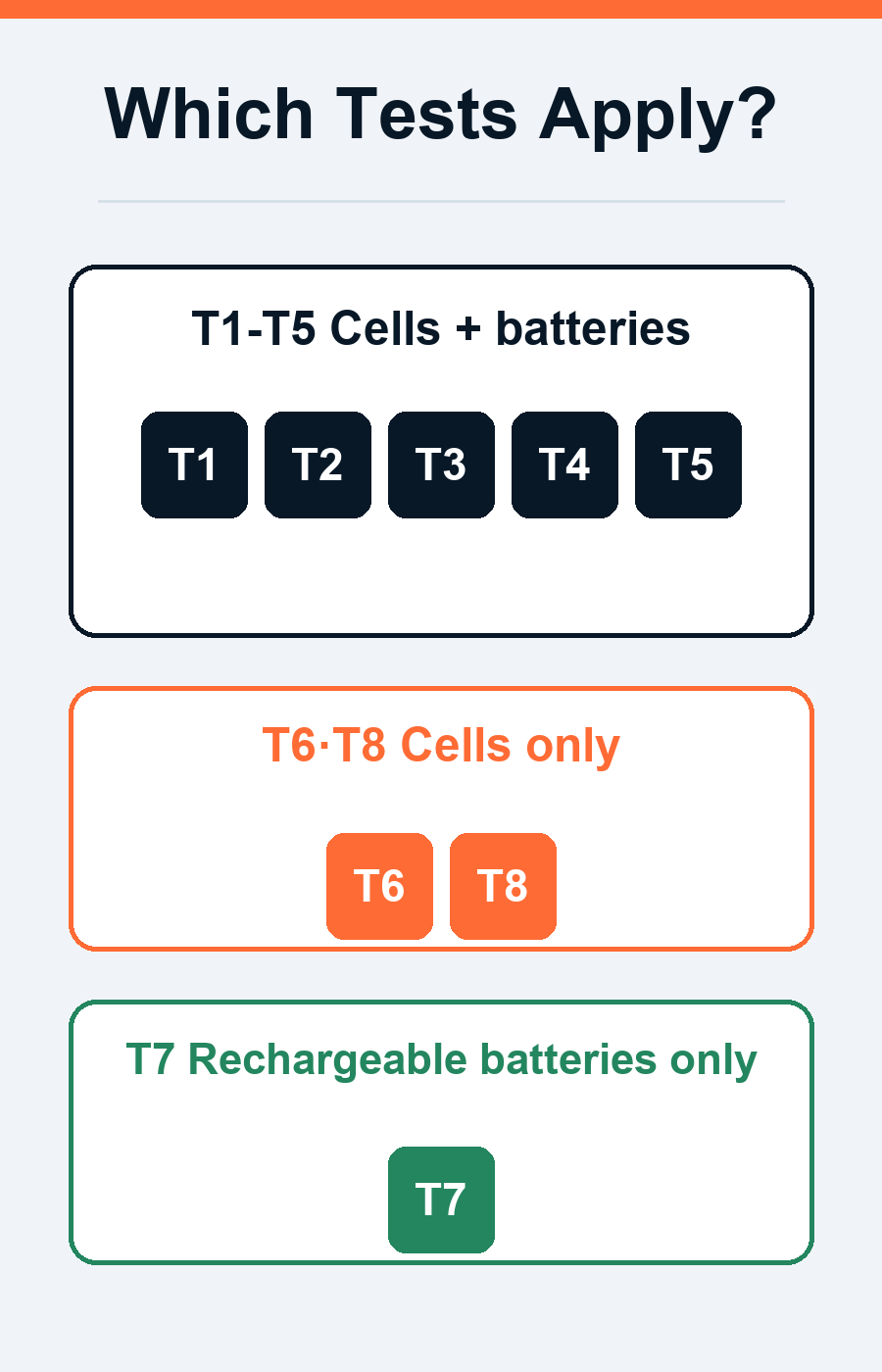
Section 38.3 defines eight tests, and they do not all apply to the same thing. Some are run on cells, some on assembled batteries, and some on both. That distinction is not academic: it determines whether a summary covering cells also covers the pack you are buying, which is the question behind most held shipments.
| Test | What it simulates | Applies to |
|---|---|---|
| T1 Altitude simulation | Low-pressure air transport | Cells and batteries |
| T2 Thermal test | Rapid temperature cycling | Cells and batteries |
| T3 Vibration | Transport vibration | Cells and batteries |
| T4 Shock | Impact during handling | Cells and batteries |
| T5 External short circuit | A short across the terminals | Cells and batteries |
| T6 Impact or crush | Mechanical deformation | Cells only |
| T7 Overcharge | Charging beyond limits | Rechargeable batteries only |
| T8 Forced discharge | Discharge driven past zero | Cells only |
Read that scope column against field 7 on the summary. If the document describes cells and lists T6 and T8, it is a cell-level summary. A pack assembled from those cells generally needs its own coverage, and section 38.3 addresses assembled batteries separately — which is exactly what field 9 on the checklist refers to. A cell summary alone is not automatically a pack summary.
We get asked for “the UN 38.3 certificate” more often than for the test summary by name, and the wording matters more than it sounds. There is no certificate in the sense of a listing mark you can look up in a public database. There is a test summary, tied to a design, issued off a report with a number. When a buyer asks for the certificate and receives something glossy with no report number on it, that is usually the moment to slow down and ask which report it came from.
Rule of thumb: the phrase to use with a supplier is “please send the UN 38.3 test summary and the SDS for model X.” Naming both documents and the model in one sentence sorts organized suppliers from disorganized ones faster than any questionnaire.
What the Summary Does Not Tell You
Two limits on the document catch buyers who assume it covers more than it does. Neither is a sign that anything is wrong with the supplier — they are simply the boundaries of what a test summary is for, and knowing them saves an awkward exchange during a booking.
- It is a summary, not the full test report. The underlying report stays with the manufacturer and the laboratory; the summary is the digest the Manual requires them to make available. Buyers who ask for “the full report” and receive a summary sometimes read the refusal as evasion. It usually is not. Ask instead for the report number and the laboratory contact, which is what lets the document be traced.
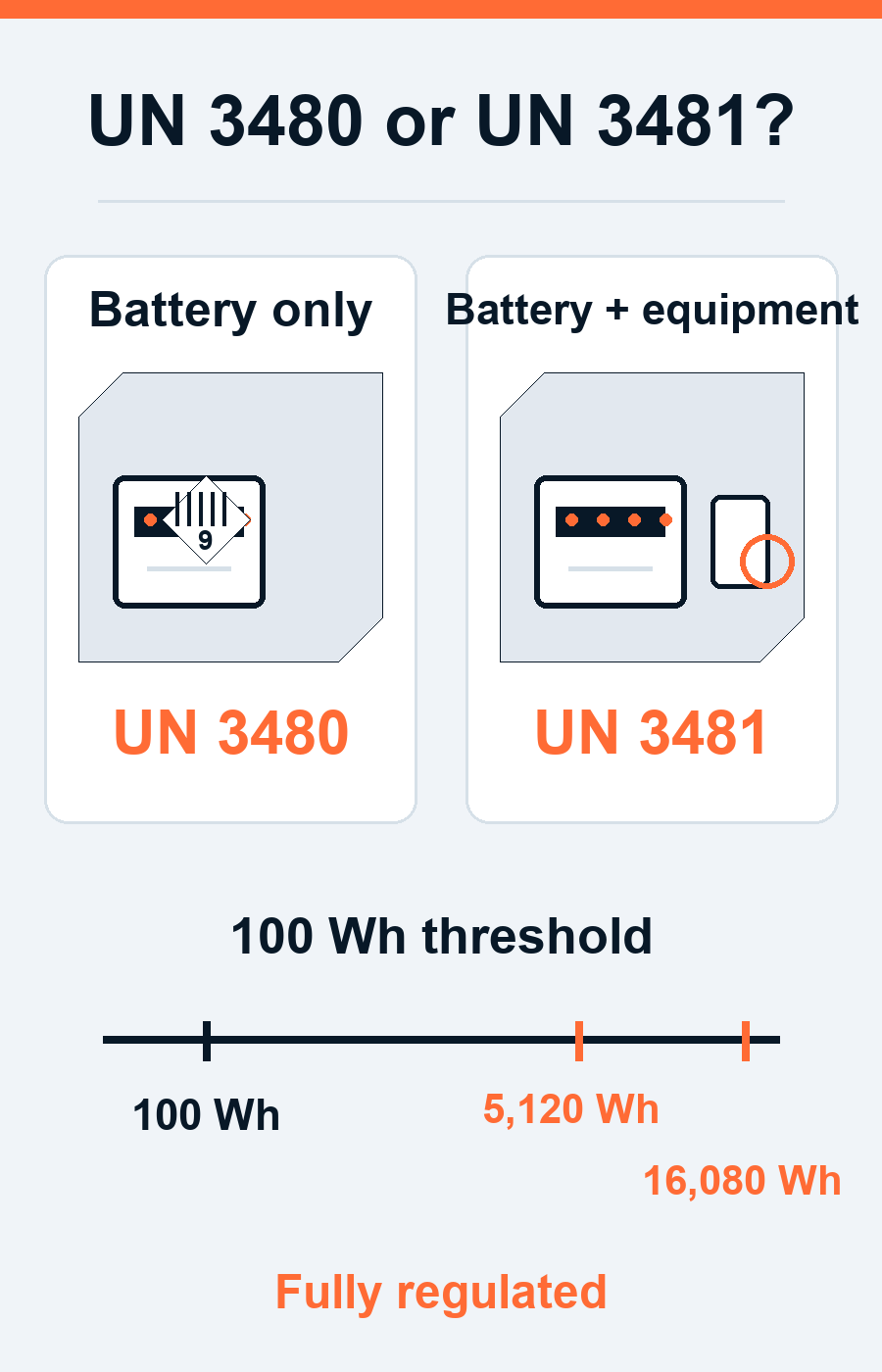
- It does not classify your shipment. Classification comes from the UN number and the applicable packing instruction, not from the test summary. Lithium batteries shipped on their own travel under UN 3480; those packed with or installed in equipment travel under UN 3481. Home and light-commercial storage packs sit far above the 100 Wh threshold — a 5.12 kWh module is 5,120 Wh — so they are fully regulated Class 9 dangerous goods in every case, with no small-battery relief available.
One practical consequence of that classification: air transport carries a state-of-charge restriction on standalone lithium-ion batteries, which is why cells arrive partially charged rather than full. Sea freight is governed by a different code and the provisions are not identical. Confirm the requirements for your specific route and mode with your carrier or forwarder before booking, because they, not the battery supplier, are the party applying them.
Rule of thumb: the test summary answers “has this design been tested?” The UN number, packing instruction and mode answer “how does this particular shipment travel?” A supplier owes you the first. A forwarder owes you the second. Problems happen when each assumes the other has handled both.
Two Situations Where the Paperwork Decides the Outcome
Consider a distributor in the Texas Hill Country consolidating a mixed pallet for sea freight. The forwarder asks for documentation per model, and the supplier sends one summary covering the cell used across the range. It is a genuine document, but the pack model numbers on the purchase order do not appear anywhere on it, so the forwarder cannot match paperwork to goods and the booking waits.
Now picture an installer in a Chicago row house project who has the transport paperwork in perfect order and assumes the compliance question is closed. The AHJ asks for evidence of the system listing at inspection, and UN 38.3 is not that evidence. The batteries arrived legally and still cannot be energized until the listing documents are produced.
Four Ways Buyers Get This Wrong
| Mistake | ❌ Don’t | ✅ Do |
|---|---|---|
| Treating UN 38.3 as a safety listing | Show the summary to an inspector as proof of compliance | Request UL 1973 / UL 9540 documentation separately |
| Accepting a summary without matching the model | File the PDF because it says UN 38.3 at the top | Check field 7 against the model on your PO |
| Assuming a cell summary covers the pack | Ship pallets on a cell-level document alone | Confirm assembled-battery coverage (field 9) |
| Ignoring the Manual revision | Reuse a summary from several years ago unchecked | Confirm the cited revision is current (field 10) |
| Asking the vague question | “Do you have UN 38.3?” | “Send the test summary and SDS for model X” |
| Leaving it to the forwarder | Assume someone downstream verified it | Check before booking; a held container costs more |
Savolture ships 51.2 V LiFePO4 packs to installers, EPCs and distributors, and we supply the UN 38.3 test summary and the SDS for the model on the order as part of the shipping document set, so the forwarder and the destination customs broker both have what they need before a container is booked. Product specifications are on the 5.12 kWh rack module and 16.08 kWh wall-mount module pages, and we list what travels with a shipment.
Take the checklist with you: download the UN 38.3 test summary checklist (PDF) — the ten required fields and the three-document gate on one page, ready to check against any supplier’s document.
Frequently Asked Questions
What does UN 38.3 mean?
It refers to section 38.3 of the UN Manual of Tests and Criteria, which sets out eight tests a lithium cell or battery design must pass to be transported. It is a transport requirement rather than a product safety certification, and it applies to the design rather than to each unit shipped.
What is the difference between UN 38.3 and an MSDS or SDS?
They serve different purposes. UN 38.3 records that a battery design passed the transport tests. An SDS communicates hazards, handling and emergency response information to carriers, warehouses and responders. Most shipments need both, and one cannot substitute for the other. Ask for them together, by model.
What is the difference between UL and UN 38.3 certification?
UL 1973 and UL 9540 are product and system safety standards used at installation, where an inspector needs evidence the equipment is listed. UN 38.3 is a transport test, used to move goods. A battery can satisfy one and not the other, so buyers should request both document sets rather than assuming either implies the other.
Is UN 38.3 mandatory?
The testing is required for lithium cells and batteries in transport, and since 1 January 2020 manufacturers and distributors have been required to make the test summary available. Exactly how carriers, forwarders and customs authorities apply it varies, so confirm requirements for your route with your carrier and destination broker.
Where do I get a UN 38.3 test summary?
From your supplier, for the specific model you are buying. It originates from the accredited laboratory that performed the tests and is issued against a numbered report. If a supplier cannot produce it for a named model within a working day or two, treat that as information about the supplier.
Does a cell test summary cover the finished battery pack?
Not automatically. Some tests apply to cells only and one applies to rechargeable batteries only, and section 38.3 addresses assembled batteries separately. Check that the document describes the pack model you ordered, and look for the reference to assembled-battery requirements rather than assuming coverage carries across.
How do I know a test summary is genuine?
Work the ten required fields. The strongest signals are a unique test report identification number, a named laboratory with contact details, a description that matches your model and watt-hour rating, and a stated Manual revision with a signatory. A document missing the report number or the model is the one to question first.
Next Steps
- Checking the installation side too? — our five supplier verification checks cover the listing documents this article deliberately leaves out.
- New to the standard itself — we explain what UL 9540 covers and how it differs from module-level listing.
- Facing an inspection — we walk through what inspectors actually ask for at sign-off.
- Comparing formats before you order — our rack-mount and wall-mount comparison covers which enclosure suits the site.
- Ordering project quantities — see our supply terms, or tell us the model and destination and we return the test summary and SDS for that model.
Sources & Further Reading
- UNECE — Manual of Tests and Criteria, Part III section 38.3 (source for the eight tests, their scope, and the test summary fields)
- PHMSA — Lithium Battery Test Summaries
- PHMSA — Transporting Lithium Batteries
- IATA — Lithium Battery Shipping Guidance
- UL Solutions — Energy Storage System Testing and Certification
Why We Wrote This
Savolture supplies LiFePO4 home and light-commercial storage to installers, EPCs and distributors. We are a channel brand rather than a plant owner, and the documents discussed here are issued by the manufacturers and laboratories involved — our part is making sure the right ones travel with the right model.
We wrote this because the existing material is split between laboratories explaining how to get tested and regulators publishing the rule text. Neither addresses the person actually holding the PDF, who has one question: does this document cover what I am buying, and is it enough to move the goods? The ten fields answer that, and they are published in the Manual for anyone to check.
| Brand | Savolture — LiFePO4 home energy storage |
| Model | B2B supply to installers, EPCs and distributors |
| Country | China |
| info@savolture.com | |
| Response | Test summary and SDS for your model inside 24 hours |
Ready to size your system?
Get a free battery recommendation.
Tell us your load, location, and backup target — we will spec the right 48V LiFePO4 system for you.