

Savolture Technical Guide
Batterie domestique basse tension ou haute tension : laquelle est la bonne ? (2026) | Savolture
For most homes, a 48V low-voltage LFP battery is the smarter choice - safer, cheaper, and never locked to one inverter brand. Here's the honest LV vs HV comparison, and when high voltage actually wins.
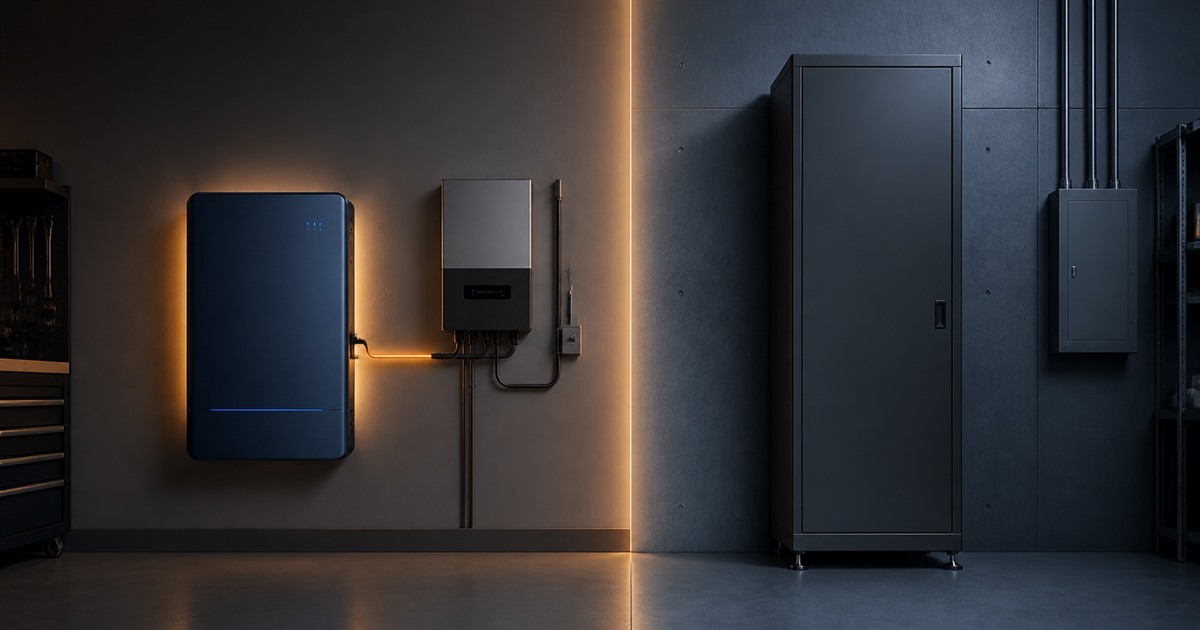
The real question
Voltage choice = inverter ecosystem lock-in 48V low-voltage = open inverters (Deye/Sol-Ark/Solis); high-voltage = single-vendor stack.body.sv-lang-fr { line-height: 1.55; }
Si vous achetez une batterie domestique en 2026, vous vous êtes certainement posé la question : devriez-vous acheter une batterie basse tension (48 V) ou une batterie haute tension (300-500 V) ? Les fiches techniques et les guides de marque s’orientent fortement vers la haute tension – une puissance plus efficace et plus élevée, « l’avenir ». Mais la plupart de ces guides sont rédigés par des entreprises qui vendent des systèmes haute tension. Voici la version honnête, provenant d’un canal qui fournit des batteries LFP 48 V et qui vous dira toujours exactement quand la haute tension est la meilleure solution.
Réponse rapide : Pour une maison typique (environ 5 à 20 kWh de stockage, monophasé, charges modérées), une batterie LFP basse tension de 48 V est le choix le plus intelligent. Il est plus sûr à manipuler, moins cher, plus facile à entretenir et fonctionne avec des onduleurs hybrides ouverts (Deye, Sol-Ark, Solis, Growatt, LuxPower), vous n’êtes donc jamais limité à une seule marque. La haute tension ne l’emporte que lorsque le système est de grande taille ou à haute puissance et que quelques pour cent de l’efficacité aller-retour comptent plus que le coût, la sécurité et le fait d’éviter le verrouillage de l’écosystème. La vraie décision concerne moins les volts que l’écosystème auquel vous souhaitez être lié.
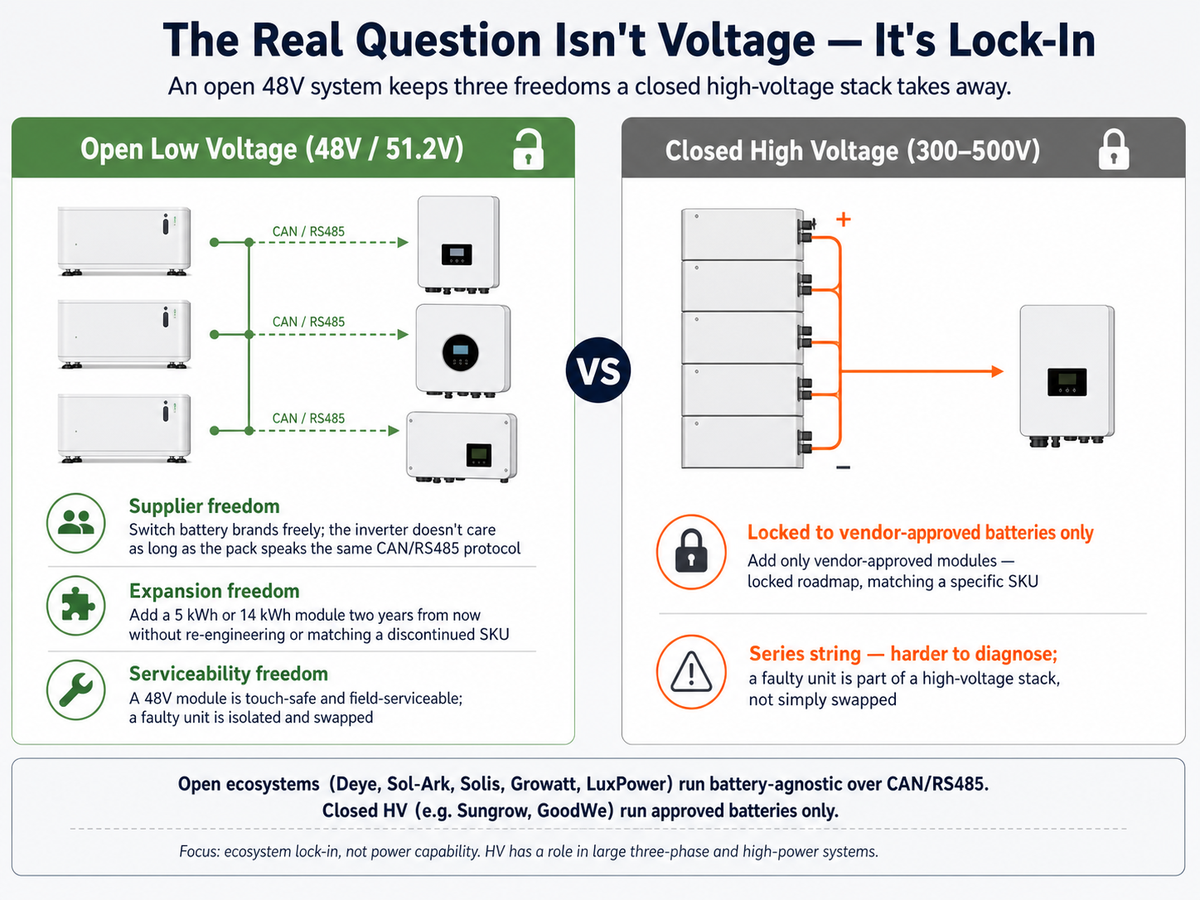
La vraie question n’est pas la tension, c’est le verrouillage
Presque tous les guides « BT vs HT » comparent les deux en termes de volts, d’efficacité et de puissance. C’est important, et nous les aborderons honnêtement ci-dessous. Mais ils passent à côté de la décision qui vous suivra réellement au cours des 10 à 15 prochaines années : votre choix de tension décide tranquillement de l’écosystème d’onduleurs avec lequel vous êtes marié.
Sur le marché actuel — et il s’agit d’une convention du marché et non d’une loi de la physique — les batteries basse tension 48 V sont celles où la compatibilité des onduleurs à protocole ouvert s’est normalisée. Les onduleurs hybrides ouverts grand public qui couvrent la plupart des installations résidentielles (Deye, Sol-Ark, Solis, Growatt, LuxPower) sont indépendants de la batterie : ils communiquent avec n’importe quel pack LFP 48 V conforme via une communication en boucle fermée CAN ou RS485. Vous pouvez mélanger les marques, vous développer ultérieurement ou changer de fournisseur sans remplacer votre onduleur. Il existe bien sûr des cas extrêmes. Victron fonctionne à 48 V mais est plus exigeant quant au BMS qu’il acceptera, et quelques plates-formes haute tension s’ouvrent lentement. Cependant, pour les onduleurs ouverts que la plupart des foyers utilisent réellement, le modèle est valable.
Les batteries haute tension ont une tendance inverse. Les principales plates-formes d’onduleurs HT – Sungrow et GoodWe en particulier – fonctionnent en boucle fermée uniquement avec des batteries figurant sur leur propre liste approuvée, généralement leur propre marque ou un ou deux partenaires (BYD, Pylontech). Fronius se situe entre les deux : certains modèles Gen24 s’associent à des piles HV BYD ou LG, d’autres acceptent un LFP 48 V ouvert via un BMS tiers pris en charge. Mais choisissez une plateforme HT fermée et vous avez, en pratique, choisi une pile à fournisseur unique. Vous souhaitez augmenter la capacité dans trois ans ? Vous achetez ce qu’ils vendent encore, à leur prix. C’est la partie omise par les fiches techniques.
Conseil de pro pour les installateurs : si un client possède déjà un onduleur Deye, Sol-Ark, Solis ou Growatt, une batterie LFP 48 V est la voie de moindre résistance : pas d’échange d’onduleur, pas de politique de batterie approuvée, et votre marge reste du côté de la batterie du devis.
Basse tension vs haute tension : la comparaison honnête
Voici le côte à côte sans le spin des ventes. Les deux sont du phosphate de fer et de lithium (LFP) dans les systèmes domestiques modernes ; la différence réside dans l’architecture du système, pas dans la chimie. (Si vous pesez plutôt des produits chimiques, consultez notre guide sur les batteries domestiques LFP vs NMC. Et si votre question concerne vraiment les niveaux basse tension – 12 V contre 24 V contre 48 V – il s’agit d’une comparaison différente, abordée dans 48V contre 24V contre 12V.)
| Dimensions | Basse tension (48 V/51,2 V) | Haute tension (300-500 V) |
|---|---|---|
| Sécurité à manipuler | Charge jusqu’à ~57-58 V, en dessous du seuil de sécurité tactile de 60 V CC (IEC 60479) — risque de choc et d’arc électrique bien inférieur | Tension continue mortelle ; exige un isolement, une formation et des EPI plus stricts |
| Compatibilité avec les onduleurs | Ouvert : Deye, Sol-Ark, Solis, Growatt, LuxPower — indépendant de la batterie via CAN/RS485 | Généralement fermé : Sungrow / GoodWe utilise uniquement des batteries approuvées ; Fronius varie selon le modèle |
| Efficacité aller-retour | Légèrement inférieur – une conversion abaisseur ajoute quelques pour cent de perte | Légèrement plus élevé (les fournisseurs citent environ 5 % ); moins de perte de conversion |
| Coût initial | Coût réduit de la batterie et du système | Coût plus élevé de la batterie et du système |
| Facilité d’entretien | Au niveau du module ; une seule unité de 5 à 16 kWh est simple à échanger ou à étendre | Chaîne de série – plus difficile à diagnostiquer et à entretenir au niveau du module |
| Idéal pour la puissance/l’échelle | La plupart des foyers : 5 à 20 kWh, monophasé, charges modérées | Grands systèmes ou systèmes triphasés, puissance continue élevée, grands panneaux photovoltaïques |
| Extensibilité | En parallèle, plus d’unités 48 V ; mélanger et assortir selon les spécifications | Ajoutez uniquement des modules approuvés par le fournisseur ; feuille de route verrouillée |
L’allégation « la haute tension est plus efficace », en dollars réels
L’argument principal en faveur de la haute tension est l’efficacité aller-retour. C’est réel : selon la physique de P = U × I, une tension plus élevée signifie un courant plus faible pour la même puissance, ce qui signifie des pertes résistives plus faibles, et une batterie de 48 V a besoin de l’onduleur pour réduire son courant continu. Le principe est donc valable.
Mais dimensionnez-le honnêtement. Selon une comparaison publiée par un grand fabricant de batteries haute tension, le gain est d’environ 5 %, soit environ 146 kWh économisés par an sur une batterie de 8 kWh utilisée une fois par jour.[1] Aux prix de l’électricité résidentiels typiques, cela est de l’ordre de 20 $ à 35 $ par an. Sur une durée de vie de 15 ans du LFP, cela représente quelques centaines de dollars.
Il s’agit d’une véritable économie, juste une petite économie à côté de l’écart de prix initial, de la marge de sécurité et du coût lié à la feuille de route de la batterie d’un fournisseur. Pour la plupart des foyers, payer une prime pour économiser 25 $ par an n’est pas une bonne affaire. Sur une grande installation à haute puissance où l’efficacité compte vraiment, les calculs peuvent s’inverser. La réponse dépend de votre système, et non d’une formule générale « HV est meilleur ».
BT ouvert vs HV fermé : ce que vous coûte réellement le lock-in
Revenez à la décision qui survit à la fiche technique. Une batterie LFP 48 V sur un onduleur ouvert vous offre trois libertés qu’une pile HT fermée ne vous offre pas :
- Liberté du fournisseur. Si une marque de batterie augmente ses prix ou quitte votre marché, vous changez : l’onduleur s’en fiche, tant que le pack utilise le même protocole CAN/RS485.
- Liberté d’expansion. Ajoutez un module de 5 kWh ou de 14 kWh dans deux ans sans réingénierie du système ni correspondance avec un SKU abandonné.
- Liberté de maintenance. Un module 48 V est sécurisé au toucher et peut être réparé sur site ; une unité défectueuse est isolée et échangée, et non renvoyée dans le cadre d’une chaîne haute tension.
Pour un système LFP 48 V, le choix de l’onduleur doit être vérifié par modèle : liste de compatibilité actuelle, firmware, documentation de communication, câble approuvé et conditions de garantie. Les interfaces CAN/RS485 ne constituent pas, à elles seules, une preuve de couplage en boucle fermée. Consultez le guide de compatibilité onduleur-batterie et les documents des fabricants concernés avant l’achat.
Deux scénarios : à quoi ressemble le choix en pratique
Imaginez une installation de 20 panneaux sur un toit sur la côte du Queensland : environ 6,5 kWh d’utilisation quotidienne moyenne, avec un onduleur hybride Growatt déjà installé sur le mur. À 48 V, l’ajout d’un module LFP de 14 kWh est un travail sur une seule ligne : l’installateur maintient l’onduleur et la batterie en boucle fermée sur CAN, et le seul nouveau SKU est la batterie. Si cette même maison s’était engagée dans une plate-forme HT fermée deux ans plus tôt, la mise à niveau pourrait signifier un nouvel onduleur et une batterie HT approuvée – souvent entre 2 000 et 4 000 $ de matériel supplémentaire pour ajouter la même énergie utilisable.
Considérons maintenant une grande propriété rurale dans l’ouest du Texas qui exécute de lourdes charges continues sur un système triphasé avec un grand générateur photovoltaïque. Ici, l’image se retourne. La puissance continue plus élevée, les longs trajets de câbles où s’ajoutent quelques pour cent d’efficacité et une garantie d’un seul fournisseur sur l’ensemble de la pile peuvent tous véritablement justifier une architecture haute tension. Aucune des deux tensions ne gagne carrément ; la bonne réponse est définie par le système devant vous, et non par le titre d’une fiche technique.
Matrice de décision : laquelle vous convient le mieux ?
| Choisissez Basse tension (48 V) si… | Choisissez Haute tension si… |
|---|---|
| Votre système consomme environ 5 à 20 kWh | Votre système est de grande taille (20 kWh+) ou triphasé |
| Vous souhaitez un onduleur ouvert (Deye / Sol-Ark / Solis / Growatt / LuxPower) | Vous vous engagez sur une plateforme unique fermée (Sungrow / GoodWe) |
| La sécurité, la facilité d’entretien et le budget sont des priorités | L’efficacité aller-retour maximale justifie la prime |
| Vous pouvez agrandir ou changer de fournisseur plus tard | Vous avez besoin d’une puissance continue très élevée |
| Vous êtes un installateur qui souhaite une flexibilité de batterie par tâche | La garantie d’un seul fournisseur sur l’ensemble du système est la plus importante |
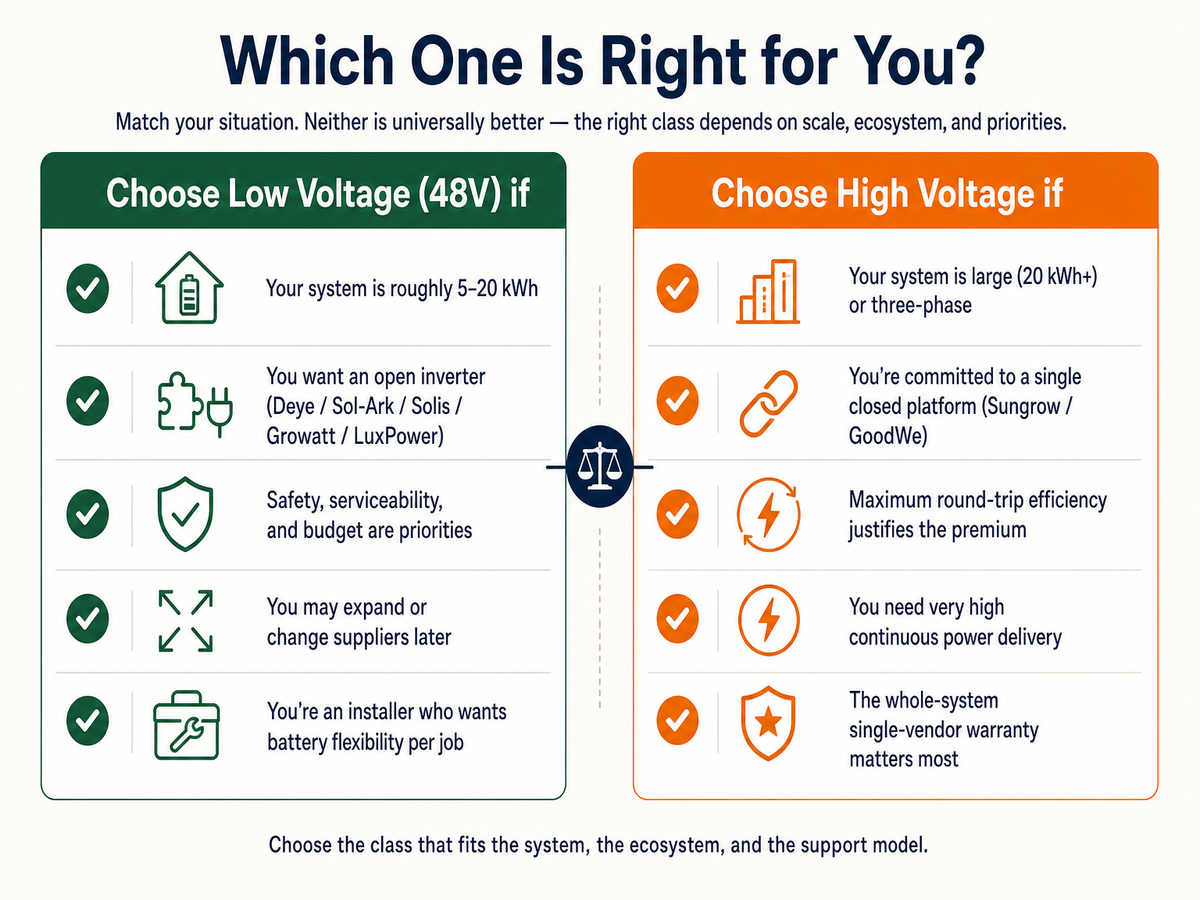
Pour la grande majorité des foyers, la colonne de gauche constitue la réponse honnête. (Le dimensionnement de la capacité réelle est une question distincte : parcourez-la dans comment dimensionner un parc de batteries, puis associez-le à un pack 48 V de notre gamme : 10,24 kWh et modules 16 kWh, ou la ligne LFP 48 V complète.)
Erreurs courantes lors du choix de la tension de la batterie
Lorsque les installateurs nous demandent de peser la basse tension par rapport à la haute tension pour un projet, la décision échoue rarement en termes d’efficacité – elle échoue en raison des erreurs de verrouillage ci-dessous, que nous soulignons avant de choisir une plate-forme.
- Traiter “une tension plus élevée = une meilleure batterie”. Il s’agit d’un compromis entre l’architecture du système et non d’un niveau de qualité. Les deux sont LFP ; les deux peuvent être excellents.
- En achetant une HT, vous ne ressentirez jamais l’efficacité. Un gain aller-retour d’environ 5 % est réel mais mineur pour une maison typique : vérifiez-le par rapport à votre propre charge avant de payer la prime.
- Ignorer le verrouillage de l’onduleur. Le coût le plus important à long terme du HT n’est généralement pas la batterie : il est lié à la feuille de route d’un fournisseur pour la durée de vie du système.
- Associer la mauvaise batterie à un onduleur fermé. Si vous avez déjà choisi Sungrow ou GoodWe, vous devez généralement utiliser leurs batteries approuvées ; un pack 48 V tiers ne fermera pas la boucle. Confirmez d’abord l’onduleur.
- Oubli de la profondeur de décharge. Dimensionnement sur l’énergie utilisable. Le LFP est généralement évalué à une profondeur de décharge de 80 % pour le cyclisme quotidien (jusqu’à 90 à 95 % comme limite technique), donc un pack de 10 kWh fournit environ 8 kWh d’énergie utilisable par jour, quelle que soit la tension.
Questions fréquemment posées
Une batterie basse tension 48 V est-elle pire qu’une batterie haute tension ?
Non. Il s’agit d’architectures différentes, et non de niveaux de qualité différents : les deux sont généralement des LFP. Une batterie basse tension de 48 V est plus sûre à manipuler, moins chère, plus facile à entretenir et compatible avec les onduleurs hybrides ouverts. La haute tension offre quelques pour cent d’efficacité aller-retour en plus et convient aux systèmes de grande taille ou à forte puissance. Pour la plupart des maisons (5 à 20 kWh), la basse tension est globalement le meilleur choix.
Dans quelle mesure une batterie haute tension est-elle réellement plus efficace ?
Les fournisseurs citent généralement une efficacité aller-retour environ 5 % plus élevée, car une tension plus élevée signifie un courant plus faible et moins de perte de conversion. En pratique, cela représente environ 100 à 150 kWh par an avec une batterie domestique de taille moyenne, soit environ 20 à 35 $ au prix habituel de l’électricité. C’est réel mais généralement faible par rapport au coût initial et aux différences de verrouillage.
Quels onduleurs fonctionnent avec une batterie basse tension de 48 V ?
Les onduleurs hybrides ouverts sont indépendants de la batterie et fonctionnent avec des packs LFP 48 V conformes en boucle fermée CAN/RS485 – parmi eux Deye, Sol-Ark, Solis, Growatt et LuxPower. Les plates-formes haute tension comme Sungrow et GoodWe n’utilisent généralement que leurs propres batteries ou celles approuvées, et Fronius varie selon le modèle. Confirmez toujours la compatibilité en boucle fermée pour votre modèle exact d’onduleur avant d’acheter.
Puis-je utiliser une batterie tierce avec un onduleur Sungrow ou GoodWe ?
Généralement non. Il s’agit d’écosystèmes fermés à haute tension qui fonctionnent en boucle fermée uniquement avec des batteries figurant sur leur liste approuvée (souvent leur propre marque). Si vous voulez avoir la liberté de choisir et de changer votre batterie, choisissez un onduleur hybride ouvert et un pack LFP basse tension 48 V.
Le 48 V est-il plus sûr que la haute tension ?
Oui, pour la manipulation. Un pack LFP 48 V/51,2 V se charge à environ 57-58 V, restant en dessous du seuil de sécurité tactile de 60 V CC, de sorte que le risque de choc et d’arc électrique est bien inférieur pour les installateurs et les propriétaires. Les systèmes à haute tension (300 à 500 V) transportent une tension continue mortelle et nécessitent une isolation et une formation plus strictes. Les deux sont sûrs lorsqu’ils sont installés correctement : nos packs 48 V sont construits selon les normes UL 1973 et UL 9540, avec une documentation de certification sur la page produit – mais la basse tension conserve une marge de sécurité plus large.
Puis-je étendre un système 48 V plus tard ?
Oui. Le LFP modulaire 48 V contient des unités supplémentaires parallèles, afin que vous puissiez démarrer avec la bonne taille et ajouter de la capacité à mesure que vos charges augmentent, sans repenser le système. Confirmez la configuration parallèle maximale sur la fiche technique et conservez les modules ajoutés dans la même famille de tension et de protocole.
Prochaines étapes
- Parcourez la gamme : consultez notre gamme de batteries LFP 48 V (modules de 5 à 16 kWh).
- Faites un contrôle de compatibilité : indiquez-nous votre onduleur et votre charge quotidienne et nous vous confirmerons un couplage en boucle fermée testé avant d’acheter.
- Lisez ensuite : le guide de couplage de l’onduleur hybride 48 V pour la configuration au niveau du modèle.
En fin de compte : pour une maison typique, une batterie LFP basse tension de 48 V sur un onduleur ouvert est le choix le plus sûr, le moins cher et le plus flexible – et elle maintient vos options ouvertes pour la prochaine décennie au lieu de vous enfermer chez un seul fournisseur.
Sources
- AlphaESS, « Batteries haute tension ou basse tension : le guide ultime du stockage d’énergie domestique », 2024 — alphaess.com (chiffre de comparaison d’efficacité).
- CEI 60479-1, Effets du courant sur les êtres humains et le bétail — base du seuil de sécurité tactile de 60 V CC.
- UL 1973 / UL 9540, normes de sécurité des systèmes de stockage d’énergie stationnaires — base de certification des batteries et des systèmes.
{“@context”:”https://schema.org”,”@graph”:[{“@type”:”BlogPosting”,”@id”:”https://savolture.com/fr/blog/low-voltage-vs-high-voltage-home-battery/#webpage”,”url”:”https://savolture.com/fr/blog/low-voltage-vs-high-voltage-home-battery/”,”name”:”Batterie domestique basse tension ou haute tension : laquelle est la bonne ? (2026)”,”description”:”Guide technique complet : Batterie domestique basse tension ou haute tension : laquelle est la bonne ? (2026). Spécifications, protocoles et conseils d’ingénierie pour professionnels du solaire.”,”inLanguage”:”fr”,”author”:{“@id”:”https://savolture.com/#organization”},”publisher”:{“@id”:”https://savolture.com/#organization”},”headline”:”Batterie domestique basse tension ou haute tension : laquelle est la bonne ? (2026)”,”mainEntityOfPage”:”https://savolture.com/fr/blog/low-voltage-vs-high-voltage-home-battery/”},{“@type”:”Organization”,”@id”:”https://savolture.com/#organization”,”name”:”Savolture”,”url”:”https://savolture.com/”,”inLanguage”:”fr”}]}
Choosing between low and high voltage?
Get a 48V LFP battery matched to your inverter
Tell us your inverter model and daily load - we'll confirm a tested closed-loop pairing before you buy.