

Savolture Technical Guide
Combien de temps durent les batteries LiFePO4 ? Les deux horloges qui décident (2026) | Savolture
Recherchez cette question et chaque réponse vous donne une plage. Cinq à dix ans. Deux mille à cinq mille cycles. Dix ans ou plus si vous en prenez soin. Ce que presque aucun d'...
body.sv-lang-fr { line-height: 1.55; }
.svba-direct-answer{background:#f0f4f8;border-left:5px solid #ff6b35;padding:16px 20px;margin:20px 0;border-radius:4px;font-size:15.5px;line-height:1.65}
.svba-checklist-box{background:#fff8f3;border:1px solid #ffd9c2;border-radius:6px;padding:16px 20px;margin:20px 0}
.svba-checklist-box strong{color:#c2410c}
table.svba-ref{width:100%;border-collapse:collapse;margin:20px 0;font-size:14.5px}
table.svba-ref th,table.svba-ref td{border:1px solid #d4d8de;padding:10px 12px;text-align:left;vertical-align:top}
table.svba-ref th{background:#081827;color:#fff;font-weight:600}
table.svba-ref tr:nth-child(even){background:#f7f9f8}
table.svba-ref td.navy{background:#081827;color:#fff;font-weight:600;text-align:center}
table.svba-ref td.code{font-family:ui-monospace,Menlo,Consolas,monospace;font-weight:700;color:#c2410c;text-align:center}
table.svba-ref td.win{background:#f0f7f2;font-weight:600;color:#1a6b3a}
.svba-protip{background:#081827;color:#eef2f6 !important;padding:16px 20px;border-radius:6px;margin:20px 0;font-size:14.5px}
.svba-protip strong{color:#ff9a6b !important}
.svba-protip em{color:#eef2f6 !important}
.svba-warn{background:#fef2f2;border:1px solid #fecaca;border-left:5px solid #dc2626;padding:16px 20px;margin:20px 0;border-radius:4px;font-size:14.5px}
.svba-warn strong{color:#b91c1c}
.svba-mistakes{border:1px solid #e2e6ea;border-radius:6px;padding:6px 18px;margin:14px 0;background:#fafbfc}
.svba-mistakes h4{margin:14px 0 6px;font-size:16px;color:#081827}
.svba-mistakes .wrong{color:#b91c1c;font-weight:700}
.svba-mistakes .right{color:#1a6b3a;font-weight:700}
.svba-srcnote{font-size:12.5px;color:#777;font-style:italic;margin:-12px 0 18px}
.svba-cta-grid{display:grid;grid-template-columns:repeat(auto-fit,minmax(240px,1fr));gap:14px;margin:24px 0}
.svba-cta-card{background:#1a4d33;color:#fff;padding:18px;border-radius:6px;text-align:center}
.svba-cta-card a{color:#fff;text-decoration:none;font-weight:600;display:block}
.svba-cta-card small{display:block;margin-top:6px;font-weight:400;opacity:.85;font-size:13px}
.svba-faq h3{margin-top:22px;font-size:17px;color:#1a4d33}
.svba-sources{font-size:13.5px;color:#555;background:#fafafa;padding:14px 18px;border-radius:4px;margin-top:30px}
.svba-about{border:1px solid #e2e6ea;border-radius:8px;padding:4px 22px 18px;margin:34px 0 10px;background:#fbfcfd}
.svba-about h2{margin-bottom:4px}
.svba-profile{background:#081827;color:#eef2f6 !important;border-radius:6px;padding:16px 20px;margin:14px 0;font-size:14px;line-height:1.7}
.svba-profile strong{color:#ff9a6b !important}
Recherchez cette question et chaque réponse vous donne une plage. Cinq à dix ans. Deux mille à cinq mille cycles. Dix ans ou plus si vous en prenez soin. Ce que presque aucun d’entre eux ne vous donne, c’est une méthode : un moyen de prendre le numéro imprimé sur la fiche technique de votre batterie et de le convertir en une année que votre propre système atteindra réellement.
Cet écart est visible dans les résultats de recherche eux-mêmes. La page classée en premier pour cette question la plupart du temps n’est pas un guide du fabricant. Il s’agit d’un fil de discussion intitulé “Quelqu’un a-t-il réellement utilisé une batterie LiFePO4 jusqu’à la fin de sa durée de vie ? Si oui, combien de temps a-t-elle duré ?” Les gens se posent la question car les réponses publiées ne résolvent pas la question.
Voici la partie qui le résout. Une batterie au lithium fer phosphate ne vieillit pas selon un calendrier. Il vieillit sur deux à la fois, et celui qui compte pour votre système dépend moins de ce que vous achetez que de l’endroit où vous le mettez.
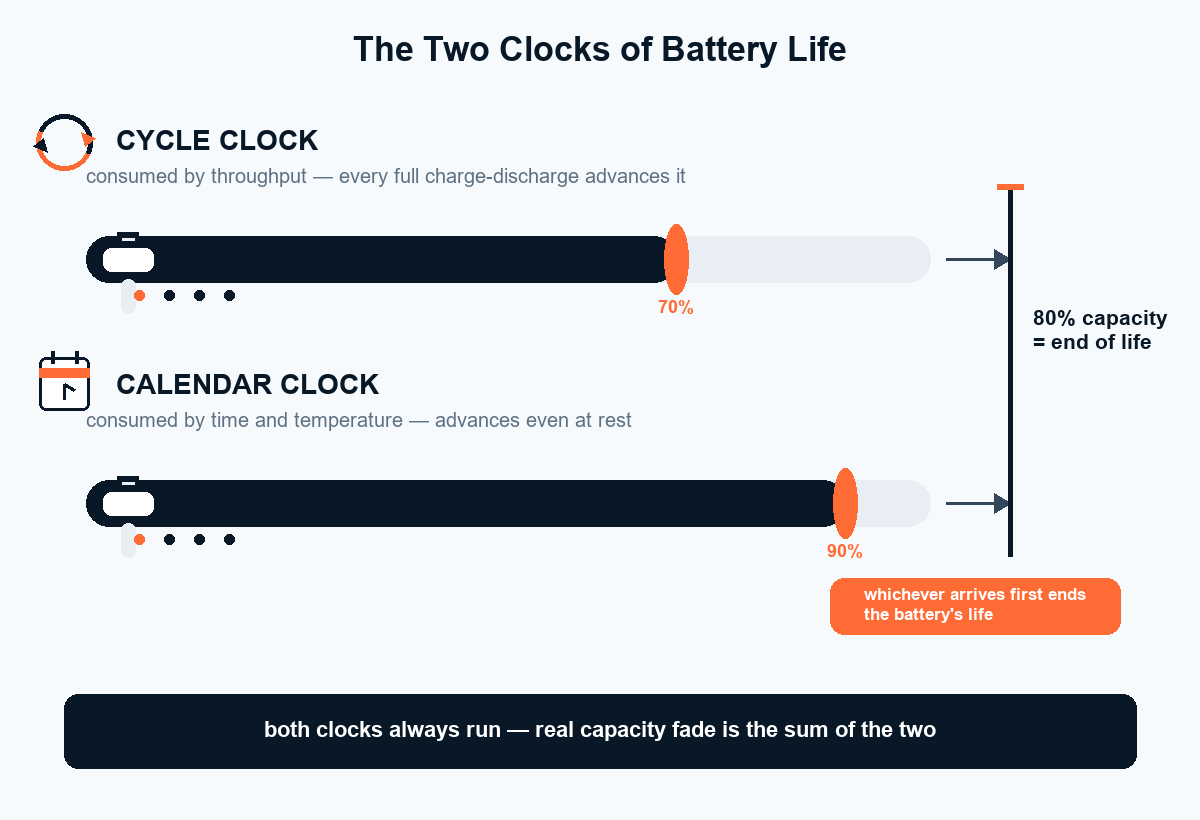
Réponse rapide : Une batterie LiFePO4 de qualité dure 10 à 20 ans dans un service solaire domestique typique, mais le cycle indiqué sur la boîte ne représente que la moitié de l’histoire. Chaque pack LFP vieillit sur deux horloges à la fois : un cycle d’horloge consommé par la charge et la décharge, et une horloge calendrier consommée par le temps et la température, même lorsque la batterie reste inactive. Un pack de 6 500 cycles exécuté une fois par jour a environ 17,8 années d’horloge de cycle. Mais des travaux évalués par des pairs sur le vieillissement calendaire des cellules LFP révèlent que l’augmentation de la température de stockage de 25 °C à 40 °C réduit la durée de vie calendaire d’environ un tiers, d’environ 23,8 ans à environ 8,7 ans. Dans un endroit chaud, l’horloge du calendrier expire en premier, ce qui signifie que les cycles supplémentaires que vous avez payés ne sont jamais utilisés. La température d’installation change la réponse plus que la fiche technique.
Les deux horloges
La durée de vie est le chiffre annoncé par les fabricants, car c’est le chiffre qui semble impressionnant. C’est aussi le nombre qui est mal interprété le plus souvent, car il ne décrit qu’un des deux processus indépendants dégradant vos cellules.
Première horloge : le cycle
Le cycle est consommé par l’énergie circulant dans les cellules. Une charge et une décharge complètes équivaut à un cycle complet équivalent. Deux cycles à demi-profondeur dans une journée comptent environ pour un cycle complet, c’est pourquoi une batterie soumise à un régime solaire quotidien peu profond vieillit plus lentement par jour civil qu’une batterie fonctionnant à plat chaque nuit.
Il s’agit de l’horloge décrite par une évaluation de « 6 500 cycles ». Les nôtres sont évalués à 6 500+ cycles pour les packs 100Ah et 200Ah et 8 500+ cycles pour le 314Ah, tous deux mesurés au point de rétention de capacité standard de 80 %.
Horloge deux : l’horloge du calendrier
L’horloge du calendrier est consommée par le temps, la température et l’état de charge au repos. Le mécanisme est la croissance de la couche d’interphase d’électrolyte solide sur l’anode, un processus chimique qui se poursuit, que le courant circule ou non. Une batterie complètement chargée dans une pièce chaude est consommée par cette horloge sans aucun travail.
C’est l’horloge dont personne ne fait la publicité, car il n’y a pas de chiffre flatteur à imprimer. C’est aussi la raison pour laquelle la question du forum ci-dessus obtient rarement une réponse claire : de nombreux packs sont retirés pour des raisons liées à cette horloge bien avant que leur nombre de cycles ne soit épuisé.
Pourquoi ce cadrage est important : Si votre horloge limite est l’horloge de cycle, l’achat d’un indice de cycle plus élevé prolonge la durée de vie de votre batterie. Si votre horloge limite est l’horloge du calendrier, l’achat d’un indice de cycle plus élevé ne prolonge rien. Savoir sur lequel vous vous trouvez vous indique où va réellement votre argent.
Une correction importante : les horloges ajoutent, elles ne font pas que courir
Le modèle à deux horloges est un outil de décision, et il convient de préciser ses limites, car c’est là que les explications simplifiées tournent mal.
La capacité s’estompe à cause du vieillissement calendaire et la capacité s’estompe à cause du cycle s’accumulent. Une batterie ne reste pas sur une horloge et ignore l’autre. L’évanouissement total est plus proche de la somme des deux contributions que de celle qui est la plus grande, ce qui signifie que la durée de vie réelle est plus courte que ce que l’une ou l’autre horloge prédit seule.
Utilisez donc les horloges de cette façon : l’horloge la plus courte vous indique quel levier actionner, et les deux ensemble vous indiquent que l’espérance de vie honnête est légèrement inférieure au chiffre le plus court. Toute source vous donnant un seul numéro d’année fiable pour une batterie qu’elle n’a jamais vue installée survente la précision disponible.
En quoi une évaluation cyclique se convertit en années
Les évaluations de cycle deviennent utiles au moment où vous les divisez par la fréquence à laquelle vous faites réellement du vélo. La plupart des maisons connectées au réseau fonctionnant à l’énergie solaire fonctionnent près d’un cycle complet équivalent par jour. Les systèmes hors réseau et les foyers bénéficiant de tarifs dépendants de l’heure d’utilisation avec de fortes charges en soirée peuvent être plus élevés.
| Votre modèle d’utilisation | Cycles complets équivalents/jour | Pack de 6 500 cycles | Pack de 8 500 cycles |
|---|---|---|---|
| Sauvegarde uniquement pannes rares, pour la plupart inactives |
~0.1 | 178 ans | 233 ans |
| Autoconsommation solaire légère utilisation partielle en soirée |
0.5 | 35,6 ans | 46,6 ans |
| Solaire domestique typique un cycle en soirée par jour |
1.0 | 17,8 ans | 23,3 ans |
| Lourd/hors réseau quotidien profond et recharges |
1.5 | 11,9 ans | 15,5 ans |
| Cyclisme commercial deux cycles complets par jour |
2.0 | 8,9 ans | 11,6 ans |
Horloge de cycle uniquement, calculée en cycles nominaux ÷ (cycles par jour × 365). Ces chiffres ignorent entièrement le vieillissement calendaire, ce qui est exactement l’erreur que corrige la section suivante.
Lisez attentivement la ligne du haut, car c’est celle qui expose le problème. Une batterie de secours uniquement a 178 ans de cycle. Personne ne croit qu’une batterie dure 178 ans. L’horloge de cycle n’est tout simplement pas la contrainte contraignante dans cette application, et toute réponse construite uniquement sur le nombre de cycles a cessé d’être utile.
Température : la variable qui fait bouger les deux horloges
La température est le levier le plus important de l’horloge calendaire et son effet n’est pas linéaire. Les tests de vieillissement calendaire à long terme sur les cellules LiFePO4 publiés dans Energies ont extrapolé le temps jusqu’à la fin de vie, défini comme une perte de capacité de 20 %, dans différentes conditions de stockage fixes.
| Conditions de stockage | Temps extrapolé à 80 % de capacité | Ce que ça te dit |
|---|---|---|
| 10 % SoC 25 °C |
45,1 ans | Frais et presque vide est l’état de vieillissement le plus lent |
| 50 % SoC 25 °C |
23,8 ans | Une base de référence intérieure réaliste |
| 50 % SoC 40 °C |
8,7 ans | Même batterie, emplacement chaud, environ un tiers de la durée de vie |
Source : Sui et coll. (2021), “Le comportement de dégradation des batteries LiFePO4/C pendant le vieillissement calendaire à long terme”, Energies 14(6):1732, doi:10.3390/en14061732 — basé sur 27 à 43 mois de vieillissement calendaire mesuré, puis extrapolé jusqu’à la fin de vie. Considérez les années absolues comme illustratives plutôt qu’exactes : les modèles alternatifs du même article placent le cas 50 % SoC / 25 °C entre environ 15 et 33 ans selon le critère de dégradation appliqué. La conclusion solide est le rapport, et non le nombre d’années : maintenir l’état de charge constant et augmenter la température de stockage de 25 °C à 40 °C réduit la durée de vie prévue d’environ un tiers. Il s’agit d’extrapolations de stockage au niveau des cellules, et non de garanties pour un système de batterie complet, ni pour un cycle d’installation réel ainsi que pour le repos.
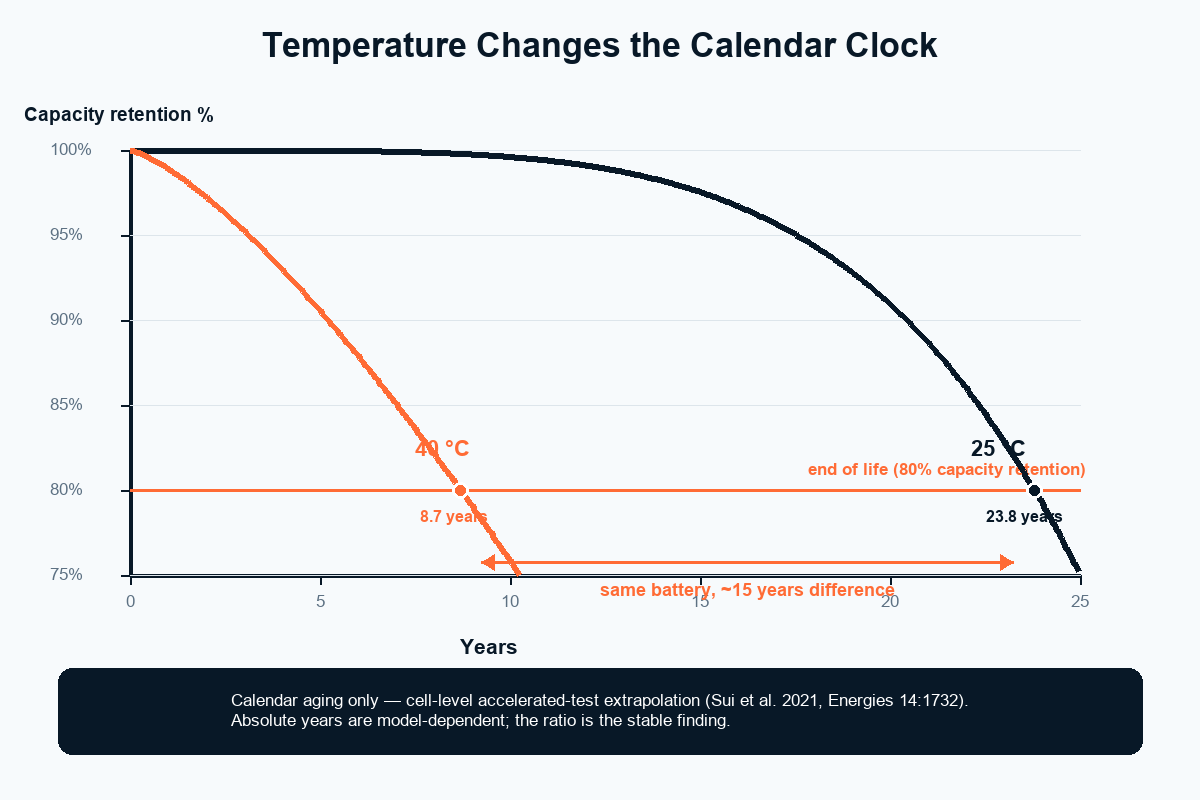
La ligne à 40 ° C est celle qui vaut la peine d’être assise. Comparez-le à la table des cycles : un pack de 6 500 cycles cyclé une fois par jour a 17,8 années de cycle, mais une horloge calendaire de l’ordre de neuf ans à cette température. La batterie atteint sa fin de vie après avoir utilisé moins de la moitié de ses cycles nominaux. Tout ce que vous avez payé au-dessus de 3 200 cycles environ ne sera jamais dépensé.
Exécutez maintenant la même comparaison pour le pack de 8 500 cycles dans cet emplacement chaud. Son cycle s’étend sur 23,3 ans. Son horloge calendaire ne bouge pas du tout, car le vieillissement calendaire ne se soucie pas de ce que dit le classement cyclique. La mise à niveau n’apporte pratiquement aucune durée de vie supplémentaire. Le même argent dépensé pour la durée de vie de la batterie aurait permis d’effectuer beaucoup plus de travail.
Cela est vrai même si vous vous méfiez des années exactes. Supposons que la durée de vie réelle à 40 ° C soit de 12 ans au lieu de neuf. La conclusion reste inchangée : il se situe toujours en dessous de la fréquence de cycle de 17,8 ans, le pack le moins cher atteint toujours sa limite pour la même raison et la prime pour les cycles supplémentaires ne rapporte toujours rien. Le classement des deux leviers survit à une large marge d’erreur dans les chiffres sous-jacents.
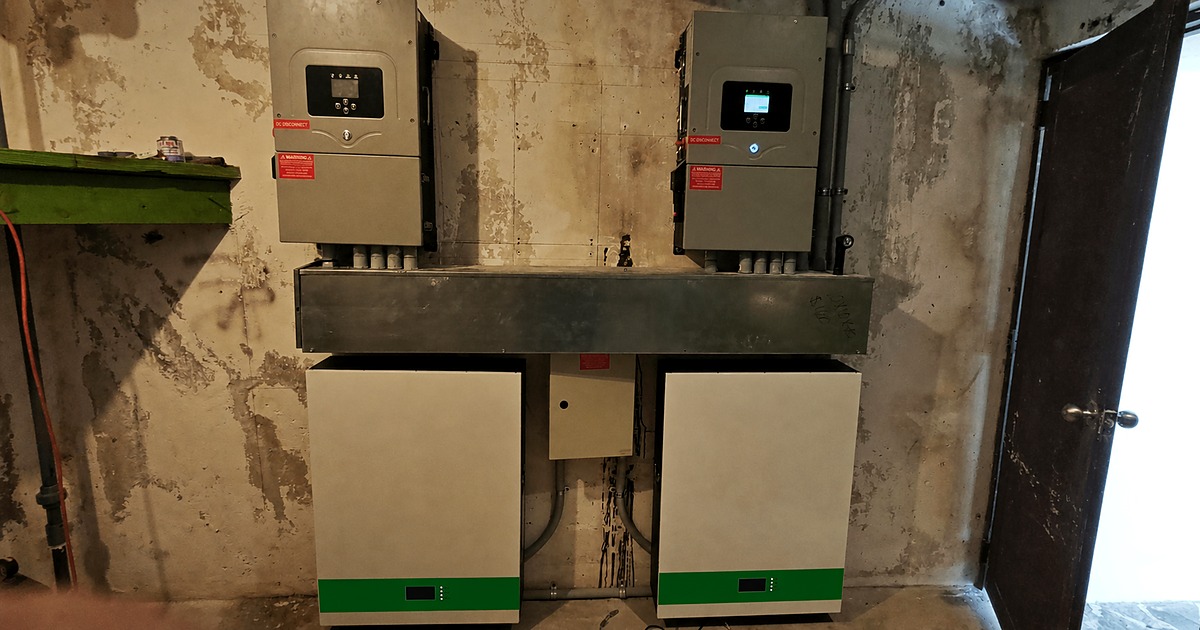
La question que l’on nous pose le plus souvent dans la fiche technique est “combien de cycles”. La question qui change réellement le résultat, à savoir où cela va-t-il vivre et à quel point il fait chaud là-dedans, est une question que presque personne ne nous pose en premier. Lorsqu’un acheteur nous dit que le pack est installé sur un mur de garage non isolé orienté à l’ouest, ce détail compte plus pour la réponse que la différence entre deux valeurs de cycle.
La température a également un plancher, pas seulement un plafond. Charger le LFP en dessous de zéro provoque un placage au lithium, qui constitue un dommage permanent plutôt qu’une décoloration progressive. Il s’agit d’une contrainte distincte du taux de vieillissement, et nous couvrons l’intégralité des fenêtres de charge, de décharge et de stockage dans le guide des températures de fonctionnement du LiFePO4.
Les trois qualificatifs manquants derrière chaque numéro de cycle
Une évaluation de cycle n’a aucun sens en tant qu’outil de comparaison à moins que trois conditions de test ne soient indiquées à côté. Les fournisseurs publient régulièrement le numéro et omettent les conditions, ce qui rend la comparaison entre marques peu fiable.
1. À quelle profondeur de décharge ? La durée de vie est indiquée dans un DoD spécifique. La même cellule évaluée à 80 % DoD et à 100 % DoD produit des nombres très différents, et un cycle moins profond donne toujours plus de cycles. Une note sans DoD ne peut pas être comparée à celle qui l’indique.
2. À quelle température et à quel taux C ? Les tests de cycle sont un travail accéléré, fonctionnant souvent plus chaud et plus rapidement qu’une batterie domestique ne l’a jamais connu. Cela va dans les deux sens : les conditions de laboratoire peuvent être plus difficiles que celles de votre garage, ou considérablement plus douces que celles d’un toit chaud.
3. Jusqu’à quel seuil de fin de vie ? C’est celui-là qui gonfle tranquillement les chiffres. La fin de vie est généralement définie comme une rétention de capacité de 80 %, mais les seuils publiés dans l’ensemble du secteur varient d’environ 70 % à 80 %. L’évaluation d’une cellule à 70 % au lieu de 80 % permet à un fabricant d’annoncer un nombre de cycles beaucoup plus important pour une cellule identique.
Lorsque deux batteries annoncent 6 000 et 8 000 cycles, la position honnête est que vous ne pouvez pas les classer tant que vous ne connaissez pas les trois conditions pour les deux. Nous publions le nôtre au point de rétention de 80 %, qui est la plus stricte des deux conventions communes. C’est également la raison pour laquelle notre comparaison de quatre mesures avec les batteries de rack de serveur EG4 traite la « durée de vie à un DoD indiqué » comme une mesure plutôt que de traiter un nombre de cycles brut comme une spécification.
Qu’est-ce qui met réellement fin à la durée de vie d’une batterie domestique
La diminution progressive de la capacité jusqu’à 80 % est la définition classique de la fin de vie. Sur le terrain, les packs sont généralement retirés pour des raisons qui arrivent plus tôt et n’ont rien à voir avec la chimie cellulaire.
| Chemin d’échec | Déclencheur typique | Évitable ? |
|---|---|---|
| Fondu du calendrier | SoC à haute température et repos élevé | En grande partie — implantation et conception thermique |
| Fondu cyclique | Cyclisme quotidien profond, taux C élevé | En partie – dimensionnez la berge pour un cyclisme moins profond |
| Défaut BMS ou électronique | Défaillance d’un composant, pénétration d’humidité, surtension | Parfois : évaluation du boîtier et qualité de l’installation |
| Déséquilibre cellulaire | Faible équilibrage, n’atteignant jamais la pleine absorption | Oui – points de consigne de charge corrects |
| Chargement à basse température | Charge en dessous de 0 °C sans chauffage | Oui — Modèles à coupure BMS ou auto-chauffants |
| Obsolescence du système | Onduleur remplacé, le protocole n’est plus pris en charge | En partie : choisissez des plates-formes à protocole ouvert |
Deux d’entre eux méritent une note. Le déséquilibre des cellules est un tueur lent qui se manifeste par une perte de capacité, mais il s’agit souvent d’un problème de configuration : un pack qui n’atteint jamais sa tension d’absorption ne donne jamais aux circuits d’équilibrage la chance de fonctionner au sommet de la charge, et la capacité utilisable diminue d’année en année. Les points de consigne de charge corrects pour un pack LFP 48 V sont la solution, et ils ne coûtent rien.
L’obsolescence du système est celle que les acheteurs sous-estiment. Une batterie peut être électriquement saine à la douzième année et être quand même remplacée car l’onduleur auquel elle était associée a disparu et le nouveau ne lui communiquera pas. Les plates-formes utilisant les protocoles ouverts CAN et RS485 offrent à ce stade davantage d’options que les écosystèmes propriétaires fermés.
Comment obtenir le numéro le plus long au lieu du numéro le plus court
Classés en fonction de la manière dont ils modifient le résultat, et non en fonction de la fréquence à laquelle ils se répètent :
1. Site it cool. Il s’agit de la décision la plus efficace disponible et elle est prise une seule fois, lors de l’installation. Espace intérieur conditionné, un mur nord ombragé dans l’hémisphère sud ou un mur sud dans l’hémisphère nord, isolation entre le pack et le soleil direct. Déplacer une batterie d’un environnement à 40 ° C vers un environnement à 25 ° C vaut plus que n’importe quelle mise à niveau de spécifications sur cette page.
2. Dimensionnez la berge pour que les cycles restent peu profonds. Une berge dimensionnée pour une profondeur de décharge de 80 % en utilisation quotidienne, plutôt que de fonctionner jusqu’à sa limite technique de 90 à 95 % la nuit, passe son horloge de cycle plus lentement. Le surdimensionnement d’un module est souvent moins coûteux sur la durée de vie du système que le remplacement anticipé d’une banque sous-dimensionnée. Un guide de capacité de batterie de 20 kWh montre comment le nombre de modules, l’énergie utilisable et la puissance de l’onduleur s’articulent avant que vous décidiez si un module supplémentaire est justifié. Le calculateur de batterie hors réseau et le guide de dimensionnement vous donneront un chiffre de départ.
3. Ne le garez pas plein. Un état de charge au repos élevé accélère le vieillissement calendaire. Un système qui se remplit à 100 % chaque après-midi et y reste jusqu’au soir vieillit plus vite qu’un système qui finit de se recharger plus près du moment où il est nécessaire. De nombreux onduleurs hybrides peuvent modifier le timing de charge.
4. Réglez correctement les paramètres de charge, une seule fois. Une tension d’absorption réglée trop basse empêche l’équilibrage ; réglé trop haut, il stresse les cellules pour une énergie supplémentaire négligeable. La compensation de température au plomb reportée sur un pack LFP est une erreur courante et évitable.
5. Pour les climats froids, achetez le radiateur plutôt que d’improviser. Les packs auto-chauffants gèrent les charges inférieures à zéro de manière contrôlée. Les rénovations de chauffage externe ne le font généralement pas.
Ce que couvre la garantie et pourquoi elle est plus courte que les deux horloges
Les garanties des batteries domestiques durent généralement 10 ans. Les deux horloges présentées dans cet article prévoient systématiquement une durée de vie plus longue que cela, ce qui soulève une bonne question : si la batterie est censée durer 17 ans, pourquoi la garantie est-elle moitié moins longue ?
Parce qu’une garantie est une position de risque commercial, pas une estimation de la durée de vie. Deux détails déterminent si le vôtre vaut quelque chose :
Est-ce une garantie de capacité ou une garantie contre les défauts ? Une garantie contre les défauts couvre les pannes. Une garantie de capacité garantit un taux de rétention, généralement de 70 % ou 80 %, à la fin du terme. La seconde est la plus significative pour une batterie, car une décoloration progressive est le résultat attendu et une défaillance pure et simple ne l’est pas.
Est-il plafonné en fonction du débit et du temps ? De nombreuses garanties indiquent à la fois une durée et un débit d’énergie total en MWh, et expirent à la première éventualité. C’est la même logique à deux horloges appliquée contractuellement. Un système hors réseau à cycles lourds peut épuiser le plafond de débit des années avant la fin de la période civile.
Lisez le plafond de débit par rapport à vos propres cycles par jour dans le tableau ci-dessus. Si les chiffres indiquent que vous atteindrez le plafond au cours de la sixième année d’une garantie de dix ans, la garantie est en réalité une garantie de six ans pour votre application.
Transformer les années en coût par kWh
La durée de vie est importante car elle fixe le dénominateur sur le seul chiffre qui décide si le stockage vaut la peine d’être acheté : le coût par kWh utilisable fourni pendant la durée de vie du système.
L’arithmétique est impitoyable dans les deux sens. Une batterie qui atteint 17 ans au lieu de 9 n’a pas une valeur légèrement meilleure, elle devient proche du double de sa valeur, car le même prix d’achat est réparti sur environ le double de l’énergie fournie. C’est également pourquoi la décision d’implantation prise dans la section précédente n’est pas un conseil d’entretien. Il s’agit d’une décision tarifaire prise au moment de l’installation.
Deux endroits pour aller plus loin : le calcul du coût du LFP par rapport au plomb fonctionne sur le même dénominateur via une comparaison chimique, et le Guide des coûts de stockage 2026 explique à quoi ressemble le numérateur aux prix actuels.
Erreurs courantes lors de l’estimation de la durée de vie de la batterie
1. Traiter la notation cyclique comme une durée de vie
Faux : “6 500 cycles, donc ça dure 17,8 ans.” Bien : Il s’agit uniquement du cycle d’horloge. Vérifiez-la par rapport à l’horloge du calendrier pour connaître la température de votre installation et prenez la plus courte, puis laissez le chiffre réel se situer en dessous.
2. Comparer les nombres de cycles entre les marques comme s’ils étaient mesurés de la même manière
Faux : “8 000 bat 6 000.” Bien : Pas tant que vous ne connaissez pas le DoD, la température de test et le seuil de fin de vie derrière les deux chiffres.
3. En supposant que la batterie soit en fin de vie, elle cesse de fonctionner
Faux : Planification du remplacement à 80 % de sa capacité. Bien : 80 % de rétention est une convention de notation, pas un point d’échec. Le LFP se dégrade de manière prévisible et de nombreux packs restent utiles bien au-delà, avec une capacité réduite.
4. Optimiser l’achat et ignorer l’installation
Faux : Payer un supplément pour les cycles supplémentaires, puis monter le pack dans un espace chaud non ventilé. Bien : Accordez d’abord votre attention au choix du site. Cela change encore plus la réponse.
Foire aux questions
Combien de temps durent les batteries LiFePO4 en années ?
Généralement 10 à 20 ans en service solaire domestique. À raison d’un cycle complet par jour, un pack de 6 500 cycles a une durée de vie d’environ 17,8 ans, tandis que le vieillissement calendaire seul est extrapolé à environ 23,8 ans à 25 ° C et à environ 8,7 ans à 40 °C. La plus courte des deux horloges fixe votre plafond et, comme les deux mécanismes s’accumulent, la figure réaliste se situe légèrement en dessous.
Les batteries LiFePO4 se dégradent-elles si vous ne les utilisez pas ?
Oui. Le vieillissement calendaire se poursuit au repos, en fonction de la température et de l’état de charge au repos. Les cellules stockées à 50 % de charge et à 25 °C ont été extrapolées pour atteindre 80 % de leur capacité en 23,8 ans environ, et les mêmes cellules à 40 °C en 8,7 ans environ. Le stockage au frais et partiellement chargé plutôt que plein ralentit considérablement cela.
Que signifie réellement « 6 500 cycles » ?
Cela signifie que les cellules ont conservé 80 % de leur capacité nominale après 6 500 cycles de charge-décharge complets dans les conditions de test indiquées par le fabricant. Ce chiffre n’est comparable entre les produits que si la profondeur de décharge, la température et le seuil de fin de vie correspondent. Les seuils dans l’ensemble du secteur varient d’environ 70 % à 80 %, et le seuil le plus souple produit un chiffre global plus élevé pour la même cellule.
Une batterie avec plus de cycles vaut-elle toujours la peine d’être payée ?
Seulement si le cycle est votre facteur limitant. Dans une installation à chaud, l’horloge du calendrier expire en premier, de sorte que les cycles supplémentaires ne sont jamais utilisés et que la mise à niveau n’ajoute aucune durée de vie. Dans un endroit frais avec de nombreux déplacements quotidiens à vélo, une note plus élevée se traduit par un plus grand nombre d’années.
Que se passe-t-il lorsqu’une batterie LiFePO4 atteint sa fin de vie ?
Cela n’arrête pas de fonctionner. La fin de vie est définie comme une baisse de la capacité jusqu’à un seuil, généralement 80 % de la capacité initiale. La batterie continue de fonctionner avec une capacité réduite, et la dégradation au-delà de ce point reste progressive plutôt que soudaine, ce qui constitue l’un des avantages pratiques de la chimie LFP par rapport à la NMC.
La profondeur de décharge change-t-elle vraiment la durée de vie ?
En substance. Les cycles moins profonds consomment moins d’horloge de cycle, c’est pourquoi le dimensionnement d’une banque pour une profondeur de décharge d’environ 80 % en utilisation quotidienne, plutôt que de fonctionner régulièrement jusqu’à la limite technique de 90 à 95 %, prolonge la durée de vie. C’est le deuxième levier le plus efficace après la température d’installation.
Pourquoi nous avons écrit ceci
Chaque classement de page pour cette question donne une gamme et une liste de conseils d’entretien. Aucun d’entre eux ne vous donne de méthode, et aucun d’entre eux ne dira à voix haute la partie inconfortable : que dans une installation chaude, un indice de cycle plus élevé représente de l’argent qui n’achète rien. Nous pouvons le dire parce que c’est vrai, peu importe chez qui vous achetez, et parce que les batteries que nous fournissons n’ont pas le nombre de cycles le plus élevé du marché. Nos packs sont évalués à plus de 6 500 cycles et à plus de 8 500 pour le 314 Ah, tous deux mesurés à 80 % de rétention de capacité plutôt qu’à la convention plus souple de 70 %. Si votre facteur limitant s’avère être l’endroit où se trouve la batterie plutôt que ce qui est imprimé dessus, nous préférons vous le dire avant de commander plutôt qu’après. Les systèmes Savolture LFP sont construits selon les exigences UL 9540, UL 1973 et CEI 62619.
Pays : China | Modèle : B2B wholesale & distribution (LFP home storage)
Courriel : info@savolture.com | Internet : savolture.com
{“@context”:”https://schema.org”,”@graph”:[{“@type”:”BlogPosting”,”@id”:”https://savolture.com/fr/blog/how-long-do-lifepo4-batteries-last/#webpage”,”url”:”https://savolture.com/fr/blog/how-long-do-lifepo4-batteries-last/”,”name”:”Combien de temps durent les batteries LiFePO4 ? Les deux horloges qui décident (2026)”,”description”:”Guide technique complet : Combien de temps durent les batteries LiFePO4 ? Les deux horloges qui décident (2026). Spécifications, protocoles et conseils d’ingénierie pour professionnels du solaire.”,”inLanguage”:”fr”,”author”:{“@id”:”https://savolture.com/#organization”},”publisher”:{“@id”:”https://savolture.com/#organization”},”headline”:”Combien de temps durent les batteries LiFePO4 ? Les deux horloges qui décident (2026)”,”mainEntityOfPage”:”https://savolture.com/fr/blog/how-long-do-lifepo4-batteries-last/”},{“@type”:”Organization”,”@id”:”https://savolture.com/#organization”,”name”:”Savolture”,”url”:”https://savolture.com/”,”inLanguage”:”fr”}]}
Ready to size your system?
Get a free battery recommendation.
Tell us your load, location, and backup target — we will spec the right 48V LiFePO4 system for you.