

Savolture Technical Guide
CEC Approved Inverters List Australia (2026): How to Read It & What It Doesn’t Cover
Before any inverter can legally connect to the grid in Australia — and before your solar or battery system qualifies for the STC rebate — the exact model has to appear on the Cl...
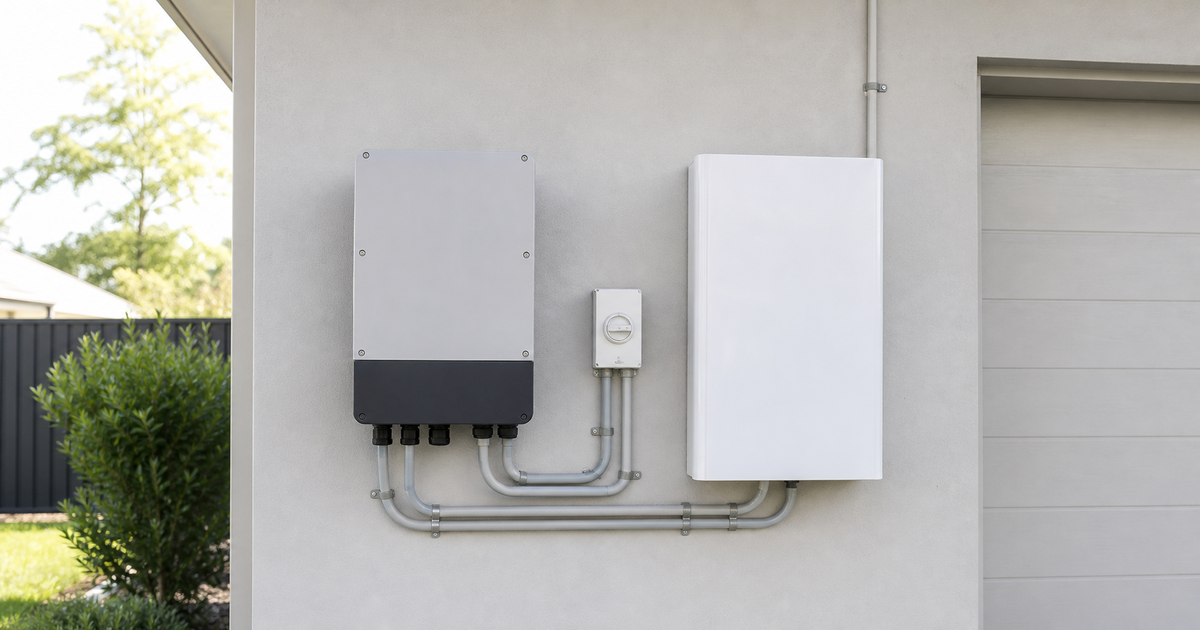
Before any inverter can legally connect to the grid in Australia — and before your solar or battery system qualifies for the STC rebate — the exact model has to appear on the Clean Energy Council’s approved inverter list. That list is the gate everything passes through. This guide covers where to find the official list, how to actually read it (the part that trips people up), what the 2026 standard update changed, and the piece almost every battery buyer misses: a compliant inverter is only half the paperwork. If you’re specifying storage, the difference between a system that sails through inspection with the full rebate and one that stalls comes down to a handful of checks — most of which the official list itself will never explain to you.
Quick answer: The official CEC approved inverter list is maintained by the Clean Energy Council and holds 1,800+ inverter and Power Conversion Equipment (PCE) models that meet AS/NZS 4777.2:2020 (Amendment 2:2024) and CSIP-AUS communication requirements. Search it free on the CEC website. For an install to earn the STC rebate, the inverter must be on that list and installed by a CEC-accredited installer. The half most buyers miss: if you’re adding a battery, the battery must separately appear on the CEC approved battery list — inverter approval does not cover it. And being on both lists is a compliance check only; whether the inverter and battery actually communicate (closed-loop over CAN/RS485) is a different question the CEC lists never answer.
Quick Reference: The CEC Approved Inverter List at a Glance
| Who maintains it | Clean Energy Council (CEC) |
| Where to find it | CEC website → Products Program → Approved inverters (free, searchable) |
| How many models | 1,800+ inverter and PCE models |
| Standard it enforces | AS/NZS 4777.2:2020, Amendment 2:2024 + CSIP-AUS |
| Why it matters | Grid connection legality + STC rebate eligibility |
| The second list to remember | CEC approved battery list (separate — required for storage) |
| Update frequency | Regularly; models are added and de-listed as standards change |
Figures per the Clean Energy Council approved products program, 2026.
01 The exact inverter model and version is on the current CEC inverter list — not just “the brand is approved.”
02 The battery is on the CEC approved battery list too — both are required for the rebate (the half buyers forget).
03 The inverter supports closed-loop communication with your battery’s BMS — CEC approval doesn’t guarantee this.
Where to Find the Official CEC Approved Inverter List
There is exactly one authoritative source, and it’s free: the Clean Energy Council’s approved inverters page. It’s a searchable database of every inverter and PCE model currently approved for grid-connected installation in Australia. Every third-party “best inverters 2026” article — and there are many — is ultimately a summary of this one list. Those are fine for shortlisting brands, but only the CEC database decides compliance.
Two official bodies are involved, and buyers routinely confuse them. Getting them straight saves a lot of wasted searching:
| Body | What it does | What you use it for |
|---|---|---|
| Clean Energy Council (CEC) | Maintains the approved product lists (inverters, batteries) | Checking whether a specific model is approved |
| Clean Energy Regulator (CER) | Administers the STC rebate scheme and REC Registry | How the rebate is claimed and validated |
The short version: the CEC decides what’s approved; the CER decides how the rebate works. A compliant, rebate-eligible install has to satisfy both — and the two lists (inverter and battery) both live under the CEC.
How to Actually Read the CEC List (the part nobody explains)
Here’s where most guides stop at “go check the list” and leave you to it. The list is a database, not a yes/no lookup, and there are four things on it that decide whether your specific unit is genuinely covered. Miss any one and you can walk away thinking you’re compliant when you’re not.
| What to check on the listing | Why it matters |
|---|---|
| Full model number, not the brand | A brand can have dozens of models; only specific ones are listed. “It’s a [major brand]” is not a compliance answer. |
| Inverter vs PCE category | The list covers grid-connect inverters and other Power Conversion Equipment (including battery-side units). The category must match what you’re installing. |
| Listing is current, not expired/withdrawn | Models roll off the list as standards change — sometimes in large batches when an amendment takes effect. |
| Standard version it meets | A model approved under the older 4777.2 doesn’t automatically carry to the 2024 amendment. Check it meets the current version. |
The practical habit: search the exact model number being quoted, confirm the listing is live, and confirm it meets the current standard. Do that against the CEC database directly — not a brochure, not a reseller’s PDF, not last year’s memory.
What the 2026 Standard Update Changed
The current benchmark is AS/NZS 4777.2:2020, Amendment 2:2024 — the grid-connection standard for inverters. Two practical effects matter to buyers.
First, older approvals don’t carry over automatically. Inverter models that met the pre-amendment standard have been rolling off the approved list, and every currently listed unit has to meet the updated requirements. An inverter that was genuinely “CEC approved” two years ago may not be today — which is exactly why the read-the-list checks above matter.
Second, the amendment brings in CSIP-AUS (the Common Smart Inverter Profile for Australia), the communication protocol that lets network operators manage exports — dynamic export limits, and in some cases remote curtailment. In plain terms: modern approved inverters are built to be talked to by the grid, not just to push power onto it.
The 4-Point Inverter Verification Checklist
“The brand is approved” is not the same as “this unit is approved.” Run any inverter you’re quoted through these four checks against the live CEC list before you sign anything. The final column is the honest part — where each check on its own still isn’t enough.
| # | Check | Why it matters | Not sufficient alone if… |
|---|---|---|---|
| 1 | Exact model match on the current list | Brands list many models; only specific ones are approved | …you matched the brand or series, not the full model number |
| 2 | Listing is current, not expired/withdrawn | Models roll off as standards update | …you’re reading a cached or third-party copy of the list |
| 3 | PCE vs inverter category fits your setup | The list spans inverters and other Power Conversion Equipment | …the unit is approved as a different equipment class than you need |
| 4 | Meets AS/NZS 4777.2:2020 Amd 2:2024 | The current standard version; older approvals don’t carry | …the approval predates the amendment and hasn’t been renewed |
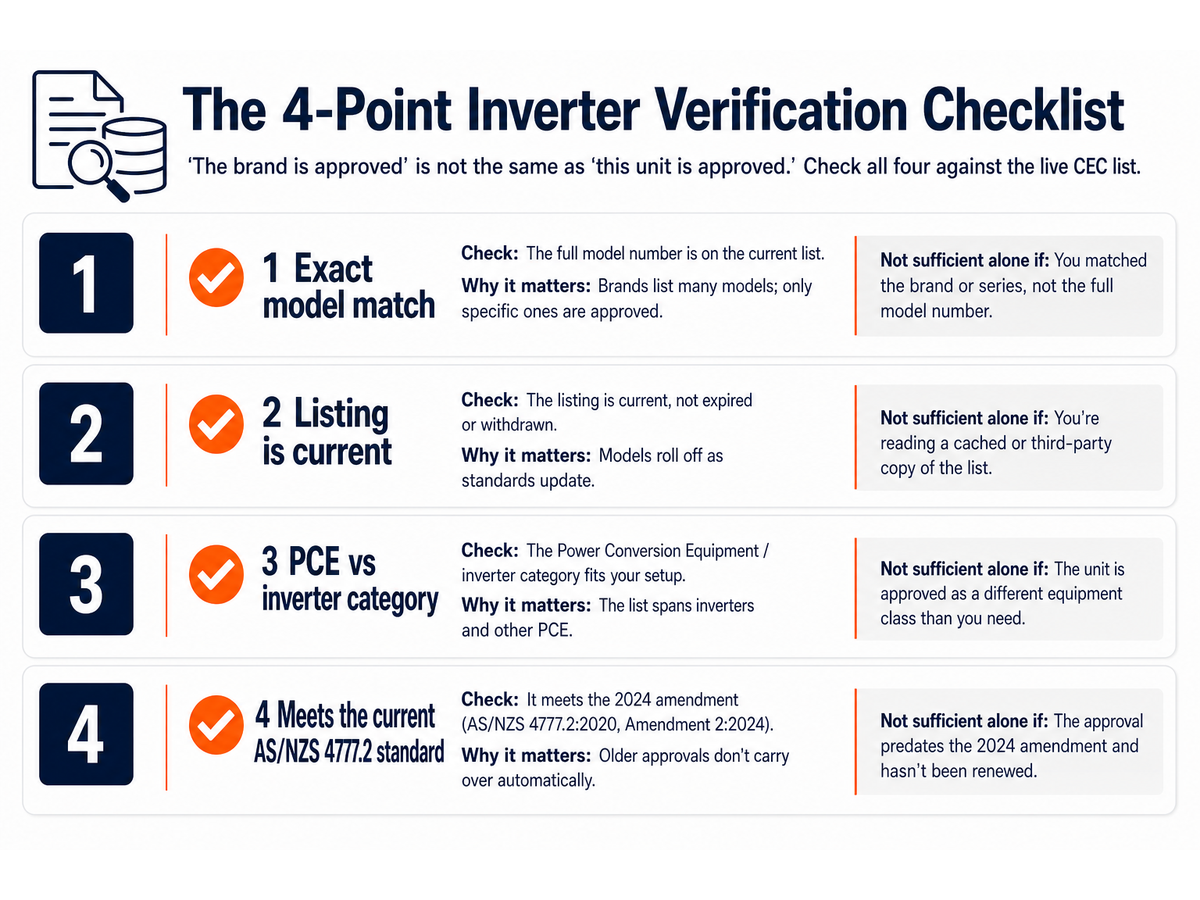
Your CEC-accredited installer should run this as a matter of course. But the buyer who checks it themselves is the one who doesn’t discover a problem at inspection — when it’s expensive to fix.
The CEC Two-List Rule (the half battery buyers miss)
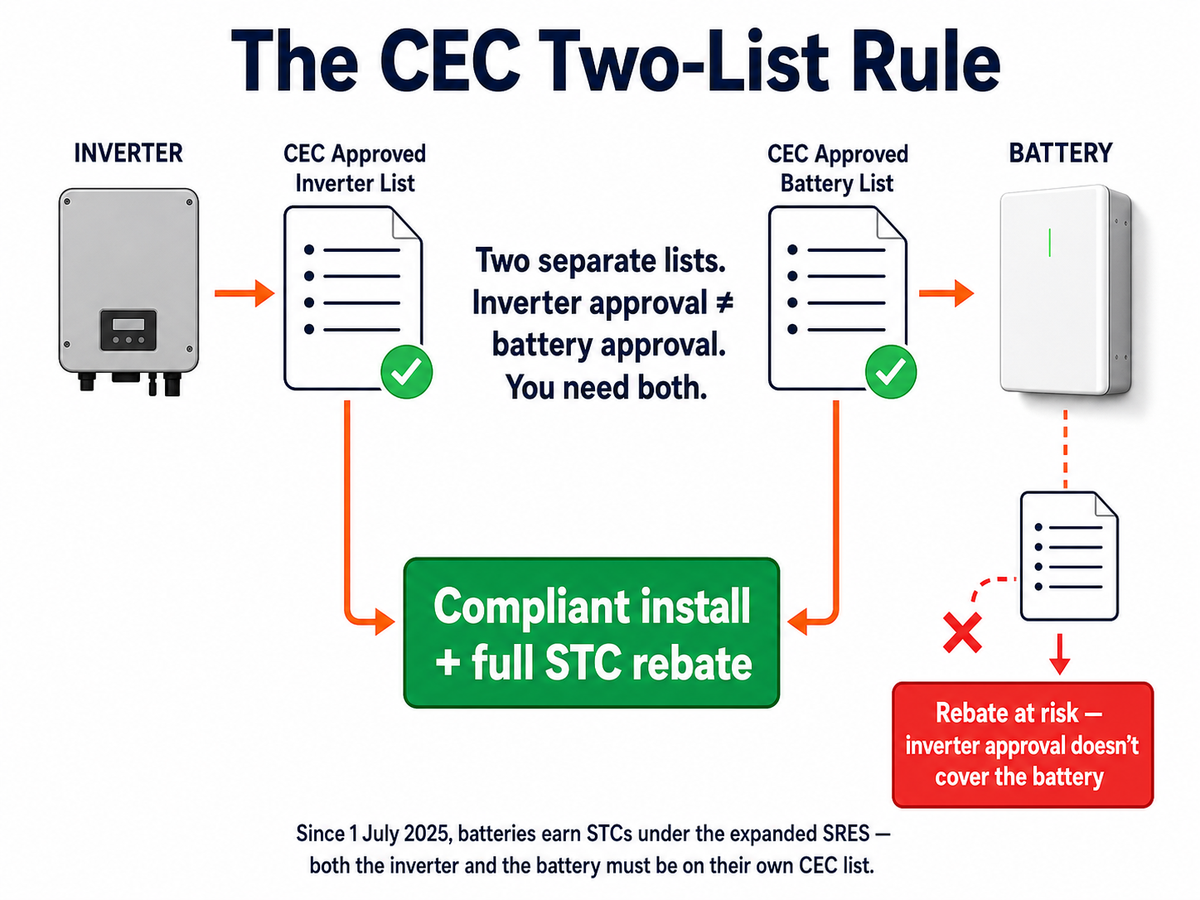
This is the single most common gap we see when Australian buyers plan a battery system. They confirm the inverter is on the CEC approved inverter list, tick the box, and assume the storage is covered. It isn’t — and the assumption can cost thousands in lost rebate.
The CEC maintains two separate product lists, and the battery has its own. For a solar-plus-storage install to qualify for the full incentive, both halves have to be approved independently:
| What you’re installing | Which CEC list it must be on | Miss it and… |
|---|---|---|
| Inverter / PCE | CEC approved inverter list | Can’t legally grid-connect; no rebate at all |
| Battery | CEC approved battery list (separate) | Battery portion may not qualify; rebate and eligibility at risk |
So the rule states simply and is easy to forget: a compliant battery system means being on both lists, not one. When you shortlist storage, verify the battery on the CEC approved battery list exactly the way you’d verify the inverter — exact model, current listing. The rebate paperwork, administered by the CER, checks both halves. If the rebate is the reason you’re going ahead, our solar battery rebate guide covers which batteries qualify and how the numbers work.
Compliance ≠ Communication
Here’s the distinction a compliance list will never tell you, and it’s the one that decides whether your system actually performs. A CEC-approved inverter and a CEC-listed battery can both be perfectly legal to install — and still not talk to each other properly.
CEC approval is about grid safety and standards conformance. It says nothing about whether the inverter and battery establish closed-loop communication over CAN or RS485, where the inverter reads the battery’s real state of charge, voltage, and cell temperature straight from its BMS. Without it, the system runs open-loop — the inverter estimating rather than reading — with softer protection and less accurate charge management. Both units can sit on their respective CEC lists and still be a poor pairing that underperforms for a decade.
This is why the compliance check and the pairing check are two separate jobs. Once both units are confirmed on their CEC lists, the next question is whether the battery’s BMS protocol is actually supported by that specific inverter — which is exactly what our inverter–battery pairing guide works through step by step.
Matching a Battery to Your Inverter: By Situation
Once the inverter is confirmed on the list, the battery decision routes by what that inverter is and how it’s set up. Find the row that matches your situation.
| Your inverter situation | What to confirm on the battery side | Watch out for |
|---|---|---|
| Hybrid inverter, adding a battery now | Battery on CEC battery list + BMS protocol supported by that inverter for closed-loop | “Compatible” on a datasheet ≠ tested closed-loop on your exact model |
| String inverter, AC-coupling a battery | Battery system with its own approved PCE; both on the relevant CEC lists | Extra conversion losses; confirm the battery’s own inverter/PCE is listed |
| Choosing inverter and battery together | Pick the pairing for confirmed closed-loop first, then confirm both on CEC lists | Buying on price alone and discovering they only run open-loop |
| Retrofitting to an older inverter | Whether the older inverter is still current on the list and supports a modern BMS | An inverter that’s rolled off the list, or has no closed-loop path |
If you’re weighing the architecture itself — low-voltage versus high-voltage battery, and how that interacts with the inverter — our LV vs HV home battery comparison covers that decision.
Popular CEC-Approved Inverter Brands (2026)
For shortlisting context only — always verify the specific model on the live list. Brands frequently seen on the current AS/NZS 4777.2 Amd 2:2024 list include Sungrow, GoodWe, Fronius, SMA, Sigenergy, and Deye, spanning single-phase residential, three-phase, and hybrid (battery-ready) categories. A hybrid inverter is the relevant category if you’re planning storage now or later — it’s built to manage a connected battery under the same 4777.2 framework.
What Happens If You Get It Wrong
The cost of a missed check isn’t theoretical, and it lands in three places:
- Grid connection refused. An inverter not on the current list — or one that’s rolled off — can’t be legally connected, forcing a swap before the system can be energised.
- STC rebate lost or clawed back. The rebate requires listed products installed by a CEC-accredited installer. A non-listed inverter or a non-listed battery can invalidate the paperwork that unlocks several thousand dollars of STC value — and the battery half is where buyers get caught.
- Warranty and insurance exposure. A non-compliant install can void product warranties and give an insurer grounds to dispute a claim if the system is involved in an incident.
Two minutes checking two lists, versus thousands in lost rebate and a system you may have to partly re-do — that’s the trade. It’s the highest-leverage habit a battery buyer can build before signing.
Three Scenarios
Picture a Sydney homeowner quoted a well-known hybrid inverter and a battery, told “both are CEC approved.” The inverter checks out. The battery model, though, isn’t on the CEC battery list — it’s a close variant of one that is. At rebate-claim time the paperwork fails on the battery line, and a $4,000-ish STC contribution evaporates over a model-number mismatch nobody verified. Two minutes on the battery list would have caught it.
Take an installer in regional Victoria retrofitting a battery to a four-year-old string inverter. The inverter was approved when installed, but has since rolled off the current list after the 2024 amendment. Confirming the current listing before quoting — rather than assuming past approval holds — is what separates a clean job from a call-back and an inverter swap.
Consider a buyer choosing on price who lands a CEC-listed inverter and a CEC-listed battery from different brands, both genuinely compliant. Six months in, the app data is patchy and the battery never charges past 90% — because the two only ever established open-loop communication. Both were on their lists; neither confirmed the closed-loop BMS handshake. Compliance was never the problem. Communication was.
Common CEC Inverter-List Mistakes
1. Checking the brand, not the exact model
✗ Wrong: “It’s a [major brand], they’re all approved.”
✓ Right: match the full model number and version to the current CEC list.
2. Trusting a third-party “2026 list” as the source of truth
✗ Wrong: rely on a blog’s or reseller’s summary.
✓ Right: shortlist from articles, but confirm on the CEC database — the only list that counts.
3. Forgetting the battery needs its own approval
✗ Wrong: approve the inverter and assume storage is covered.
✓ Right: confirm the battery on the separate CEC approved battery list — the Two-List Rule.
4. Assuming CEC approval means the units will communicate
✗ Wrong: “both are CEC-listed, so they’ll work together.”
✓ Right: confirm closed-loop BMS compatibility separately — compliance ≠ communication.
5. Trusting a past approval that’s since expired
✗ Wrong: “it was approved when we bought it.”
✓ Right: confirm the listing is current under the 2024 amendment before install.
2026 Outlook: What’s Changing for Australian Buyers
Two trends are worth planning around. First, the CSIP-AUS communication requirements under the 2024 amendment mean the grid’s ability to manage your inverter (dynamic export limits) is now standard, not optional — so a “battery-ready” hybrid inverter is increasingly the sensible default even if you’re not adding storage on day one. Second, with the federal battery rebate driving a wave of storage retrofits, the Two-List Rule is catching more buyers than ever: inverters approved years ago being paired with batteries whose approval nobody separately checked. Expect both lists to keep churning as standards tighten — which makes checking the current list, every time, the durable habit.
Frequently Asked Questions
Where is the official CEC approved inverter list?
On the Clean Energy Council website under the products program — a free, searchable database of every inverter and PCE model currently approved for grid connection in Australia. Third-party “top inverter” articles summarise it, but the CEC database is the only authoritative source.
How do I know if my inverter is CEC approved?
Search the exact model number (not just the brand) on the current CEC inverter list, confirm the listing is current, and confirm it meets AS/NZS 4777.2:2020 Amendment 2:2024. If the exact model and version aren’t there, it isn’t approved — regardless of whether the brand’s other models are.
Does the battery also need to be CEC approved?
Yes — and this is the step most buyers miss. The CEC keeps a separate approved battery list. For a solar-plus-storage install to qualify for the full incentive, the inverter must be on the inverter list and the battery on the battery list. Being on one does not cover the other.
What changed with AS/NZS 4777.2:2020 Amendment 2:2024?
It’s the updated grid-connection standard all currently approved inverters must meet, including CSIP-AUS communication requirements for export management. Older approvals don’t carry over automatically, so always check the current list against the exact model being quoted.
Does a CEC-approved inverter guarantee it works with my battery?
No. CEC approval covers grid safety and standards conformance, not whether the inverter and battery establish closed-loop communication. Two units can both be CEC-listed and still pair poorly. Confirm BMS protocol compatibility separately from the compliance check.
What’s the difference between the CEC and the Clean Energy Regulator?
The Clean Energy Council maintains the approved product lists (what’s compliant). The Clean Energy Regulator administers the STC rebate scheme (how the incentive is claimed). A compliant, rebate-eligible install has to satisfy both.
How often is the CEC inverter list updated?
Regularly — models are added as they’re approved and removed as they expire or fail to meet updated standards, sometimes in large batches when an amendment takes effect. That’s why a past approval isn’t a guarantee; always confirm the current listing.
About This Guide
Savolture offers 51.2 V LFP battery systems for the Australian market — wall-mounted and stackable models from 5.12 to 16.08 kWh, with CAN 2.0B (500 kbps) and RS485 Modbus RTU closed-loop communication to CEC-approved hybrid inverters, 6,500–8,500 cycles at 80% DoD, and models built to AS/NZS 5139, IEC 62619 and UN 38.3. Listing is held per model, so confirm the exact model on the current CEC register before you quote a rebate. We wrote this from the battery side because the question we field most from AU buyers isn’t “which inverter” — it’s “I’ve got a compliant inverter, now what makes the battery side compliant too?” The inverter details here point to the official CEC list because that’s the authoritative source; our lane is making sure the battery half of the system is on its own list, matched, and actually communicating. Always verify both products on the current CEC lists with a CEC-accredited installer before you commit.
| Talk to Savolture | |
|---|---|
| Planning an AU battery install? | 01 your inverter make and model · 02 single or three phase · 03 target storage (kWh) — we’ll confirm a CEC-listed, closed-loop-compatible battery to match. |
| Standards | LFP systems built to AS/NZS 5139 & UL standards — verify each model on the CEC battery list |
| Communication | Closed-loop (CAN/RS485) BMS support for leading hybrid inverter brands |
| Contact | HQ Shenzhen, Nanshan · LinkedIn |
Related AU Compliance Guides
- Battery placement rules: AS/NZS 5139 battery installation — where it can legally go
- Charging reference: 48V LiFePO4 battery voltage chart
Bottom line: the CEC approved inverter list is the gate every grid-connected inverter in Australia has to pass — but if you’re building a battery system, it’s only the first of two gates. Read the list properly (exact model, current listing, 2024 standard), remember the battery has its own list to be on, and confirm the two actually communicate before you commit. Passing both lists gets you the rebate; matched communication gets you a system that performs for a decade.
- Clean Energy Council — Approved inverters (the official searchable list). cleanenergycouncil.org.au
- Clean Energy Council — Inverters meeting the updated standard (AS/NZS 4777.2 Amd 2:2024). cleanenergycouncil.org.au
- Clean Energy Regulator — administers the STC scheme and REC Registry. cer.gov.au
- AS/NZS 4777.2:2020 (Amendment 2:2024) — grid-connection standard for inverters. store.standards.org.au
- Clean Energy Council — Approved batteries (the second list, for storage). cleanenergycouncil.org.au
Ready to size your system?
Get a free battery recommendation.
Tell us your load, location, and backup target — we will spec the right 48V LiFePO4 system for you.