

Savolture Technical Guide
AS/NZS 5139 Battery Installation: Location Rules Explained (2026)
If you're buying a home battery in Australia, the question that decides whether your install passes inspection isn't which battery you buy — it's where you're allowed to put it....
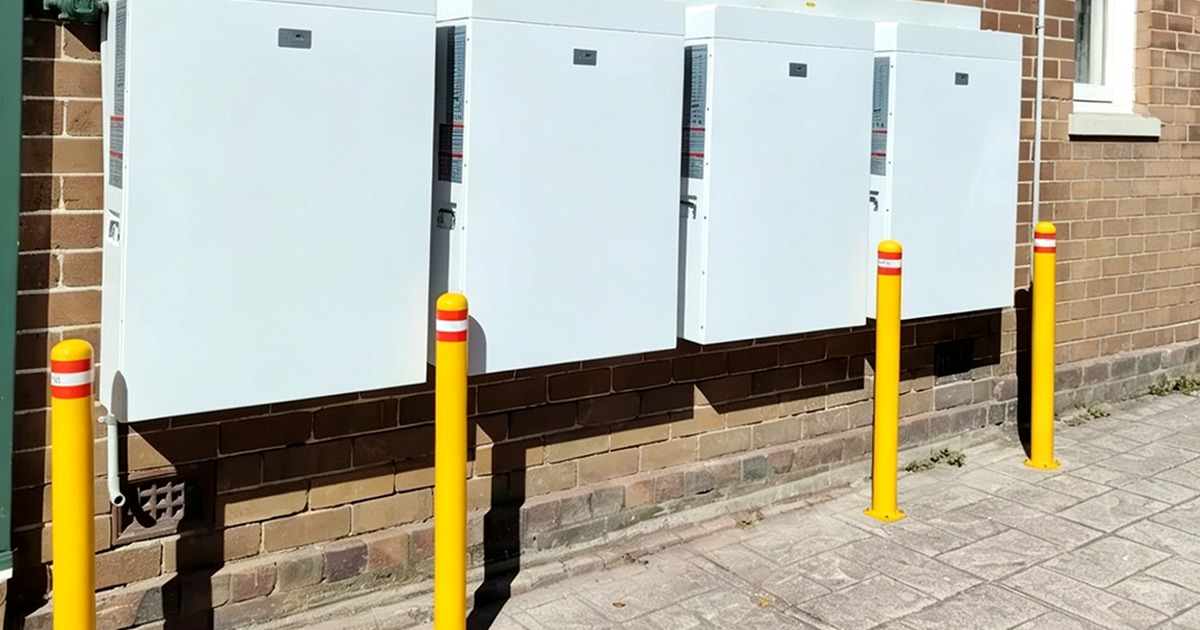
If you’re buying a home battery in Australia, the question that decides whether your install passes inspection isn’t which battery you buy — it’s where you’re allowed to put it. That answer comes from AS/NZS 5139:2019, the standard that governs battery energy storage system (BESS) installation. Get the location wrong and you don’t just fail a certificate of electrical safety; you can lose your federal STC rebate and give your insurer a reason to walk away from a claim. This guide breaks the standard down into the three rules that actually decide placement, a decision tree for your specific home, and the one product-side factor — your battery’s IP rating — that quietly determines how many compliant spots you even have.
Quick answer: AS/NZS 5139:2019 does not ban home batteries from your property — it bans them from restricted locations. A lithium battery generally cannot be installed inside or on a wall of a habitable room (bedroom, living room, kitchen, dining room, study), within 600mm of a window, doorway, building exit, or appliance, or in ceiling spaces, wall cavities, or under stairways and escape routes. Where a battery sits on a combustible wall shared with a habitable room, a non-combustible barrier must extend 600mm to each side and 900mm above the unit. Garages, external walls, and dedicated outdoor enclosures are usually the compliant choices — and an outdoor-rated (IP65) battery gives you the most placement flexibility.
- Is the proposed wall shared with — or within 600mm of a window/door into — a habitable room? If yes, it needs a fire barrier or a different spot.
- Is the battery outdoor-rated (IP65) or indoor-only? This decides whether the carport/side yard is even an option.
- Did your installer put the AS/NZS 5139 location class in writing in your file? No documentation = a compliance risk at inspection.
What AS/NZS 5139 Actually Governs (and What It Doesn’t)
AS/NZS 5139:2019 — “Electrical installations — Safety of battery systems for use with power conversion equipment” — is the Australian/New Zealand standard that sets the safety and installation requirements for a residential or small-commercial battery energy storage system (BESS). It governs the installation: where the battery can go, what clearances and zones apply, ventilation, and the fire-separation measures that protect the rest of the building from a thermal runaway event.
It is one layer of a three-standard stack, and installers routinely conflate them. Knowing which does what tells you which question to ask:
| Standard | What it governs | The question it answers |
|---|---|---|
| AS/NZS 5139:2019 | Battery installation — location class, clearances, fire separation, ventilation | “Where can this battery legally go?” |
| AS/NZS 4777.2:2020 | Inverter grid connection — anti-islanding, power quality, DRM | “Is the inverter compliant to connect to the grid?” |
| AS/NZS 3000 (Wiring Rules) | General electrical installation — applies on top of both | “Is the wiring itself safe and legal?” |
A battery that is on the Clean Energy Council approved list satisfies the product requirement — but that listing says nothing about your installation. AS/NZS 5139 is where a CEC-listed battery can still end up in a non-compliant spot. The two are separate gates, and both have to pass. If you haven’t confirmed your exact model is CEC-listed yet, do that first with our CEC approved battery list guide, then come back to placement.
The 3 Restricted-Zone Rules (memorise these)
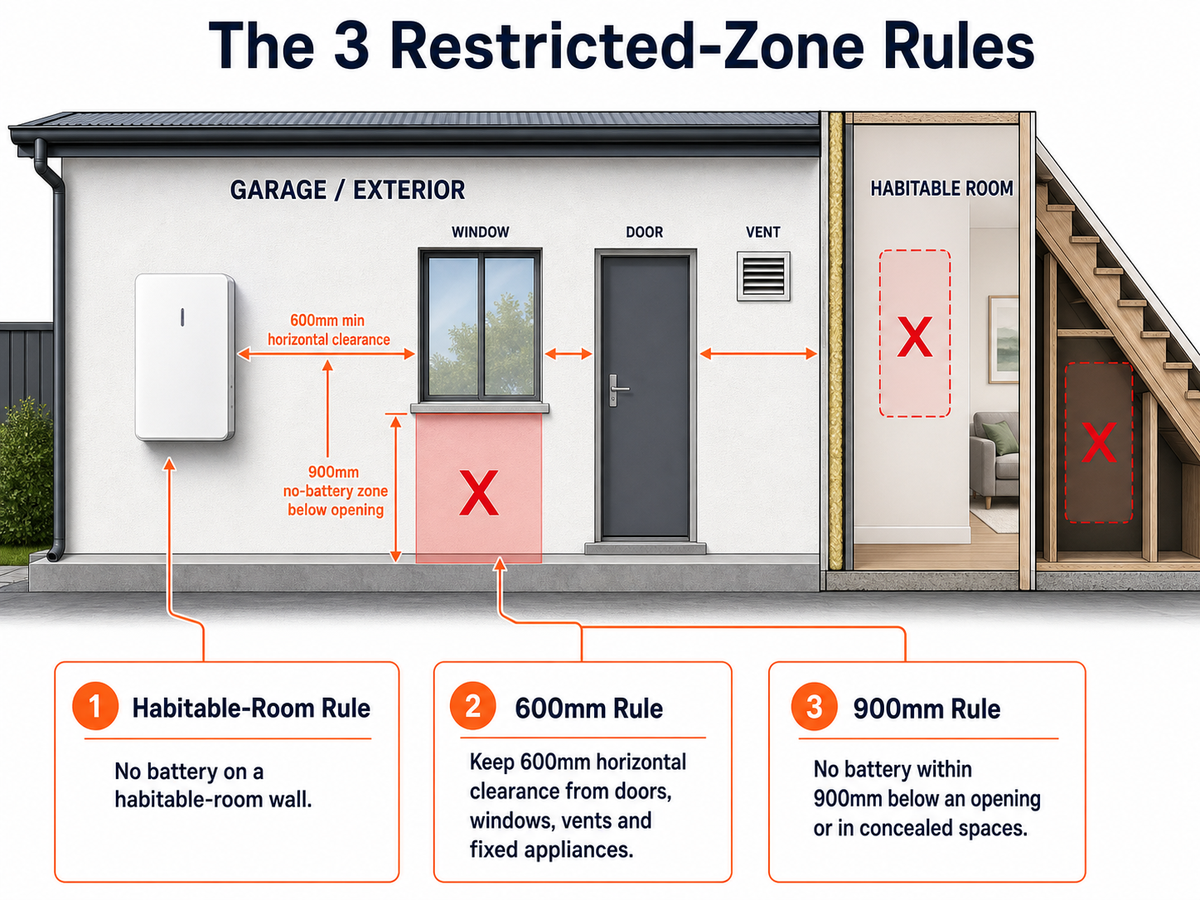
Almost every 5139 placement failure comes down to breaking one of three rules. If your proposed location clears all three, you’re usually in compliant territory.
Rule 1 — The Habitable-Room Rule
A lithium battery cannot be installed inside a habitable room, or mounted on the room-side of a wall that encloses one, without additional fire separation. Under the standard, a habitable room means a room used for normal domestic activities: bedrooms, living rooms, lounge/family rooms, kitchens, dining rooms, and studies. Non-habitable spaces — garages, laundries, dedicated plant/utility rooms, and the external face of a building — are where batteries are meant to live.
The reason is blunt: if a cell goes into thermal runaway, the standard’s job is to keep the vented gas and heat out of the rooms where people sleep and gather. That is also why a garage or an external wall is the default recommendation, not an afterthought.
Rule 2 — The 600mm Rule
The battery must sit at least 600mm away, horizontally, from any window, doorway, building exit/entry, ventilation opening into a habitable room, or fixed appliance. This clearance stops a battery incident from blocking an escape path or venting straight into an opening that feeds a living space. It is the single most-missed measurement in the field, because a wall that looks fine often has a window edge or a wall vent sitting just inside the 600mm zone.
Rule 3 — The 900mm / Enclosed-Space Rule
The battery cannot be installed where it would sit within 900mm below any of the openings above, and it cannot go in enclosed or concealed spaces — ceiling voids, wall cavities, roof spaces, under stairways, or beneath access walkways and escape routes. These are spaces where heat and gas concentrate and where a fault is hard to detect and fight. “It fits in the cavity” is never a compliance argument.
The Fire Separation Rule — With the Numbers Competitors Leave Out
This is where most guides go vague, so here are the actual dimensions. If a battery has to be mounted on a wall that is combustible (timber-framed weatherboard, some cladding systems) and that wall is shared with a habitable room, AS/NZS 5139 requires a non-combustible barrier — typically fibre-cement sheeting — between the battery and the wall.
That barrier is not just a patch behind the unit. It must extend:
| Direction | Minimum barrier extension beyond the battery |
|---|---|
| Each side (left & right) | 600mm |
| Above the unit | 900mm |
| Material | Non-combustible (e.g. fibre-cement / cement sheeting) |
The practical takeaway: fire separation is a real cost and labour item — sheeting, fixing, and sometimes a rethink of the whole location. It’s almost always cheaper and cleaner to pick a compliant non-combustible wall or an outdoor position in the first place than to retrofit a barrier onto the one spot the homeowner originally wanted.
The Location Classification Decision Tree
Rather than memorising the standard, work your specific home through this. Find the row that matches your proposed spot and read across to what 5139 requires.
| Proposed location | Compliant? | What AS/NZS 5139 requires | Still confirm (where this isn’t the whole answer) |
|---|---|---|---|
| Detached garage / dedicated plant room | ✅ Usually best | Non-habitable space; observe 600mm clearances to doors/vents; ventilation per battery datasheet | A garage storing fuel or with a workbench may need extra separation — “garage” isn’t automatically compliant |
| External wall, non-combustible (brick/render), shaded | ✅ Good | Outdoor-rated battery; 600mm from windows/vents; weather + heat protection | Direct afternoon sun still needs shading; confirm the battery’s IP rating suits full outdoor exposure |
| External wall, combustible (weatherboard), backing a habitable room | ⚠️ Conditional | Outdoor-rated battery plus non-combustible barrier: 600mm sides, 900mm above | Barrier extent can vary with the battery’s datasheet — confirm exact dimensions for your model |
| Internal wall shared with a bedroom/living room | 🔴 Restricted | Generally not permitted without relocation or full fire separation — treat as a no | Even with full fire separation, many building surveyors won’t pass it — ask your local authority before designing around it |
| Under stairs / in a cavity / ceiling or roof space | 🔴 Prohibited | Enclosed/concealed space — not permitted, full stop | No exception path — don’t look for a workaround here |
| Attached garage in a bushfire-prone area (BAL zone) | ⚠️ Check | 5139 clearances plus local bushfire/BAL construction overlays may add requirements | Higher BAL ratings add stricter rules; confirm your specific BAL rating, not just “bushfire area” |
The IP-Rating Placement Multiplier (the product-side factor)
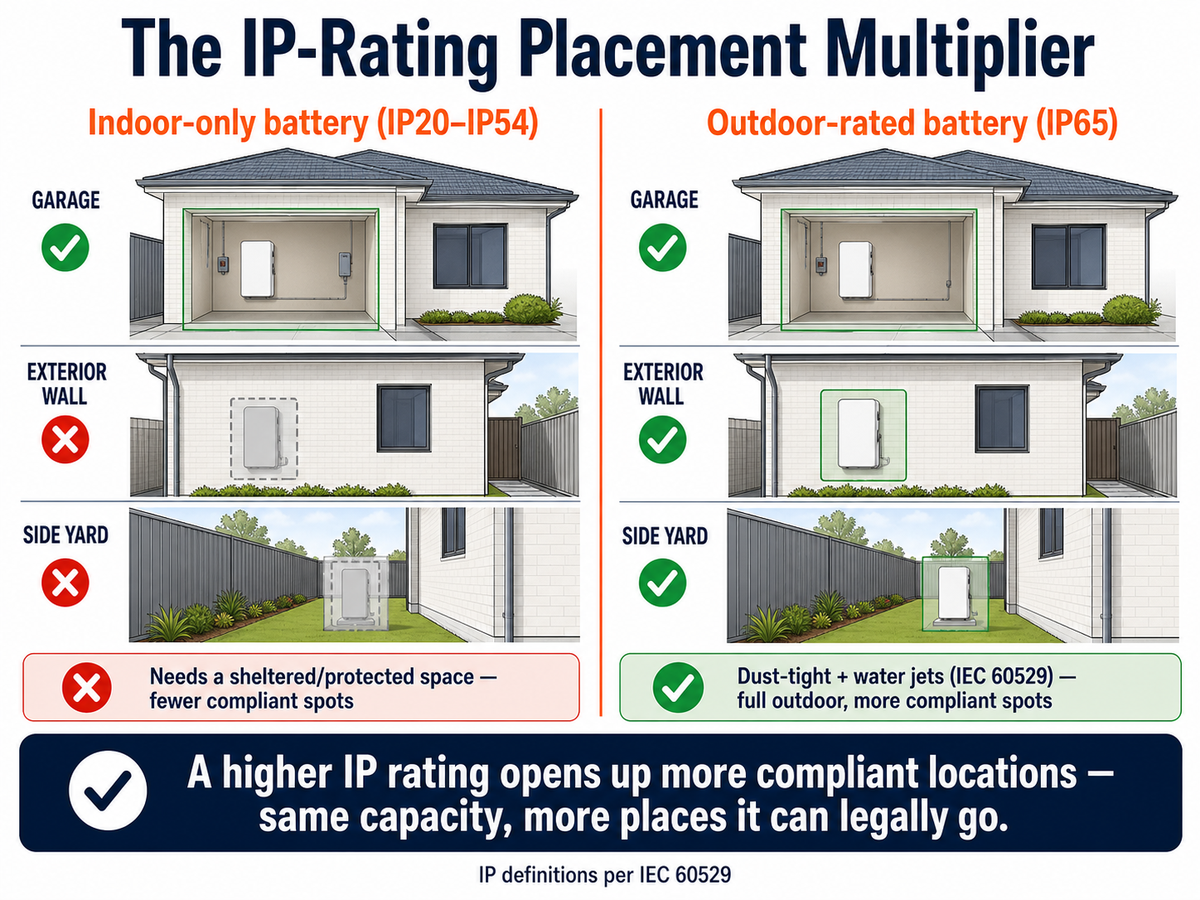
Here is the angle installers rarely frame for buyers, and it’s the one that most changes your options: your battery’s ingress protection (IP) rating decides how many of the compliant locations above are actually open to you.
An indoor-only battery (roughly IP20–IP54) has to live in a protected space — which in a home with no suitable garage or plant room can leave you fighting over the one internal wall that isn’t restricted, and often losing. An outdoor-rated battery (IP65), by contrast, can be mounted on an external wall or in a side-yard enclosure, which is usually the easiest way to clear all three restricted-zone rules at once — you simply step outside the habitable-room problem entirely.
So the IP rating isn’t a spec-sheet footnote; it’s a placement multiplier. Two batteries with identical capacity can leave you with wildly different compliant-location counts. When you’re shortlisting, an IP65 LFP unit built to AS/NZS 5139 standards buys you flexibility that a cheaper indoor-only unit takes away — the outdoor-rated 48V LFP battery line is built with this in mind.
What Happens If the Battery Is Installed Non-Compliantly
The cost of getting placement wrong is not theoretical, and it lands in three places:
- Certificate of electrical safety / inspection fails. A licensed inspector who finds a battery in a restricted location can refuse to sign off, forcing relocation before the system can be energised.
- STC rebate at risk. Federal battery incentives under the Cheaper Home Batteries Program require a compliant install by a CEC-accredited installer. A non-compliant location can jeopardise the paperwork that unlocks several thousand dollars of STC value.
- Insurance exposure. If a non-compliant battery is involved in an incident, an insurer has grounds to dispute the claim — turning a placement shortcut into full property exposure.
A 60-second location check against three rules, versus tens of thousands of dollars of downside — that is the highest-leverage habit a homeowner or installer can build before signing anything.
Real Placement Scenarios
Picture a Melbourne homeowner who wants the battery in the garage — ideal on paper. On the wall they’ve chosen, the internal roller-door frame vents sit 450mm to one side and a personnel-access door is 500mm to the other. Both breach the 600mm rule. The fix isn’t a different battery; it’s shifting the mount 200mm along the same wall to clear both openings. Two minutes of measuring at quote stage saves a callback.
Take a Brisbane weatherboard home with no garage. The only practical wall backs a bedroom and is combustible. An indoor-only battery here is effectively a dead end. Switching to an outdoor-rated IP65 unit on the shaded southern external wall — a non-habitable, non-combustible-clad face — clears all three rules without a fire barrier at all. The product choice solved the compliance problem.
Consider a regional NSW property in a bushfire (BAL) zone. The attached garage clears 5139’s clearances cleanly, but the local Building Code of Australia bushfire overlay adds construction requirements the standard alone doesn’t cover. Here the lesson is the opposite of “5139 is the whole answer” — clearing the battery standard is necessary but not sufficient; the local overlay is a second gate.
Most Common AS/NZS 5139 Placement Mistakes
Across the Australian installers and EPCs we supply, the same placement slip-ups surface again and again — and the majority happen at quoting, not on the tools.
1. Assuming “garage = automatically fine”
✗ Wrong: mount on the nearest garage wall.
✓ Right: measure 600mm from every door, window, wall vent, and appliance on that wall first.
2. Treating “CEC-listed” as covering the install
✗ Wrong: “the battery’s approved, so the install is fine.”
✓ Right: CEC listing is the product gate; AS/NZS 5139 is the separate install gate. Both must pass.
3. Specifying an indoor-only battery for a home with no compliant indoor wall
✗ Wrong: pick on price, then discover there’s nowhere legal to put it.
✓ Right: confirm the IP rating suits an available compliant location before choosing the model.
4. Skipping the fire barrier on a combustible habitable-room wall
✗ Wrong: mount straight onto weatherboard backing a bedroom.
✓ Right: non-combustible barrier extending 600mm sides / 900mm above — or relocate.
5. Not documenting the location class in the customer file
✗ Wrong: install and move on.
✓ Right: record the AS/NZS 5139 location-class assessment in writing — inspectors and rebate audits will ask for it.
Frequently Asked Questions
Can you install a home battery in a garage in Australia?
Yes — a garage is a non-habitable space and is usually the preferred location under AS/NZS 5139. The catch is clearances: the battery must sit at least 600mm horizontally from any door, window, ventilation opening, or appliance on that wall, and cannot be in an enclosed cavity. Measure the specific wall before committing.
Can a battery be installed on a bedroom or living room wall?
Generally no. AS/NZS 5139 treats bedrooms, living rooms, kitchens, dining rooms and studies as habitable rooms, and a lithium battery cannot be mounted on the room-side of a wall enclosing one without full fire separation. Where a combustible external wall backs a habitable room, a non-combustible barrier extending 600mm to the sides and 900mm above is required — most installers relocate instead.
What is a habitable room under AS/NZS 5139?
A room used for normal domestic living — bedrooms, living/lounge rooms, kitchens, dining rooms and studies. Garages, laundries, dedicated plant rooms and the external face of the building are non-habitable and are where batteries are meant to be installed.
Does battery location affect my rebate?
It can. Federal STC incentives require a compliant installation by a CEC-accredited installer. A battery in a restricted location can fail inspection and jeopardise the paperwork that unlocks the rebate — so a non-compliant spot risks both safety sign-off and several thousand dollars of incentive.
Does AS/NZS 5139 require an outdoor battery?
No — it requires the battery to be out of restricted locations, which can be achieved indoors in a compliant non-habitable space like a garage. But an outdoor-rated (IP65) battery gives you the most compliant options, because it can go on an external wall or in a side-yard enclosure and side-step the habitable-room problem entirely.
Is AS/NZS 5139 the only standard that applies to my battery install?
No. AS/NZS 5139 governs the battery installation, AS/NZS 4777.2 governs the inverter’s grid connection, and AS/NZS 3000 (the Wiring Rules) applies on top of both. In bushfire (BAL) zones, local Building Code of Australia overlays can add further requirements. Your installer should be able to point to compliance with each that applies.
About This Guide
Savolture supplies LFP home and small-commercial battery systems built to AS/NZS 5139 and UL standards, with configurations aimed at the Australian market. We wrote this guide because the question we field most often from AU installers and homeowners isn’t “which battery” — it’s “where can it legally go,” and the answer changes which battery makes sense. The placement rules here are drawn from AS/NZS 5139:2019 and Clean Energy Council guidance; always confirm your specific site with a CEC-accredited installer, since local overlays and site conditions vary.
| Talk to Savolture | |
|---|---|
| Planning an AU install? | 01 your install spot (garage / external wall / bushfire zone) · 02 combustible or non-combustible wall · 03 indoor or outdoor-rated preference — we’ll confirm a CEC-listed, AS/NZS 5139-suitable configuration before you quote. |
| IP rating | Outdoor-rated (IP65) LFP options for maximum placement flexibility |
| Standards | Built to AS/NZS 5139 & UL — verify each model on the CEC list before quoting |
| Contact | HQ Shenzhen, Nanshan · LinkedIn |
Related AU Battery Guides
- Sizing your system: Is a 14kWh battery big enough for an Australian home?
- The rebate: Solar battery rebate Australia 2026 — which batteries qualify
- Matching the inverter (AS/NZS 4777.2): Inverter–battery pairing guide
Bottom line: AS/NZS 5139 doesn’t stop you putting a battery on your property — it stops you putting it somewhere dangerous. Clear the three restricted-zone rules, respect the fire-separation numbers on any combustible habitable-room wall, and let your battery’s IP rating open up the compliant locations rather than fight for the one indoor wall that isn’t restricted. Get placement right on paper first, and the inspection, the rebate, and the insurer all take care of themselves.
- AS/NZS 5139:2019 — Electrical installations, Safety of battery systems for use with power conversion equipment — the governing standard. store.standards.org.au
- Electrical Regulatory Authorities Council (ERAC) — Battery Energy Storage System, the regulators’ guidance detailing restricted locations and the 600mm / 900mm clearance requirements. erac.gov.au (PDF)
- Clean Energy Council — Approved battery products & installation guidance. cleanenergycouncil.org.au
- Australian Building Codes Board (ABCB) — Building Code of Australia, relevant to bushfire (BAL) and construction overlays. abcb.gov.au
Ready to size your system?
Get a free battery recommendation.
Tell us your load, location, and backup target — we will spec the right 48V LiFePO4 system for you.