

Savolture Technical Guide
CEC Approved Battery List Australia 2026: How Installers Verify Compliance
Whether you are a homeowner checking if the battery in your quote qualifies for the rebate, or an accredited installer protecting your CEC accreditation, the "CEC approved batte...
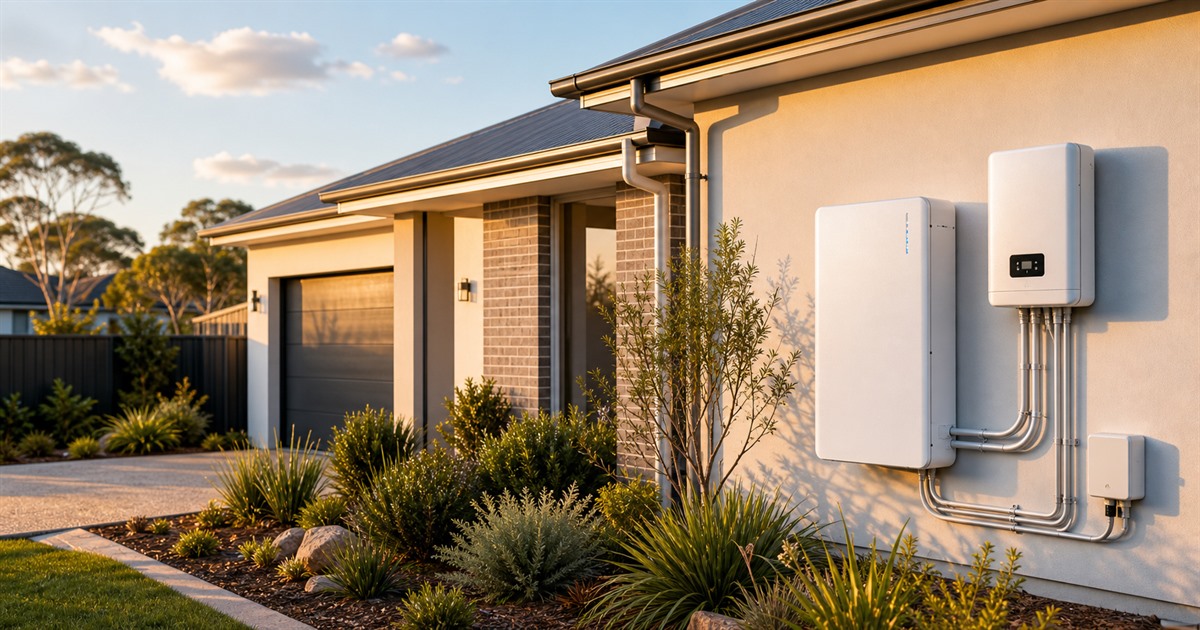
Whether you are a homeowner checking if the battery in your quote qualifies for the rebate, or an accredited installer protecting your CEC accreditation, the “CEC approved battery list” is the document that decides whether thousands of dollars of federal incentive are on the table. The list itself is public and free — but most people either can’t find the right file, or assume “listed” means “ready to install.” Neither is true. This guide shows you what is actually on the list, how to find and download it, how to verify a model in under 60 seconds, and the AS/NZS compliance layers that pair with it before any battery touches a wall.
- Get the exact model number (SKU) from your quote — not the marketing name.
- Search that model on the CEC battery list. One exact match = approved.
- Confirm your installer is CEC-accredited and the system is 5–28 kWh (the rebate band). No match on any of these = no rebate.
What the CEC Approved Battery List Actually Is
The Clean Energy Council’s Approved Battery Products list is the single national register that determines which residential and small-commercial batteries qualify for federal incentives in Australia. Under the 2026 Cheaper Home Batteries Program (delivered through the Small-scale Renewable Energy Scheme and administered by the Clean Energy Regulator), only batteries on this register can generate Small-scale Technology Certificates (STCs) when paired with an eligible PV system.
The list is updated approximately every two weeks. A model gets listed only after the supplier submits independent test reports demonstrating compliance with the IEC 62619 safety standard and the CEC’s own Best Practice Guide. Listing applies to specific model numbers — a 10 kWh and a 14 kWh variant of the same product line are two separate listings, and a firmware or enclosure revision can trigger a re-listing requirement. Choosing between a 10 kWh and 14 kWh variant? See whether a 14kWh battery is big enough for an Australian home, and for the wider buying decision our 100Ah vs 200Ah lithium battery guide.
What’s Actually on the CEC List in 2026
This is the part most guides skip. The register currently holds over 1,000 lithium-based battery products, and knowing how it is organised is what turns a confusing PDF into a 60-second check. Each entry carries the same core data fields:
| Field on the list | What it tells you | Why it matters |
|---|---|---|
| Manufacturer / Brand | The company that submitted the product | Filter here first to narrow 1,000+ rows |
| Model number | The exact SKU approved | Must match your quote character-for-character |
| Nominal capacity (kWh) | Rated / nameplate energy | Used for the rebate band (5–28 kWh) |
| Usable capacity (kWh) | Energy you actually cycle | The honest sizing number — see usable vs nominal below |
| Approved date / Expiry date | When listing started and lapses | An expired or de-listed model earns no STCs |
A few practical realities of the 2026 list:
- LFP (LiFePO4) dominates. The overwhelming majority of newly listed residential models are lithium iron phosphate, reflecting its thermal-stability and AS/NZS 5139 advantages over NMC for indoor/wall installs.
- It is organised by manufacturer, then model. Filtering by brand is far faster than scrolling — if you know the supplier, you can confirm a SKU in seconds.
- Capacity variants are listed separately. A modular platform that stacks 5 kWh units will show each configuration as its own entry, so match the configured size on your quote.
- “Listed” is a moving target. Roughly fortnightly updates mean a model approved last quarter can be superseded; always check the live entry, not a saved screenshot from months ago.
Where to Find and Download the List
There are two official sources, and it is worth knowing both:
| Source | Format | Best for |
|---|---|---|
| Clean Energy Council — Approved batteries | Searchable web database + filters | Quick brand/model lookup, current status |
| Clean Energy Regulator — CEC approved batteries | Downloadable Excel (.xls) | Offline search, sorting by capacity, audit trail |
Ignore search results pointing to the California Energy Commission battery list — that is a US register and has no bearing on Australian rebate eligibility. For Australia, the CEC and CER pages above are the only binding sources.
The 2026 Rebate Reality: a Declining STC Factor
Being on the list unlocks the rebate — but the rebate’s value is now falling on a fixed schedule, which changes the “should I install now” maths. Under the Cheaper Home Batteries Program (running to 2030), the STC factor that sets the discount declines every six months:
| Period (2026) | STC factor (per usable kWh) | Effect |
|---|---|---|
| January – April | ~8.4 | Highest 2026 rebate |
| May – December | ~6.8 | ~19% lower than Jan–April |
Eligibility is capped to a 5–28 kWh band: systems under 5 kWh receive no rebate, the per-kWh amount tapers after 14 kWh, and drops sharply above 28 kWh. As of mid-2026 the factor is the lower 6.8 rate, and it steps down again at the next six-month boundary. Confirm the current factor with the Clean Energy Regulator before quoting, because the exact dollar figure moves with both the factor and the STC spot price. For the full installed-cost picture, see our solar battery storage cost guide.
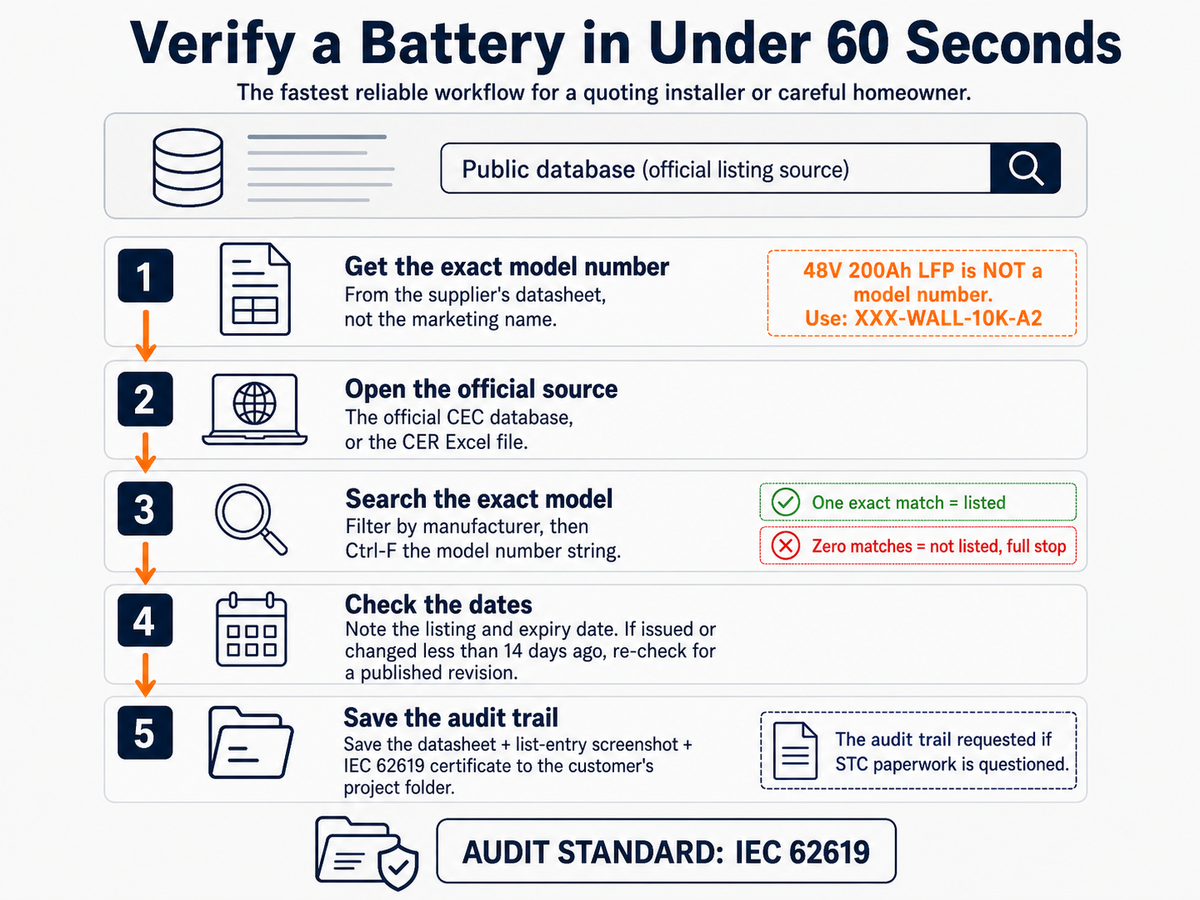
How to Verify a Battery in Under 60 Seconds
The fastest reliable workflow for a quoting installer or a careful homeowner:
- Get the exact model number from the supplier’s datasheet — not the marketing name. “48V 200Ah LFP” is not a model number; something like “SVL-WALL-10K-A2” is.
- Open the official CEC database or the CER Excel file.
- Filter by manufacturer, then Ctrl-F the model number string. One exact match = listed. Zero matches = not listed, full stop.
- Note the listing and expiry date. If the listing was issued or changed less than 14 days ago, re-check in case a revision has been published.
- Save the datasheet, a screenshot of the list entry, and the IEC 62619 certificate to the customer’s project folder — the audit trail the Clean Energy Regulator will request if STC paperwork is questioned.
CEC Listed vs AS/NZS 5139 vs AS/NZS 4777.2 — the Three-Layer Check
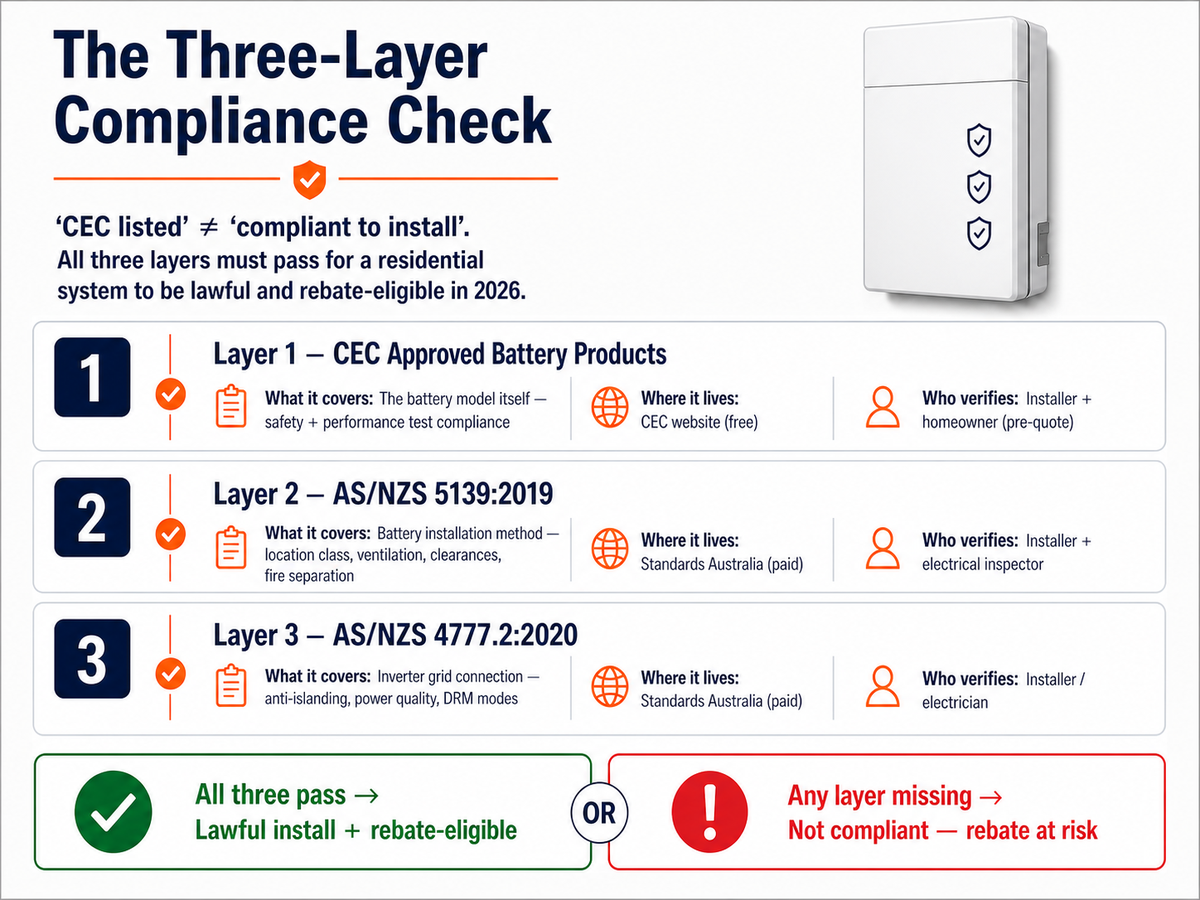
This is where most compliance failures start. Australian installers regularly conflate “CEC listed” with “compliant to install” — the two are not the same. CEC listing means the product is approved; AS/NZS 5139 governs how it is installed; AS/NZS 4777.2 governs the inverter. All three must pass for a residential system to be lawful and rebate-eligible in 2026.
| Standard / List | What It Covers | Where It Lives | Who Verifies |
|---|---|---|---|
| CEC Approved Battery Products | The battery model itself — safety + performance test compliance | CEC website (free) | Installer + homeowner (pre-quote) |
| AS/NZS 5139:2019 | Battery installation method — location class (indoor/outdoor/restricted), ventilation, clearances, fire separation | Standards Australia (paid) | Installer + electrical inspector |
| AS/NZS 4777.2:2020 | Inverter grid connection — anti-islanding, power quality, DRM modes | Standards Australia (paid) | Installer + DNSP/network |
| AS/NZS 3000:2018 (Wiring Rules) | General electrical installation — applies on top of all of the above | Standards Australia (paid) | Installer (mandatory) |
A battery that is CEC-listed but installed in a location that breaches AS/NZS 5139 (for example, an indoor installation in a habitable-room location class without the required fire separation) is still a non-compliant installation. The CEC treats that as an accreditation issue, not a product issue.
Quick Reference Table — What to Check by Scenario
| Scenario | Required Check | Common Pitfall | Where to Look |
|---|---|---|---|
| New residential PV + battery (STC claim) | CEC battery listing + CEC accredited designer/installer + AS/NZS 5139 + AS/NZS 4777.2 | Battery listed but inverter not 4777.2 — STC denied | Inverter pairing guide |
| Battery retrofit to existing PV | Inverter compatibility + AS/NZS 5139 location class + revised CES (Certificate of Electrical Safety) | Existing inverter pre-2020 not 4777.2:2020 compliant | DNSP connection rules |
| Off-grid in remote AU | Battery listing optional (no STC) but AS/NZS 5139 still mandatory | Skipping 5139 because “off-grid doesn’t need a permit” — wrong | State electrical safety regulator |
| Commercial 30–100 kWh stack | CEC commercial listing + AS/NZS 5139 commercial class + DNSP approval | Residential listing used in commercial — invalid | Rack-scale platform |
Real Installer Scenarios
Picture an installer in the western Sydney corridor quoting a 13.5 kWh battery alongside an existing 6.6 kW solar array. The customer is excited about the federal rebate. The supplier sends a datasheet labelled “48V 250Ah Wall LFP — CEC compliant.” A 60-second check of the CEC list for the exact model number returns zero matches. What the supplier labelled “CEC compliant” referred to cell-level IEC 62619 testing — not product-level CEC listing. Without listing, the customer loses several thousand dollars of STC value. The installer either pivots to a listed alternative from the same product line or walks the deal.
Take a Brisbane installer handed a CEC-listed 10 kWh wall battery for an indoor laundry installation. The model is on the list and the inverter is 4777.2 compliant. But AS/NZS 5139:2019 classifies that laundry as a habitable room under the standard’s location decision tree, which requires either relocation or a fire-rated enclosure. The product is fine; the install location is the failure. Relocating to the carport adds two hours of labour and clears compliance.
Consider a remote QLD off-grid solar project. No STC, no rebate, no CEC listing requirement for the battery itself. The installer skips the CEC paperwork — correctly — but also skips AS/NZS 5139 because “off-grid is unregulated.” That assumption misreads the standard. AS/NZS 5139 applies to all battery energy storage systems, grid-connected or not. State electrical safety inspectors do issue defect notices on off-grid installs.
Most Common CEC Compliance Mistakes
Across the Australian installers and EPCs we supply, the same compliance slip-ups surface again and again — and almost all of them happen at quoting or pre-install, not in the technical spec itself. When our team helps a project confirm a battery is genuinely on the CEC list before the paperwork goes to the DNSP, these are the five we flag most often.
1. Treating “CEC compliant” wording as equivalent to CEC listing
✗ Wrong: “Supplier datasheet says CEC compliant — that’s enough.”
✓ Right: Open the CEC list, search the exact model number, screenshot the match.
2. Quoting on a model number that gets superseded between quote and install
✗ Wrong: Quote in January, install in April, never re-check the listing.
✓ Right: Re-verify the CEC listing 7 days before install, and again on install day if the gap exceeds one fortnight.
3. Skipping AS/NZS 5139 location class because the install “looks fine”
✗ Wrong: Wall-mount the battery wherever there’s space.
✓ Right: Run the AS/NZS 5139 decision tree — habitable room, restricted location, outdoor — and document the class in the customer file.
4. Mixing a 2018 inverter with a new battery on a “no DNSP needed” assumption
✗ Wrong: Reuse the legacy inverter to save the customer money.
✓ Right: Inverter must be AS/NZS 4777.2:2020 compliant — older 2015 inverters are excluded from current battery rebate eligibility.
5. Treating cyclone-prone (Region C/D) installs the same as suburban Melbourne
✗ Wrong: Standard wall-mount kit on a North Queensland coastal build.
✓ Right: Verify the product’s wind region certification and use cyclone-rated mounting hardware that matches the local council’s Building Code of Australia overlay.
6. Forgetting the homeowner needs to keep documentation for 5 years
✗ Wrong: Hand over keys and move on.
✓ Right: Provide the customer with a single PDF pack: CEC listing screenshot, datasheets, IEC certificates, CES, AS/NZS 5139 location class statement. Required for warranty and any rebate audit.
True Cost of Installing a Non-Compliant Battery
The financial exposure on a single non-compliant 10 kWh residential install in 2026 typically lands like this:
| Loss Item | Approximate Cost (AUD) | Who Wears It |
|---|---|---|
| Federal STC rebate denied (Cheaper Home Batteries Program) | $3,000 – $4,000 | Homeowner (or installer if absorbed) |
| State rebate denied (varies by state) | $0 – $2,400 | Homeowner |
| Rectification labour (relocation, replacement) | $1,200 – $3,500 | Installer |
| CEC accreditation suspension (lost quarters of work) | $15,000 – $60,000 revenue | Installer |
| Insurance claim denial if a non-compliant battery is involved in an incident | Full property exposure | Homeowner |
A 60-second list lookup against $50,000+ of downside risk is the highest-leverage habit a quoting installer can build. For context on what a fully compliant system costs, see solar battery storage cost in 2026. For customers without solar already installed, battery backup without solar covers the grid-charge path and AU eligibility.
If you’re specifying a battery for a 2026 AU install, Savolture’s 51.2 V LFP platform — wall-mounted and stackable models from 5.12 to 16.08 kWh, CAN 2.0B (500 kbps) and RS485 Modbus RTU closed-loop communication, 6,500–8,500 cycles at 80% DoD and a 10–15 year warranty stated per model — is built to AS/NZS 5139 and IEC 62619, with UN 38.3 transport documentation. Because CEC listing is held per model rather than per brand, run the exact model through the same 60-second check above before you finalize a quote.
Next Steps
Frequently Asked Questions
Where can I download the CEC approved battery list?
Two official sources. The Clean Energy Council publishes a searchable database free at cleanenergycouncil.org.au/industry-programs/products-program/batteries, and the Clean Energy Regulator publishes the same register as a downloadable Excel file at cer.gov.au. Use the CEC database for a quick brand/model lookup; download the CER spreadsheet when you want to sort by capacity or keep an offline audit copy. Both update roughly every fortnight.
How many batteries are on the CEC approved list?
Over 1,000 lithium-based battery products as of 2026, the large majority of them LFP (lithium iron phosphate) residential and small-commercial models. The list is organised by manufacturer and model number, with nominal and usable capacity, approval date and expiry date for each entry.
Is a battery automatically CEC approved if its cells pass IEC 62619?
No. IEC 62619 is a cell-level safety standard. CEC listing applies to the finished product (enclosure, BMS, integration) and requires a CEC-specific submission, separate from any IEC cell test.
How often is the CEC Approved Battery Products list updated?
Roughly every two weeks. Installers should re-verify any quoted model within 7 days of install and check a fresh copy at least monthly for active projects.
Does CEC listing mean the battery is approved for off-grid use in Australia?
CEC listing primarily targets grid-connected residential and small-commercial systems under the federal STC scheme. Off-grid installs do not require CEC listing for STC reasons (no STCs apply), but still must meet AS/NZS 5139 installation requirements.
Can I install a US-certified UL 9540 battery in Australia?
UL 9540 is a US standard and does not substitute for CEC listing. Some product lines hold both certifications and can be sold in both markets, but each market still requires its own local verification. In Australia, the CEC listing is the binding document for residential rebate eligibility. See our UL 9540 vs UL 9540A guide for the US side.
What size battery qualifies for the 2026 rebate?
The Cheaper Home Batteries Program applies to systems from 5 kWh up to 28 kWh of usable capacity. Systems under 5 kWh get no rebate, the per-kWh amount tapers after 14 kWh, and it drops sharply above 28 kWh. The STC factor that sets the dollar value also declines every six months (around 8.4 in Jan–April 2026, around 6.8 from May 2026), so confirm the current rate with the Clean Energy Regulator.
What happens if a battery loses its CEC listing after my install?
An install that was compliant on the install date remains compliant, and STCs already created are not retroactively revoked. However, future installs of the same model become ineligible from the de-listing date forward.
- Clean Energy Council — Approved batteries (Products Program): cleanenergycouncil.org.au
- Clean Energy Regulator — CEC approved batteries (downloadable register): cer.gov.au
- Department of Climate Change, Energy, the Environment and Water — Cheaper Home Batteries Program (STC factor schedule): dcceew.gov.au/energy/programs/cheaper-home-batteries
- Standards Australia — AS/NZS 5139:2019 (battery installations) and AS/NZS 4777.2:2020 (inverter grid connection): standards.org.au
- IEC 62619 — safety requirements for secondary lithium cells and batteries for industrial applications.
Ready to size your system?
Get a free battery recommendation.
Tell us your load, location, and backup target — we will spec the right 48V LiFePO4 system for you.