

Savolture Technical Guide
100Ah vs 200Ah Lithium Battery: How to Choose for Your Solar Project (2026)
Choose between 100Ah and 200Ah lithium batteries by balancing daily kWh, parallel strings, install space, future expansion, and serviceability.
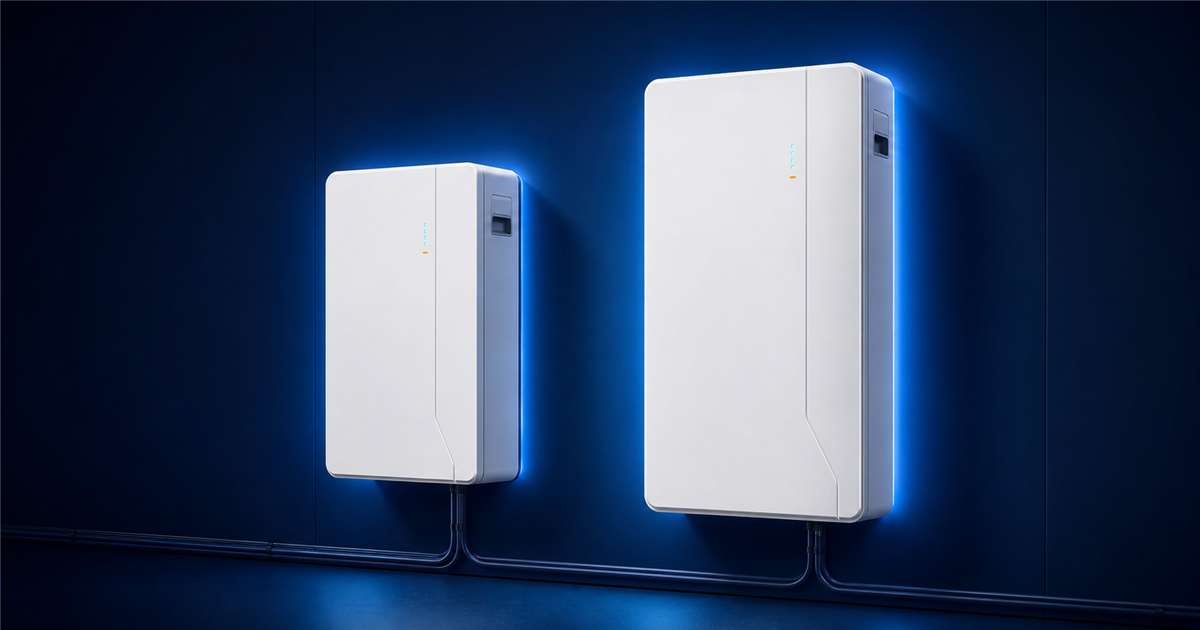
Capacity rule
Bank kWh = voltage x Ah x parallel strings / 1000 Use capacity, install constraints, and expansion plan to choose 100Ah or 200Ah modules.Every week we get the same question from US solar installers, RV builders, and homeowners shopping for their first lithium upgrade: “Should I get a 100Ah or a 200Ah lithium battery?”
Short answer: For 48V (51.2V) home and off-grid solar storage, choose a 100Ah (5.12 kWh) battery for entry-level backup, single-circuit or cabin loads, and one-person installs; choose a 200Ah (10.24 kWh) battery for single-cabinet whole-home essential backup that has to last overnight. Most “100Ah vs 200Ah” advice online is written for 12V RV and camping setups — this is the 48V residential and installer decision, where load profile and 24-month growth matter more than portability.
It sounds like a capacity question. It isn’t. Most of the time, when this decision goes wrong, it’s because someone optimized for the wrong constraint — usually upfront price, occasionally weight, almost never actual load profile and 12-month growth plan. The result: a system that’s either oversized (and over-budget) or undersized (and the customer is upgrading again 14 months later).
This guide walks through the framework we use to spec 100Ah vs 200Ah 51.2V LFP batteries for actual 2026 US residential and light-commercial projects. No spec-sheet copy-paste, no AI-generated checklist — just the four questions that actually drive the decision, the math behind them, and the three project types where we still see installers pick wrong.
The 30-Second Answer (For People In a Hurry)
If you only have a minute, the rough rule for 48V (51.2V) LFP residential storage in 2026 looks like this:
- Pick a 100Ah lithium battery (5.12 kWh) when the project is entry-level lithium replacing lead-acid, partial backup for 2-4 essential circuits, a remote cabin running weekend loads, or an RV/marine install where cabinet depth and single-person handling matter more than total runtime.
- Pick a 200Ah lithium battery (10.24 kWh) when the customer wants a single-cabinet whole-home essential backup, plans to run essential loads overnight through a 6–10 hour outage, or wants a cleaner installation than parallel 100Ah modules (one cabinet, one BMS handoff, one warranty claim).
- Mix them when the buyer is on a 12–24 month phased upgrade path: start with one 100Ah, add modules as load and budget grow. Once total capacity passes 10 kWh, the decision reverses — additional capacity favors 200Ah modules for cleaner cabinet density.
That’s the shortcut. The rest of this article explains why, because the shortcut breaks badly in three specific project types we see almost weekly.
Core Spec Comparison: 100Ah vs 200Ah at 51.2V
Both batteries share the same 51.2V (16 cells × 3.2V nominal) LiFePO4 chemistry, the same general BMS architecture, and the same operating envelope. They differ on the dimensions that actually matter for project planning: total energy, single-cabinet runtime, weight, install crew, and cost per usable kWh.
| Parameter | 100Ah LFP (5.12 kWh) | 200Ah LFP (10.24 kWh) |
|---|---|---|
| Nominal Voltage | 51.2 V | 51.2 V |
| Energy (Nominal) | 5.12 kWh | 10.24 kWh |
| Usable Energy @ 80% DoD | ~4.10 kWh | ~8.20 kWh |
| Weight | 28 kg (62 lb) | ~84 kg (185 lb) |
| Install Crew | 1 person | 2 people (or lift gear) |
| Max Continuous Discharge | 100A | 150A |
| Cycle Life @ 80% DoD | 6,500+ | 6,500+ |
| Cell Chemistry | LiFePO4 (16S1P) | LiFePO4 (16S1P) |
| Typical Wall Footprint | ~520 × 480 mm | ~780 × 550 mm |
| Parallel Capability | Up to 4 units (20.48 kWh) | Up to 16 units (~163 kWh) |
| Best Fit | Entry, RV, cabin, modular start | Whole-home essential, off-grid base |
For a full 100Ah lithium battery specification sheet or the matching 200Ah lithium battery technical details, see the product pages — both include the full BMS protection thresholds, charge voltage envelope, and self-discharge data that don’t fit in a side-by-side comparison.
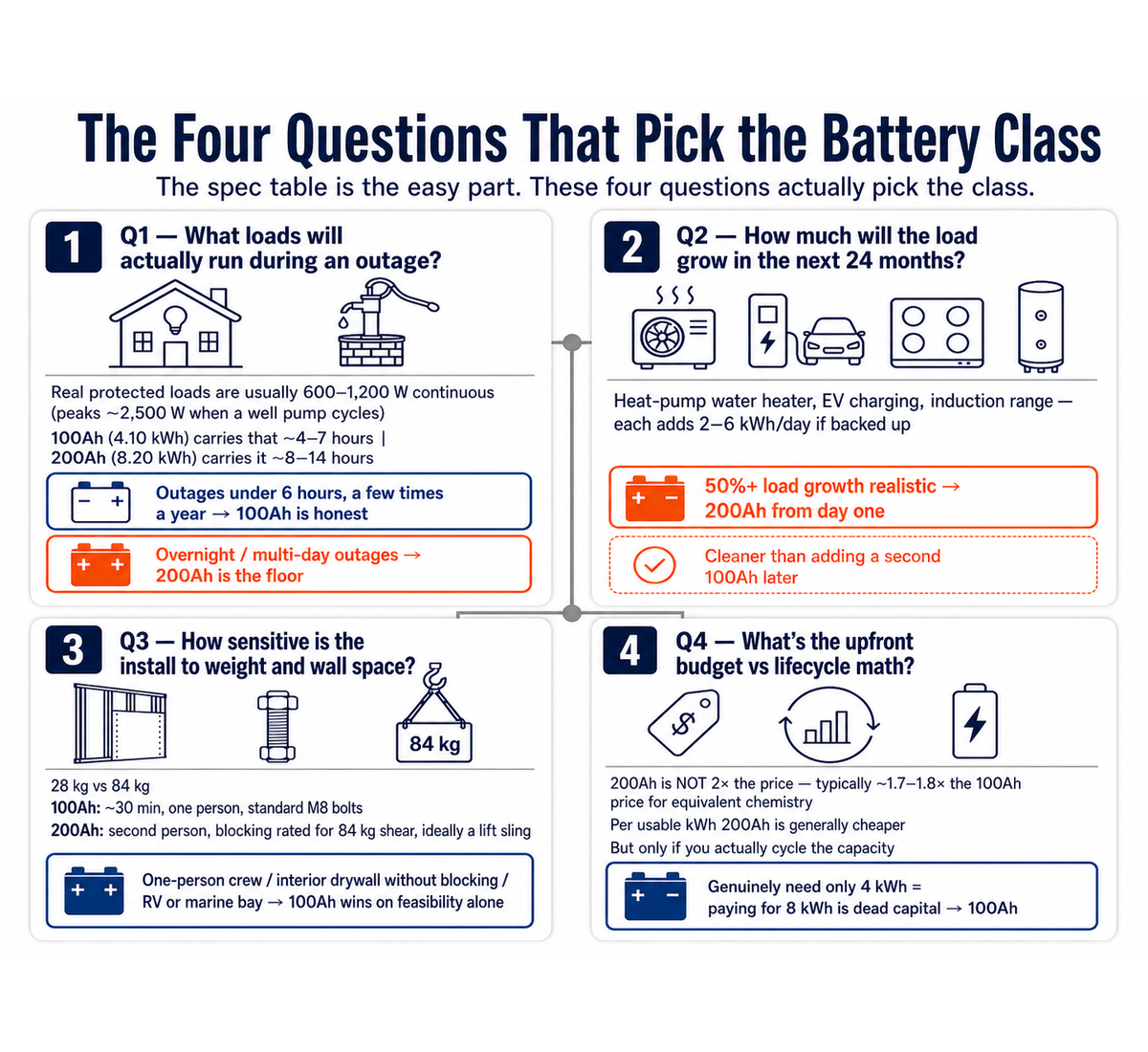
The Four Questions That Actually Pick the Battery Class
The spec table is the easy part. Here’s the framework we walk customers through before quoting either battery:
1. What loads will actually run during an outage?
Not what the customer says they’ll run — what they’ll actually plug in. The pattern we see: customers describe full-home loads, then once we audit the panel, the real protected loads are refrigerator, well pump, internet/router, a couple of LED circuits, garage opener, and one TV. Total: 600–1,200 W continuous, peaking briefly at 2,500 W when the well pump cycles.
A 100Ah battery (4.10 kWh usable) carries that 600–1,200 W load for roughly 4–7 hours. A 200Ah battery (8.20 kWh usable) carries it for 8–14 hours. If outages in the region typically last under 6 hours and recur a few times per year, 100Ah is honest. If outages can stretch overnight or run multiple days (winter storms, wildfire grid shutoffs), 200Ah is the floor — not the ceiling.
2. How much will the load grow in the next 24 months?
This is the question most installers skip. The household profile that needs 5 kWh today often needs 10+ kWh within two years — not because the family changes, but because electrification keeps happening: heat-pump water heater, EV charging, induction range, home office HVAC. Each of those adds 2–6 kWh/day if backed up.
If a 24-month load growth of 50%+ is realistic, buying a single 100Ah today usually means a second 100Ah within a year. That’s fine if the customer is okay running two cabinets in parallel. If they want a single-cabinet system long-term, 200Ah from day one is the cleaner answer.
3. How sensitive is the install to weight and wall space?
28 kg vs 84 kg sounds obvious until you’re standing in a partially finished garage with one installer, one ladder, no lift gear, and the homeowner watching. A 100Ah unit goes up in roughly 30 minutes with standard M8 bolts. A 200Ah unit needs a second person, a stud-finder, blocking that can take 84 kg in shear, and ideally a lift sling.
For projects where the install crew is one person, where the wall is interior drywall over standard 16″ framing without blocking, or where the cabinet has to go into an RV bay or marine compartment with a 24″ door, 100Ah wins on physical feasibility alone — even if the energy math says 200Ah.
4. What’s the upfront budget vs lifecycle math?
200Ah is not 2× the price of 100Ah — manufacturing volume and cell-class economics typically put 200Ah at about 1.7–1.8× the 100Ah price for equivalent chemistry. So per usable kWh, 200Ah is generally cheaper.
But that math assumes the customer actually uses the larger capacity. If the load profile genuinely only needs 4 kWh, paying for 8 kWh of cells you’ll never cycle is just dead capital sitting in a cabinet. The 80% DoD cycle life advantage only matters if you’re regularly cycling deep.
What a 100Ah vs 200Ah Battery Can Actually Run
The fastest way to make the capacity decision concrete is runtime per appliance. The figures below assume the battery is doing nothing else — in a real outage you run several loads at once, so divide accordingly. All runtimes use usable energy at 80% DoD: 4.10 kWh for the 100Ah and 8.20 kWh for the 200Ah.
| Appliance | Typical running draw | 100Ah (4.10 kWh) alone | 200Ah (8.20 kWh) alone |
|---|---|---|---|
| Full-size refrigerator | ~150 W avg | ~27 hours | ~2.3 days |
| Chest freezer | ~100 W avg | ~41 hours | ~3.4 days |
| Wi-Fi router + modem | ~20 W | 8+ days | 17+ days |
| Whole-home LED lighting | ~100 W | ~41 hours | ~82 hours |
| 50″ LED TV | ~100 W | ~41 hours | ~82 hours |
| Window AC (8,000 BTU) | ~700 W | ~5.8 hours | ~11.7 hours |
| Microwave (in use) | ~1,000 W | ~4.1 hours | ~8.2 hours |
| 1.5 kW space heater | ~1,500 W | ~2.7 hours | ~5.5 hours |
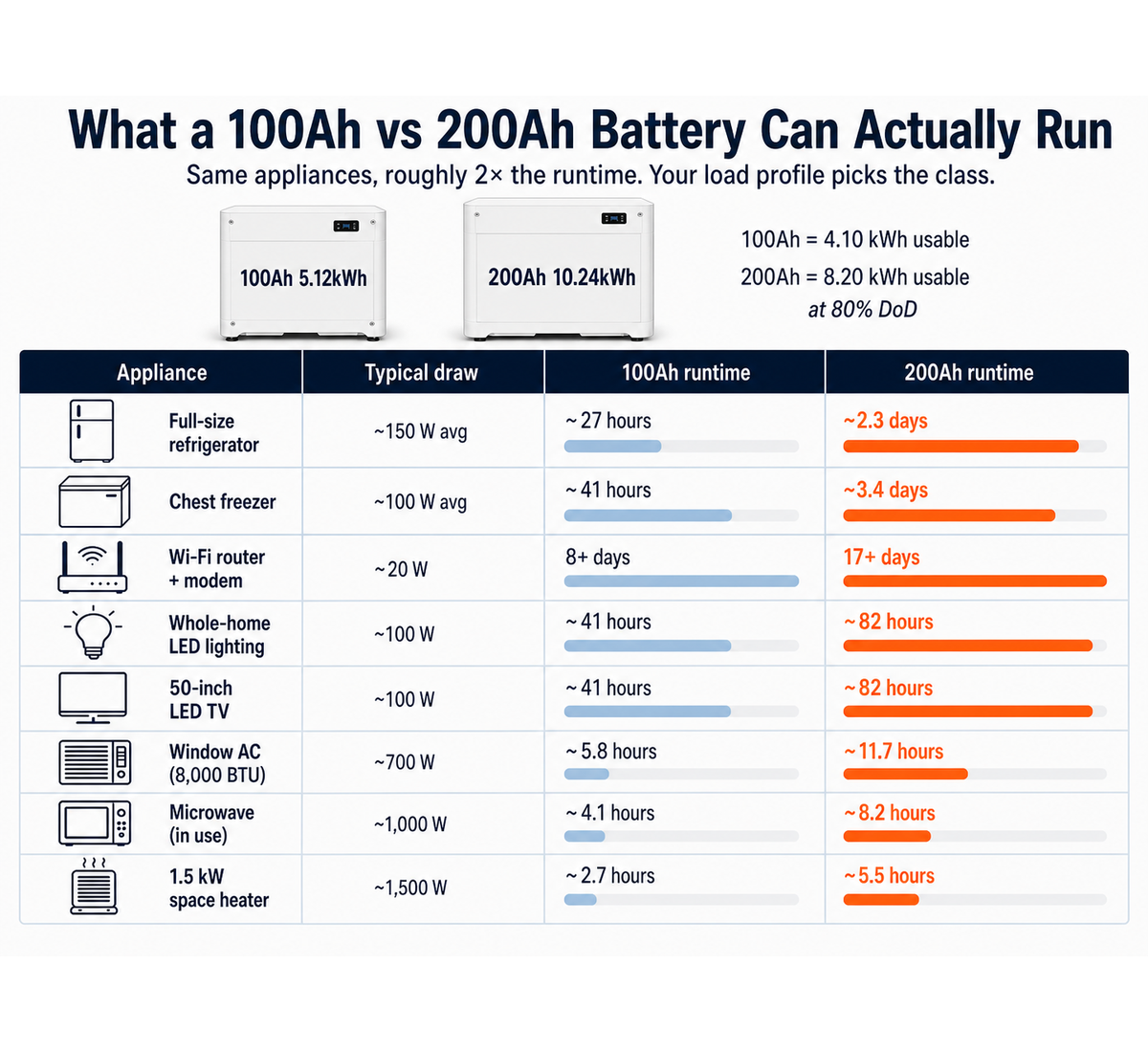
So, can a 200Ah battery run a refrigerator? Easily — on its own a 200Ah (8.20 kWh usable) keeps a typical 150 W fridge cold for more than two days. The more useful question is the whole bundle: a realistic essential-loads package (fridge + a few LED circuits + internet + a well pump that cycles) draws 600–1,200 W continuous. A 100Ah carries that for roughly 4–7 hours; a 200Ah for 8–14 hours. That single difference — making it through the night versus not — decides most residential backup projects. To match these numbers to your own appliance list, see the 200Ah lithium battery details or step down to the 100Ah model.
How Much Solar Do You Need to Recharge Each One?
Runtime is only half the system. The battery also has to refill during daylight, and that’s where panel count — not battery class — quietly becomes the constraint. The estimates below assume standard 400 W panels, about 4.5 peak-sun hours per day, and roughly 80% round-trip efficiency through the charge controller and charge losses.
| Battery | Energy to put back (full cycle + losses) | 400 W panels for a full recharge in one good solar day | Array size |
|---|---|---|---|
| 100Ah (5.12 kWh) | ~4.6 kWh | 3–4 panels | ~1.4 kW |
| 200Ah (10.24 kWh) | ~9.2 kWh | 6–7 panels | ~2.6 kW |
How many solar panels do you need to charge a 200Ah battery in 5 hours? About six to seven 400 W panels — roughly 2.6 kW of array. Five good peak-sun hours is close to a full day’s harvest, so the count barely changes from a normal solar day; a 100Ah needs about four panels. The battery’s own charge acceptance (these LFP packs comfortably take 50–100 A) is well above what 2.6 kW of solar delivers, so the panel array is the limiting factor, not the BMS. To size the array against your real daily load and autonomy days, run the off-grid battery calculator or follow the step-by-step sizing guide.
Three Project Types Where Installers Pick Wrong
Project Type 1: The “Future EV” Pre-Buy
Customer mentions getting an EV “next year.” Installer spec’s 200Ah from day one to “future-proof.” Result: customer’s EV never materializes (or they decide to charge at work). The 200Ah cabinet sits at 30% cycling depth, the customer is upset about the upfront spend, and the installer loses the referral.
What works better: Spec one 100Ah today, sized to current loads. Quote the second 100Ah (or 200Ah upgrade) as a documented Phase 2 at month 12–18 when actual EV purchase happens. Customer pays for capacity they use; you build trust.
Project Type 2: The Off-Grid Cabin That Becomes Full-Time
Weekend cabin gets repositioned during 2020–2024 as remote-work property, becomes full-time residence. The original 100Ah system handles weekend loads fine but breaks under continuous use. Battery gets cycled harder, deeper, more often than designed.
What works better: For any cabin that might become full-time within 5 years, default to 200Ah from day one. The cost delta isn’t enough to justify an undersized system that gets replaced. If full-time isn’t on the table, 100Ah is honest.
Project Type 3: The “I Just Want Backup” That Turns Into Self-Consumption
Customer wants outage backup, doesn’t care about solar self-consumption. Installer spec’s 100Ah, customer is happy. Six months later, the utility raises rates 25%, the customer wants to start using solar to offset evening peak rates, and now they need 2× the capacity they bought.
What works better: Ask explicitly: “If electricity rates climbed 30% in your area, would you want to start self-consuming?” If yes, spec for the self-consumption profile, not the backup profile. That usually means 200Ah or more.
When the Answer Is “Both” (And When That’s Actually Smart)
Mixing 100Ah and 200Ah batteries in the same system is technically possible if both use the same chemistry, voltage class, and BMS communication protocol — but it’s almost never the right answer for new installs. The capacity mismatch causes uneven cycling depth across the cells, the BMS has to manage two different state-of-charge curves, and the warranty handoff gets complicated when one module fails.
See also: 48V vs 24V vs 12V battery: complete voltage guide for residential and off-grid systems
The exception: phased upgrades where the customer starts with one 100Ah and adds a second 100Ah within a year, then upgrades to 200Ah modules when total system capacity exceeds 10 kWh. In that path, you eventually replace the 100Ah units with 200Ah units rather than running mixed capacities long-term.
For larger projects (16+ kWh, light commercial, multi-family residential), the answer is usually neither — it’s a single 314Ah LFP battery at 16.08 kWh per cabinet, which avoids the parallel-stack complexity altogether.
Inverter Compatibility: Same Story for Both
Both 100Ah and 200Ah Savolture batteries use the same 51.2V LFP platform and the same CAN/RS485 communication protocols. Compatibility is identical across both: Sol-Ark 12K/15K, MegaRevo 5K-12K, Luxpower SNA, Victron MultiPlus II, EG4 6000XP, Schneider XW Pro, and others.
What changes is inverter sizing. A 100Ah battery’s 100A continuous discharge maps to ~5 kW continuous through the inverter. A 200Ah battery’s 150A continuous maps to ~7.5 kW. If the inverter is already spec’d at 10K+, the 200Ah battery is the natural pair — the 100Ah will leave inverter headroom unused.
For broader 48V system architecture and inverter pairing logic across the Savolture lineup, see the 48V battery platform overview.
Real Numbers: Lifecycle Cost Per Usable kWh
Skipping over actual pricing (which varies by channel, volume, and freight), here’s the structure of the lifecycle math:
- Cycle count: Both batteries are rated 6,500+ cycles at 80% DoD. That’s roughly 17 years at one daily cycle.
- Usable energy per cycle: 100Ah delivers ~4.10 kWh; 200Ah delivers ~8.20 kWh.
- Lifetime usable energy: 100Ah delivers ~26,650 kWh over service life; 200Ah delivers ~53,300 kWh.
- Cost per delivered kWh: Roughly equivalent on a per-kWh basis if both batteries are fully cycled.
The lifecycle math only favors 200Ah if the system actually cycles it. Buying capacity you don’t use is just storing money in a cabinet — you get the cycle life advantage on cells you never discharge to 80% DoD.
For installers running honest project economics for clients, the U.S. Department of Energy’s solar energy storage reference covers the broader payback math frameworks.
Common Questions
Can I run one 100Ah and one 200Ah in parallel?
Technically yes if both have matching chemistry, voltage class, and BMS protocol — but it’s strongly not recommended. Capacity mismatch causes uneven cycling, faster wear on the smaller cell pack, and warranty complications. If you need 15 kWh of storage, use two 200Ah units (20.48 kWh) and accept the slight oversizing, or use one 314Ah (16.08 kWh).
Will a 100Ah battery last as long as a 200Ah battery?
Cycle life is identical (6,500+ at 80% DoD) because both use the same LFP chemistry and cell engineering. Calendar life depends on installation environment (temperature, ventilation, charge habits) far more than capacity class.
Which is better for an off-grid cabin?
Weekend-use cabin: 100Ah is usually enough. Full-time off-grid residence: start with 200Ah, plan for 2 or 3 units in parallel. The capacity classification depends entirely on the load profile, not the cabin classification.
Can I replace my lead-acid bank with one 100Ah lithium?
Usually yes if the lead-acid bank was rated 400Ah or smaller in lead-acid terms. A 100Ah LFP at 80% DoD delivers more usable energy than a 200Ah lead-acid at 50% DoD, with much faster recharge and far longer cycle life. Verify inverter has a lithium charging profile before swapping. For the full lithium-versus-lead-acid cost and lifespan breakdown, see our LiFePO4 vs lead-acid cost math guide.
Do I need UL9540 certification for residential install?
Most US AHJs require UL9540 system listing or UL9540A test data for residential energy storage installations, particularly in California and the Northeast. For details on what UL9540 actually means for installer documentation, see our UL9540 certification installer guide.
How do I size off-grid storage from scratch?
If you’re starting a new off-grid project from a blank load list, the calculation framework matters more than the battery class. See our step-by-step off-grid battery sizing calculator for the worksheet.
Can a 200Ah lithium battery run a refrigerator?
Yes — comfortably. A 200Ah 51.2V battery holds about 8.20 kWh usable at 80% DoD, enough to run a typical 150 W full-size refrigerator for more than two days on its own. In a realistic backup scenario where the fridge shares the battery with lights, internet, and a well pump (600–1,200 W combined), expect 8–14 hours of runtime. A 100Ah covers the same bundle for about 4–7 hours.
How many solar panels do I need to charge a 200Ah battery?
About six to seven standard 400 W panels (~2.6 kW of array) will fully recharge a 200Ah (10.24 kWh) battery in one good solar day, including charge-controller losses. A 100Ah battery needs roughly three to four panels. Because five peak-sun hours is close to a full day’s harvest, the count is about the same whether you want the refill in five hours or across a whole day.
Next Steps
The right capacity choice depends on your actual daily load — not a rule of thumb. Run the numbers once and the answer is almost always clear.
- Compare specifications side by side — See the full 100Ah LiFePO4 and 200Ah LiFePO4 spec sheets including cycle life, dimensions, and compatible inverters.
- Use the Off-Grid Battery Sizing Calculator — If you’re unsure which capacity fits your load, the step-by-step sizing guide walks through daily kWh, autonomy days, and DoD in 15 minutes.
- Plan your inverter pairing — Once you settle on 100Ah or 200Ah capacity, see our guide on choosing the right inverter to pair with your 100Ah or 200Ah battery — covers BMS communication and the pre-purchase 3-step verification.
- Request a project quote — Send us your load profile and location and we’ll recommend the right configuration with a freight timeline. Start here →
Sources & Further Reading
- U.S. DOE — Solar Energy Technologies Office: Battery Storage Basics. energy.gov
- NREL — REopt Lite: Residential Battery Storage Payback Calculator. reopt.nrel.gov
- NEC Article 706 — Energy Storage Systems — Sizing and installation requirements for residential battery systems.
- EVE LFP Cell Technical Specifications — Cycle life, temperature range, and capacity retention data underlying the lifecycle comparisons in this guide.
Two Real Capacity Decisions
Case A: Flagstaff, AZ off-grid cabin — 100Ah was exactly right
A weekend cabin near Flagstaff running only LED lights, a 12V refrigerator (45W), phone charging, and a small water pump. Daily load calculated at 1.8 kWh. With 2 days autonomy and 80% DoD, the required bank size was 4.5 kWh — one 100Ah LiFePO4 unit at 5.12 kWh covered it with headroom. Going to 200Ah would have added $700 in unused capacity that the cabin’s small 600W solar array couldn’t fully charge anyway.
Case B: Asheville, NC whole-home backup — 200Ah was necessary
A grid-tied home in Asheville added battery backup for storm outages. The load prioritization included a refrigerator (150W), HVAC blower (400W), kitchen outlets (400W avg), and lighting — totaling 5.8 kWh/day for 24 hours of backup. One 100Ah unit at 5.12 kWh would run out before morning. One 200Ah unit at 10.24 kWh covered the load with comfortable margin. The homeowner had originally spec’d 100Ah to save $700 and would have been disappointed on the first use. For permitted grid-tied backup installations, the UL 9540 listed home battery system for grid-tied installations is the standard permitting choice.
The True Cost of Sizing Wrong
Undersizing has a hard financial cost that installers rarely include in the original quote:
See also: size your off-grid battery
See also: home battery backup guide
See also: best solar battery for your home
- Generator fuel for undersized systems: A system that runs out of power at 11 PM and needs to start a generator 3 nights/week costs roughly $600–$900/year in fuel. Over 5 years, that’s $3,000–$4,500 — more than the cost difference between 100Ah and 200Ah.
- Early replacement from chronic over-discharge: Running a 100Ah battery at 95%+ DoD nightly degrades cycle life significantly. A battery rated for 6,500+ cycles at 80% DoD can deliver far fewer at 95% DoD — chronic over-discharge can cut effective service life roughly in half.
- Customer callback cost: One return visit for a “battery not lasting through the night” complaint costs 2–4 hours of labor and often a free upgrade. The margin difference between 100Ah and 200Ah is almost always less than the callback cost.
Choosing 100Ah or 200Ah?
Send us your capacity target and install space.
We will match module size, parallel count, and 48V LiFePO4 battery layout for your project.