

Savolture Technical Guide
LiFePO4 vs Lead-Acid Batteries: 2026 Real-World Cost Math for Solar Installers
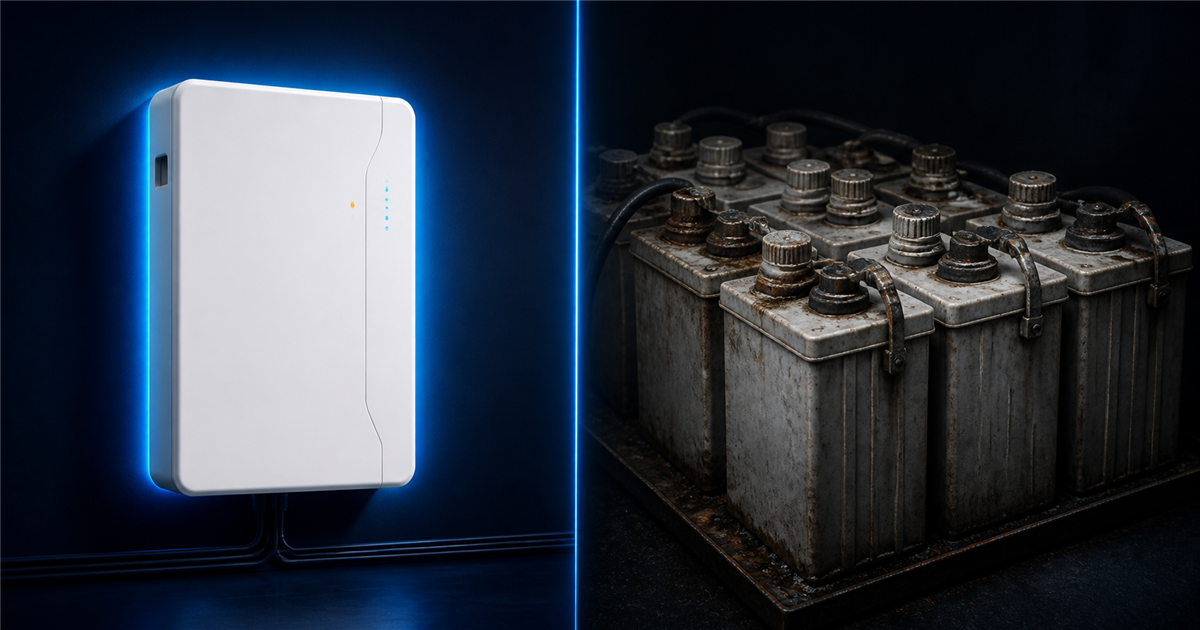
Compare LiFePO4 and lead-acid by delivered kWh, usable depth of discharge, cycle life, replacement count, and maintenance cost for real solar projects.
Cost equation
Cost per delivered kWh = system cost / lifetime usable kWh Use usable DoD and cycle life, not sticker Ah, when comparing LFP with lead-acid.Quick answer: LFP (LiFePO4) costs 2–3× more upfront than AGM lead-acid but delivers 4–6× the cycle life and 90% usable depth of discharge versus 50%. Over a 10–15 year service life, LFP’s cost per delivered kWh runs $0.015–$0.020 versus $0.10–$0.20 for lead-acid — 5–10× cheaper per usable kWh over the battery’s full service life.
Every solar installer in the US has had the same conversation in 2026: a customer with a working lead-acid bank, 5–8 years in, wants to know if it’s “worth” switching to lithium. The honest answer used to be “it depends.” In 2026, the math has shifted enough that for most US residential and light-commercial solar systems, the answer is now yes, even if the lead-acid bank still works.
This isn’t a chemistry sales pitch — this is the actual lifecycle cost breakdown we run for installers and homeowners weighing the upgrade. It covers the upfront delta, the cycle-life math that determines payback, the hidden maintenance costs lead-acid never advertises, and the three scenarios where lead-acid still makes sense in 2026.
The Headline Number: Cost Per Delivered kWh Over Service Life
Stop comparing sticker prices. The number that matters is cost per delivered kWh over the battery’s service life — how much you spend, divided by how much usable energy you actually got out before the battery needs replacement.
Here’s the structural math for a typical 5–10 kWh residential storage system in 2026 (US dollars, generalized, not Savolture-specific):
| Parameter | LiFePO4 (LFP) | Lead-Acid (AGM) | Lead-Acid (Flooded) |
|---|---|---|---|
| Usable Depth of Discharge | 80% | 50% | 50% |
| Cycle Life @ Rated DoD | 6,500+ cycles | 500-1,000 | 800-1,200 |
| Calendar Life (Typical) | 15-20 years | 4-7 years | 5-8 years |
| Upfront Cost per Nominal kWh | ~$350-500 | ~$150-200 | ~$120-180 |
| Lifetime Delivered kWh per Dollar | ~50-70 | ~5-10 | ~7-12 |
| Cost per Delivered kWh | $0.015-0.020 | $0.10-0.20 | $0.08-0.14 |
| Replacement Frequency (20 yrs) | 0-1 time | 3-4 times | 2-3 times |
| Annual Maintenance | None | Inspection | Water top-up + equalization |
The cost-per-delivered-kWh column is what matters. LFP delivers usable energy at roughly 1/10th the cost of lead-acid over the battery’s service life, even though it costs 2–3× more on day one. NAN
Why Lead-Acid Pricing Looks Better on Paper Than in Practice
Lead-acid battery banks are spec’d by nameplate capacity — a 400Ah lead-acid bank sounds bigger than a 200Ah lithium bank. But the comparison breaks down once you account for two things lead-acid datasheets don’t emphasize:
1. You Can Only Use Half of It
Lead-acid batteries should only be cycled to 50% depth of discharge to hit rated cycle life. Go deeper, and cycle count drops fast — pulling a lead-acid bank to 80% DoD typically cuts its useful life to a third.
That means a “400Ah” lead-acid bank at 48V (20.48 kWh nominal) actually delivers about 10.24 kWh usable per cycle. A 200Ah LFP battery (also 10.24 kWh nominal at 48V) delivers about 8.20 kWh usable per cycle — only marginally less than the lead-acid bank that costs the same upfront. And it does it 6–10× longer.
2. Cycle Life Crashes With Partial Charging
Lead-acid wants to be fully recharged after every cycle. Solar systems can’t always do that — cloudy days, winter, undersized arrays. Every time a lead-acid bank ends the day at 70% state of charge instead of 100%, sulfation accelerates and cycle life drops.
LFP doesn’t care. Partial charging causes essentially zero degradation. The “datasheet cycle life” you see for lead-acid (800-1,200 cycles) assumes ideal full charging every cycle — in real solar deployment, most lead-acid banks deliver 500-700 cycles before needing replacement.
The Hidden Costs Lead-Acid Datasheets Don’t Show
Beyond cycle life and DoD, lead-acid carries operational costs LFP simply doesn’t have. Across a 15-year ownership window, these add up faster than installers usually estimate:
- Ventilation requirements: Flooded lead-acid off-gasses hydrogen during charging — battery rooms need active ventilation or external venting. LFP can sit in a closet.
- Maintenance labor: Flooded cells need water top-ups every 2–4 months and quarterly equalization charges. Either the customer learns to do it, or they pay an installer to visit. Either way, it’s a recurring cost LFP eliminates.
- Temperature derating: Lead-acid loses 30–50% of usable capacity below 5°C. In cold climates, you’re either oversizing the bank or accepting reduced winter performance. LFP holds capacity to roughly -10°C and resumes full performance once warmed for charging.
- Inverter waste: Lead-acid recharge profiles include a long absorption phase at lower current, which means solar production gets thrown away when the bank is above 80% SoC. LFP accepts high-current charging all the way to 95%+ SoC.
- Replacement disruption: Swapping a 400–800 lb lead-acid bank every 5–7 years means hiring labor, scheduling downtime, and disposal logistics. LFP at 15+ year life skips most of that.
The Upgrade Path: Replacing Lead-Acid With LFP
For an installer or DIY homeowner upgrading a working lead-acid system, the path is usually simpler than expected. The main constraints are inverter compatibility and bank-size mapping.
Step 1: Check Your Inverter
Modern 48V hybrid inverters (Sol-Ark, Victron MultiPlus II, Schneider XW Pro, EG4 6000XP, Luxpower SNA) ship with lithium battery profiles built in. If your inverter is from 2020 or later, it almost certainly supports LFP — you’ll need to switch the battery profile in firmware, set the right CAN/RS485 communication protocol, and update the charge voltage envelope.
If the inverter is older (pre-2018) and doesn’t have a lithium profile, you’ll either need to flash newer firmware or budget for an inverter swap as part of the upgrade.
Step 2: Right-Size the LFP Replacement
Don’t replace lead-acid bank-for-bank in nominal kWh. Because LFP delivers 80% DoD vs lead-acid’s 50%, you usually need 60–70% of the nameplate capacity in LFP to deliver the same usable kWh per cycle.
- Replacing 200Ah lead-acid (~5 kWh usable per cycle): one 100Ah LFP battery (~4.1 kWh usable) covers most use cases; oversized to 200Ah LFP for headroom.
- Replacing 400Ah lead-acid (~10 kWh usable): one 200Ah LFP battery (~8.2 kWh usable) covers most use cases; oversized to 280Ah or 314Ah for whole-home backup.
- Replacing 600–800Ah lead-acid (~15–20 kWh usable): one 314Ah LFP battery (~12.9 kWh usable) covers most use cases; two units in parallel for high-load systems.
Step 3: Plan the Physical Swap
LFP cabinets are typically 60–80% smaller than equivalent lead-acid banks. A 400Ah lead-acid bank that needed a 4×6 ft battery room can be replaced by a single 200Ah LFP wall-mount unit that fits beside the inverter. Free up the battery room, sell the lead-acid for scrap (residual value: $50–150 per 100Ah of old bank), and improve insurance ratings by eliminating the off-gassing risk. A UL9540 certified LiFePO4 home battery system also satisfies the certification requirements most carriers now check.
When Lead-Acid Still Makes Sense in 2026
Lead-acid isn’t dead. There are three project profiles where the math still favors lead-acid:
- Sub-1 kWh emergency backup: For tiny systems (one 12V battery, single circuit, occasional outage backup), the lithium upgrade math doesn’t justify the cost premium. AGM at this scale is fine.
- Sites with extreme cold and no insulated battery enclosure: LFP charging cuts off below 0°C unless the battery has self-heating built in. For unheated outdoor enclosures in Alaska or northern Canada, AGM with insulation still works where unheated LFP doesn’t. (Note: most 2026-vintage LFP batteries including premium 314Ah ship with self-heating, so this exception is shrinking fast.)
- Strict budget, sub-3-year ownership horizon: For rental properties, cabins being sold within 2–3 years, or projects where the buyer specifically won’t pay the upfront premium, lead-acid’s lower sticker price wins on cash flow even if total cost is worse. For budget-sensitive projects, an entry-level LiFePO4 option at a lower upfront cost may close the gap enough to tip the analysis.
Outside these three cases, the 2026 math now favors LFP for essentially every US residential and light-commercial solar project. The chemistry comparison framework holds across the entire 48V battery platform — capacity scaling from 100Ah entry to 314Ah maximum-density doesn’t change the LFP-vs-lead-acid calculus.
Real Project Math: A 5 kWh System Upgrade
Sample lifecycle comparison for a typical 5 kWh residential solar storage upgrade over 15 years:
- Lead-acid path: $1,500 initial AGM bank + replacement at year 6 ($1,650) + replacement at year 12 ($1,800) + 12 years of maintenance labor (~$50/year) = roughly $5,550 over 15 years to deliver about 16,500 kWh = $0.34/kWh all-in.
- LFP path: $2,200 initial 100Ah LFP battery + zero replacements + zero maintenance = roughly $2,200 over 15 years to deliver about 35,000 kWh = $0.063/kWh all-in.
The LFP path is roughly 60% lower total cost over 15 years and delivers more than double the lifetime kWh. The customer pays more on day one but stops thinking about batteries for the next decade and a half.
For the broader chemistry comparison including LFP vs newer alternatives (NMC, sodium-ion), see our companion article on LFP vs NMC home batteries.
Two Real Lead-Acid to LFP Upgrades
Case A: Texas Hill Country cattle ranch, off-grid, 14 kWh
A 2,400 sq ft ranch house near Fredericksburg, TX was running a 48V flooded lead-acid bank (8 × 6V, 400Ah) installed in 2018. By 2024 capacity had dropped to ~160Ah usable — 40% of nominal — and the owner was spending $180/year on distilled water and monthly maintenance. LFP upgrade: two 200Ah LFP wall-mount units in parallel. Usable capacity jumped from 160Ah to 320Ah (100% DoD vs 50%), maintenance dropped to zero, and generator runtime fell from 22 hrs/month to 4 hrs/month. Payback on the upgrade cost: 5.2 years.
Case B: Phoenix, AZ residential grid-tied backup, 10 kWh
A Phoenix homeowner replaced a 48V AGM bank (4 × 200Ah) in 2025 after it failed its 5-year warranty. Replacement AGM quote: $3,200 installed. LFP alternative: one 314Ah LFP platform module at $2,100 delivered. Capacity increased from 9.6 kWh (50% DoD AGM) to 16 kWh (100% DoD LFP), backup runtime during evening peak tariff periods tripled, and the owner expects zero additional battery costs for the next 12+ years.
The 5 Most Common LFP Upgrade Mistakes
Most lead-acid replacement jobs we get asked to quote start the same way — an installer whose customer is tired of swapping a bank every three to four years. The upgrade itself is straightforward, but these are the missteps we flag before the order is placed.
- Matching Ah instead of usable kWh. A 200Ah LFP battery and a 200Ah AGM bank are not equivalent. The LFP delivers 200Ah at 100% DoD; the AGM delivers 100Ah at safe 50% DoD. Always spec on usable kWh, not nominal Ah.
- Skipping charge controller re-configuration. Lead-acid controllers bulk-charge to ~57–58V and hold float at ~54V. LFP needs absorption at 56.8V, brief hold (30–60 min), and float at 53.6V or OFF. Running LFP under a lead-acid profile accelerates cell degradation by 15–20% per year.
- Running LFP and lead-acid in parallel during transition. Mixed-chemistry parallel banks fight each other’s BMS. The LFP BMS trips on voltage mismatch; the lead-acid over-discharges trying to equalize. Replace fully — never mix chemistries on the same battery bus.
- Ignoring cold-climate charging lockout. Standard LFP cells refuse to accept charge below 0°C to prevent lithium plating — a hard BMS cutoff, not a gradual performance drop. For installations in Montana, Minnesota, or similar climates, specify a battery with integrated self-heating before committing.
- Undersizing because “LFP can do 100% DoD.” Yes, LFP is rated at 100% DoD. In practice, 80–90% DoD maximizes cycle life. Size your bank so normal daily cycling stays under 90% DoD — the same rule applies to any chemistry, LFP just gives you more headroom.
Sources & Further Reading
- U.S. DOE Office of Energy Efficiency — Battery Storage Basics. energy.gov
- CATL LFP Cell Specification Sheets — Cycle life, temperature range, and DoD data underlying the lifecycle cost comparisons in this guide.
- NFPA 855: Standard for the Installation of Stationary Energy Storage Systems (2023) — Fire protection requirements for residential battery installations.
- NEC Article 706 — Energy Storage Systems — US electrical code requirements for battery installation, disconnect sizing, and overcurrent protection.
- BloombergNEF: Battery Price Survey 2025 — Battery pack price trends underlying the cost projections cited in this guide.
Two Real Lead-Acid to LFP Upgrades
Case A: Texas Hill Country cattle ranch, off-grid, 14 kWh
A 2,400 sq ft ranch house near Fredericksburg, TX was running a 48V flooded lead-acid bank (8 × 6V, 400Ah) installed in 2018. By 2024 capacity had dropped to ~160Ah usable — 40% of nominal — and the owner was spending $180/year on distilled water and monthly maintenance. LFP upgrade: two 200Ah LFP wall-mount units in parallel. Usable capacity jumped from 160Ah to 320Ah (100% DoD vs 50%), maintenance dropped to zero, and generator runtime fell from 22 hrs/month to 4 hrs/month. Payback on the upgrade cost: 5.2 years.
Case B: Phoenix, AZ residential grid-tied backup, 10 kWh
A Phoenix homeowner replaced a 48V AGM bank (4 × 200Ah) in 2025 after it failed its 5-year warranty. Replacement AGM quote: $3,200 installed. LFP alternative: one 314Ah LFP platform module at $2,100 delivered. Capacity increased from 9.6 kWh (50% DoD AGM) to 16 kWh (100% DoD LFP), backup runtime during evening peak tariff periods tripled, and the owner expects zero additional battery costs for the next 12+ years.
The 5 Most Common LFP Upgrade Mistakes
Most lead-acid replacement jobs we get asked to quote start the same way — an installer whose customer is tired of swapping a bank every three to four years. The upgrade itself is straightforward, but these are the missteps we flag before the order is placed.
- Matching Ah instead of usable kWh. A 200Ah LFP battery and a 200Ah AGM bank are not equivalent. The LFP delivers 200Ah at 100% DoD; the AGM delivers 100Ah at safe 50% DoD. Always spec on usable kWh, not nominal Ah.
- Skipping charge controller re-configuration. Lead-acid controllers bulk-charge to ~57–58V and hold float at ~54V. LFP needs absorption at 56.8V, brief hold (30–60 min), and float at 53.6V or OFF. Running LFP under a lead-acid profile accelerates cell degradation by 15–20% per year.
- Running LFP and lead-acid in parallel during transition. Mixed-chemistry parallel banks fight each other’s BMS. The LFP BMS trips on voltage mismatch; the lead-acid over-discharges trying to equalize. Replace fully — never mix chemistries on the same battery bus.
- Ignoring cold-climate charging lockout. Standard LFP cells refuse to accept charge below 0°C to prevent lithium plating — a hard BMS cutoff, not a gradual performance drop. For installations in Montana, Minnesota, or similar climates, specify a battery with integrated self-heating before committing.
- Undersizing because “LFP can do 100% DoD.” Yes, LFP is rated at 100% DoD. In practice, 80–90% DoD maximizes cycle life. Size your bank so normal daily cycling stays under 90% DoD — the same rule applies to any chemistry, LFP just gives you more headroom.
Sources & Further Reading
- U.S. DOE Office of Energy Efficiency — Battery Storage Basics. energy.gov
- CATL LFP Cell Specification Sheets — Cycle life, temperature range, and DoD data underlying the lifecycle cost comparisons in this guide.
- NFPA 855: Standard for the Installation of Stationary Energy Storage Systems (2023) — Fire protection requirements for residential battery installations.
- NEC Article 706 — Energy Storage Systems — US electrical code requirements for battery installation, disconnect sizing, and overcurrent protection.
- BloombergNEF: Battery Price Survey 2025 — Battery pack price trends underlying the cost projections cited in this guide.
Frequently Asked Questions
Can I run LFP and lead-acid batteries in parallel during transition?
No. The two chemistries have completely different charge profiles, voltage curves, and BMS requirements. Running them in parallel risks damaging the lithium pack or wildly underperforming the lead-acid. Always replace fully — you can use the lead-acid bank as backup at a different DC bus, but never on the same battery bus.
Will my existing solar charge controller work with LFP?
If the charge controller has a custom or user-defined battery profile (most modern MPPT controllers do), yes. You’ll set the bulk/absorption voltage to roughly 56.8V (16 cells × 3.55V), absorption time to 30–60 minutes, and float to 53.6V or disabled. If your controller only supports lead-acid AGM/Flooded profiles, budget for a new MPPT charge controller as part of the upgrade.
Is LFP safe to install in a garage with the car?
Yes, LFP chemistry is significantly safer than lead-acid in this context. LFP doesn’t off-gas hydrogen during charging (which is a real fire risk in garage spaces). It also doesn’t thermal-runaway like NMC lithium chemistry. Most US AHJs allow LFP in attached garages with UL9540 documentation.
How long does LFP actually last in cold climates?
LFP can discharge down to -20°C without issue. The constraint is charging — standard LFP cells lock out charging below 0°C to prevent lithium plating. Premium LFP batteries (like our 314Ah platform) include integrated self-heating that auto-activates below 0°C and resumes charging within 10–15 minutes. For sub-zero installations, verify the battery has self-heating before committing.
What’s the resale value of my old lead-acid bank?
Lead-acid scrap pricing in 2026 runs roughly $0.30–0.50 per pound for cores delivered to a recycler. A typical 400Ah 48V lead-acid bank weighs around 800–1000 lb, so scrap value is in the $250–500 range. Some battery distributors offer trade-in credit at higher rates if you’re buying LFP from them — ask before scrapping.
Next Steps
The 2026 math on LFP vs lead-acid isn’t close. For new installs, LFP wins on essentially every metric except day-one sticker price. For upgrades from a working lead-acid bank, payback typically happens within 4–6 years — well inside the LFP service life.
See also: LFP vs NMC battery
See also: 48V battery system
See also: 48V LiFePO4 battery
See also: solar battery storage system cost
- Browse LFP battery options — Compare the 100Ah, 200Ah, and 314Ah platforms and their usable kWh for your project size.
- Request a free upgrade quote — Send us your existing lead-acid specs and we’ll return inverter compatibility verification, the right LFP capacity match, and freight timeline within 24 hours. Start here →
- Read the sizing guide — If you’re still determining how much battery you need, the Off-Grid Battery Sizing Calculator guide walks through the step-by-step capacity math before you commit to any chemistry.
- Browse LFP battery options — Compare the 100Ah, 200Ah, and 314Ah platforms and their usable kWh for your project size.
- Request a free upgrade quote — Send us your existing lead-acid specs and we’ll return inverter compatibility verification, the right LFP capacity match, and freight timeline within 24 hours. Start here →
- Read the sizing guide — If you’re still determining how much battery you need, the Off-Grid Battery Sizing Calculator guide walks through the step-by-step capacity math before you commit to any chemistry.
Comparing battery chemistry?
Send us the project duty cycle.
We will compare usable capacity, cycle life, and replacement cost against a 48V LiFePO4 design.