
Savolture Technical Guide
Batterie de secours domestique sans énergie solaire : ce qu’elle peut (et ne peut pas) faire | Savolture
Réponse rapide : Oui : une batterie domestique peut parfaitement fonctionner sans panneaux solaires. Elle se recharge alors depuis le réseau. Sans production solaire, elle rempl...
body.sv-lang-fr { line-height: 1.55; }
Réponse rapide : Oui : une batterie domestique peut parfaitement fonctionner sans panneaux solaires. Elle se recharge alors depuis le réseau. Sans production solaire, elle remplit toutefois seulement deux fonctions, aux logiques économiques très différentes : (1) l’alimentation de secours en cas de panne, qui maintient les charges critiques lorsque le réseau tombe, et (2) l’arbitrage tarifaire, qui consiste à charger aux heures creuses et à décharger aux heures de pointe selon votre contrat. Le secours est une assurance pour votre tranquillité d’esprit ; l’arbitrage n’est rentable que là où l’écart tarifaire est suffisamment important. Le choix le plus souple consiste à installer dès maintenant un onduleur hybride, afin de pouvoir ajouter du solaire plus tard sans remplacer l’équipement.
Recherchez « batterie de secours domestique sans énergie solaire » et vous obtiendrez un mur de « oui, vous pouvez ! » des articles qui s’arrêtent là où commence la vraie question. Bien sûr, cela fonctionne : la batterie ne se soucie pas de savoir si les électrons proviennent d’un toit ou du service public. La question qui détermine réellement si cela vaut votre argent est plus précise : sans énergie solaire, à quoi sert cette batterie ? Si vous vous trompez de réponse, soit vous dépensez trop pour une capacité que vous ne recyclerez jamais, soit vous achetez une unité qui ne peut pas transporter votre maison en cas de panne de courant. Ce guide présente les deux tâches qu’une batterie sans énergie solaire peut effectuer, comment dimensionner chacune d’entre elles et la décision qui vous empêche de vous enfermer.
Tout d’abord, la limite honnête : une batterie sans énergie solaire ne se recharge pas d’elle-même
Avec l’énergie solaire, une batterie domestique est un réservoir quotidien : le soleil la remplit chaque matin, votre maison la puise chaque soir et le cycle se répète. Retirez le solaire et cette boucle se brise. Une batterie chargée sur le réseau se recharge uniquement à partir du réseau, ce qui signifie qu’en cas de panne prolongée, une fois vide, elle reste vide jusqu’à ce que le courant électrique revienne. Comme le dit clairement EnergySage, une batterie connectée au réseau sans énergie solaire est « en fait, une réserve unique ».
Ce seul fait remodèle chaque décision de dimensionnement ci-dessous. Avec l’énergie solaire, vous pouvez dimensionner une batterie plus petite et compter sur le soleil de demain ; sans elle, la batterie représente la totalité du budget énergétique en cas de panne. Cela ne fait pas d’une batterie sans énergie solaire une mauvaise idée – cela signifie simplement que vous devez réfléchir sur le travail pour lequel vous l’achetez.
Travail 1 – Sauvegarde en cas de panne : acheter une assurance, pas un retour sur investissement
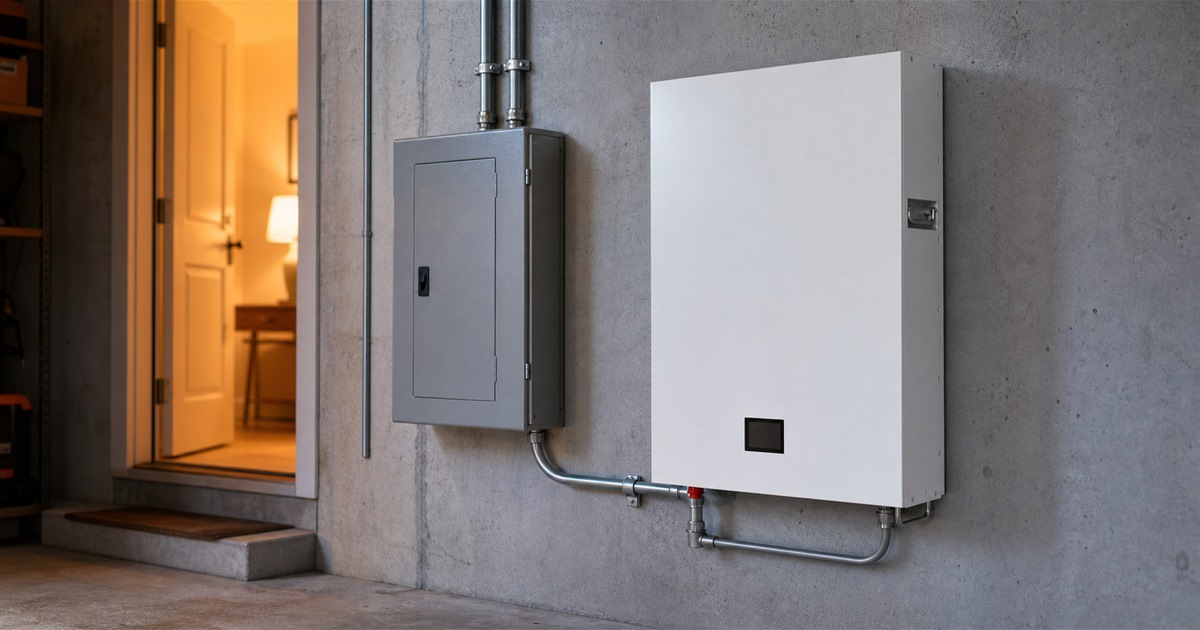
C’est la raison la plus courante pour laquelle les propriétaires installent une batterie sans énergie solaire : le réseau n’est pas fiable, un générateur est bruyant et a besoin de carburant, et ils veulent que les lumières, Internet, le réfrigérateur et quelques prises continuent de fonctionner en cas de panne. Ici, la batterie est un onduleur silencieux et automatique pour toute la maison.
L’économie fonctionne différemment de ce à quoi les gens s’attendent. Vous n’essayez pas de récupérer la batterie : vous payez pour la résilience, de la même manière que vous payez pour une assurance habitation que vous espérez ne jamais utiliser. La bonne façon de le dimensionner est de charges critiques × durée d’exécution, et non de rechercher un chiffre de récupération.
Combien de temps faut-il réellement que cela dure ? Les données du réseau américain fournissent un cadre utile. Au cours d’une année typique, le client moyen ne voit qu’environ deux heures d’interruptions non liées à des tempêtes ; mais les événements météorologiques majeurs changent rapidement la donne : 2024 a poussé la moyenne nationale à près de neuf heures, les ouragans Beryl, Helene et Milton responsables à eux seuls d’environ 80 % des heures perdues (U.S. Energy Information Administration, Formulaire EIA-861 / Electric Power Annual). Ce qu’il faut retenir : les incidents de routine nécessitent très peu de batterie, mais si vous faites face à des pannes de tempête sur plusieurs jours, la capacité – et idéalement un chemin pour recharger – compte beaucoup.
| Ce que tu protèges | Charge critique typique | Taille approximative de la batterie pour rouler une soirée + toute la nuit |
|---|---|---|
| Essentiels uniquement (lumières, internet, téléphones, réfrigérateur) | ~0,3 à 0,6 kW en moyenne | 5 à 10 kWh |
| Essentiels + pompe de puits / CPAP / bureau à domicile | ~0,6 à 1,0 kW en moyenne | 10 à 15 kWh |
| La majeure partie de la maison, moins les CVC/EV lourds | ~1,0 à 1,8 kW en moyenne | 15 à 30 kWh |
| Toute la maison y compris. Climatisation/pompe à chaleur, plusieurs jours | 2 kW+ en moyenne | 30 kWh+ et une source de recharge |
Il s’agit de cibles d’énergie utilisable à une profondeur de décharge d’environ 80 %, le chiffre de cycle quotidien pour la chimie LFP. Pour transformer votre propre liste d’appareils électroménagers en un numéro, exécutez-la via notre calculateur de batterie hors réseau : le calcul est identique, que l’énergie solaire soit présente ou non dans l’image. Pour la couverture des pannes dans toute la maison, la question de conception passe de « quelle taille de batterie » à « quels circuits » – le cœur de la planification d’un panneau de secours pour toute la maison.
À quoi cela ressemble en pratique. Imaginez un locataire d’une maison en rangée à Dallas qui ne peut pas installer l’énergie solaire mais perd de l’électricité pendant la tension estivale du réseau. Ils sauvegardent le réfrigérateur, Internet, la climatisation des fenêtres et les lumières (environ 0,8 kW en moyenne) avec une batterie d’environ 10 kWh et un onduleur hybride îloté sur un petit sous-panneau de secours. Il se recharge pendant la nuit avec une alimentation hors pointe bon marché et supporte une panne typique de 6 à 10 heures avec une marge, silencieux et sans émissions dans un placard utilitaire ; une batterie LFP de 100 Ah compacte couvre une construction uniquement essentielle comme celle-ci. Prenons plutôt l’exemple d’une maison ombragée de Nouvelle-Angleterre dont le toit n’est pas un candidat solaire : les tempêtes hivernales coupent l’électricité pendant 12 à 24 heures, elles sont donc dimensionnées pour l’essentiel, ainsi que le ventilateur de la fournaise et la pompe du puits, et conservent une réserve élevée pour la saison des tempêtes, passant à une banque de batterie LFP de 314 Ah plus grande. Parce que le toit exclut l’énergie solaire, ils ajoutent une entrée de générateur pour les rares événements de plusieurs jours : la batterie gère tout plus rapidement, instantanément et silencieusement.
Travail 2 — Arbitrage de factures : de vraies mathématiques, souvent décevantes
Le deuxième travail est purement financier : si votre service public facture des tarifs en fonction de l’heure d’utilisation (TOU), vous chargez la batterie lorsque l’électricité est bon marché (la nuit ou hors pointe de midi) et la déchargez pendant la fenêtre de pointe coûteuse, réduisant ainsi les kilowattheures les plus chers de votre facture. Aucune énergie solaire n’est requise : le réseau effectue la « génération ».
Ici, vous devez absolument rechercher le retour sur investissement, et c’est là que la plupart des gens sont surpris. Une batterie ne produit pas d’énergie ; cela ne fait que passer d’une heure bon marché à une heure chère, de sorte que votre rendement total correspond à l’écart de prix entre les heures creuses et les heures de pointe, multiplié par le kWh que vous pouvez déplacer chaque jour. Sur la plupart des marchés américains, cet écart est trop faible pour battre le coût du matériel : des analyses indépendantes situent le retour sur investissement de l’arbitrage sans énergie solaire dans une fourchette de 7 à 18 ans, et moins de 5 ans est rare en dehors des États où les prix sont élevés, comme la Californie, où les différentiels de durée de vie sont élevés. Une batterie utilisée uniquement à des fins d’arbitrage se révélera rapidement : votre facture de services publics est le tableau de bord.
Deux choses rendent l’arbitrage plus viable lorsqu’il est réalisé, et toutes deux favorisent la LFP. Tout d’abord, vous avez besoin d’une chimie conçue pour les cyclages profonds quotidiens : l’arbitrage signifie un cycle complet chaque jour, c’est pourquoi les packs LFP évalués pour 6 000 à 8 500 cycles sont le bon outil et une banque d’acide au plomb de secours uniquement n’est pas la bonne. Deuxièmement, plus le kWh quotidien que vous pouvez déplacer est important, plus le spread réel s’accumule rapidement. Nous détaillons plus en détail les chiffres sous-jacents dans notre Guide des coûts de stockage des batteries solaires pour 2026.
| Tâche 1 – Sauvegarde en cas de panne | Travail 2 – Arbitrage de factures | |
|---|---|---|
| Ce que tu achètes | Résilience / assurance | Un retour financier |
| Comment le juger | Charges critiques × durée d’exécution | Récupération par rapport à l’écart de prix TOU |
| À quelle fréquence il cycle | Rarement (uniquement pendant les pannes) | Une fois par jour |
| Où cela a du sens | Partout avec un réseau peu fiable | Prix élevé + large écart de durée de vie (par exemple CA) |
| Meilleure chimie | LFP (longue durée de conservation + cycle de vie) | LFP (cyclage profond quotidien, 6 000 à 8 500 cycles) |
La troisième voie : installer le système solaire maintenant, ajouter des panneaux plus tard
Voici la décision que presque aucun guide de l’acheteur ne mentionne, et c’est celle qui vous protège de la limitation de la « réserve unique ». S’il y a une chance que vous ajoutiez l’énergie solaire dans les prochaines années – hausse des tarifs, un véhicule électrique, un toit que vous finirez par refaire des bardeaux – vous pouvez sortir du piège dès aujourd’hui en choisissant un onduleur hybride au lieu d’un boîtier de secours alimenté par batterie uniquement.
Un onduleur hybride fait trois choses qu’une unité de secours rechargeable ne peut pas faire : il peut “îloter” votre maison du réseau pendant une panne afin que la batterie alimente vos circuits de manière transparente, il gère la charge du réseau pour l’arbitrage maintenant, et il a déjà les entrées solaires câblées et prêtes pour le jour où vous ajoutez des panneaux. Lorsque ce jour arrive, votre « réserve unique » facturée par le réseau devient un réservoir quotidien auto-remplissant – pas d’échange d’onduleur, pas de réautorisation du système central. Vous pouvez lire comment l’onduleur et la batterie doivent être adaptés dans notre guide de couplage de l’onduleur hybride et de la batterie, et consulter le matériel sur la page série d’onduleurs hybrides.
C’est pourquoi nous orientons la plupart des acheteurs sans énergie solaire vers une pile d’onduleur hybride + batterie LFP 48 V plutôt que vers un tout-en-un sans entrées PV. Le coût supplémentaire est aujourd’hui faible ; le coût de découvrir l’année prochaine que votre boîtier de secours ne pourra jamais accepter l’énergie solaire est un remplacement complet.
Batterie de secours par rapport à un générateur (pas d’énergie solaire)
Si la résilience aux pannes est la seule raison pour laquelle vous achetez, l’alternative honnête n’est pas une autre marque de batterie, mais un générateur de secours. Ils résolvent le même problème dans des directions opposées et les compromis sont clairs.
| Batterie de secours (pas d’énergie solaire) | Générateur de secours | |
|---|---|---|
| Basculement | Instantané (sous-seconde), sans interruption | Délai de 10 à 30 secondes |
| Bruit / fumées | Silencieux, sans émissions, s’installe à l’intérieur | Fort, échappement, extérieur uniquement |
| Carburant | Aucun — recharge depuis le réseau | Propane / gaz naturel / diesel |
| Entretien | Minime | Huile, filtres, cycles d’exercices périodiques |
| Panne de plusieurs jours | Limité par la capacité sauf surdimensionné | Fonctionne aussi longtemps qu’il y a de carburant |
Le commerce honnête : un générateur gagne en cas de pannes indéfinies sur plusieurs jours parce qu’il produit sa propre électricité à partir du carburant ; une batterie gagne en termes de transfert instantané, de silence, de zéro émission, d’installation à l’intérieur et d’économies de temps d’utilisation quotidiennes du travail 2. De nombreux propriétaires associent une batterie de bonne taille pendant les 10 à 24 premières heures – ce qui couvre la grande majorité des pannes – et acceptent qu’un événement rare sur plusieurs jours est le travail du générateur, ou ajoutent de l’énergie solaire plus tard (la troisième voie) pour que la batterie puisse se recharger d’elle-même.
Ne sautez pas les permis et la sécurité simplement parce qu’il n’y a pas d’énergie solaire
Une hypothèse courante est qu’une batterie sans énergie solaire est en quelque sorte exemptée des certifications dont un système solaire + stockage a besoin. Ce n’est pas le cas. La plupart des autorités compétentes (AHJ) autorisent le système de stockage d’énergie quelle que soit la façon dont il se charge, ce qui signifie qu’elles rechercheront toujours un système répertorié UL 9540 et, pour les plus grandes banques, les données de propagation d’incendie UL 9540A sous NFPA 855. La construction selon les normes UL 9540 n’est pas facultative simplement parce que vous avez ignoré les panneaux – budgétisez le permis de la même manière que vous le feriez pour une installation solaire complète.
Erreurs courantes (et référence rapide)
- Acheter pour un « retour sur investissement » lorsque la tâche est une sauvegarde. Si vous souhaitez une résilience en cas de panne, arrêtez de calculer le retour sur investissement : vous souscrivez une assurance. Taille par charges critiques, pas par feuille de calcul.
- Acheter pour un arbitrage lorsque l’écart de durée de vie est mince. Vérifiez d’abord l’écart de pointe réel par rapport à l’écart hors pointe de votre service public. Pas de propagation, pas d’économies : la batterie déplace simplement la même énergie bon marché.
- Oubliez le piège de la « réserve unique ». Sans énergie solaire ni générateur, une batterie vide reste vide pendant le reste d’une panne de plusieurs jours. Taille correspondant à la pire panne que vous souhaitez réellement couvrir.
- Choisir un boîtier alimenté uniquement par batterie, sans apport solaire. Si l’énergie solaire est même possible, un onduleur hybride garde la porte ouverte pour le prix d’une petite prime aujourd’hui.
- Utilisation d’une batterie de secours pour l’arbitrage quotidien. Le cyclisme quotidien exige un LFP évalué pour des milliers de cycles ; Les produits chimiques au plomb ou à faible cycle meurent rapidement sous cette obligation.
- En supposant qu’aucun permis n’est nécessaire. Le système de stockage doit toujours être homologué UL 9540 et approuvé par l’AHJ, quelle que soit la source de charge.
Foire aux questions
Une batterie domestique peut-elle fonctionner sans panneaux solaires ?
Oui. Une batterie domestique se recharge à partir de la source à laquelle vous la connectez, et le réseau fonctionne aussi bien qu’un réseau sur le toit. Sans l’énergie solaire, la batterie effectue l’une des deux tâches suivantes : elle agit comme une alimentation de secours automatique en cas de panne, ou elle transfère l’énergie des heures creuses bon marché vers les heures de pointe coûteuses selon un plan d’utilisation. La seule chose qu’il ne peut pas faire sans l’énergie solaire est de se remplir pendant une longue panne une fois le réseau en panne.
Une batterie domestique en vaut-elle la peine sans énergie solaire ?
Cela dépend du travail. Pour la sauvegarde en cas de panne, cela vaut la même chose que l’assurance : vous payez pour la résilience, pas pour un retour financier, et cette valeur est la plus élevée là où le réseau n’est pas fiable. Pour l’arbitrage pur sur factures, le calcul est plus difficile : le retour sur investissement s’étend généralement sur 7 à 18 ans et ne dépasse que 5 ans sur les marchés à prix élevés et avec un large écart de durée d’utilisation, comme en Californie. Vérifiez l’écart de prix entre les périodes de pointe et les heures creuses de votre service public avant de compter sur des économies.
De quelle taille de batterie ai-je besoin pour une sauvegarde sans énergie solaire ?
Taille en fonction des charges critiques et du temps d’exécution. Seuls les éléments essentiels (éclairage, Internet, réfrigérateur) consomment en moyenne environ 0,3 à 0,6 kW, soit 5 à 10 kWh utilisables par soirée et pendant la nuit. Ajoutez une pompe de puits, un CPAP ou un bureau à domicile et vous obtenez entre 10 et 15 kWh ; la majeure partie de la maison, moins les CVC lourds, se situe entre 15 et 30 kWh. Une couverture contre les tempêtes sur plusieurs jours nécessite plus de 30 kWh et, idéalement, un moyen de se recharger, car une batterie sans énergie solaire ne se recharge pas d’elle-même.
Puis-je ajouter de l’énergie solaire à un système de batterie plus tard ?
Oui, si vous le planifiez maintenant en installant un onduleur hybride plutôt qu’un boîtier de secours sur batterie uniquement. Un onduleur hybride comprend déjà des entrées solaires, donc lorsque vous ajoutez des panneaux plus tard, il convertit votre « réserve unique » chargée par le réseau en un système quotidien à remplissage automatique — sans remplacement de l’onduleur ni réautorisation du système central. Le choix d’un matériel fonctionnant uniquement sur batterie est ce qui oblige à un échange coûteux à terme.
Une batterie domestique est-elle meilleure qu’un générateur sans énergie solaire ?
Pour la plupart des pannes, oui : une batterie transfère instantanément, fonctionne silencieusement, sans fumée, s’installe à l’intérieur et ne nécessite presque aucun entretien, tandis qu’un générateur de secours prend 10 à 30 secondes pour démarrer et brûle du carburant. Le seul endroit où un générateur gagne encore est une panne indéfinie de plusieurs jours, car il produit de l’électricité à partir de carburant alors qu’une batterie sans énergie solaire est limitée par sa capacité. Une réponse courante est une batterie de bonne taille pour les 10 à 24 premières heures de toute panne – qui couvre la grande majorité d’entre elles – avec une entrée de générateur ou un futur solaire tenu en réserve pour de rares événements longs.
Une batterie sans énergie solaire a-t-elle encore besoin de permis et de UL 9540 ?
Dans la plupart des juridictions, oui. Les AHJ autorisent le système de stockage d’énergie en fonction de ce qu’il est, et non de la façon dont il se charge, donc un système répertorié UL 9540 est généralement toujours requis, ainsi que des données d’incendie UL 9540A pour les grandes banques sous NFPA 855. Ne présumez pas que sauter les panneaux ignore le permis – confirmez les exigences auprès de votre AHJ local avant d’acheter.
Adaptez la batterie au travail
Le moyen le plus rapide de gaspiller de l’argent pour une batterie sans énergie solaire est d’acheter avant d’avoir nommé le travail. Dites-nous lequel vous recherchez : résilience aux pannes, arbitrage de factures ou fondation prête pour l’énergie solaire – ainsi que vos charges critiques et votre plan tarifaire de services publics, et nous spécifierons la batterie, l’onduleur hybride et l’autonomie correspondant. Commencez par l’approche sauvegarde pour toute la maison si les pannes sont à l’origine du problème, comparez les choix dans notre meilleur guide de batterie domestique ou dans le guide d’achat de batterie de secours domestique plus large, ou parcourez le Batterie LFP 200 Ah si vous connaissez déjà vos chiffres.
{“@context”:”https://schema.org”,”@graph”:[{“@type”:”BlogPosting”,”@id”:”https://savolture.com/fr/blog/home-battery-backup-without-solar/#webpage”,”url”:”https://savolture.com/fr/blog/home-battery-backup-without-solar/”,”name”:”Batterie de secours domestique sans énergie solaire : ce qu’elle peut (et ne peut pas) faire”,”description”:”Guide technique complet : Batterie de secours domestique sans énergie solaire : ce qu’elle peut (et ne peut pas) faire. Spécifications, protocoles et conseils d’ingénierie pour professionnels du solaire.”,”inLanguage”:”fr”,”author”:{“@id”:”https://savolture.com/#organization”},”publisher”:{“@id”:”https://savolture.com/#organization”},”headline”:”Batterie de secours domestique sans énergie solaire : ce qu’elle peut (et ne peut pas) faire”,”mainEntityOfPage”:”https://savolture.com/fr/blog/home-battery-backup-without-solar/”},{“@type”:”Organization”,”@id”:”https://savolture.com/#organization”,”name”:”Savolture”,”url”:”https://savolture.com/”,”inLanguage”:”fr”}]}
Ready to size your system?
Get a free battery recommendation.
Tell us your load, location, and backup target — we will spec the right 48V LiFePO4 system for you.