

Savolture Technical Guide
Température de fonctionnement de la batterie LiFePO4 : plages de charge, de décharge et de stockage (2026) | Savolture
Réponse rapide : Une batterie domestique LiFePO4 (LFP) a trois fenêtres de température différentes, et une seule d'entre elles décide de l'endroit où vous pouvez l'installer en ...
body.sv-lang-fr { line-height: 1.55; }
.svba-cta-grid{display:grid;grid-template-columns:repeat(auto-fit,minmax(240px,1fr));gap:14px;margin:24px 0}
.svba-cta-card{background:#1a4d33;color:#fff;padding:18px;border-radius:6px;text-align:center}
.svba-cta-card a{color:#fff;text-decoration:none;font-weight:600;display:block}
.svba-cta-card small{display:block;margin-top:6px;font-weight:400;opacity:.85;font-size:13px}
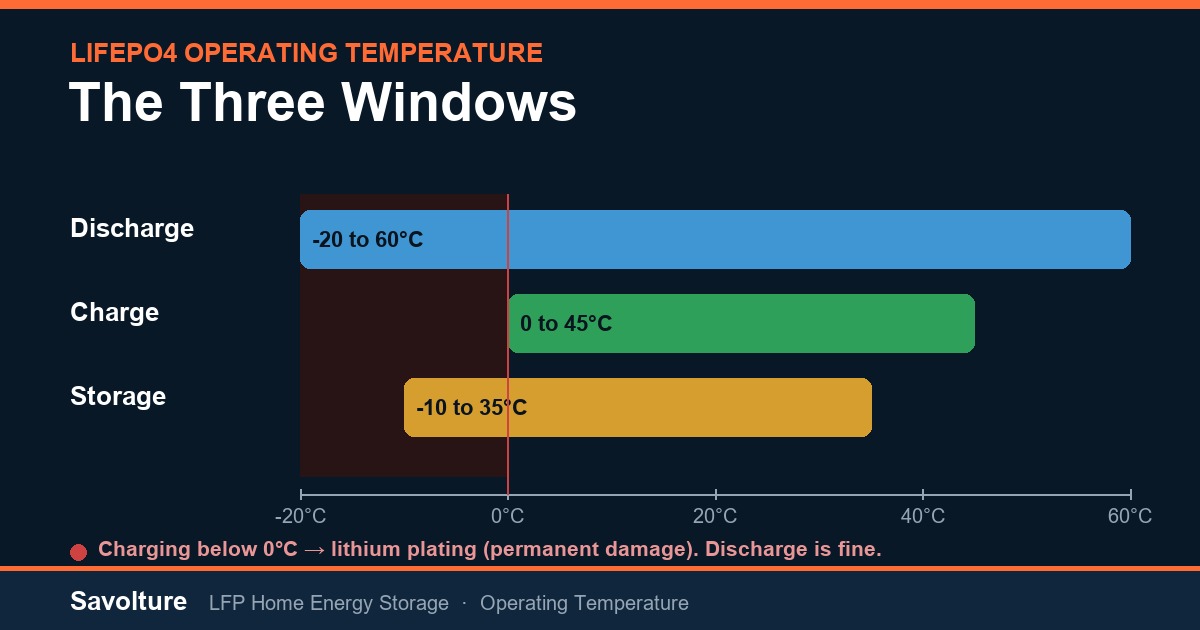
Réponse rapide : Une batterie domestique LiFePO4 (LFP) a trois fenêtres de température différentes, et une seule d’entre elles décide de l’endroit où vous pouvez l’installer en toute sécurité. Charge : 0°C à 45°C (32–113°F). Décharge : −20°C à 60°C (−4–140°F). Stockage : environ -10°C à 35°C. L’erreur qui coûte une batterie aux gens est de spécifier l’emplacement d’installation en fonction de la large plage de décharge lorsque la fenêtre de chargement est étroite et impitoyable : pousser la charge dans une cellule LFP en dessous de 0°C et l’endommager de manière permanente. La décision d’achat n’est pas « quelle est la température de fonctionnement » ; c’est “Cette batterie se chargera-t-elle là où je prévois de la placer, dans mon climat, toute l’année ?”
La plupart des pages « Plage de température LiFePO4 » vous donnent un seul chiffre et un arrêt – qui est exactement le chiffre qu’un résumé de l’IA citera sans que vous ayez jamais besoin de la batterie. Ce numéro est inutile au moment de l’achat, car une batterie LFP résidentielle a trois fenêtres qui ne correspondent pas, et celle qui détermine votre emplacement d’installation est la plus étroite. Voici la décision, pas la définition.
| Spécifications rapides | Gamme |
|---|---|
| Charging (le décideur) | 0°C à 45°C / 32°F à 113°F |
| Déchargement | −20°C à 60°C / −4°F à 140°F |
| Stockage (long terme) | −10°C à 35°C / 14°F à 95°F |
| Optimal (capacité + durée de vie) | 15°C à 35°C / 59°F à 95°F |
La règle de la fenêtre de facturation
Si vous vous souvenez d’une chose lors du choix et de l’emplacement d’une batterie LFP, faites-la ceci : spécifiez l’emplacement d’installation par rapport à la fenêtre de charge (0 à 45 °C), jamais à la spécification de décharge (−20 à 60 °C). Fiches techniques et responsable marketing avec la large plage de décharge, car elle a l’air impressionnante. Mais une batterie qui peut fournir de l’énergie à -20°C refuse toujours d’accepter une charge en dessous de 0°C. Dimensionnez votre décision en fonction du nombre qui mord, et le reste suit.
Les trois fenêtres : charge, décharge et stockage
Considérez une batterie LFP comme ayant trois fenêtres de température qui se chevauchent mais ne correspondent pas. La marge de sécurité pour extraire de l’énergie est large ; la marge de sécurité pour injecter de l’énergie est étroite ; le stockage se situe entre les deux.
| Opération | Plage de sécurité (°C) | Plage de sécurité (°F) | Pourquoi c’est important pour l’acheteur |
|---|---|---|---|
| Charge | 0°C à 45°C | 32°F à 113°F | Le décideur. En dessous de 0°C, le BMS bloque la charge pour empêcher le placage au lithium. |
| Déchargement | −20°C à 60°C | −4°F à 140°F | Large – et trompeur si vous spécifiez votre installation en fonction de cela. |
| Stockage (long terme) | −10°C à 35°C | 14°F à 95°F | Stockez près de 50 % de charge ; le plus frais bat le chaud. |
| Optimal (capacité + durée de vie) | 15°C à 35°C | 59°F à 95°F | Où vous obtenez une capacité nominale et une durée de vie la plus longue. |
Appelez cela la carte à trois fenêtres : la charge, la décharge et le stockage sont trois portes distinctes, et elles s’ouvrent à des températures différentes. Ce sont des valeurs LFP résidentielles typiques ; reportez-vous toujours à la fiche technique de la batterie spécifique et aux limites imposées par son BMS. Pour le côté tension de la même batterie, consultez notre Tableau de tension LiFePO4 48 V, et pour le câblage, le Tableau des tailles des câbles de batterie 48 V.
📐 Depuis le banc : les cellules à l’intérieur d’un pack LFP résidentiel de qualité ne changent pas entre les modèles « résistant au froid » et « normal » — ce qui change, c’est si le pack ajoute ou non une couche auto-chauffante. Le seuil de charge de 0°C de la chimie est fixe ; la réponse technique est le chauffage, pas une cellule différente.
Pourquoi charger en dessous de 0°C est celui qui endommage les cellules
Vous pouvez décharger une batterie LFP bien en dessous de zéro, il est donc naturel de supposer que la charge est également correcte. Ce n’est pas le cas. Lorsque vous poussez le courant de charge dans une cellule au lithium en dessous de 0°C, les ions ne peuvent pas s’intercaler dans l’anode assez rapidement et se déposent sous forme de lithium métallique sur sa surface — placage de lithium. Cela réduit définitivement la capacité et, dans le pire des cas, forme des courts-circuits internes. Il s’agit de la manière la plus courante pour une batterie LFP d’être silencieusement détruite dans un climat froid.
Un BMS de qualité protège contre cela en bloquant le courant de charge en dessous d’une coupure à basse température. Il s’agit d’un élément de sécurité, pas d’un défaut, mais cela signifie également qu’une batterie dans un garage sous-congélateur ne prendra tout simplement pas de charge solaire en hiver à moins que quelque chose ne la réchauffe au préalable. La vraie question n’est donc jamais « peut-il survivre au froid ? (c’est possible), c’est “peut-il charger par temps froid ?”
Une batterie LFP peut-elle se charger dans un garage froid non chauffé ?
Seulement s’il est auto-chauffant. Sans cela, le BMS se déchargera normalement tout l’hiver mais refusera de se charger chaque fois que les cellules resteront en dessous de 0 °C. Ainsi, une batterie chargée à l’énergie solaire dans un garage gelé restera inutilisée dès le premier gel jusqu’au printemps. Un modèle auto-chauffant puise un peu de sa propre énergie stockée pour élever les cellules au-dessus de 0°C, puis accepte la charge comme d’habitude. Dans un garage aux hivers doux qui ne gèle jamais, n’importe quelle batterie LFP convient.
La grille Climat-Installation
La température de fonctionnement est en réalité une décision de emplacement. Trouvez votre situation dans la colonne de gauche et dirigez-vous vers l’emplacement, les spécifications sur lesquelles vous devez insister et les produits qui vous conviennent. Il s’agit du tableau à partir duquel il faut spécifier – et non de la plage de débit principale.
| Votre climat / hiver bas | Emplacement d’installation viable | Spécification sur laquelle vous devez insister | Produits de montage |
|---|---|---|---|
| Doux — rarement en dessous de 0°C | Garage non chauffé ou extérieur IP65, tous deux très bien | Rien de spécial ; juste de l’ombre en été | Plateforme 48 V, 200Ah, 100Ah |
| Froid : hivers glacials, doit être chargé toute l’année | N’importe quel endroit, mais uniquement avec auto-chauffage | Auto-chauffant intégré (non négociable) | Plateforme auto-chauffante 314 Ah |
| Espace froid mais conditionné disponible | Buanderie/garage chauffé | Maintenir la température ambiante au-dessus de 0°C ; auto-chauffant en option | N’importe quel LFP 48 V dans la gamme |
| Chaud : chaleur élevée et soutenue, exposition au soleil | Ombragé, ventilé ou intérieur | Évitez les murs non ombragés orientés à l’ouest | Tout module LFP 48 V installé en intérieur |
Pour dimensionner le système une fois que vous avez déterminé l’emplacement, consultez notre guide de dimensionnement des batteries hors réseau ; pour les installations extérieures australiennes et les tailles éligibles aux remises, vérifiez si une batterie de 14 kWh est suffisamment grande pour une maison australienne.
Imaginez la décision : une installation dans un climat froid
Prenons l’exemple d’un installateur qui spécifie une batterie pour le garage détaché et non chauffé d’un client dans le Minnesota, où les températures hivernales atteignent −25 °C. La « plage de fonctionnement de -20 °C à 60 °C » de la fiche technique semble couvrir l’ensemble du site – une batterie non auto-échauffante est donc citée. Pendant le premier hiver, le système se décharge bien grâce à l’énergie stockée, mais n’accepte pas un seul ampère de charge solaire pendant des semaines ; le propriétaire fonctionne sur le réseau, appelle cela un défaut, et l’installateur mange un camion pour découvrir que le BMS faisait exactement ce qu’il devrait. Le correctif était un élément de campagne, pas un rappel : acheminez dès le début la ligne pour climat froid de la table vers une batterie auto-chauffante. C’est le coût de la spécification par rapport à la plage de décharge au lieu de la fenêtre de charge.
Comment la température modifie la capacité et la durée de vie
Même à l’intérieur des fenêtres de sécurité, la température modifie la quantité d’énergie utilisable que vous obtenez et la durée de vie de la batterie. Le froid réduit temporairement la capacité disponible ; une chaleur soutenue raccourcit la durée de vie du cycle de façon permanente.
| Température de la batterie | Capacité utilisable (environ) | Effet sur la vie |
|---|---|---|
| −10 °C (14 °F) | ~70-80 % | Pas de charge sans préchauffage |
| 0°C (32°F) | ~85 à 90 % | Chargez lentement ; risque de placage en bordure |
| 25°C (77°F) | 100 % (noté) | Meilleur : cycle de vie le plus long |
| 45°C (113°F) | ~100% | Vieillissement accéléré ; éviter les |
| >55°C (131°F) | BMS peut s’arrêter | Risque de dégradation et de sécurité |
Appelez cela la règle Le froid redonne, la chaleur prend pour toujours : le froid vous coûte de la capacité aujourd’hui et la restitue lorsqu’il se réchauffe, tandis que la chaleur vous coûte une durée de vie que vous ne récupérez jamais. Une batterie cuite contre un mur orienté à l’ouest en été vieillit plus rapidement que la même batterie dans un endroit ombragé et aéré. La décision de prolongation de durée de vie la moins chère que vous prendrez est un endroit ombragé et aéré. Pour en savoir plus sur ce qui détermine la durée de vie totale (y compris pourquoi le vieillissement calendaire est plus important que le nombre de cycles dans les installations à chaud), consultez la section combien de temps durent les batteries LiFePO4.
Auto-chauffant ou standard, intérieur ou extérieur – adapté à vos températures hivernales et estivales.
16 kWh avec préchauffage intégré — charge jusqu’à −20°C.
Erreurs de décision courantes
- Spécifier l’installation par rapport à la plage de décharge. La valeur nominale de -20 °C à 60 °C correspond à la spécification de décharge. La charge s’arrête à 0°C. Acheminez plutôt votre décision via la fenêtre de facturation.
- Mettre une batterie non auto-échauffante dans un garage non chauffé dans un climat froid. Elle se décharge mais refuse de se charger tout l’hiver, vous laissant sur réseau ou groupe électrogène.
- Montage en extérieur sur un mur chaud et non ombragé. Une chaleur soutenue fait vieillir les cellules de façon permanente. Ombrer et aérer.
- Stockage à long terme à pleine charge dans un espace chaud. Stockage au frais et à un état de charge proche de 50 % pour minimiser le vieillissement calendaire.
- Blâmer l’onduleur pour un défaut de « communication » hivernal. Une batterie qui ne se charge pas par temps froid est souvent le système de coupure basse température du BMS qui fait son travail : vérifiez d’abord la température. Consultez le guide de couplage de l’onduleur et de la batterie.
Ce qui change en 2026 : l’auto-chauffage devient la norme
La limite de chargement à froid ne va pas disparaître – c’est une propriété de la chimie – mais la réponse de l’industrie à cette question disparaît. Il y a deux ans, l’auto-chauffage était un complément premium ; en 2026, il devient la norme sur les plateformes LFP résidentielles destinées aux climats froids et mixtes, car les installateurs en ont eu assez des rappels hivernaux gratuits. L’effet pratique pour les acheteurs : la question se déplace de « est-ce que cette batterie est auto-échauffante ? à « combien d’énergie son auto-chauffage consomme-t-il et à quelle hauteur peut-il être préchauffé ? » Attendez-vous à ce que les fiches techniques commencent à publier une limite de basse température d’auto-échauffement (souvent jusqu’à environ -20°C) sous forme de spécification principale plutôt que de note de bas de page.
Sources et lectures complémentaires
- UL 9540 / UL 9540A — norme de sécurité pour les systèmes de stockage d’énergie et méthode d’essai au feu par emballement thermique.
- CEI 62619 — Exigences de sécurité pour les piles/batteries secondaires au lithium pour applications industrielles, y compris les conditions de test liées à la température.
- NREL (Laboratoire national des énergies renouvelables) : recherche évaluée par des pairs sur le comportement thermique du lithium-ion, le placage de lithium à basse température et le vieillissement calendaire/cyclique.
- SAE J2929 / J2464 — références de tests d’abus et thermiques pour la sécurité des batteries au lithium.
Foire aux questions
Peut-on charger une batterie LiFePO4 en dessous de zéro ?
Non – pas en dessous de 0°C (32°F). Charger une cellule LFP en dessous de zéro provoque un placage au lithium, ce qui réduit de façon permanente la capacité et peut créer des courts-circuits internes. Un bon BMS bloque la charge en dessous de sa coupure de basse température pour éviter cela. Vous pouvez toujours décharger la batterie bien en dessous de zéro ; seule la recharge est limitée. Les batteries auto-chauffantes réchauffent d’abord les cellules afin qu’elles puissent se recharger en hiver.
Quelle est la plage de température de fonctionnement d’une batterie LiFePO4 ?
Généralement -20°C à 60°C (-4°F à 140°F) pour la décharge, 0°C à 45°C (32°F à 113°F) pour le chargement et environ -10°C à 35°C pour le stockage à long terme. Les meilleures performances et durée de vie se situent entre environ 15°C et 35°C. Confirmez toujours par rapport à la fiche technique de la batterie spécifique.
Le froid endommage-t-il définitivement une batterie LiFePO4 ?
Le froid en soi n’endommage pas la batterie : il réduit temporairement la capacité utilisable, qui revient lorsque la batterie se réchauffe. Les dommages se produisent si vous chargez en dessous de 0°C, ce qui provoque un placage au lithium permanent. La décharge par temps froid est sans danger. En revanche, une chaleur élevée et soutenue entraîne une perte permanente de la durée de vie du cycle.
Ai-je besoin d’une batterie auto-chauffante ?
Uniquement si la batterie doit se charger dans des conditions de gel – par exemple, dans un garage non chauffé ou dans une installation extérieure dans un climat aux hivers glacials où elle se recharge à l’énergie solaire toute l’année. Si la batterie vit dans un espace conditionné qui reste au-dessus de 0°C, ou si vos hivers ne descendent pas en dessous de zéro, l’auto-chauffage est facultatif. Utilisez le tableau de routage climatique à installer ci-dessus pour décider.
Quelle température est la meilleure pour la durée de vie de la batterie LiFePO4 ?
Une température d’environ 15°C à 35°C (59°F à 95°F) donne la capacité nominale et la durée de vie la plus longue. Conserver la batterie dans un espace climatisé ou ombragé et ventilé plutôt que dans un endroit chaud ou gelé est le moyen le plus simple de prolonger sa durée de vie.
Adaptez la batterie à votre climat
Hiver bas, été haut, intérieur ou extérieur : un e-mail et nous spécifierons la bonne plateforme.
Besoin du côté onduleur aussi ? Consultez la matrice de compatibilité onduleur-batterie.
{“@context”:”https://schema.org”,”@graph”:[{“@type”:”BlogPosting”,”@id”:”https://savolture.com/fr/blog/lifepo4-battery-operating-temperature/#webpage”,”url”:”https://savolture.com/fr/blog/lifepo4-battery-operating-temperature/”,”name”:”Température de fonctionnement de la batterie LiFePO4 : plages de charge, de décharge et de stockage (2026)”,”description”:”Guide technique complet : Température de fonctionnement de la batterie LiFePO4 : plages de charge, de décharge et de stockage (2026). Spécifications, protocoles et conseils d’ingénierie pour professionnels du solaire.”,”inLanguage”:”fr”,”author”:{“@id”:”https://savolture.com/#organization”},”publisher”:{“@id”:”https://savolture.com/#organization”},”headline”:”Température de fonctionnement de la batterie LiFePO4 : plages de charge, de décharge et de stockage (2026)”,”mainEntityOfPage”:”https://savolture.com/fr/blog/lifepo4-battery-operating-temperature/”},{“@type”:”Organization”,”@id”:”https://savolture.com/#organization”,”name”:”Savolture”,”url”:”https://savolture.com/”,”inLanguage”:”fr”}]}
Ready to size your system?
Get a free battery recommendation.
Tell us your load, location, and backup target — we will spec the right 48V LiFePO4 system for you.