

Savolture Technical Guide
Tableau des tailles des câbles de batterie 48 V : la règle ÷4 expliquée | Savolture
Réponse rapide : Pour une batterie LFP de 48 V (51,2 V) alimentant un onduleur hybride sur une courte distance (moins de ~5 à 7 pieds / 1,5 à 2 m), dimensionnez le câble de batt...
body.sv-lang-fr { line-height: 1.55; }
.svba-cta-grid{display:grid;grid-template-columns:repeat(auto-fit,minmax(240px,1fr));gap:14px;margin:24px 0}
.svba-cta-card{background:#1a4d33;color:#fff;padding:18px;border-radius:6px;text-align:center}
.svba-cta-card a{color:#fff;text-decoration:none;font-weight:600;display:block}
.svba-cta-card small{display:block;margin-top:6px;font-weight:400;opacity:.85;font-size:13px}
Réponse rapide : Pour une batterie LFP de 48 V (51,2 V) alimentant un onduleur hybride sur une courte distance (moins de ~5 à 7 pieds / 1,5 à 2 m), dimensionnez le câble de batterie principal en fonction du courant continu continu de l’onduleur plus une marge de 25 %, maintenue sous une chute de tension d’environ 3 % : environ 6 AWG (16 mm²) pour 3 kW, 4 AWG (25 mm²) pour 5 kW, 2 AWG (35 mm²) pour 6 kW, 1/0 (50 mm²) pour 8 kW, 2/0 (70 mm²) pour 10 kW, 3/0 (95 mm²) pour 12 kW et 4/0 (120 mm²) pour 15 kW. Les courses plus longues nécessitent la taille supérieure. Vérifiez toujours par rapport au manuel de votre onduleur, à l’intensité admissible NEC 310.16 et à un électricien agréé.
Presque tous les « tableaux des tailles de câbles de batterie » en ligne sont conçus pour les systèmes automobiles et de camping-car 12 V. Si vous en copiez un sur un système de stockage solaire de 48 V, vous dépasserez les spécifications du câble de deux calibres : payez pour le cuivre dont vous n’avez pas besoin et luttez pour sertir les cosses qui ne correspondent pas aux bornes de votre onduleur. La physique qui manque à tout le monde : à 48 V, vous déplacez la même puissance avec un quart du courant, le câble peut donc être considérablement plus petit. Ce tableau est conçu nativement pour le câblage batterie-onduleur LFP 48 V, dimensionné de la manière dont il est réellement réalisé sur le terrain.
Le tableau des tailles des câbles de batterie 48 V (Batterie → Onduleur)
Il s’agit du câble CC principal reliant le parc de batteries (ou son jeu de barres) à l’onduleur hybride. Les tailles supposent une batterie/câble de soudage en cuivre résistant à une température de 105 °C, un court trajet, l’onduleur fonctionnant à une puissance nominale continue et un objectif de chute de tension de 3 % ou moins. La colonne actuelle représente la consommation continue de l’onduleur à 48 V avec une marge de service continu de 25 %.
| Onduleur (continu) | Courant continu continu à 48 V | +25% de marge | Taille du câble (AWG) | Métrique (mm²) |
|---|---|---|---|---|
| 3 kW | ~63 A | ~78 A | 6 AWG | 16 mm² |
| 5 kW | ~104 A | ~130 A | 4 AWG | 25 mm² |
| 6 kW | ~125 A | ~156 A | 2 AWG | 35 mm² |
| 8 kW | ~167 A | ~208 A | 1/0 AWG | 50 mm² |
| 10 kW | ~208 A | ~260 A | 2/0 AWG | 70 mm² |
| 12 kW | ~250 A | ~313 A | 3/0 AWG | 95 mm² |
| 15 kW | ~313 A | ~391 UN | 4/0 AWG | 120 mm² |
Au-dessus de ~12 kW, de nombreux installateurs font passer deux câbles plus petits en parallèle par polarité (par exemple 2× 1/0) au lieu d’un seul 4/0, car un câble plus fin est plus facile à acheminer et à terminer. Pour savoir comment la sortie continue de l’onduleur est liée à la limite de décharge de la batterie, consultez notre guide de couplage de l’onduleur hybride et de la batterie – le câble ne peut être aussi utile que l’indice de décharge continue du BMS qui le sous-tend.
kW de l’onduleur, distance et taille des cosses : un seul e-mail, aucune hypothèse.
La règle ÷4 : pourquoi le 48 V nécessite beaucoup moins de câble que le 12 V
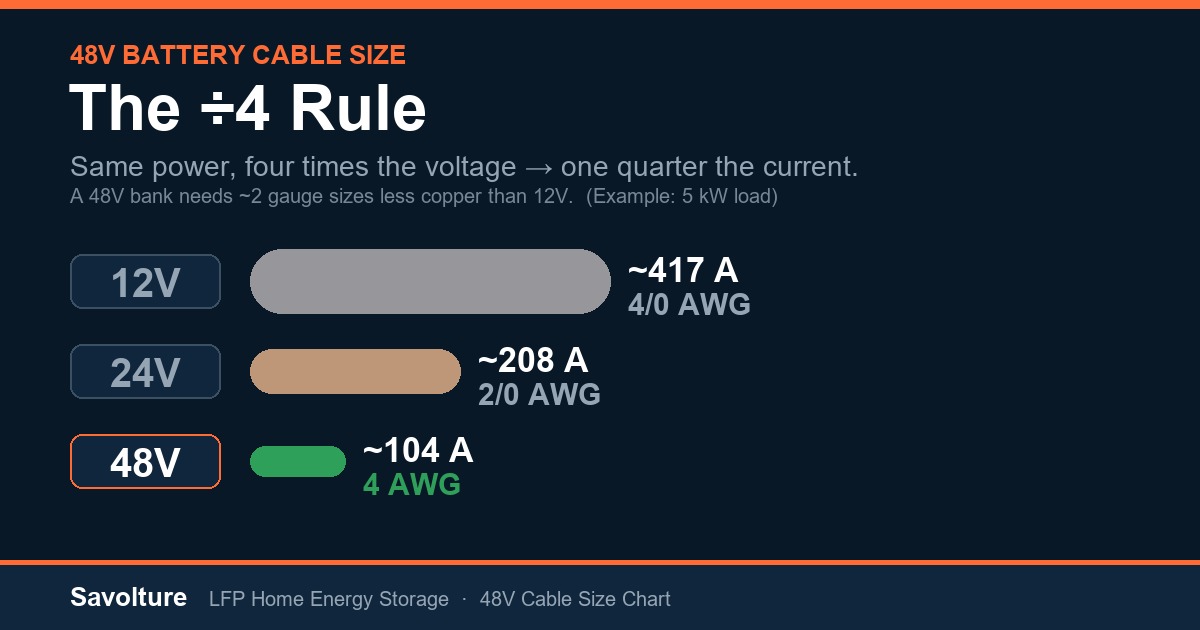
La puissance est égale à Volts fois Ampères. Maintenez la puissance constante et augmentez la tension, et le courant – la chose qui dimensionne réellement un câble – diminue proportionnellement. Un système 48 V fonctionne à quatre fois la tension d’un système 12 V, il consomme donc un quart du courant pour la même puissance. C’est la principale raison pour laquelle le 48 V est devenu l’architecture par défaut pour le stockage domestique.
| Même charge de 5 kW | Tension du système | Courant continu | Câble typique |
|---|---|---|---|
| Système 12V | 12 V | ~417 A | 4/0 AWG (120 mm²) |
| Système 24V | 24 V | ~208 A | 2/0 AWG (70 mm²) |
| Système 48V | 48 V | ~104 A | 4 AWG (25 mm²) |
Les mêmes 5 kW qui nécessitent un câble 4/0 massif et coûteux à 12 V tombent à 4 AWG ordinaire à 48 V – deux tailles de calibre plus petites et une fraction du coût du cuivre. C’est également pourquoi une version 48 V est globalement moins chère et plus propre à câbler. Si vous choisissez toujours une tension système, notre Comparaison 48 V contre 24 V contre 12 V vous présente le compromis complet.
Trois câbles, trois tailles différentes
Le “câble de batterie” n’est pas un seul câble. Une véritable installation 48 V comporte trois circuits distincts, et c’est en les regroupant que les constructions DIY tournent mal :
- Interconnexions de batterie : les cavaliers courts reliant les modules de batterie en série ou en parallèle. Chacun transporte le courant complet de la banque, de sorte qu’ils correspondent (ou dépassent) le calibre du câble principal. Utilisez les cosses et les spécifications de couple du fabricant de la batterie ; une interconnexion desserrée constitue un risque d’incendie.
- Banc de batteries → jeu de barres / shunt : transporte le courant total du système. Dimensionnez-le à la même valeur de graphique que l’exécution principale. Si vous mettez plusieurs armoires de batteries en parallèle, le câble de chaque armoire transporte uniquement sa part, mais l’alimentation combinée vers le jeu de barres transporte la totalité.
- Jeu de barres → onduleur — le tronçon principal dans le tableau ci-dessus. Il s’agit de celui dimensionné pour le courant continu complet de l’onduleur.
Le dimensionnement correct de chaque pied fait partie du traitement de l’onduleur et de la batterie comme un seul système plutôt que comme deux boîtiers. La matrice de compatibilité onduleur-batterie couvre l’aspect communication de ce même principe.
Comment la taille du câble est réellement déterminée
Deux limites déterminent la jauge, et vous choisissez celle qui est la plus stricte :
- Ampacité — le câble doit transporter en toute sécurité le courant continu sans surchauffe. NEC 310.16 et la classification du fabricant de câbles donnent le plafond. Appliquez une marge de 1,25 × pour les charges à service continu (l’onduleur peut tirer la puissance nominale pendant des heures).
- Chute de tension : à distance, un câble fin gaspille de l’énergie sous forme de chaleur et affame l’onduleur en cas de charge élevée. Ciblez 3 % ou moins (2 % pour les versions critiques en termes de performances). La chute de tension évolue en fonction de la longueur de course, donc une jauge qui convient à 5 pieds peut nécessiter une augmentation de taille à 15 pieds.
La formule de chute de tension pour un fonctionnement en courant continu est Vd = (2 × L × I × R) ÷ 1 000, où L est la longueur unidirectionnelle en pieds, I le courant et R est la résistance du câble par 1 000 pieds. Le « 2 × » représente les conducteurs positifs et négatifs. En pratique : gardez les câbles de batterie aussi courts et directs que la disposition le permet, et lorsqu’une course devient longue, augmentez la taille plutôt que de rechercher le pourcentage exact. La tension au repos est une question distincte — pour cela, consultez notre Tableau de tension LiFePO4 48 V.
N’oubliez pas le fusible et les cosses
Un câble correctement dimensionné nécessite toujours une protection contre les surintensités et des terminaisons appropriées :
- Fusible de classe T entre le positif de la batterie et l’onduleur, évalué au-dessus du courant continu de l’onduleur mais égal ou inférieur à l’intensité admissible du câble. Les banques LFP peuvent fournir un énorme courant de défaut, et un fusible de classe T a la capacité d’interruption nécessaire pour le gérer, là où les fusibles automobiles (ANL) ne le peuvent pas.
- Cosses et sertissages adaptés au calibre du câble et à la taille du goujon de borne. Une cosse en cuivre étamé à sertissage hydraulique et serrée selon les spécifications fait la différence entre une connexion propre et un joint chaud à haute résistance qui se desserre avec le temps.
- Faites correspondre la borne de l’onduleur : vérifiez la taille maximale des cosses acceptées par les bornes de la batterie de l’onduleur avant d’acheter le câble. C’est exactement pourquoi le surdimensionnement d’un tableau 12 V se retourne contre lui : les cosses 4/0 ne conviennent pas à une borne conçue pour 2 AWG.
Erreurs courantes de dimensionnement des câbles 48 V
- Utiliser une carte 12 V sur un système 48 V. L’erreur la plus courante que nous constatons. Les installateurs que nous fournissons et qui viennent du monde 12 V dépassent régulièrement les spécifications de deux jauges – gaspillant de l’argent et se retrouvant avec des cosses qui ne conviennent pas à l’onduleur. Utilisez une carte native 48 V.
- Dimensionnement à la puissance nominale, en ignorant le service continu. Un onduleur de 12 kW peut tirer 12 kW pendant des heures. Taille au courant continu avec une marge de 1,25×, et non à un bref chiffre de pointe.
- Ignorer la longueur du parcours. Un câble qui transmet le courant admissible peut toujours tomber en panne en cas de chute de tension sur une longue distance. Vérifiez les deux ; augmenter la taille pour la distance.
- Cosses dépareillées ou bornes sous-serties. Un mauvais sertissage crée un point chaud à haute résistance. Utilisez la bonne cosse et une sertisseuse appropriée, pas un marteau.
- Pas de fusible de classe T, ou un fusible sous-estimé. Le courant de défaut du LFP est élevé ; le fusible doit avoir le calibre d’interruption correspondant.
- Mélanger les calibres des câbles sur des batteries parallèles. Des longueurs de câble ou des calibres inégaux font qu’une batterie effectue plus de travail, vieillit plus rapidement et se déclenche en premier. Gardez les exécutions parallèles identiques.
- L’oubli de la température affecte la batterie située derrière le câble. Le câble transporte du courant, mais le pack situé derrière lui a ses propres limites de température, en particulier pour le chargement dans des climats froids. Consultez notre Guide des températures de fonctionnement LiFePO4 avant d’installer la batterie dans un espace non chauffé.
Sources et lectures complémentaires
- NEC (NFPA 70) Article 310.16 — tableaux d’intensité admissible des conducteurs pour la capacité de transport de courant.
- Article 706 du NEC – Exigences d’installation du système de stockage d’énergie.
- ABYC E-11 — Norme sur les systèmes électriques CA et CC (la référence marine largement utilisée pour les meilleures pratiques de câblage de batterie CC).
- Blue Sea Systems — Assistant de circuit CC et méthodologie d’intensité admissible/chute de tension pour le câblage de la batterie.
Foire aux questions
De quelle taille de câble ai-je besoin pour un onduleur 48 V 5 000 W ?
Pour un onduleur de 5 kW (5 000 W) sur une batterie de 48 V avec une courte distance inférieure à environ 5 à 7 pieds, un câble de batterie en cuivre de 4 AWG (25 mm²) est le choix typique : il couvre la consommation continue d’environ 104 A plus une marge de 25 % à une chute de tension inférieure à 3 %. Pour des courses plus longues, passez à 2 AWG. Vérifiez toujours la taille maximale des cosses acceptées par les bornes de votre onduleur.
Puis-je utiliser un tableau des câbles de batterie 12 V pour un système 48 V ?
Non, et cela surdimensionne considérablement le câble. Un système 48 V transporte un quart du courant d’un système 12 V pour la même puissance, il a donc besoin d’environ deux tailles de calibre plus petites. L’utilisation d’une carte 12 V gaspille de l’argent en cuivre et vous laisse souvent avec des cosses trop grosses pour les bornes de l’onduleur. Utilisez une carte native 48 V.
Comment prendre en compte la longueur du câble et la chute de tension ?
Dimensionnez d’abord l’intensité admissible (le câble doit transporter le courant continu en toute sécurité), puis vérifiez la chute de tension sur la longueur réelle de votre câble, en ciblant 3 % ou moins. La chute de tension augmente avec la distance, donc une jauge adéquate à 5 pieds peut nécessiter une augmentation à 15 pieds. En cas de doute, optez pour une taille plus grande plutôt que de faire passer un câble fin sur une longue distance.
Quel fusible passe entre une batterie 48V et l’onduleur ?
Un fusible de classe T sur le positif de la batterie, évalué au-dessus du courant continu de l’onduleur mais égal ou inférieur à l’intensité admissible du câble. Les batteries LFP peuvent fournir un courant de défaut très élevé, et un fusible de classe T a le taux d’interruption élevé nécessaire pour le supprimer en toute sécurité – ce que les fusibles de type automobile ne peuvent pas fournir.
Ce tableau remplace-t-il un électricien ou un code local ?
Non. Il s’agit d’une référence de planification pour vous aider à définir une version 48 V. Le dimensionnement final du câble doit suivre le manuel de votre onduleur, NEC (et tout amendement local) ou ABYC pour la marine, et le jugement d’un électricien agréé. Les codes et les exigences de l’onduleur ont priorité sur tout tableau général.
Combien de temps durera réellement la batterie derrière ces câbles ?
Un pack LFP de qualité est généralement garanti pour plus de 6 000 cycles, mais la durée de vie réelle dépend de deux horloges indépendantes : le débit de cycle et le vieillissement du calendrier, et la température est le plus grand accélérateur de l’horloge du calendrier. Pour obtenir une description complète, consultez combien de temps durent les batteries LiFePO4.
Obtenez le bon câble du premier coup
Modèle d’onduleur, distance, charges cibles — nous renvoyons le calibre de câble et la nomenclature correspondants.
Parcourez la série d’onduleurs hybrides ou commencez par notre guide de dimensionnement des batteries hors réseau si vous choisissez toujours la capacité. Nouveau sur le 48V ? Lisez d’abord 48 V contre 24 V contre 12 V.
{“@context”:”https://schema.org”,”@graph”:[{“@type”:”BlogPosting”,”@id”:”https://savolture.com/fr/blog/48v-battery-cable-size-chart/#webpage”,”url”:”https://savolture.com/fr/blog/48v-battery-cable-size-chart/”,”name”:”Tableau des tailles des câbles de batterie 48 V : la règle ÷4 expliquée”,”description”:”Guide technique complet : Tableau des tailles des câbles de batterie 48 V : la règle ÷4 expliquée. Spécifications, protocoles et conseils d’ingénierie pour professionnels du solaire.”,”inLanguage”:”fr”,”author”:{“@id”:”https://savolture.com/#organization”},”publisher”:{“@id”:”https://savolture.com/#organization”},”headline”:”Tableau des tailles des câbles de batterie 48 V : la règle ÷4 expliquée”,”mainEntityOfPage”:”https://savolture.com/fr/blog/48v-battery-cable-size-chart/”},{“@type”:”Organization”,”@id”:”https://savolture.com/#organization”,”name”:”Savolture”,”url”:”https://savolture.com/”,”inLanguage”:”fr”}]}
Ready to size your system?
Get a free battery recommendation.
Tell us your load, location, and backup target — we will spec the right 48V LiFePO4 system for you.