

Savolture Technical Guide
Tableau de tension de la batterie LiFePO4 48 V : état de charge et tensions de charge (2026) | Savolture
A 48V LiFePO4 battery is nominally 51.2V, charges to ~57.6V, and reads ~48V empty. Here's the real state-of-charge voltage chart and charging setpoints - plus why the flat LFP curve means voltage alone can't tell you the exact charge.
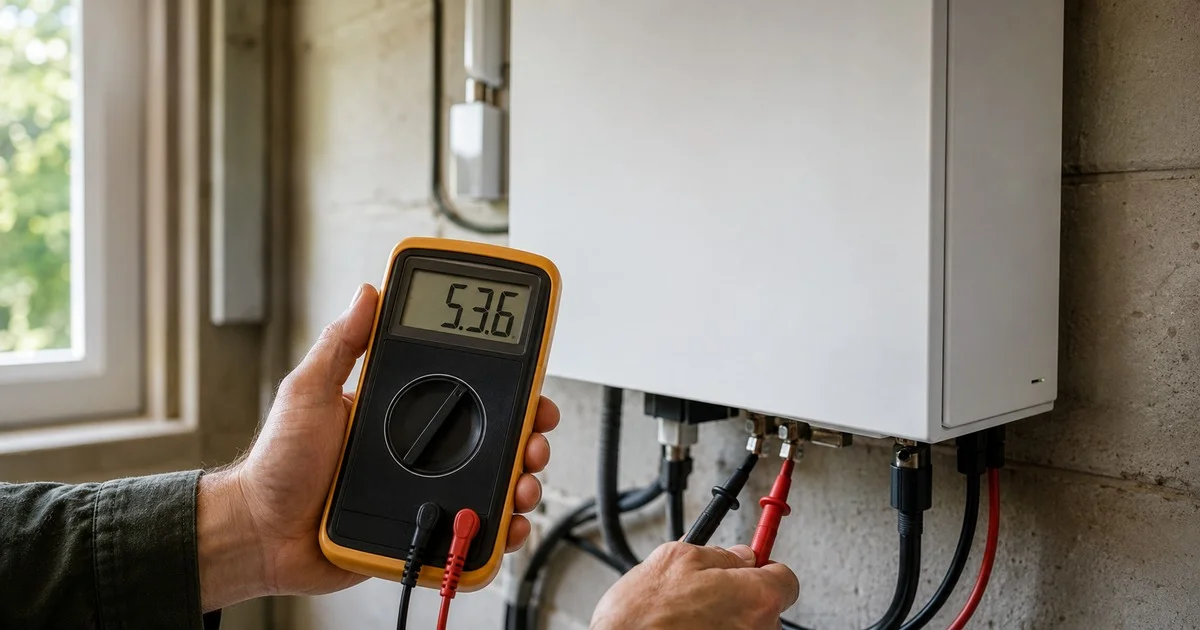
The key insight
LFP voltage is a map, not a fuel gauge 20-90% charge spans only ~52-53.6V; use a shunt or BMS state of charge for accuracy.body.sv-lang-fr { line-height: 1.55; }
.svba-cta-grid{display:grid;grid-template-columns:repeat(auto-fit,minmax(240px,1fr));gap:14px;margin:24px 0}
.svba-cta-card{background:#1a4d33;color:#fff;padding:18px;border-radius:6px;text-align:center}
.svba-cta-card a{color:#fff;text-decoration:none;font-weight:600;display:block}
.svba-cta-card small{display:block;margin-top:6px;font-weight:400;opacity:.85;font-size:13px}
Si vous venez de câbler une banque LiFePO4 48 V et que le compteur indique 51, 52, peut-être 54 volts, votre première pensée est probablement « ai-je acheté un raté – pourquoi n’atteindra-t-il pas 48… ou 58 ? Ce n’est pas le cas, et voici la version courte : une batterie LFP « 48 V » est nominalement 51,2 V, elle se charge à près de 58 V et elle passe presque toute sa vie dans une bande étroite de 52 à 54 V. Le numéro sur la boîte est une étiquette et non une tension de fonctionnement. Vous trouverez ci-dessous le véritable tableau de tension LiFePO4 48 V – et la seule chose que la plupart des tableaux classés pour cette recherche se trompent : pour LiFePO4, la tension est un mauvais moyen de lire l’état de charge.
Référence rapide : Une batterie LiFePO4 48 V est un pack de 16 cellules (16S), nominal 51,2 V (16 × 3,2 V). Reposé et plein, il se situe à proximité de 54,4 V ; il se charge (absorption) à environ 56,8-57,6 V ; la moitié de la charge est proche de 52,8 V ; pratique à vide, c’est environ 48V ; et le BMS coupe près de 40V (2,5V/cellule) pour protéger les cellules. Étant donné que la courbe LFP est plate, une charge de 20 à 90 % ne couvre que ~52 à 53,6 V — donc un voltmètre vous indique « plein, à moitié ou vide », et non un pourcentage exact. Pour cela, utilisez un moniteur shunt ou un onduleur qui lit le BMS via CAN/RS485.
Tableau de tension LiFePO4 48 V (51,2 V) – état de charge
Il s’agit de tensions de repos (pas de courant de charge ou de décharge, réglées pendant plus de 30 minutes) pour un pack LiFePO4 16S à température ambiante (~25°C / 77°F). La colonne par cellule vous permet de vérifier la lecture de votre BMS.
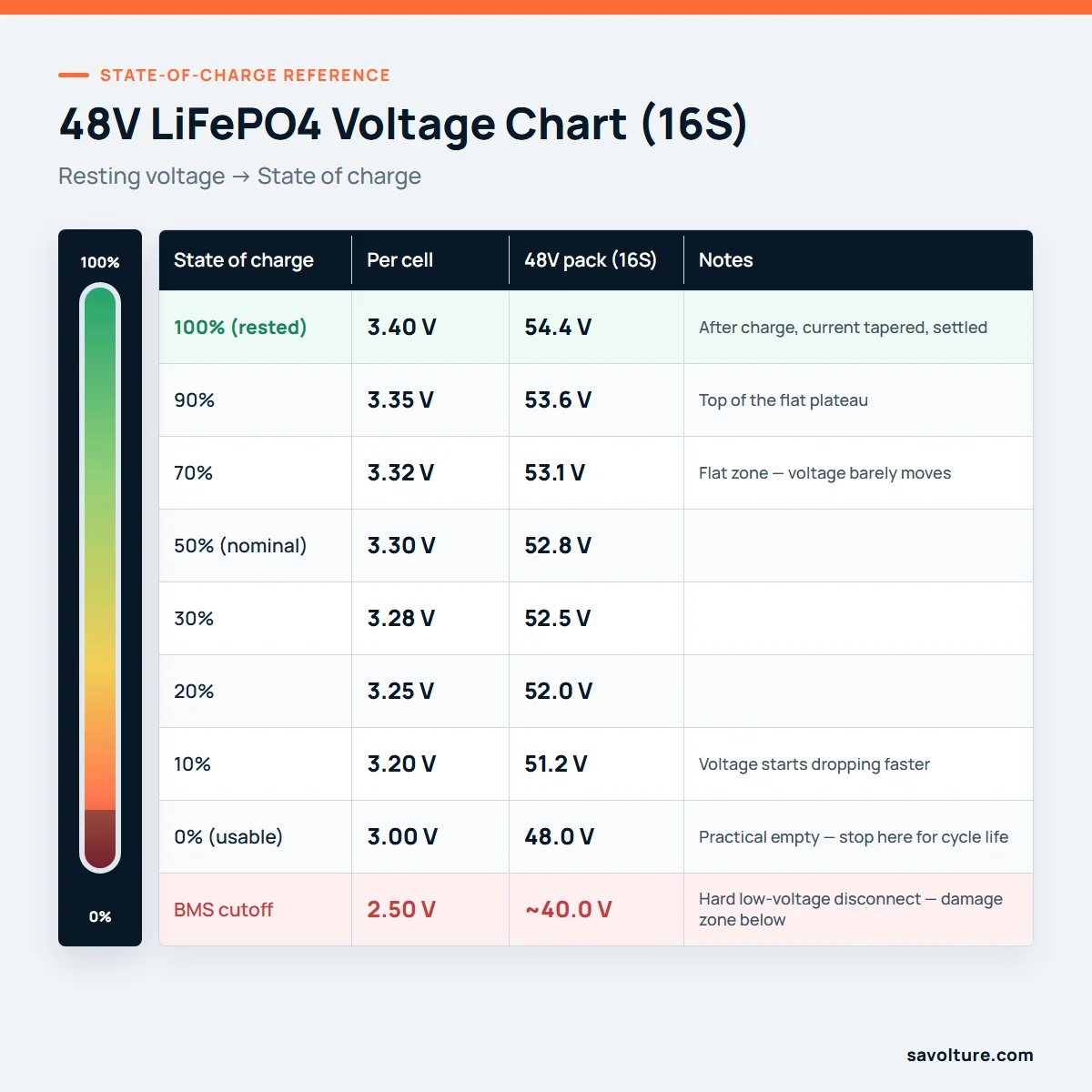
| État de charge | Par cellule | Pack 48V (16S) | Remarques |
|---|---|---|---|
| 100 % (reposé) | 3,40 V | 54,4 V | Après charge, courant réduit, réglé |
| 90% | 3,35 V | 53,6 V | Haut du plateau plat |
| 70% | 3,32 V | 53,1 V | Zone plate – la tension bouge à peine |
| 50 % (nominal) | 3,30 V | 52,8 V | |
| 30% | 3,28 V | 52,5 V | |
| 20% | 3,25 V | 52,0 V | |
| 10% | 3,20 V | 51,2 V | La tension commence à chuter plus rapidement |
| 0% (utilisable) | 3,00 V | 48,0 V | Vide pratique – arrêtez-vous ici pour la durée de vie |
| Seuil BMS | 2,50 V | ~40,0 V | Déconnexion dure basse tension – zone de dommages ci-dessous |
Les valeurs sont typiques des packs domestiques 16S LiFePO4 modernes et varient de ±0,1 à 0,2 V/cellule selon la marque et la température. Remarquez à quel point le milieu est compressé : la planéité est toute l’histoire, et c’est là que la plupart des tableaux de tension induisent les gens en erreur.
La tension est une carte, pas une jauge de carburant : le piège de la zone plate
Regardez à nouveau le graphique. Entre 20 % et 90 % de charge, le pack passe d’environ 52,0 V à 53,6 V, soit environ 1,5 V sur 70 % de la capacité utilisable. Appelez cela le piège à zone plate : ce plateau est exactement ce qui rend le LiFePO4 excellent sous charge (il maintient la tension au lieu de s’affaisser), mais cela signifie également qu’une erreur de lecture de 0,1 V équivaut à une erreur de 20 à 30 % dans votre estimation de l’état de charge.
C’est là que de nombreux graphiques de tension LiFePO4 populaires tournent mal : plusieurs décrivent la courbe comme « un petit changement de tension provoque un petit changement de charge », ce qui est inverse. C’est le contraire : dans la zone plate, un petit changement de tension cache un grand changement de charge. Ainsi, un graphique de tension de repos n’est fiable que pour trois choses : confirmer qu’un pack est à peu près plein, à moitié ou vide, et définir des limites de charge et de coupure sûres. Ce n’est pas fiable pour “Il me reste 47 %”.
Pour un nombre précis, vous avez besoin d’un moniteur de batterie basé sur un shunt (compteur de coulomb) qui mesure le courant entrant et sortant, ou d’un onduleur en boucle fermée qui lit le propre état de charge du BMS via CAN/RS485. Si un SoC précis est important pour le dimensionnement des sauvegardes – et c’est le cas – prévoyez l’un d’entre eux, pas un voltmètre. Les onduleurs capables de lire le BMS sont décrits dans notre guide de compatibilité onduleur-batterie.
Pourquoi votre batterie 48 V indique 51-54 V (et n’atteindra pas 58 V) – et c’est normal
C’est la question qui se cache derrière la moitié de la question « Ma batterie est-elle cassée ? » panique, alors répondons-y directement. La tension que vous voyez réellement dépend de ce que fait la batterie en ce moment :
- Au repos, un pack complet indique ~54,4 V, et non 58 V. Les chiffres de 56,8 à 58,4 V sont des tensions de charge : le chargeur pousse le pack là-haut, et une fois qu’il s’arrête et que le pack se stabilise, il retombe aux 54 s les plus bas. Une batterie LFP pleine et reposée à 54 V fait exactement ce qu’elle devrait.
- En cas de décharge, la tension chute. Une charge lourde peut faire descendre momentanément un pack de 53 V à 50-51 V sans que la batterie soit presque vide. La tension récupère lorsque la charge chute.
- « Il ne chargera pas au-delà de 51 à 52 V » signifie généralement qu’il est encore à mi-charge ou que la charge le masque – ou que la tension de charge de l’onduleur est réglée trop basse. Un chargeur correctement configuré prendra un pack 16S jusqu’à ~56,8-57,6V pendant l’absorption. (Il y a un diagnostic complet pour cela ci-dessous.)
- Le temps froid indique une valeur plus basse et offre une capacité utilisable moindre – suffisamment pour que la température mérite sa propre section, ensuite.
Donc, avant de décider qu’une batterie est défectueuse : reposez-la, vérifiez si elle est en charge ou en charge et confirmez vos paramètres de charge. Neuf fois sur dix, la « mauvaise » tension est la faute de la carte et non de la batterie.
La température change chaque chiffre du graphique
Chaque tension indiquée dans le tableau ci-dessus suppose un pack confortable de ~25°C (77°F). Déplacez la batterie dans un garage froid ou dans un toit chaud et deux choses changent : la capacité utilisable et les règles de charge. C’est la partie que presque aucune page de tableau de tension ne couvre, et c’est là que les installateurs se retrouvent pris.
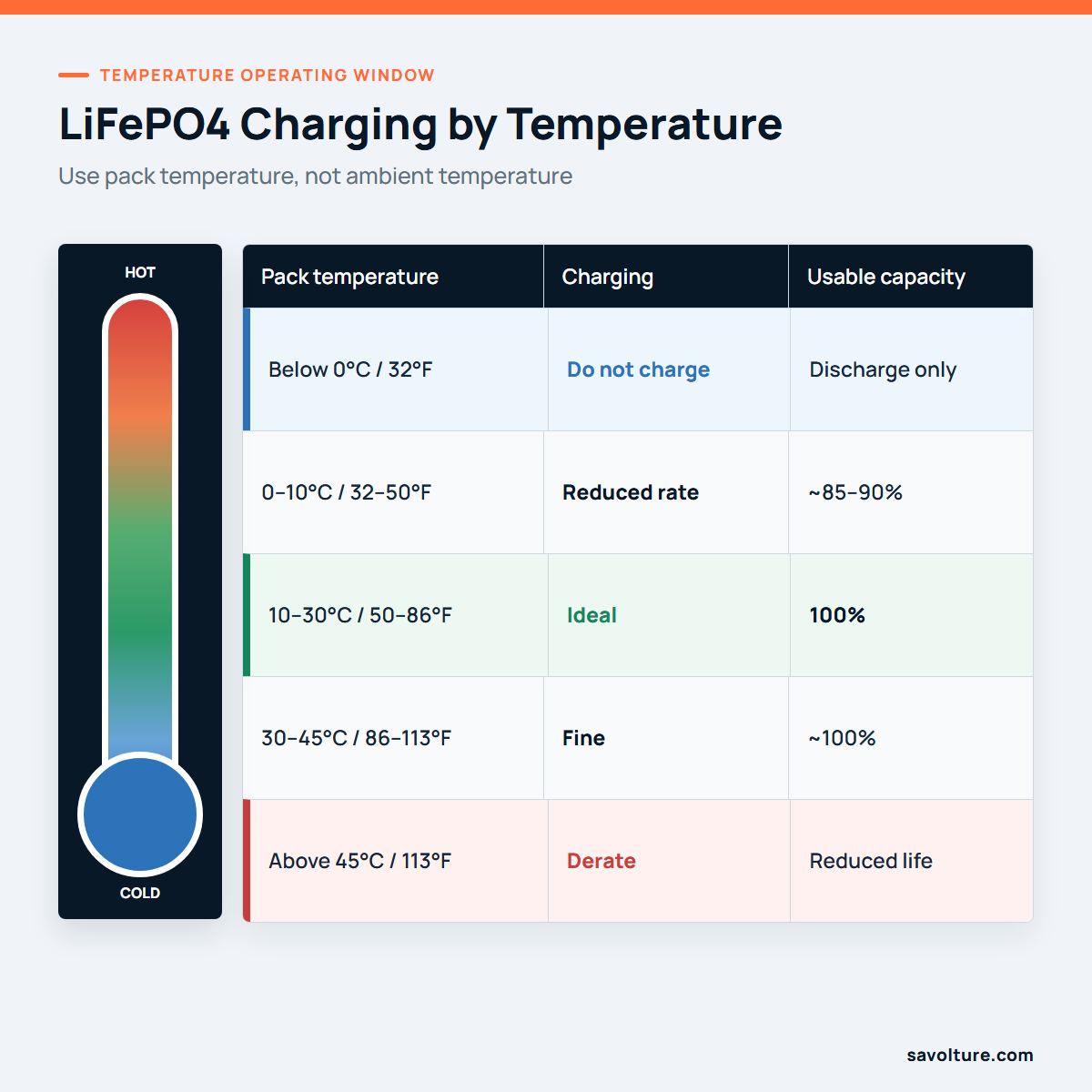
| Température du pack | Chargement | Capacité utilisable | Que faire |
|---|---|---|---|
| En dessous de 0°C / 32°F | Ne chargez pas | Décharge uniquement | Charger une cellule LFP froide plaque le lithium et l’endommage de manière permanente. Un bon bloc BMS se charge ici ; recherchez l’auto-chauffage si vous installez dans un espace de congélation. |
| 0 à 10 °C / 32 à 50 °F | Tarif réduit | ~85 à 90 % | Chargez lentement ; le pack accepte le courant mais ne doit pas être poussé trop fort. |
| 10-30°C / 50-86°F | Idéal | 100% | Conditions de référence — le tableau ci-dessus est exact ici. |
| 30 à 45 °C / 86 à 113 °F | Très bien | ~100% | Fonctionnement normal ; évitez simplement de sceller le pack dans une boîte chaude non ventilée. |
| Au-dessus de 45°C / 113°F | Déclasser | Durée de vie réduite | La chaleur soutenue est le plus grand accélérateur du vieillissement calendaire : gardez le sac à l’abri du soleil direct. |
Deux choses surprennent les gens ici. Premièrement, la décharge tolère bien mieux le froid que la charge : un pack LFP fournira volontiers une puissance bien en dessous de zéro ; il ne doit tout simplement pas recevoir de frais à cet endroit. Deuxièmement – et cela fait trébucher quiconque vient du plomb – LiFePO4 a besoin de peu ou pas de compensation de température sur la tension de charge. Le coefficient de compensation de température appliqué par votre ancien chargeur AGM (augmenter la tension par temps froid, l’abaisser par temps chaud) est incorrect pour le LFP. Réglez la compensation de température sur zéro et laissez la chimie plate et la coupure à basse température du BMS faire le travail. L’application d’habitudes au plomb à un pack de lithium est l’une des erreurs de configuration les plus courantes que nous constatons. Pour connaître les plages complètes de charge, de décharge et de stockage, y compris les températures exactes auxquelles l’auto-échauffement est rentable, consultez notre guide des températures de fonctionnement LiFePO4.
Tensions de charge 48 V LiFePO4 : vrac, absorption, float
Si vous configurez un chargeur ou un onduleur hybride, ces points de consigne sont plus importants que le tableau SoC, car ils déterminent la durée de vie. Pour un pack LiFePO4 16S :
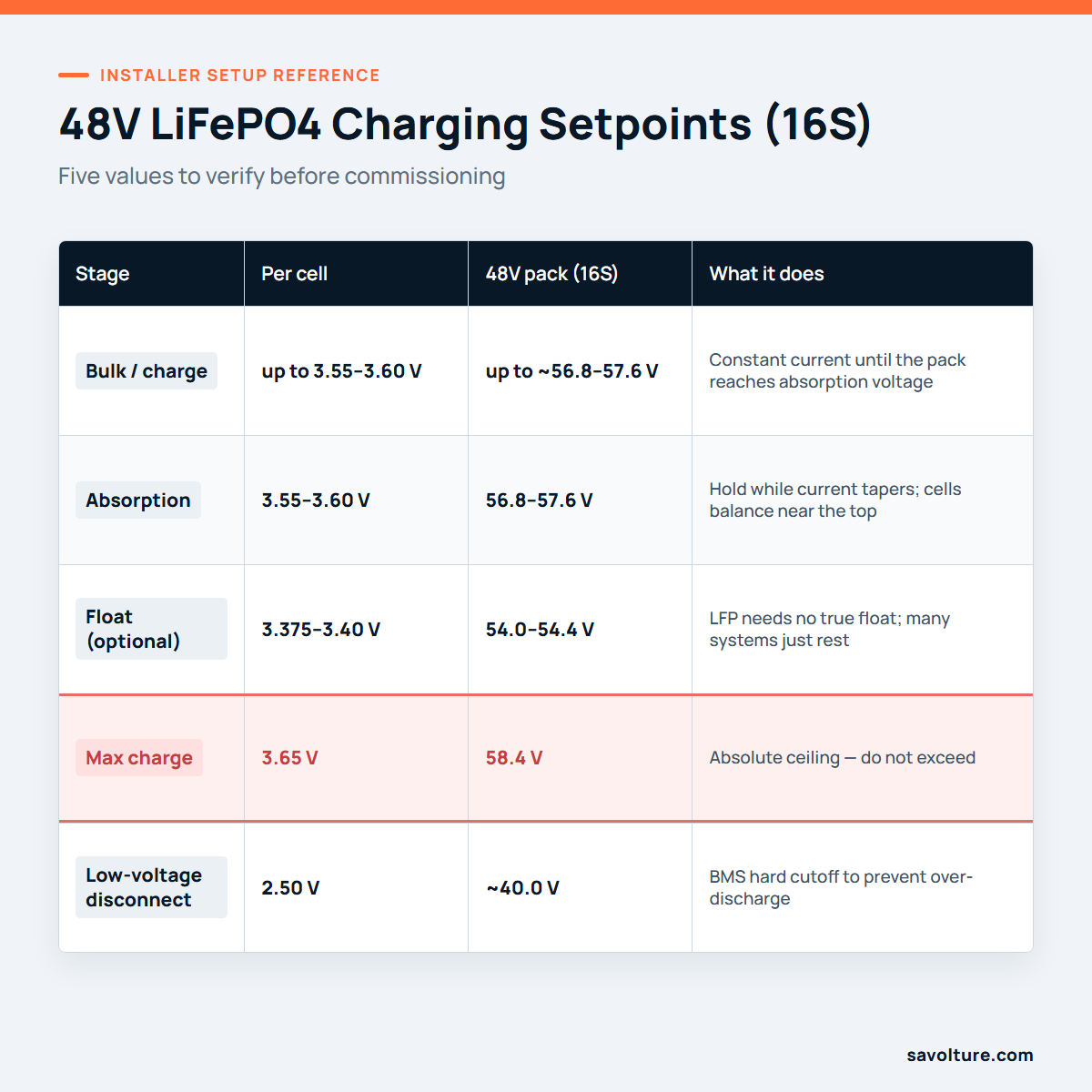
| Scène | Par cellule | Pack 48V (16S) | Ce que ça fait |
|---|---|---|---|
| Vrac/facturation | jusqu’à 3,55-3,60 V | jusqu’à ~56,8-57,6 V | Courant constant jusqu’à ce que le pack atteigne la tension d’absorption |
| Absorption | 3,55 à 3,60 V | 56,8–57,6 V | Tenez pendant que le courant diminue ; les cellules s’équilibrent près du sommet |
| Flottant (facultatif) | 3,375-3,40 V | 54,0 à 54,4 V | LFP n’a pas besoin de véritable flotteur ; de nombreux systèmes se reposent |
| Charge maximale | 3,65 V | 58,4 V | Plafond absolu – ne pas dépasser |
| Déconnexion basse tension | 2,50 V | ~40,0 V | Coupure dure du BMS pour éviter une décharge excessive |
Un profil courant et conservateur est l’absorption à 56,8-57,6 V avec peu ou pas de flotteur (ou un faible flotteur de 54 V), qui remplit le pack sans le stationner à la tension maximale à chaque cycle. Reportez-vous toujours à la fiche technique de votre batterie spécifique : les seuils BMS y sont définis par cellule, et l’onduleur n’a besoin que de charger à l’intérieur d’eux. Pour connaître le câblage au niveau du modèle et les étapes du menu, consultez le guide de couplage de l’onduleur hybride 48 V.
Deye, Growatt, Sol-Ark, GoodWe — nous confirmons les bonnes valeurs de volume/absorption/flotteur avant d’acheter.
Modules rack serveur 10,24 kWh et 16 kWh — prêts pour la boucle fermée CAN/RS485.
Pourquoi les mêmes frais indiquent un pourcentage inférieur à mesure que votre colis vieillit
Voici une question que nous recevons des propriétaires un an ou deux plus tard : “Rien n’a changé, mais la batterie qui affichait 99 % après une charge complète atteint désormais 97 % et elle semble se vider plus rapidement. Est-ce qu’elle est en train de mourir ?” Presque toujours, non – vous voyez ce que nous appellerons le décalage de tension d’évanouissement de capacité, et il s’agit d’un comportement normal du LFP plutôt que d’un défaut.
Deux choses distinctes se produisent lorsque les cellules accumulent des cycles et du temps calendaire :
- Le pack contient véritablement un peu moins d’énergie. Le LFP s’estompe lentement : un pack de qualité a encore environ 80 % de sa capacité d’origine après plusieurs milliers de cycles. Mais cette année, « 100 % plein » stocke moins de kWh qu’à l’état neuf, donc la même charge domestique le draine un peu plus rapidement. C’est la moitié “se vide plus rapidement”. La vitesse à laquelle cette horloge fonctionne réellement dépend de la température et de la profondeur de décharge. Nous décomposons les calculs en combien de temps durent les batteries LiFePO4.
- L’estimation du pourcentage du BMS dérive entre les étalonnages. Un BMS apprend la véritable capacité du pack en surveillant les cycles complets de charge/décharge. Si vous portez rarement le pack à une absorption complète de 100 %, sa référence interne « pleine » se désynchronise lentement et le pourcentage affiché s’écarte. Il s’agit de la moitié « n’atteindra plus 100 % » – et c’est souvent réparable.
Le tableau de tension lui-même bouge à peine par cellule à mesure que le pack vieillit – ce qui change, c’est que la résistance interne augmente, de sorte qu’un pack vieillissant s’affaisse davantage sous la charge et récupère plus lentement, ce qui rend une lecture de tension uniquement encore moins fiable qu’elle ne l’était lorsqu’elle était neuve. C’est une raison supplémentaire pour laquelle le piège à zone plate s’aggrave avec l’âge, et non s’améliore.
Que faire réellement : exécutez une charge complète jusqu’à une absorption complète toutes les quelques semaines pour permettre au BMS de se recalibrer ; une à deux fois par an, mesurer la capacité réelle avec un shunt sur une décharge complète et comparer avec la plaque signalétique Ah. Un fondu progressif vers environ 80 % de la durée de vie nominale est la durée de vie attendue, et non un échec : planifiez le remplacement en pensant uniquement lorsque vous descendez bien en dessous ou voyez une cellule s’écarter du pack.
Comment lire l’état de charge avec précision
Parce que la tension n’est pas fiable dans la zone plate, voici la hiérarchie pratique, du pire au meilleur :
- Tension de repos : gratuite, mais valable uniquement pour “plein/à moitié/vide”. Reposez d’abord la meute, sinon cela n’a aucun sens.
- Compteur shunt/coulomb — mesure le courant entrant et sortant ; précis à quelques pour cent une fois calibré. Le bon outil pour une banque DIY sans communications en boucle fermée.
- Lecture BMS en boucle fermée — le propre BMS de la batterie signale l’état de charge à l’onduleur via CAN/RS485, et l’onduleur affiche et agit sur le nombre réel. C’est le plus précis et le moins compliqué, car c’est la batterie qui compte.
Pour un système de sauvegarde domestique où vous devez faire confiance au « % restant » sur l’écran, une batterie qui signale un véritable SoC à un onduleur hybride ouvert mérite d’être spécifiée dès le départ. C’est le couplage en boucle fermée que nous confirmons avant d’acheter.
Obtenez les bons points de consigne de tension de charge et vérifiez la compatibilité CAN/RS485 avant de commander.
Deye, Growatt, Sol-Ark, GoodWe – quels protocoles fonctionnent, lesquels ne fonctionnent pas.
Diagnostic : “il charge à 51 V et s’arrête” — le 3-check
De chaque message “ma batterie est cassée”, la version spécifique la plus courante est une sorte de “elle ne chargera pas au-delà de 51 points de volts.” Avant de suspecter le pack, effectuez ces trois vérifications dans l’ordre – le défaut se situe bien plus souvent en amont de la batterie.
- Est-il réellement au repos ou fonctionne-t-il toujours ? Un pack indiquant 51 V sous charge peut être rempli à 60–70 % – la charge fait baisser la tension aux bornes. Débranchez la charge, attendez et relisez. S’il monte dans les 52 ou 53, il n’y a jamais eu de problème.
- Quelle est la tension de charge de l’onduleur réglée ? C’est le coupable habituel. Si l’absorption est configurée, par exemple, entre 51 et 52 V (un reste d’acide de plomb ou une valeur personnalisée trop conservatrice), le chargeur cesse de pousser exactement là où vous le voyez caler. Un pack LFP 16S nécessite une absorption à 56,8–57,6 V. Augmentez la consigne jusqu’à la valeur de la fiche technique de la batterie et le “plafond” disparaît. Si vous utilisez un onduleur Deye, consultez la Liste des batteries approuvées Deye pour connaître les codes de configuration corrects.
- Le BMS retient-il pour une vraie raison ? Si la tension de charge est correcte et que le pack refuse toujours de monter, le BMS peut limiter la charge parce qu’il fait trop froid (voir la section sur la température – en dessous de 0°C, il bloquera complètement la charge) ou parce que une cellule s’est enfuie des autres et a atteint son plafond par cellule plus tôt. Un onduleur en boucle fermée ou l’application de la batterie affichera les tensions par cellule ; une seule cellule située en hauteur alors que la moyenne du pack est faible signifie que le pack doit être équilibré et non remplacé.
Ce n’est qu’après les trois vérifications qu’il vaut la peine de s’adresser au fournisseur. En pratique, l’étape 2 résout la grande majorité de ces problèmes.
Erreurs courantes lors de la lecture de la tension LFP de 48 V
Les appels d’assistance que nous recevons des installateurs lisant un pack 48 V sur le terrain se résument presque toujours aux mêmes erreurs de lecture ci-dessous – presque jamais à une batterie défectueuse.
- Lecture du SoC sur un pack chargé. Un voltmètre sur une batterie en charge ou en décharge vous montre la charge, pas la charge. Reposez-le d’abord.
- Je m’attends à ce qu’un pack complet indique 58 V. 58 V est une tension de charge ; un pack LFP complet reposé lit ~ 54,4 V. Les deux sont corrects.
- Faire confiance à la tension dans la zone plate. Entre 20 et 90 %, la tension est presque inutile comme jauge : utilisez un shunt ou des données BMS en boucle fermée.
- Report de la compensation de température au plomb. LFP veut une compensation de température nulle sur la tension de charge ; la seule règle de température qui compte est « pas de chargement en dessous de zéro ».
- Régler l’absorption trop élevée. Pousser vers 58,4 V à chaque cycle met les cellules sous pression et ne génère presque aucune énergie supplémentaire utilisable ; 56,8–57,6 V remplit le pack avec plus de marge.
- Confondre la coupure du BMS avec “vide”. La coupure de ~ 40 V est un plancher de prévention des dommages, pas un objectif quotidien. Dimensionnez l’énergie utilisable autour de 80 % de profondeur de décharge pour le cyclisme quotidien (jusqu’à 90 à 95 % comme limite technique) et arrêtez-vous à près de 48 V en utilisation normale.
- Deviner la taille du câble à partir de la seule tension. Un système 48 V génère un courant plus élevé que 96 V ou HT pour la même puissance, ce qui signifie que le calibre du câble est plus important. Utilisez notre tableau des tailles de câbles de batterie 48 V pour obtenir le calibre AWG adapté à votre longueur de course.
Questions fréquemment posées
À quelle tension une batterie LiFePO4 48 V est-elle complètement chargée ?
Environ 56,8-57,6 V pendant la charge (absorption), s’établissant à environ 54,4 V au repos une fois le courant de charge arrêté. Le maximum absolu est de 58,4 V (3,65 V/élément), que vous ne devez pas dépasser. L’étiquette « 48 V » correspond à la valeur nominale (51,2 V) ; Les packs LFP se chargent toujours bien au-dessus de leur tension nominale, donc une lecture d’un pack reposé dans les 54 secondes est pleine et normale.
Pourquoi ma batterie 48 V ne lit-elle que 51-52 V ?
Généralement parce qu’il est sous charge, à mi-charge ou partiellement déchargé – tout cela est normal. 51,2 V est la tension nominale et également à peu près la barre des 10 % au repos, tandis qu’une charge lourde peut brièvement affaisser un pack sain dans les années 50. Laissez le pack reposer sans charge et sans charge pendant 30 minutes, puis comparez-le au tableau. S’il s’établit à près de 52,8 V, il est à moitié plein ; près de 54V c’est plein. S’il ne charge réellement pas au-delà des 50 s, exécutez le diagnostic en trois vérifications ci-dessus : un réglage de tension de charge de l’onduleur faible en est la cause habituelle.
Pourquoi ma batterie affiche-t-elle un pourcentage inférieur à la même charge que l’année dernière ?
Il s’agit d’un vieillissement normal et non d’un échec. Deux choses se combinent : le pack contient légèrement moins d’énergie à mesure que les cellules accumulent des cycles (une charge complète stocke donc moins de kWh qu’à l’état neuf), et l’estimation du pourcentage du BMS dérive s’il voit rarement un cycle de charge complète complet pour se recalibrer. Exécutez une charge complète jusqu’à une absorption complète toutes les quelques semaines pour permettre au BMS de réapprendre « 100 % », et une ou deux fois par an, vérifiez la capacité réelle avec un shunt. Une diminution progressive vers environ 80 % de la capacité nominale correspond à la durée de vie prévue.
La température modifie-t-elle le tableau de tension 48 V ?
Oui. Le graphique suppose ~25°C (77°F). Par temps froid, la capacité utilisable chute et la tension est un peu plus basse ; Il est important de noter qu’un pack LFP ne doit pas être chargé en dessous de 0°C (32°F) sans fonction d’auto-chauffage, bien qu’il puisse toujours se décharger. Par une chaleur supérieure à ~45°C (113°F), le pack fonctionne toujours mais vieillit plus vite. Contrairement au plomb, le LiFePO4 ne nécessite pratiquement aucune compensation de température sur la tension de charge : réglez la température sur zéro.
Quelle est la tension nominale d’une batterie LiFePO4 48V ?
51,2 V. Un pack LFP 48 V est composé de 16 cellules en série (16 S) et chaque cellule LiFePO4 a une tension nominale de 3,2 V — 16 × 3,2 V = 51,2 V. Vous verrez « 48 V » et « 51,2 V » utilisés pour la même batterie.
Puis-je utiliser la tension pour connaître le niveau de charge de ma batterie LiFePO4 ?
Seulement grossièrement. La courbe LiFePO4 est plate, donc entre environ 20 % et 90 % la tension du pack ne bouge que d’environ 1,5 V — une petite erreur de lecture devient une erreur SoC importante, et elle s’aggrave à mesure que le pack vieillit et que sa résistance interne augmente. Utilisez un moniteur de batterie basé sur un shunt ou un onduleur en boucle fermée qui lit l’état de charge du BMS pour plus de précision ; utilisez la tension uniquement pour confirmer « plein, à moitié ou vide ».
Sur quoi dois-je régler la tension de charge de mon onduleur pour une batterie LFP 48 V ?
Une configuration conservatrice courante est l’absorption à 56,8-57,6 V avec peu ou pas de flotteur (ou ~ 54 V de flotteur), ne dépassant jamais 58,4 V. Faites toujours correspondre la fiche technique de votre batterie spécifique, car les seuils BMS sont définis par cellule. Si votre onduleur fonctionne en boucle fermée avec la batterie, il suit automatiquement les limites du BMS.
A quelle tension une batterie LiFePO4 48V est-elle vide ?
En pratique, le vide est d’environ 48 V (3,0 V/cellule) — arrêtez-vous là pour une utilisation quotidienne pour protéger la durée de vie. La coupure brutale du BMS est proche de 40 V (2,5 V/cellule), un plancher de prévention des dommages plutôt qu’un objectif quotidien. En dessous d’environ 10 %, la tension chute rapidement, le signal « presque vide » devient donc plus fiable en bas qu’au milieu.
Prochaines étapes
Nous confirmons l’appariement CAN/RS485 en boucle fermée et les valeurs de volume/absorption/flotteur pour votre configuration spécifique.
- Choisir d’abord une architecture ? Lisez les batteries domestiques basse tension et haute tension et 48 V contre 24 V contre 12 V.
- Combien de temps durera ce pack ? Découvrez combien de temps durent les batteries LiFePO4 : les deux horloges qui déterminent la durée de vie réelle.
- Dimensionnement des câbles ? Utilisez le tableau des tailles de câbles de batterie 48 V pour obtenir le calibre AWG adapté à la longueur et au courant de votre câble.
En bout de ligne : une batterie LiFePO4 de 48 V a une durée de vie comprise entre environ 48 V (vide) et 57,6 V (en charge), soit une valeur nominale de 51,2 V, et reste pleine à proximité de 54,4 V. Sa courbe plate fait de la tension une carte, pas une jauge de carburant – et la température et l’âge ne font qu’élargir l’écart entre ce que dit le compteur et ce qu’il y a réellement dans le pack. Définissez vos limites de charge à partir de la fiche technique, lisez l’état de charge à partir d’un shunt ou du BMS, gardez le pack à l’abri du froid pendant la charge, et une lecture « faible » cessera de ressembler à un défaut.
Sources et lectures complémentaires
- Battery University — BU-808 : Comment prolonger les batteries au lithium — compromis entre tension de charge et longévité, effets de température et profondeur de décharge. batteryuniversity.com
- Battery University — BU-410 : Chargement à hautes et basses températures — pourquoi les piles au lithium ne doivent pas être chargées en dessous de zéro. batteryuniversity.com
- UL 1973 / UL 9540 — normes de sécurité pour les batteries et systèmes de stockage d’énergie stationnaires ; la base de certification derrière les seuils de protection BMS. ul.com
{“@context”:”https://schema.org”,”@graph”:[{“@type”:”BlogPosting”,”@id”:”https://savolture.com/fr/blog/48v-lifepo4-battery-voltage-chart/#webpage”,”url”:”https://savolture.com/fr/blog/48v-lifepo4-battery-voltage-chart/”,”name”:”Tableau de tension de la batterie LiFePO4 48 V : état de charge et tensions de charge (2026)”,”description”:”Guide technique complet : Tableau de tension de la batterie LiFePO4 48 V : état de charge et tensions de charge (2026). Spécifications, protocoles et conseils d’ingénierie pour professionnels du solaire.”,”inLanguage”:”fr”,”author”:{“@id”:”https://savolture.com/#organization”},”publisher”:{“@id”:”https://savolture.com/#organization”},”headline”:”Tableau de tension de la batterie LiFePO4 48 V : état de charge et tensions de charge (2026)”,”mainEntityOfPage”:”https://savolture.com/fr/blog/48v-lifepo4-battery-voltage-chart/”},{“@type”:”Organization”,”@id”:”https://savolture.com/#organization”,”name”:”Savolture”,”url”:”https://savolture.com/”,”inLanguage”:”fr”}]}
Setting up a 48V LFP system?
Get a 48V LFP battery matched to your inverter
Send us your inverter and loads - we'll confirm the closed-loop pairing so your inverter reads true BMS state of charge.