

Savolture Technical Guide
48V Battery for Solar: Sizing, Matching & the Right Capacity (2026)
Quick answer: A 48V (51.2V nominal LFP) battery is the modern default for any solar system above roughly 3 kW — it moves the same power at a quarter of the current of...
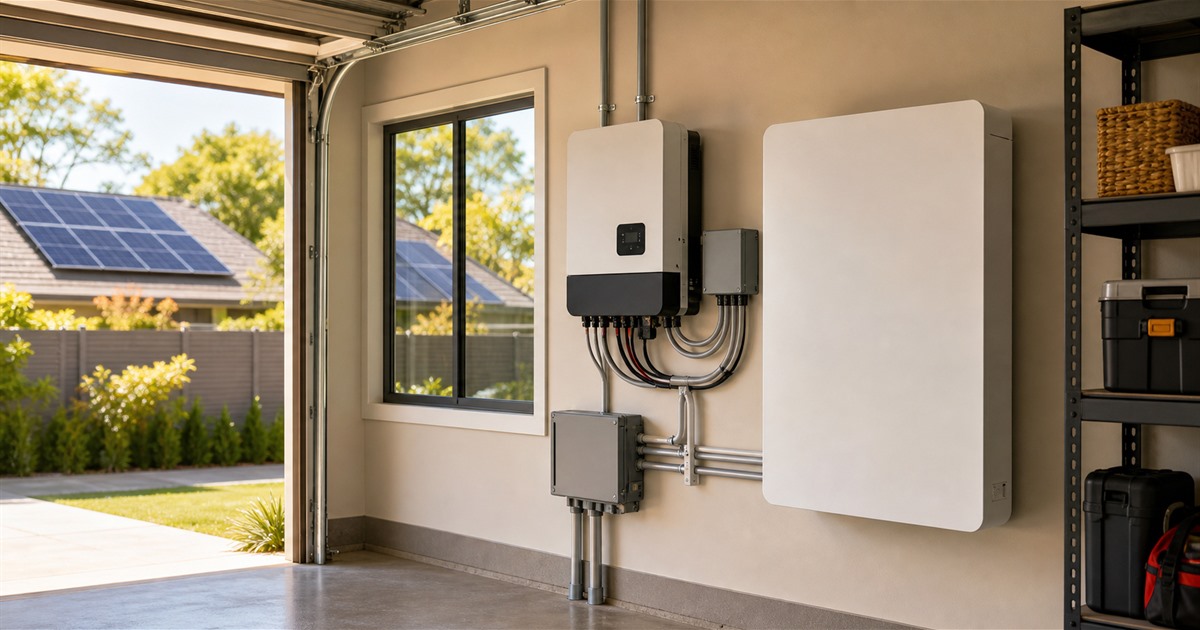
Quick answer: A 48V (51.2V nominal LFP) battery is the modern default for any solar system above roughly 3 kW — it moves the same power at a quarter of the current of a 12V bank, so it wastes less in wiring and pairs cleanly with today’s hybrid inverters and MPPT charge controllers. But “which 48V solar battery” is not a question you answer off a price list. It is a match: your array size and daily consumption set the capacity, your inverter sets the communication protocol, and your climate decides whether you need self-heating. The question we field most from installers is not “which battery is best” — it is “why does my new battery only ever reach 80% on a sunny day,” and nine times out of ten the answer is a mismatch that could have been caught with one calculation before purchase. This guide is that calculation, and the three-way match around it, from a storage engineering view rather than a catalog.
| Quick specs | Value |
|---|---|
| Nominal voltage | 51.2V (16 LFP cells in series × 3.2V), called “48V class” |
| Common capacities | 100Ah (~5 kWh) / 200Ah (~10 kWh) / 314Ah (~16 kWh) |
| Usable depth of discharge | 80% daily / 90–95% at the technical limit |
| Round-trip efficiency | ~95% (LFP) |
| Cycle life | ~6,000 cycles at 80% DoD (LFP typical) |
| Talks to inverter via | CAN or RS485 (closed-loop) — must match the inverter |
| Best fit | Solar systems > ~3 kW: off-grid, hybrid, whole-home backup |
Search “48V solar battery” and you get product grids and forum threads — lists of batteries with a price, or scattered opinions. We read the top-ranking pages before writing this: the biggest solar retailers each carry roughly 100–150 words of actual guidance above their product grid, and none of them tell you how to match a battery to your array. That gap — the decision, not the catalog — is what this guide fills.
The Array-to-Battery Match: Why the Battery Follows the Solar, Not Your Budget
Call it the Array-to-Battery Match: your solar array and your daily load set the battery capacity — not your budget, and not a round number that sounds reassuring. Two failure modes come from ignoring it, and we see both regularly when installers send us a bank that “isn’t performing.”
Undersize the battery against a large array and you clip production: the panels make power the battery is already too full to store, and it is simply thrown away every afternoon. Oversize the battery against a small array and it never fully recharges on a cloudy stretch — it sits at partial charge for days, so you paid for kilowatt-hours you can’t actually cycle. That “only reaches 80%” complaint from the intro is almost always this second case: the array is too small to fill the bank the owner was talked into buying.
The battery should be large enough to bank a full day of the array’s realistic output and carry your loads through the night — no more, no less. This is also why 48V wins above ~3 kW: at the same power, a 48V bank pulls a quarter of the current of a 12V bank, so the charge controller, busbars and cabling all run cooler and cheaper. For the wiring side of that math, see the 48V battery cable size chart.
📐 From the bench: the single most common spec error we catch is a battery chosen first and an array sized to “whatever fits the roof” second. Size the array to your load, then size the battery to the array. The order matters — reverse it and one of the two will always be wrong.
The Solar-Battery Sizing Equation
You can calculate the capacity you need before you shop for anything. The Solar-Battery Sizing Equation:
Battery capacity (Ah) = (daily load in kWh × days of autonomy) ÷ (48V × usable DoD)
Work an example. A cabin using 8 kWh/day, wanting one day of autonomy, at 80% usable DoD on a 51.2V bank: that is 8,000 Wh ÷ (51.2V × 0.8) = ~195Ah, so a 200Ah (10 kWh) battery. Want two days of cloudy-weather autonomy? Double it to ~390Ah — two 200Ah modules, or one 314Ah plus headroom. The equation turns “which size?” into arithmetic instead of a sales conversation.
Two inputs trip people up. Daily load is not your utility bill average — it is what you actually run when off-grid, which for most homes is a deliberately trimmed subset (fridge, well pump, lights, internet), typically 5–15 kWh/day. Days of autonomy is how long you need to ride through clouds without full sun; one day for grid-backup, two to three for true off-grid in a cloudy region. For a fuller walkthrough including the array and inverter sides, use our off-grid battery sizing guide.
Match by Situation: the Routing Table
Find your solar setup on the left and route across to the capacity and configuration that fits — not a generic “biggest battery you can afford” answer.
| Your solar setup / daily load | Recommended capacity | Configuration notes | Fitting product |
|---|---|---|---|
| Small array / weekend cabin (<5 kWh/day) | 100Ah (~5 kWh) | Single module; basic MPPT + hybrid inverter | 100Ah LFP |
| Whole-home daily cycling (8–12 kWh/day) | 200Ah (~10 kWh) | Closed-loop comms to inverter; size MPPT to array | 200Ah LFP |
| Large off-grid / multi-day autonomy (15 kWh+/day) | 314Ah or stacked modules | Parallel modules; highest density per cabinet | 314Ah LFP |
| Cold-climate off-grid (must charge below 0°C) | Match capacity above + self-heating | Self-heating is non-negotiable for winter solar charging | 314Ah self-heating platform |
Whichever capacity you land on, they share the same Savolture 48V LFP platform — cross-compatible, same BMS protocol, same inverter pairing — so you can start small and stack later without re-engineering the system. That modularity is the quiet advantage over an all-in-one: your sizing estimate does not have to be perfect on day one.
How a 48V Solar Battery Sits in the System: the Signal Chain
A battery is not a component you drop in alone. It sits in a signal chain between the panels and the loads, and every link has a job that, if skipped, breaks the link after it. This is the register we walk through when someone asks us to sanity-check a design:
| Stage | Component | Its job | What fails without it done right |
|---|---|---|---|
| 1. Harvest | Solar array | Produce DC power sized to daily load | Battery never fully charges; chronic partial state |
| 2. Regulate | MPPT charge controller | Convert array voltage to the battery’s charge window | Under/overcharge; lost capacity, safety risk |
| 3. Store | 48V LFP battery + BMS | Bank energy, enforce cell limits | Over-discharge, cell imbalance, cold-charge damage |
| 4. Communicate | CAN/RS485 link | BMS tells inverter real SoC and limits | Inverter guesses; nuisance faults, wrong cutoffs |
| 5. Invert | Hybrid inverter | Convert DC to AC for loads, manage backup | Overload trips, no backup during outage |
| 6. Protect | DC cabling + fusing | Carry current without loss, fault protection | Voltage drop, heat, fire risk |
Chain structure follows NEC Article 690 (PV) and 706 (energy storage) practice; component roles reflect industry-standard hybrid solar design.
Do I need a special charge controller for a 48V battery?
You need an MPPT controller (or a hybrid inverter with a built-in one) whose output range covers the battery’s roughly 40–58V charge window, set to LFP setpoints — not a lead-acid profile inherited from an old system. A PWM controller or a mismatched voltage window is the second-most-common problem we see after capacity mismatch. It is not that the battery is incompatible; it is that the controller was never configured for LFP.
The Three-Way Compatibility Check: Battery, Charge Controller, Inverter
The battery, the MPPT and the inverter all have to agree, and disagreement is where most “incompatible battery” complaints actually live:
- Charge controller / MPPT: output voltage window must cover the battery’s full charge range (~40–58V for 51.2V LFP). An MPPT on lead-acid setpoints will chronically under- or over-charge the pack.
- Inverter communication: the BMS talks to the inverter over CAN or RS485 so the inverter obeys real state-of-charge and charge/discharge limits. Confirm the protocol matches before you buy — see the hybrid inverter and battery pairing guide and the full inverter-battery compatibility matrix.
- Voltage setpoints: bulk, absorption and float voltages set for LFP, not a lead-acid hand-me-down. For where those voltages sit across the charge curve, see the 48V LiFePO4 voltage chart.
💡 Pro tip: before ordering, get the exact CAN/RS485 protocol name your inverter expects and confirm the battery supports it. A five-minute question at quote time prevents the most common commissioning-day headache we hear about.
The 5 48V-Solar-Battery Killers
Most “my solar battery underperforms” problems trace to one of these — all catchable at spec time, not after installation.
| Killer | Root cause | Where it bites | Fix |
|---|---|---|---|
| Capacity mismatched to array | Battery too small (clips solar) or too big (never fills) | Wasted production or chronic partial charge | Size with the Sizing Equation against real array output |
| Lead-acid charge setpoints | MPPT/inverter left on a default lead-acid profile | Chronic under/overcharge, lost capacity | Program LFP bulk/absorption/float voltages |
| No BMS–inverter comms | Wrong protocol or miswired CAN/RS485 | Inverter guesses limits; nuisance faults | Confirm protocol match and comms pinout before install |
| No low-temperature protection | Charging an LFP cell below 0°C plates lithium | Permanent capacity loss in cold climates | Spec self-heating where winter solar charging is needed |
| Undersized DC cabling | Wire gauge sized for lower current than the bank delivers | Voltage drop, heat, efficiency loss | Size cable to the bank’s real current (roughly ÷4 vs 12V) |
The Cost Math: What a 48V Battery Actually Costs Per Usable Cycle
Sticker price is the wrong number to compare. The number that matters is cost per usable kWh-cycle — what you pay for each kilowatt-hour the battery will actually deliver over its life. An LFP pack rated for ~6,000 cycles at 80% DoD delivers far more lifetime energy than a cheaper lead-acid bank rated for ~500 cycles at 50% DoD, even when the LFP costs three times as much upfront.
Run it: a 10 kWh LFP bank cycled daily at 80% delivers 8 kWh × 6,000 cycles = ~48,000 kWh over its life. The same nominal lead-acid capacity at 50% DoD and 500 cycles delivers 5 kWh × 500 = 2,500 kWh — roughly a twentieth. That is why the industry has converged on LFP for solar storage, and why “cheaper battery” almost never means “cheaper energy.” Compare batteries on lifetime delivered kWh, not on the shelf price.
Reality Check: A Bigger Battery Won’t Fix an Undersized Array
The most common shopping mistake is treating the battery as the whole answer — buying the largest 48V bank in the budget and expecting energy independence. But a battery only ever stores what your panels make. If the array cannot refill the bank on an average solar day, the extra capacity just sits empty and you have spent money on kilowatt-hours you will never cycle. Solar-plus-storage is a system: array, charge controller, battery and inverter sized together. When someone asks us to spec “the biggest battery you have,” the first questions back are always about the array and the daily load — because that is what the battery has to serve, and a battery matched to nothing is just an expensive shelf.
What’s Changing in 2026
Two shifts are reshaping 48V solar batteries. First, LFP is now effectively the only chemistry worth considering at this scale — lead-acid is gone from serious solar builds and NMC has retreated to weight-sensitive niches — so the decision has moved from “which chemistry” to “which capacity and configuration.” Second, closed-loop communication between battery and inverter is shifting from a premium feature to a baseline expectation, and self-heating is moving from an add-on to standard equipment on cold-climate platforms. The practical effect for buyers: the specs that differentiate a good 48V solar battery in 2026 are comms compatibility, modularity and cold-weather capability — not raw cell chemistry, which has largely converged. Choose on the match and the ecosystem, not the cell.
Sources & Further Reading
- UL 9540 / UL 9540A — safety standard for energy storage systems and the thermal-runaway fire test method used to evaluate them.
- IEC 62619 — safety requirements for secondary lithium cells and batteries for industrial and stationary applications.
- NEC Article 690 & 706 — US National Electrical Code articles for solar photovoltaic systems and energy storage system installation.
- U.S. DOE Solar Energy Technologies Office — federal research on solar-plus-storage system sizing and grid integration.
- Data-Driven Cycle Life Prediction of Lithium-Based Rechargeable Batteries (peer-reviewed) — research on cycle life and capacity fade under real charge/discharge conditions.
- Wikipedia: Lithium iron phosphate battery — background on LFP chemistry, cycle life and thermal stability.
Frequently Asked Questions
What size 48V battery do I need for solar?
Use the Solar-Battery Sizing Equation: daily load in kWh times days of autonomy, divided by (48V times usable DoD, ~0.8). An 8 kWh/day load with one day of autonomy needs about 200Ah (10 kWh); two days roughly doubles it. Size against your array’s realistic daily output, not a round number — in our experience, the array, not the battery, is what usually limits real-world performance.
Is a 48V battery better than 12V or 24V for solar?
For any system above roughly 3 kW, yes. At the same power a 48V bank carries a quarter of the current of a 12V bank, so wiring, busbars and the charge controller run cooler and cost less, and it pairs with the broadest range of modern hybrid inverters. 12V and 24V still make sense for small RV, marine or single-circuit setups.
Can I charge a 48V battery directly from solar panels?
Not directly — you need an MPPT charge controller (standalone or built into a hybrid inverter) between the panels and the battery, set to LFP voltage setpoints. The MPPT’s output range must cover the battery’s ~40–58V charge window. Panels wired to the correct MPPT input voltage then charge the bank efficiently.
What capacity 48V solar batteries are available?
Common residential capacities are 100Ah (~5 kWh), 200Ah (~10 kWh) and 314Ah (~16 kWh), all on the same 51.2V LFP platform. They are cross-compatible and can be paralleled, so you can start with one module and stack more as your load or array grows without replacing the inverter.
Will any 48V battery work with my inverter?
Physically most 48V-class batteries fit any 48V hybrid inverter’s voltage window, but for proper operation the battery’s BMS should communicate with the inverter over a matching CAN or RS485 protocol. Confirm protocol compatibility and comms wiring before buying — it is the most common source of pairing problems we get asked about.
How long will a 48V LFP solar battery last?
An LFP pack typically delivers around 6,000 cycles at 80% depth of discharge — roughly 15+ years of daily solar cycling — versus a few hundred cycles for lead-acid. Real lifespan depends on temperature (heat shortens it, sustained cold blocks charging) and staying within the BMS limits, which is why self-heating matters in cold climates.
About This Guide
We wrote this because the search results for “48V solar battery” are almost entirely product grids that assume you already know what to buy — and the questions we field from installers and homeowners show that most people don’t, because the real decision is a match between array, battery and inverter that no price list explains. Savolture offers LFP home and off-grid storage on a modular 48V platform, built to UL 9540 and AS/NZS standards. We are the people you talk to before you buy, not just a checkout — when a customer sends us their numbers, our first job is to tell them honestly whether they even need the capacity they were about to order. This guide reflects how we actually help buyers spec a system rather than sell them the biggest box.
Match a 48V Battery to Your Solar Setup
Trying to size a system, or just replace a battery you already know the spec for? If you are sizing a system, send us your solar array size (kW), your daily consumption (kWh) and your inverter brand — our team will work through the match with you: the right capacity from the table above, the correct comms protocol for your inverter, and self-heating if your climate needs it. There is no wrong question here; we would rather spend ten minutes on the array-to-battery match now than have you discover a mismatch after installation. If you already know exactly what you need, browse the Savolture hybrid inverter and battery platform directly, and we are just a message away if you want a second set of eyes on the spec. Either way, the goal is a battery matched to your array — not a bigger number on an invoice.
| Talk to Savolture | |
|---|---|
| Brand | Savolture — LFP home & off-grid energy storage |
| Product line | 48V (51.2V) LFP platform: 100Ah / 200Ah / 314Ah, modular & stackable |
| Standards | Built to UL 9540 and AS/NZS |
| Markets served | United States & Australia |
| Best way to reach us | Send your array kW + daily kWh + inverter brand for a spec match |
Ready to size your system?
Get a free battery recommendation.
Tell us your load, location, and backup target — we will spec the right 48V LiFePO4 system for you.