

Savolture Technical Guide
Can a Home Battery Charge Your EV During a Power Outage?
Quick answer: Yes — a home battery can keep your EV charging during a power outage, but only if the system is set up for it. A grid-tied battery that shuts down when the g...
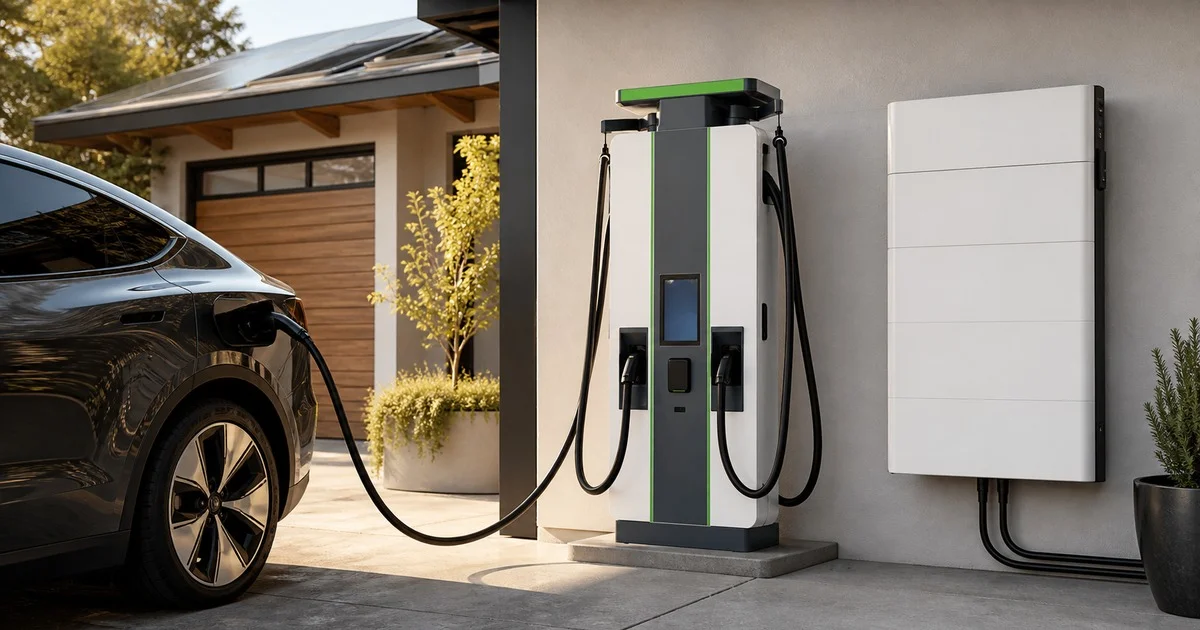
Quick answer: Yes — a home battery can keep your EV charging during a power outage, but only if the system is set up for it. A grid-tied battery that shuts down when the grid goes down (for safety) won’t help; you need a battery paired with a hybrid inverter that supports backup or off-grid operation, sized to cover both your home’s essential loads and the charging draw. For most homes, that means topping up the EV at a reduced Level 1 or throttled Level 2 rate during an outage, not full-speed charging.
Blackouts are exactly when a charged car matters most — and exactly when the grid can’t fill it. Pairing home battery storage with the right EV charger closes that gap. Here’s how the pieces fit.
Why a Normal Grid-Tied Battery Won’t Charge Your EV in an Outage
By code, grid-tied inverters must disconnect during an outage so they don’t back-feed the lines and endanger utility crews. If your battery is purely grid-tied, it goes dark with everything else. To power anything — lights, fridge, or a car — during an outage, the battery needs a hybrid inverter with a backup gateway that islands your home safely from the grid. That’s the same capability behind any whole-home backup system: the battery keeps a protected part of your electrical panel live while the grid is down.
The Real Constraint: Charging Speed vs Battery Capacity
An EV is a huge load compared to household essentials. A Level 2 charger can pull 7–11 kW — more than a whole home’s baseline draw. Run that flat-out from a home battery and you’ll drain the pack in an hour or two, leaving nothing for the fridge and lights. The practical approach during an outage is to throttle EV charging:
- Level 1 (120V, ~1.4 kW): slow but sustainable — adds roughly 4–5 miles of range per hour without starving the rest of the house.
- Throttled Level 2: many chargers let you cap the amperage, so you can add meaningful range while keeping headroom for home loads.
- Smart / bidirectional chargers: coordinate with the battery to charge only when there’s surplus and even feed power back. Manufacturers like Hongjiali build bidirectional EV charging stations designed for exactly this kind of solar-plus-storage coordination.
The takeaway: size the battery for essentials plus a slow EV top-up, not for full-speed charging. For a rural or frequently-hit property, an off-grid solar system with a larger LFP bank makes sustained EV charging realistic; for occasional urban outages, a modest backup battery plus throttled charging is usually enough.
How to Size It
Start from your daily essential load (fridge, well pump, lights, internet — typically 5–15 kWh/day), then add whatever EV range you actually need during an outage. Adding ~40 miles of range costs roughly 12–14 kWh from the battery. So a home that wants essentials plus a daily EV top-up during a multi-day outage is looking at a larger LFP bank — the 314Ah LFP platform or multiple stacked modules — paired with a hybrid inverter rated for the combined load. For a walkthrough of the battery side, see our off-grid battery sizing guide.
The Bottom Line
A home battery can keep your EV charging through an outage — if it’s built for backup, sized for the combined load, and paired with a charger that can throttle or coordinate. Solar makes it sustainable over multi-day events by refilling the battery each day. Tell us your vehicle, your essential loads, and how long your outages typically last, and we’ll spec an LFP battery and hybrid inverter that keep both your home and your car running when the grid doesn’t.
Ready to size your system?
Get a free battery recommendation.
Tell us your load, location, and backup target — we will spec the right 48V LiFePO4 system for you.