

Savolture Technical Guide
48V vs 24V vs 12V Battery: Which Voltage Wins for Your 2026 Solar Project
Compare 12V, 24V, and 48V battery systems using load size, current, cable length, inverter power, and future expansion instead of nominal voltage alone.
Voltage math
Current amps = watts / battery voltage Higher voltage reduces current, cable size, voltage drop, and heat for larger solar systems.The first real decision in any DIY solar or battery storage project isn’t which brand to buy — it’s what voltage to run. 12V, 24V, or 48V. Every other choice (inverter, charge controller, wire gauge, breaker sizing, battery model) flows from this one. Pick wrong, and you’ll either spend 3× on copper or hit a power ceiling six months into ownership.
This guide walks through the voltage decision the way we walk customers through it: with the actual math, the actual breakpoints, and the actual project types where each voltage class wins. By the end, you’ll know whether your system is a 12V, 24V, or 48V project — and why.
The Short Answer (For People Who Want to Get to Wiring)
- 12V: Small loads under 1,500W continuous. RVs, vans, boats under 30 ft, single-circuit emergency backup. Battery bank up to ~2-3 kWh.
- 24V: Mid-range loads 1,500–3,000W continuous. Tiny homes, larger marine, off-grid sheds. Battery bank 2-5 kWh. Increasingly skipped in 2026 in favor of jumping straight to 48V.
- 48V (51.2V LFP): 3,000W+ continuous loads. Residential whole-home backup system, off-grid cabin, light commercial, EV charging. Battery bank 5 kWh and up. This is the 2026 default for any system that’s not specifically RV or marine.
If you’re already past 3 kW of inverter capacity and 5 kWh of battery storage, stop reading and start spec’ing 48V. Everything else in this article is justification.
The Physics That Drives the Decision
The voltage decision comes down to one equation: Power = Voltage × Current. If you want to move the same amount of power, you can do it with high voltage and low current, or low voltage and high current. Higher current means thicker copper, larger breakers, more heat, more loss.
For a 3,000W load running through the DC bus:
- At 12V: 250 amps of current. You need 2/0 AWG copper minimum (about $15-25/ft), 300A class T fuses, and you’ll still lose 4-6% in DC wire resistance.
- At 24V: 125 amps. 2 AWG copper, 150A fuses, 2-3% wire loss.
- At 48V: 62.5 amps. 6 AWG copper, 80A breakers, 1-2% wire loss.
The 48V system uses copper that costs roughly 1/8th the price per foot compared to the 12V equivalent, runs through smaller conduit, generates dramatically less heat, and delivers more usable power to the inverter input. For any system above 1,500W continuous, the wiring savings alone usually pay for the voltage upgrade.
Side-by-Side: 12V vs 24V vs 48V System Characteristics
| Parameter | 12V | 24V | 48V (51.2V LFP) |
|---|---|---|---|
| Practical Inverter Range | 200W-1,500W | 1,000W-3,000W | 3,000W-30,000W+ |
| Continuous Load Capacity | ~1,200W | ~2,400W | ~7,500W+ (per 100Ah) |
| Typical Battery Bank Range | 1-3 kWh | 2-5 kWh | 5-100+ kWh |
| Wire Gauge for 3,000W Load | 2/0 AWG | 2 AWG | 6 AWG |
| Wire Cost per 20 ft Run | $300-500 | $100-180 | $30-60 |
| DC Wire Losses (Typical) | 4-6% | 2-3% | 1-2% |
| Charge Controller Sizing | Limited choices >60A | Wider options | Largest selection & sizes |
| Inverter Options 2026 | RV/marine specialty | Shrinking | Massive market, all major brands |
| Future Upgrade Path | Locked in (hard to scale) | Difficult (mismatched cells) | Easy (parallel modules) |
| Typical Use | RV, boat, single circuit | Tiny home, shed | Whole-home, off-grid, commercial |
When 12V Wins (And Why It’s Shrinking)
12V isn’t dead — it’s the right answer for a specific set of projects where everything around it is also 12V:
- RV / Class B van builds: Vehicle electrical systems are already 12V (chassis, lights, water pump, refrigerator). Adding a 48V house bank means doubling the DC conversion hardware. Stay 12V.
- Boats under 30 ft: Engine starting batteries and most marine accessories are 12V. House bank that matches simplifies everything.
- Single-circuit emergency backup: One refrigerator, one lighting circuit, one router. Sub-1 kWh of storage. The 48V infrastructure cost dwarfs the benefit.
- Off-grid trailers / overland builds: Auxiliary power for a mobile setup where every battery / inverter / wire decision is constrained by space and weight.
For any of these, 12V is fine. The shrinking part is everything outside this list. Homes, cabins, sheds, light commercial — all moving to 48V because the wiring math no longer justifies anything else.
Why 24V Is Getting Skipped in 2026
24V used to be the natural “between” choice — bigger than 12V, simpler than 48V. In 2026, it’s increasingly the wrong middle ground for two reasons:
- Inverter ecosystem is consolidating around 48V: The biggest hybrid inverters (Sol-Ark 12K/15K, Schneider XW Pro, Victron Quattro, EG4 6000XP) are 48V-native. 24V options are still available but the high-end models are 48V-only.
- Battery module sizing matches 48V better: 51.2V LFP batteries pack 16 cells in series to hit the nominal voltage cleanly. 24V (25.6V LFP) uses 8 cells, which means you need more parallel cell groups for the same capacity, raising BMS complexity.
The 24V exception: large marine vessels (35+ ft) with significant house loads. Marine systems often standardize on 24V because the engine alternator can charge it directly without a DC-DC converter, and the vessel’s electrical infrastructure is already partially 24V. Outside of that specific application, jumping from 12V (small) straight to 48V (large) is the cleaner 2026 path.
Why 48V (51.2V LFP) Dominates Everything Else
If your project is grid-tied solar, off-grid cabin, whole-home backup, light commercial, multi-family residential, or anything in between, 48V is the default voltage class for one simple reason: every part of the supply chain has consolidated around it.
Inverter Selection
The largest, most-supported, most-certified hybrid inverters in 2026 are 48V-native: Sol-Ark 12K/15K/30K, Schneider XW Pro, Victron MultiPlus II / Quattro, EG4 6000XP, Luxpower SNA, Outback Radian, MegaRevo. 48V systems get the broadest UL listings, the most firmware updates, and the best technical support — including Savolture’s 48V hybrid inverter compatible with all standard LFP batteries.
Battery Selection
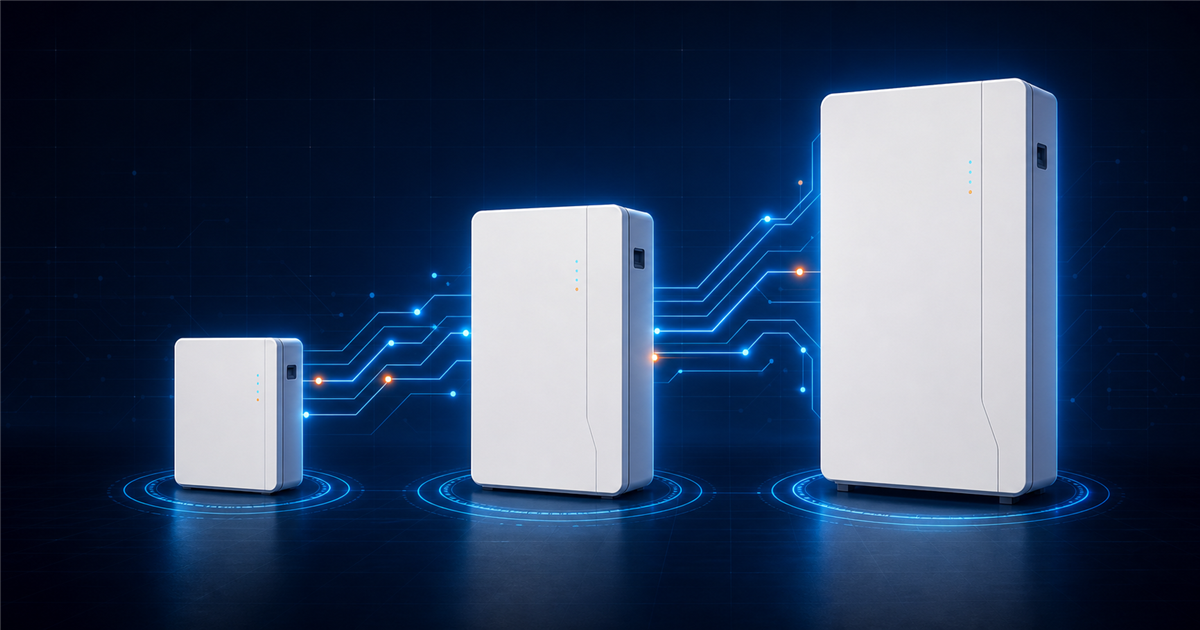
51.2V LFP wall-mount batteries are the densest, most certified, and most easily-installed residential storage products on the market. The Savolture 48V battery platform ranges from 100Ah entry (5.12 kWh) through 200Ah whole-home (10.24 kWh) to 314Ah maximum density (16.08 kWh). All on the same 48V platform — cross-compatible, same BMS protocol, same inverter pairing.
Code Compliance
US AHJs and most international codes have aligned standards for 48V battery installation. UL9540 system listings, NEC 706 articles, and AS/NZS 5139 (Australia) all assume 48V architecture for residential and light-commercial deployments. 12V/24V systems often face additional documentation requirements or simply aren’t covered by streamlined permitting paths.
Wire and BOS Savings
As shown earlier, the wire gauge drops by roughly 4× going from 12V to 48V at the same power. Combine that across DC battery cables, charge controller wiring, and inverter input wiring, and a typical residential system saves $500–1,500 in copper and BOS hardware by choosing 48V.
Real Project Examples: Which Voltage for Which Build
Example A: 24 ft Class C RV, Full-Time Travel
- Loads: refrigerator, water pump, LED lights, induction cooktop (occasional), 600W microwave, laptop charging
- Peak load: 1,800W (microwave + everything else)
- Daily consumption: ~3-4 kWh
- Verdict: 12V. Vehicle is already 12V, alternator-to-DC charging works directly, lithium house bank at 2 kWh (200Ah at 12V) covers loads cleanly.
Example B: Off-Grid Tiny Home, 2 Adults
- Loads: heat pump, induction range, well pump, refrigerator, LED lights, electronics
- Peak load: 4,200W (well pump cycling while range is on)
- Daily consumption: ~12 kWh in summer, ~18 kWh in winter with heat
- Verdict: 48V. 24V can’t comfortably handle the 4,200W peak; 48V scales easily. Start with one 200Ah LFP (10.24 kWh), plan for second unit within 2 years as electrification grows.
Example C: Suburban Whole-Home Essential Backup
- Loads: HVAC blower, refrigerator, freezer, well pump, internet, garage opener, essential lighting
- Peak load: 6,500W (HVAC startup + well pump)
- Daily consumption during outage: ~15-25 kWh
- Verdict: 48V. 314Ah LFP at 16.08 kWh for a single-cabinet whole-home solution, paired with 10K+ hybrid inverter. Wire size, breaker sizing, and inverter cost all dramatically lower than equivalent 24V.
Example D: 38 ft Sailing Catamaran, Live-Aboard
- Loads: refrigeration, watermaker, autopilot, navigation electronics, lighting, occasional A/C
- Peak load: 3,500W (watermaker + everything)
- Daily consumption: ~10-15 kWh
- Verdict: 24V or 48V. Engine alternator charging argues for 24V; modern marine inverter/chargers (Victron Quattro) work cleanly at 48V too. Final choice depends on existing onboard infrastructure and whether owner is doing a full rebuild or incremental upgrade.
Mistakes to Avoid in the Voltage Decision
When an installer asks us to help spec a bank, the voltage choice is usually settled in the first two minutes — then undone by one of the mistakes below. These are the ones we catch most often before wire and breakers get ordered.
- Picking 12V to “stay simple”: For a residential project, 12V is the opposite of simple — the wire sizing alone creates a complexity tax that 48V eliminates.
- Picking 24V because it’s “in between”: Almost never the right answer in 2026. Either go small (12V for RV/marine/single-circuit) or go full (48V for everything else).
- Future-proofing with 48V on a tiny RV: Don’t do this. Adding 48V to an existing 12V vehicle infrastructure creates DC-DC converter complexity, doubles your battery handoff hardware, and rarely justifies the upgrade.
- Trying to mix voltage classes: Don’t run a 24V battery bank with a 48V inverter, or 12V and 48V in parallel. The hardware to bridge between voltage classes is expensive and the loss is real.
Sources & Further Reading
- NREL PVWatts Calculator — National Renewable Energy Laboratory tool for solar irradiance and system sizing by US location. pvwatts.nrel.gov
- NEC Article 310 — National Electrical Code conductor ampacity tables; basis for wire gauge vs. current ratings cited in this guide.
- NEC Article 690 — Solar photovoltaic systems installation requirements, including voltage and overcurrent protection rules.
- Victron Energy: Wiring Unlimited — Comprehensive cable sizing reference used by professional installers worldwide. victronenergy.com
- U.S. DOE — Solar Energy Technologies Office: Battery Storage Basics. energy.gov
Sources & Further Reading
- NREL PVWatts Calculator — National Renewable Energy Laboratory tool for solar irradiance and system sizing by US location. pvwatts.nrel.gov
- NEC Article 310 — National Electrical Code conductor ampacity tables; basis for wire gauge vs. current ratings cited in this guide.
- NEC Article 690 — Solar photovoltaic systems installation requirements, including voltage and overcurrent protection rules.
- Victron Energy: Wiring Unlimited — Comprehensive cable sizing reference used by professional installers worldwide. victronenergy.com
- U.S. DOE — Solar Energy Technologies Office: Battery Storage Basics. energy.gov
Sources & Further Reading
- NREL PVWatts Calculator — National Renewable Energy Laboratory tool for solar irradiance and system sizing by US location. pvwatts.nrel.gov
- NEC Article 310 — National Electrical Code conductor ampacity tables; basis for wire gauge vs. current ratings cited in this guide.
- NEC Article 690 — Solar photovoltaic systems installation requirements, including voltage and overcurrent protection rules.
- Victron Energy: Wiring Unlimited — Comprehensive cable sizing reference used by professional installers worldwide. victronenergy.com
- U.S. DOE — Solar Energy Technologies Office: Battery Storage Basics. energy.gov
FAQ
Can I upgrade from 12V to 48V later?
Technically yes but it usually requires replacing the inverter, charge controller, and batteries — basically rebuilding the system. If there’s any chance the project will scale beyond 1,500W continuous or 3 kWh of storage, start with 48V even if you’re only using a fraction of the capacity on day one.
Is 48V dangerous compared to 12V or 24V?
48V is below the OSHA-defined “low voltage” threshold (under 50V DC) for shock hazard. With proper installation, it’s no more dangerous than 12V or 24V. The actual danger in all battery systems is short-circuit fault current — and 48V is safer here because the same power means less current.
What’s the actual difference between “48V” and “51.2V”?
“48V” is industry shorthand inherited from lead-acid systems where the nominal voltage was 48V (4×12V batteries in series). Modern LFP batteries pack 16 cells in series at 3.2V nominal each, which equals 51.2V actual nominal. The system is called “48V class” because it’s inverter-compatible with the legacy 48V ecosystem, but the actual operating voltage is 51.2V. For the full chemistry cost analysis, see why LiFePO4 is the only chemistry worth choosing at 48V.
Will 48V inverters work with 24V batteries?
No. Inverters are voltage-class specific. A 48V inverter requires 48V battery input within a tight tolerance band (typically 40V–58V DC). Connecting 24V batteries to a 48V inverter will either trip a low-voltage shutdown or damage the inverter.
For an off-grid cabin, should I start with 24V or jump to 48V?
If the cabin will see continuous use or might become a primary residence, 48V from day one. Cabin loads tend to grow as the property gets used more — refrigeration upgrades, water heater electrification, EV charging. 48V scales; 24V hits a ceiling and forces a rebuild. For a true weekend-only cabin with sub-2 kWh battery needs, 24V can work, but most cabin builds in 2026 jump directly to 48V.
What inverter brands work best with 48V LFP batteries?
For US residential split-phase 120/240V: Sol-Ark 12K/15K, EG4 6000XP, Schneider XW Pro. For international 230V single-phase: Victron MultiPlus II / Quattro, MegaRevo, Luxpower SNA. All major 48V hybrid inverters in 2026 have built-in lithium battery profiles and CAN/RS485 communication with LFP batteries.
Bottom Line
The 2026 voltage decision is simpler than it used to be:
- RV, marine under 30 ft, single-circuit emergency: 12V
- Larger marine (30+ ft sailing/cruising): 24V if matching existing infrastructure
- Anything residential or commercial — cabins, homes, off-grid, light commercial: 48V
For US residential and off-grid projects choosing 48V, the natural next decisions are battery capacity (100Ah / 200Ah / 314Ah) and inverter pairing. We covered the 100Ah vs 200Ah capacity decision in a separate guide; for general off-grid sizing, see our step-by-step off-grid battery sizing calculator, and for inverter compatibility, our 48V battery and hybrid inverter pairing guide.
If you’re spec’ing a 48V LFP system for a US project, request a project quote — we’ll work backward from your loads to battery capacity to inverter pairing, and send the full specification within 24 hours.
See also: LFP battery chemistry
See also: LiFePO4 vs lead-acid
Sizing a 48V bank?
Send us your load list and inverter size.
We will check voltage, current, cable implications, and battery capacity for a quote-ready 48V LiFePO4 setup.