

Savolture Technical Guide
How to Size an Off-Grid Solar Battery System (Step-by-Step Calculator)
A step-by-step off-grid battery sizing workflow using daily kWh, autonomy days, usable DoD, inverter losses, and cold-weather derating.
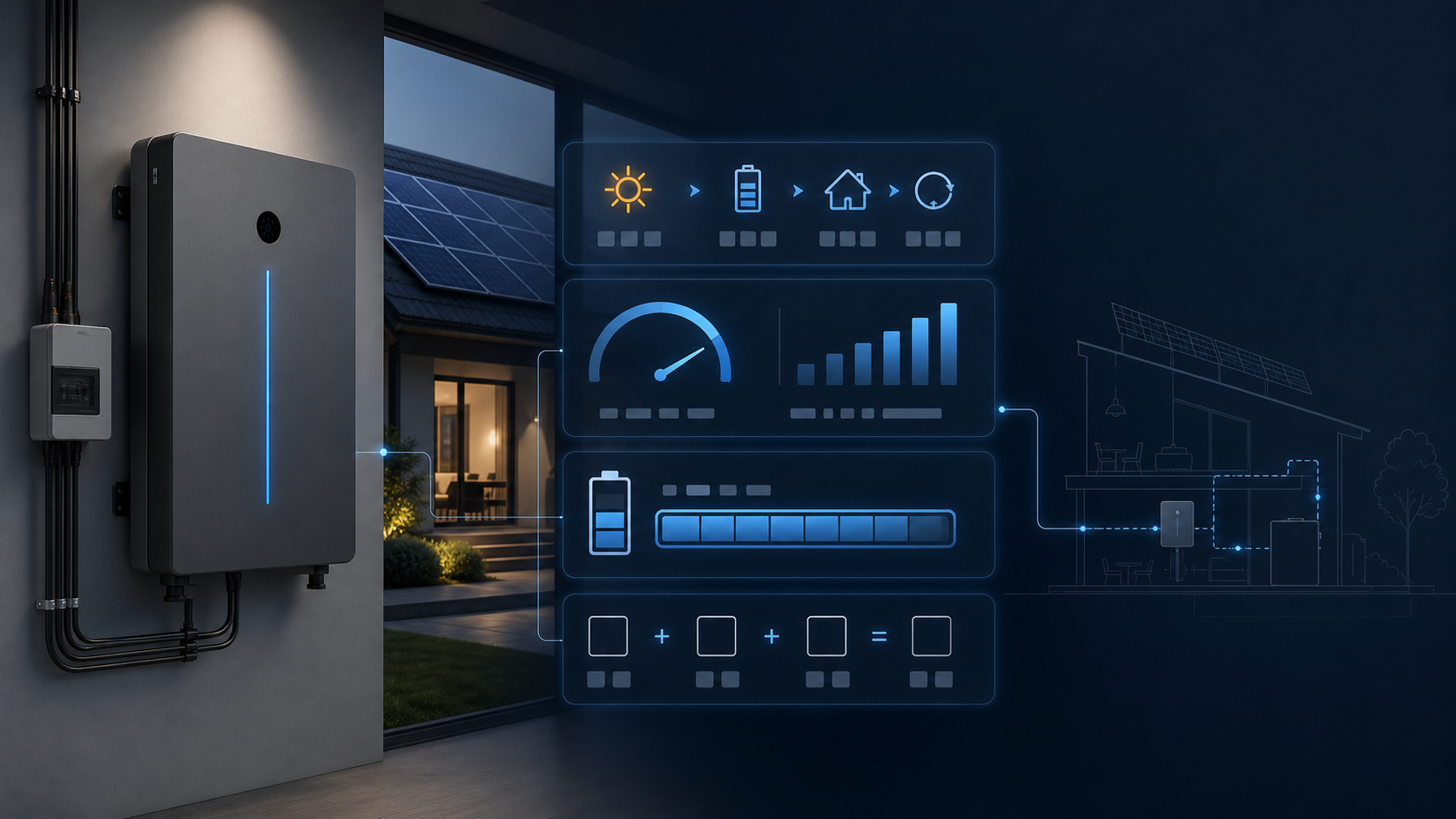
Sizing equation
Daily kWh x autonomy days / usable DoD Then add inverter losses, cold-weather derating, and future load growth.Reviewed by the Savolture Technical Team — Updated May 2026
Quick answer: Multiply your daily essential load (kWh/day) by your target autonomy days, then divide by 0.9 for LFP’s 90% usable depth of discharge. A US home running essentials (5–8 kWh/day) needs a 10–18 kWh rated bank for overnight backup. A 200Ah 48V LFP battery (10.24 kWh) handles most single-day scenarios. Size up for whole-home or 2-day autonomy.
Quick answer: Multiply your daily essential load (kWh/day) by your target autonomy days, then divide by 0.9 for LFP’s 90% usable depth of discharge. A US home running essentials (5–8 kWh/day) needs a 10–18 kWh rated bank for overnight backup. A 200Ah 48V LFP battery (10.24 kWh) handles most single-day scenarios. Size up for whole-home or 2-day autonomy.
You’ve decided to go off-grid. You’ve picked out solar panels. Maybe you’ve even chosen an inverter.
Now comes the question that trips up more first-time off-gridders than any other: how big does the battery bank need to be?
Get it wrong and you’ll either overspend by thousands on capacity you don’t need — or worse, run out of power on the third cloudy day and find yourself running a generator at 2 a.m. in a snowstorm. We’ve seen both. Repeatedly.
This guide walks you through the exact sizing process professional installers use, plus the variables most online calculators quietly skip — cold-weather derating, phantom loads, and what really happens when you parallel batteries from different manufacturers. No fluff. Just the math, with real numbers you can plug in today.
Step 1: Calculate Your Daily Energy Consumption
Before you can size anything, you need one number: how many kilowatt-hours (kWh) you use per day.
If you’re already in a home with a utility meter, check your electric bill — it shows monthly kWh. Divide by 30 for daily average. That number is the single most reliable input you have. (The U.S. Energy Information Administration reports the average US home uses about 10,500 kWh/year — roughly 29 kWh/day — but your actual load may differ significantly.)
Building new or don’t have a meter? Use this appliance-by-appliance method:
| Appliance | Watts | Hours/Day | Daily kWh |
|---|---|---|---|
| Refrigerator | 150 | 10 (compressor cycling) | 1.5 |
| LED Lighting (10 bulbs) | 100 | 6 | 0.6 |
| Well Pump | 750 | 4 | 3.0 |
| Laptop + Router | 100 | 12 | 1.2 |
| Washing Machine | 500 | 1 | 0.5 |
| Microwave | 1,200 | 0.25 | 0.3 |
| Ceiling Fans (3) | 225 | 8 | 1.8 |
| Chest Freezer | 100 | 8 | 0.8 |
| Subtotal | 9.7 kWh |
A minimal off-grid cabin uses 5–10 kWh/day. A full-time family home typically lands at 15–30 kWh/day. A large home with electric HVAC can exceed 40 kWh/day. For smaller cabins at the low end, a compact 100Ah 48V LFP module for smaller off-grid cabins covers basic loads such as lighting, refrigerator, and phone charging.
Pro tip: Add 20% to your calculated total for system losses (inverter efficiency, wire resistance, BMS self-consumption). So 9.7 kWh becomes ~12 kWh as your design target. Calculators that don’t add this buffer are the #1 reason new off-grid systems underperform in year one.
Step 2: Decide Your Days of Autonomy
Days of autonomy = how many days your battery bank can power your home with zero solar production. This is your buffer for cloudy stretches, storms, or winter months with short days.
| Climate / Location | Recommended Autonomy |
|---|---|
| Desert Southwest (AZ, NM, NV) | 1–2 days |
| Temperate (TX, GA, NC) | 2–3 days |
| Northern / Cloudy (OR, WA, MI) | 3–5 days |
| Snow country with generator backup | 1–2 days |
Most off-grid systems target 2–3 days of autonomy as the sweet spot between cost and reliability. Going to 5+ days without a generator backup is rarely cost-effective — you’re paying for capacity that only gets used a handful of times per year.
Formula: Daily kWh × Days of Autonomy = Total Energy Needed
Example: 12 kWh/day × 3 days = 36 kWh of usable battery capacity needed.
Step 3: Account for Depth of Discharge (DoD)
You can’t drain a battery to zero — well, you can, but you’ll destroy it fast. Every battery chemistry has a recommended maximum depth of discharge:
| Battery Type | Max Recommended DoD | Usable from 10 kWh Rated |
|---|---|---|
| Lead-Acid (FLA/AGM) | 50% | 5 kWh |
| NMC Lithium-Ion | 80% | 8 kWh |
| LiFePO4 | 90–95% | 9–9.5 kWh |
This is why LiFePO4 fundamentally changes the sizing equation. You need nearly half the rated capacity compared to lead-acid for the same usable energy — and you get 8,000+ cycles instead of 1,500. For a deeper comparison of chemistries, see our LFP vs NMC home battery breakdown.
Formula: Total Energy Needed ÷ DoD = Required Rated Battery Capacity
Example with LiFePO4 (90% DoD): 36 kWh ÷ 0.90 = 40 kWh rated capacity.
Example with lead-acid (50% DoD): 36 kWh ÷ 0.50 = 72 kWh rated capacity — almost double the steel, weight, and floor space.
Step 4: The Cold-Weather Variable Most Calculators Skip
Here’s a sizing variable that almost no online calculator includes, and it’s the one that bites cold-climate off-gridders hardest: LiFePO4 cells cannot accept charge below 32°F (0°C). A reputable BMS will block charging once the cell temperature drops below freezing — protecting the cells from lithium plating, but leaving you with no way to recover capacity from your solar array.
Two consequences for sizing:
- If the battery lives in an unheated outbuilding in a cold climate, assume zero usable solar charging on days when the battery stays below freezing. Plan an extra day of autonomy on top of your base number.
- If the battery has integrated self-heating (common on quality 48V LiFePO4 modules), it pulls heating energy from the pack itself — budget another 0.5–1.5 kWh/day of heating load during winter.
The practical fix: locate the battery indoors or in a conditioned space whenever possible. Garage installations in Texas or Arizona work fine year-round. Garage installations in Minnesota usually do not, unless the cabinet is insulated and the battery has self-heat.
Step 5: Choose Your Battery Voltage Architecture
Off-grid battery systems typically run at 12V, 24V, or 48V. Higher voltage means lower current for the same power, which means thinner wires, lower losses, and smaller breakers. For systems above 3-4 kWh of storage, 48V is now the residential standard — see our 48V battery platform overview for the full capacity lineup (100Ah, 200Ah, 314Ah).
See also: 48V vs 24V vs 12V battery voltage: complete 2026 comparison
| System Voltage | Best For | Max Practical Size |
|---|---|---|
| 12V | Small cabins, RVs | Up to 3 kWh |
| 24V | Medium cabins, tiny homes | Up to 8 kWh |
| 48V | Full homes, any system over 5 kWh | Unlimited (modular) |
Rule of thumb: If your system is over 5 kWh, go 48V. Every serious off-grid inverter (Sol-Ark, EG4, Victron Quattro, Schneider XW) runs on 48V. The wiring is simpler, the efficiency is higher, and you’ll have far more expansion options. Our 314Ah 48V LFP modules and 200Ah wall-mount units are both 48V-native and parallel automatically over CAN bus.
Step 6: Size Your Solar Array
Your solar panels need to fully recharge your battery bank during a single day of good sun. If they can’t, your batteries will slowly drain over consecutive days, and your generator runtime climbs.
Formula: Daily kWh Usage ÷ Peak Sun Hours × 1.25 (loss factor) = Solar Array Size
| Location | Annual Avg Peak Sun Hours |
|---|---|
| Phoenix, AZ | 6.5 |
| Austin, TX | 5.3 |
| Denver, CO | 5.0 |
| Atlanta, GA | 4.6 |
| Portland, OR | 3.5 |
| Detroit, MI | 3.8 |
Example: 12 kWh/day ÷ 5.0 peak hours × 1.25 = 3.0 kW solar array — that’s six 500W panels. For Portland or Detroit, the same 12 kWh load needs closer to a 4.3 kW array.
Peak sun hours are annual averages. Size for your worst month if you have no generator backup — December in northern latitudes can deliver 40–60% less production than June. The NREL PVWatts calculator gives free monthly-resolution data for any U.S. ZIP code.
Step 7: Verify Your Charge Controller Rating
Your MPPT charge controller must handle both the maximum voltage from your panel string and the maximum charge current into your battery bank.
Key specs to check: Max input voltage must exceed your panel string’s open-circuit voltage (Voc) in cold temperatures — cold panels produce higher voltage than nameplate. Max charge current must handle your array’s maximum output at battery voltage.
Example: A 3 kW array at 48V = ~63A charge current. You’d need at minimum a 60A MPPT controller, but an 80A unit gives headroom for future panel additions — and additions are almost always cheaper than replacements.
Quick Sizing Reference Table
| Home Type | Daily kWh | Battery (LiFePO4) | Solar Array | Autonomy | Match a kit |
|---|---|---|---|---|---|
| Weekend Cabin | 5–8 | 5 kWh | 2 kW | 2 days | 5kWh kit |
| Tiny Home | 10–15 | 10 kWh | 3–4 kW | 2 days | 10kWh kit |
| Small Family Home | 15–25 | 15 kWh | 5–7 kW | 2–3 days | 15kWh kit |
| Large Family Home | 25–40 | 20–30 kWh | 7–10 kW | 2–3 days | 20kWh+ system |
| Homestead w/ Shop | 35–50 | 30–40 kWh | 10–15 kW | 2–3 days | 20kWh+ system |
Two Real Sizing Examples
Case A: Texas Hill Country family home, 2,200 sq ft
Utility bill averaged 720 kWh/month → 24 kWh/day. Family of four, two mini-split AC zones, well pump, electric range. They wanted full off-grid with 2 days of autonomy and a propane generator for emergencies.
- Design daily load with 20% buffer: 24 × 1.20 = 29 kWh/day
- Total energy for 2 days: 29 × 2 = 58 kWh usable
- Rated capacity at 90% DoD: 58 ÷ 0.90 ≈ 65 kWh of LiFePO4 (four 16 kWh modules)
- Solar array at 5.3 peak sun hours: 29 ÷ 5.3 × 1.25 ≈ 6.8 kW
- Inverter: 12 kW 48V split-phase (covers AC startup surges)
Case B: Oregon coast cabin, 800 sq ft, weekends only
Couple uses the cabin Friday–Sunday. Lights, fridge, water pump, laptops, electric kettle. No AC, propane heat. Conservative 6 kWh/day when occupied, 1.5 kWh/day phantom load when empty.
- Design daily load with buffer: 6 × 1.20 = 7.2 kWh/day
- Autonomy target: 4 days (Oregon coast, weekend-only use, no generator)
- Total energy: 7.2 × 4 = 29 kWh usable
- Rated capacity at 90% DoD: 29 ÷ 0.90 ≈ 32 kWh of LiFePO4
- Solar array at 3.5 peak sun hours: 7.2 ÷ 3.5 × 1.25 ≈ 2.6 kW
Note how the Oregon cabin uses one-quarter the daily energy of the Texas home but needs nearly half the battery capacity. The autonomy multiplier dominates whenever solar resource is low or use is intermittent. This is also why “I only use X kWh/day” answers rarely lead directly to “buy Y kWh of battery.”
The Most Common Sizing Mistakes
Mistake 1: Sizing batteries to daily usage, not autonomy. If you use 20 kWh/day and buy a 20 kWh battery, you have zero buffer. One cloudy day and you’re in the dark or burning diesel.
Mistake 2: Using lead-acid DoD numbers for LiFePO4. If someone tells you to “multiply by 2 for safety,” that rule was for lead-acid at 50% DoD. LiFePO4 at 90% DoD doesn’t need that doubling — you’re paying twice for capacity you’ll never use.
Mistake 3: Ignoring seasonal variation. Solar production in December can be 40–60% lower than June in northern latitudes. Size for your worst usable month, not your annual average, if you don’t have generator backup.
Mistake 4: Forgetting phantom loads. Routers, phone chargers, standby power, inverter self-consumption — these silently add 1–3 kWh/day. On a 10 kWh/day system, that’s 10–30% of your entire budget gone before you’ve turned a light on.
Mistake 5: Mixing battery brands or ages in parallel. Different BMS firmware, different state-of-charge curves, different internal resistance — the newer, healthier pack ends up doing most of the work and aging faster. If you plan to expand, stay within one product family from the same manufacturer. Our 200Ah and 314Ah wall-mount modules communicate over a shared CAN bus precisely so you can grow the bank without this problem.
The True Cost of Getting It Wrong
Undersizing and oversizing both cost money — just in different ways.
Undersized system: You’ll run a generator more often. A 5 kW propane generator at half-load burns roughly 0.6 gal/hr. Running it 200 hours a year (which is conservative for a chronically undersized system) costs $700–$1,200/year in propane alone — plus oil, filters, and reduced generator lifespan. Over 10 years, that’s easily $10,000 you wouldn’t have spent if you’d added one more battery module up front.
Oversized system: You’ll pay for batteries that mostly sit at full charge. LiFePO4 calendar aging is slow but not zero — a pack that lives at 100% SoC year-round loses capacity faster than one that cycles in the 20–90% range. Oversizing by 50% buys you maybe 10% more functional headroom and you’ll feel the cost the day you write the check.
The sweet spot is usually “right-sized at install, modular for expansion later.” Buy enough to cover your typical year. Leave panel space and inverter capacity to grow into the system — not out of it.
Next Steps
Already know your numbers? Browse our off-grid system kits from 5 kWh weekend cabins to 20 kWh+ full homes — all built on LiFePO4 with 8,000+ cycle life and integrated 48V architecture.
Sizing for an Australian home? See our guide on whether a 14kWh battery is big enough for an Australian home, including how the Cheaper Home Batteries rebate affects the right capacity.
Want certified-safe modules for permitted U.S. installs? Read our UL9540 installer guide so you know what to ask any supplier before quoting a job. If inverter compatibility is the next question, see our guide on how to pair your off-grid battery with a hybrid inverter.
Need help with your specific situation? Request a free system design — tell us your location, daily usage, and goals. We send a detailed sizing recommendation, with kit options at multiple price points, within 24 hours.
Off-Grid Sizing FAQ
How many kWh of batteries do I need for a 2,000 sq ft off-grid home?
A 2,000 sq ft home typically uses 20–35 kWh/day depending on climate, HVAC type, and lifestyle. With 2 days of autonomy and LiFePO4 at 90% DoD, you’d need 45–78 kWh of rated battery capacity. Most homeowners in this range start with 20–30 kWh and expand modularly as needs grow.
Is 10 kWh enough for off-grid?
For a cabin, tiny home, or very efficient small home using under 15 kWh/day — yes. For a standard family home with AC and electric appliances — likely not as your sole battery bank. You’d need at least 15–20 kWh with a backup generator for extended cloudy periods.
How many solar panels do I need for off-grid?
Divide your daily kWh usage by your location’s peak sun hours, then multiply by 1.25 for losses. A 20 kWh/day home in Texas (5.3 peak hours) needs about 4.7 kW — roughly ten 500W panels. The same home in Oregon (3.5 peak hours) needs closer to 7.2 kW.
Can I start small and expand later?
Yes, and it’s usually the smart move. Our 48V LiFePO4 modules connect in parallel — start with 10 kWh, add another 5, 10, or 16 kWh module when budget allows or your needs grow. The BMS units communicate over CAN bus and balance automatically. The one rule: stay within the same product family so the BMS protocols match.
What about air conditioning off-grid?
AC is the biggest energy consumer in most homes — a central unit can use 10–15 kWh/day alone. Mini-splits are far more efficient (3–5 kWh/day per zone) and start with lower surge current, which means a smaller inverter. If you’re planning off-grid with AC, size your system for summer loads, not annual averages.
Will my batteries work in cold weather?
LiFePO4 cells discharge down to about −4°F (−20°C) with minor capacity loss but cannot accept charge below 32°F (0°C) without damage. A quality BMS will block cold charging automatically. Solutions are either (a) install the battery indoors or in a conditioned space, or (b) use a module with integrated self-heating — budget extra capacity for the heating load.
See also: 100Ah vs 200Ah battery
See also: home battery backup guide
See also: 200Ah lithium battery
See also: solar battery storage cost 2026
Sources & Further Reading
- NREL PVWatts Calculator — free monthly solar resource data for any U.S. location: pvwatts.nrel.gov
- UL 9540 (Standard for Energy Storage Systems and Equipment) — the safety certification required for permitted residential ESS installs in code-adopting jurisdictions
- NEC Article 706 — National Electrical Code provisions for energy storage systems
Need a quote-ready system size?
Send us your load list and backup target.
We will map daily kWh, inverter pairing, battery capacity, and solar input into a practical 48V LiFePO4 system recommendation.