

Savolture Technical Guide
How to Import LiFePO4 Batteries from China to Indonesia: HS Code, Import Duty, VAT, PPh 22 and Documents (2026)
Short answer: LiFePO4 batteries from China fall under subheading 8507.60 (energy storage battery packs: candidate line 8507.60.39). With an SKA Form E, the ACFTA import duty for...
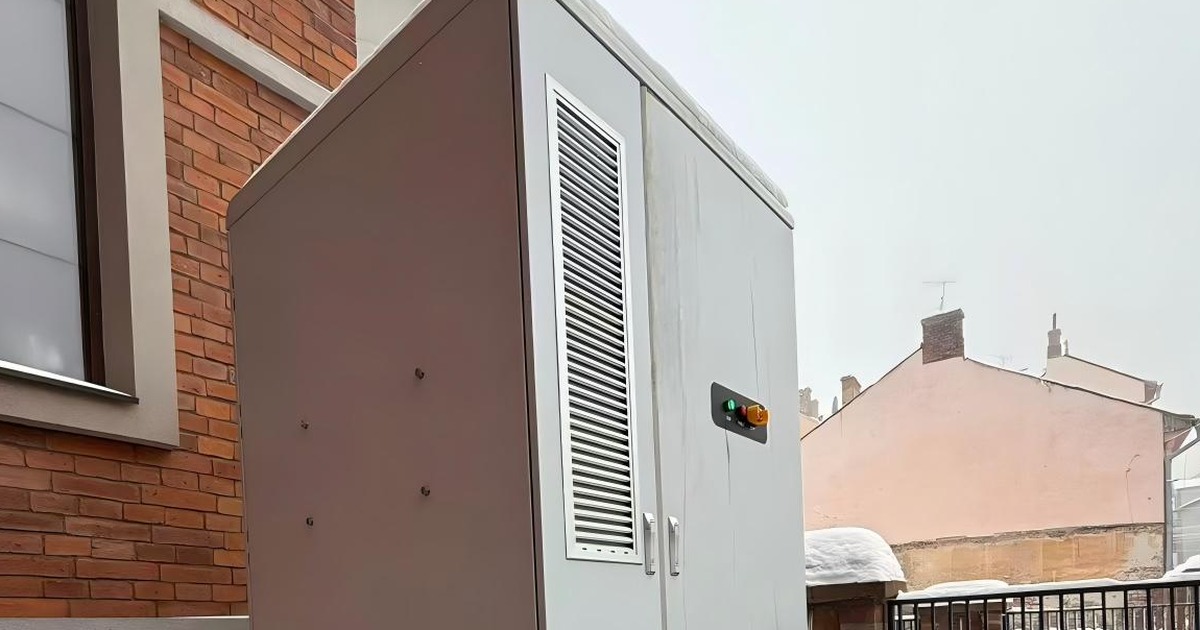
Short answer: LiFePO4 batteries from China fall under subheading 8507.60 (energy storage battery packs: candidate line 8507.60.39). With an SKA Form E, the ACFTA import duty for 8507.60.39 and 8507.60.90 is 0% (PMK 46/PMK.010/2022). Import taxes still payable: effective VAT (PPN) of 11% (12% × 11/12, PMK 131/2024) and PPh 22 of 2.5% with an API or 7.5% without an API, for importers with an NPWP (PMK 34/2017). The only Producer Importer (Importir Produsen, IP) and Surveyor Report (Laporan Surveyor, LS) requirement we found for 8507.60 applies to non-new (tidak baru) lithium batteries (Permendag 24/2025, on the border list since 9 October 2026). Sea shipments follow Class 9 dangerous goods rules (UN 3480), with batteries that have passed UN 38.3 testing.
Written by Marvin Zhou, Savolture, a LiFePO4 battery factory in Shenzhen, China. Translated from our Indonesian version. Rates and articles are cited from the regulation texts at JDIH Kemenkeu, JDIH BPK, JDIH Kemendag and INSW; the KMK 74/MK.BC/2026 border list was read from a copy of its appendix. Checked 10 November 2026. The official texts of these regulations are in Indonesian; English terms below are our working translation, with the Indonesian term in brackets where it matters. This article is not legal or tax advice; final confirmation lies with your PPJK (licensed customs broker) and tax consultant.
The First 4 Questions from LiFePO4 Battery Importers
What is the HS code for lithium and LiFePO4 batteries in Indonesia?
Lithium-ion batteries, including LiFePO4, fall under subheading 8507.60 of BTKI 2022 (Indonesia’s customs tariff book). For battery packs there are four tariff lines: 8507.60.31 (laptops), 8507.60.32 (aircraft), 8507.60.33 (vehicles of Chapter 87) and 8507.60.39 (other). Line 8507.60.90 is “other” outside battery packs. Energy storage rack modules or cabinets are candidates for 8507.60.39, but final classification is decided by Indonesian Customs (Bea Cukai) based on the goods description and specifications.
What is the import duty on lithium batteries from China to Indonesia?
With a valid Certificate of Origin Form E (SKA Form E), the ACFTA (ASEAN-China Free Trade Area) rate for 8507.60.39 and 8507.60.90 is 0.00% (PMK 46/PMK.010/2022, Appendix I). Without a valid Form E, the general (MFN) BTKI rate applies. BTKI has been amended several times (including PMK 10 of 2024, PMK 62 of 2025 and PMK 50 of 2026), so check the MFN rate for your tariff line in INSW before filing the PIB (import declaration).
How much VAT (PPN) and PPh 22 apply to imported lithium batteries?
Import VAT (PPN) is 12% multiplied by an “other value” tax base of 11/12 of the import value, giving an effective rate of 11% for goods not classed as luxury goods (PMK 131 of 2024, Article 3). Article 22 income tax on imports (PPh 22) for goods not listed in the specific-goods appendix is 2.5% of the import value if the importer uses an API (importer identification number) and 7.5% if not (PMK 34/PMK.010/2017, Article 2). This PPh 22 is not final and can be credited as a prepayment of the current year’s income tax.
Do new lithium batteries need a special import licence in Indonesia?
In the regulations we checked (Appendix I of Permendag 21 of 2025, Permendag 24 of 2025 jo. Permendag 23 of 2026, and the border-control list KMK 74/MK.BC/2026), we found no Import Approval (Persetujuan Impor) or Producer Importer requirement for new lithium batteries under 8507.60. The listed requirements apply to non-new (tidak baru) lithium batteries: Producer Importer status (Importir Produsen, IP) and a Surveyor Report (Laporan Surveyor, LS), with a start date on the border list of 9 October 2026. Prohibition and restriction (Lartas) status can change, so check your tariff line in INSW before the goods ship.
Most of the top pages we checked on 10 November 2026, in both Indonesian and English searches about importing lithium batteries from China, were written by freight forwarders, couriers or tariff calculators and apply to any country: battery types, SDS, UN 38.3, sea or air, then an invitation to use their service. What is rarely written down is Indonesia’s own rules: which BTKI tariff line applies, what the import duty is with Form E, how the 11% VAT has been calculated since 2025, and whether lithium batteries need a special import licence. This guide answers all four from the official texts, then closes with a list of documents you can request from a factory in China.
The 4-Layer Import Check for LiFePO4 Batteries
Short answer: Before you import lithium batteries from China, and before you pay a deposit to the factory, check four layers in order: (1) tariff classification under 8507.60; (2) importer licensing and prohibition or restriction status; (3) landed charges, meaning import duty with or without Form E, VAT (PPN) and PPh 22; (4) Class 9 dangerous goods shipping requirements. Any layer left unclear at the start becomes a source of extra cost at the port.
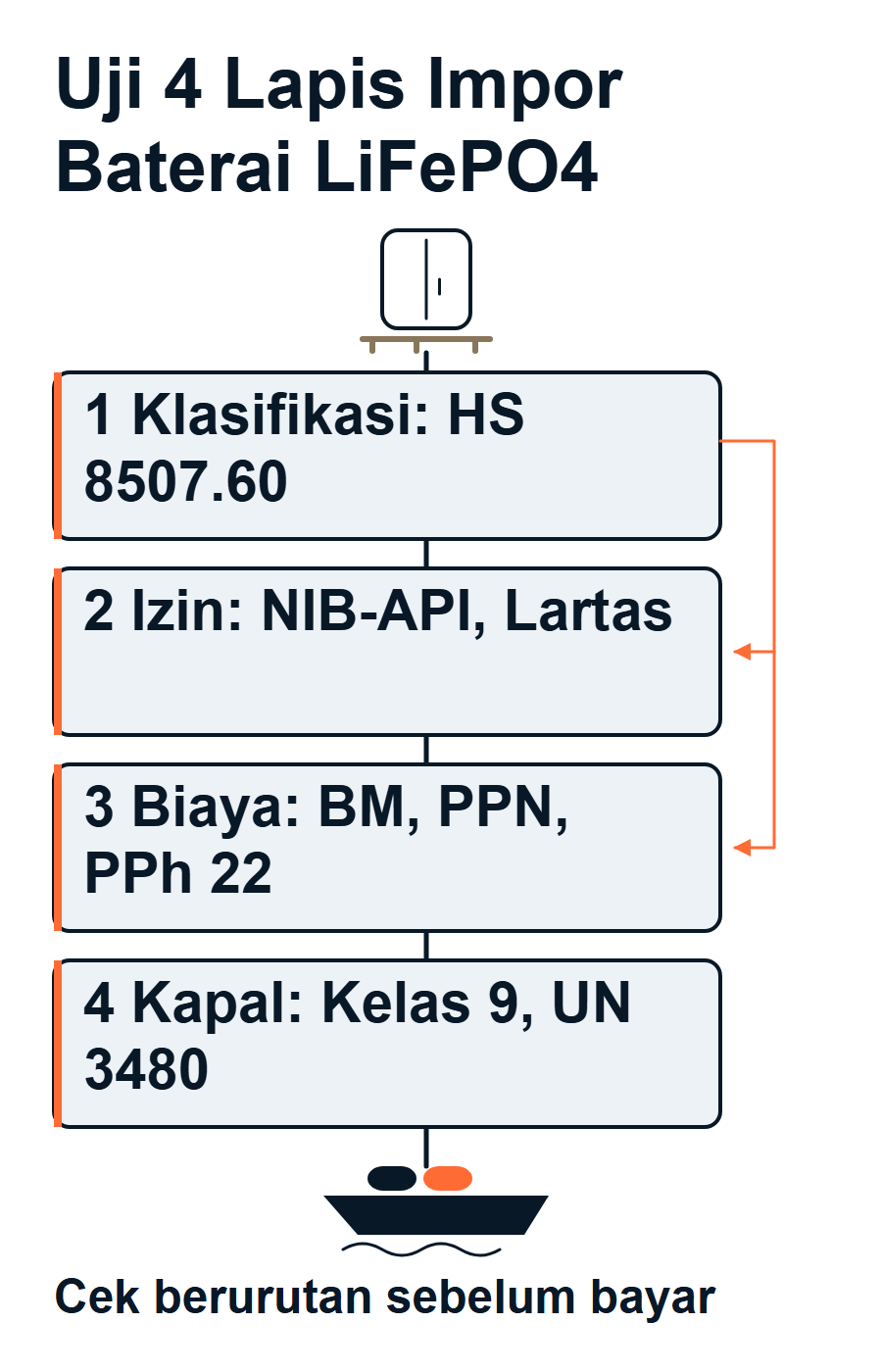
| Layer | Question | Basis | Who confirms |
|---|---|---|---|
| 1. Classification | Which tariff line: 8507.60.39 (other battery packs) or 8507.60.90? | BTKI 2022 (PMK 26/PMK.010/2022 and amendments) | Importer and PPJK; decided by Customs (Bea Cukai) |
| 2. Licensing | Does the NIB serve as an API? Is the tariff line subject to Lartas? | Permendag 16/2025; Permendag 21/2025; Permendag 24/2025 | Importer; check INSW per tariff line |
| 3. Costs | 0% import duty with Form E or the MFN rate; VAT (PPN); PPh 22 | PMK 46/PMK.010/2022; PMK 131/2024; PMK 34/PMK.010/2017 | Importer, PPJK, tax consultant |
| 4. Shipping | UN 3480 or UN 3536; are the SDS and UN 38.3 available? | UN Model Regulations; IMDG Code; IATA for air | Factory (shipper) and forwarder |
Layer 1 determines layers 2 and 3, because Lartas status and duty rates are attached to the tariff line. If the tariff line is wrong, the duty figure and the licensing answer are wrong too.
Indonesian Import Terms Used in This Guide
Short answer: Indonesian customs and tax documents use Indonesian terms and acronyms. Your PPJK and the INSW system will use these terms, so this guide keeps them and gives a working English translation.
| Term | Indonesian | Working English meaning |
|---|---|---|
| BTKI | Buku Tarif Kepabeanan Indonesia | Indonesia’s customs tariff book (8-digit tariff lines) |
| PIB | Pemberitahuan Impor Barang | Import declaration filed with Customs |
| PPJK | Pengusaha Pengurusan Jasa Kepabeanan | Licensed customs broker |
| NIB / API | Nomor Induk Berusaha / Angka Pengenal Importir | Business identification number / importer identification number; API-P = producer importer, API-U = general importer |
| IP / LS | Importir Produsen / Laporan Surveyor | Producer Importer status / surveyor report (surveyor verification) |
| Lartas | Larangan dan pembatasan | Import prohibitions and restrictions |
| SKA Form E | Surat Keterangan Asal Form E | ACFTA certificate of origin for goods from China |
| PPN / PPh 22 | Pajak Pertambahan Nilai / Pajak Penghasilan Pasal 22 | VAT / Article 22 income tax collected on imports |
| NPWP / PKP | Nomor Pokok Wajib Pajak / Pengusaha Kena Pajak | Tax ID number / VAT-registered business |
| Nilai pabean / nilai impor | — | Customs value / import value (customs value plus import duty and customs charges) |
| INSW | Indonesia National Single Window | Government portal for tariff lines, Lartas status and import documents |
Layer 1: HS Code 8507.60 in BTKI 2022
Short answer: Lithium-ion batteries, including LiFePO4 chemistry, sit under subheading 8507.60 of BTKI 2022. The subheading is split into battery packs (8507.60.31, .32, .33, .39) and “other” (8507.60.90). 51.2 V rack modules, cabinets and BESS for energy storage are not for laptops, aircraft or Chapter 87 vehicles, so the candidate line is 8507.60.39.
| Tariff line | Description (summarised from BTKI 2022) | Relevant for energy storage? |
|---|---|---|
| 8507.60 | – Lithium-ion | Parent subheading |
| 8507.60.31 | – – – Battery packs of a kind used for laptops including notebooks and subnotebooks | No |
| 8507.60.32 | – – – Battery packs of a kind used for aircraft | No |
| 8507.60.33 | – – – Battery packs of a kind used for vehicles of Chapter 87 | No (vehicle batteries) |
| 8507.60.39 | – – – Battery packs, other | Main candidate for rack modules, cabinets, BESS |
| 8507.60.90 | – – Other (not battery packs) | To be confirmed by the PPJK, for example for cells |
Source: tariff line search for 8507.60 in INSW INTR and BTKI Chapter 85 from the Directorate General of Customs and Excise, checked 10 November 2026. Because final classification is decided by Customs, put a full description on the invoice: cell chemistry (LiFePO4), nominal voltage, kWh capacity and function (stationary energy storage). A description that only says “lithium battery” is harder to match to a tariff line. A system that integrates a PCS or inverter in a single unit may be classified differently from a battery pack; confirm the tariff line with your PPJK before the PO.
Layer 2: NIB-API, Lartas, and New vs Non-New Batteries
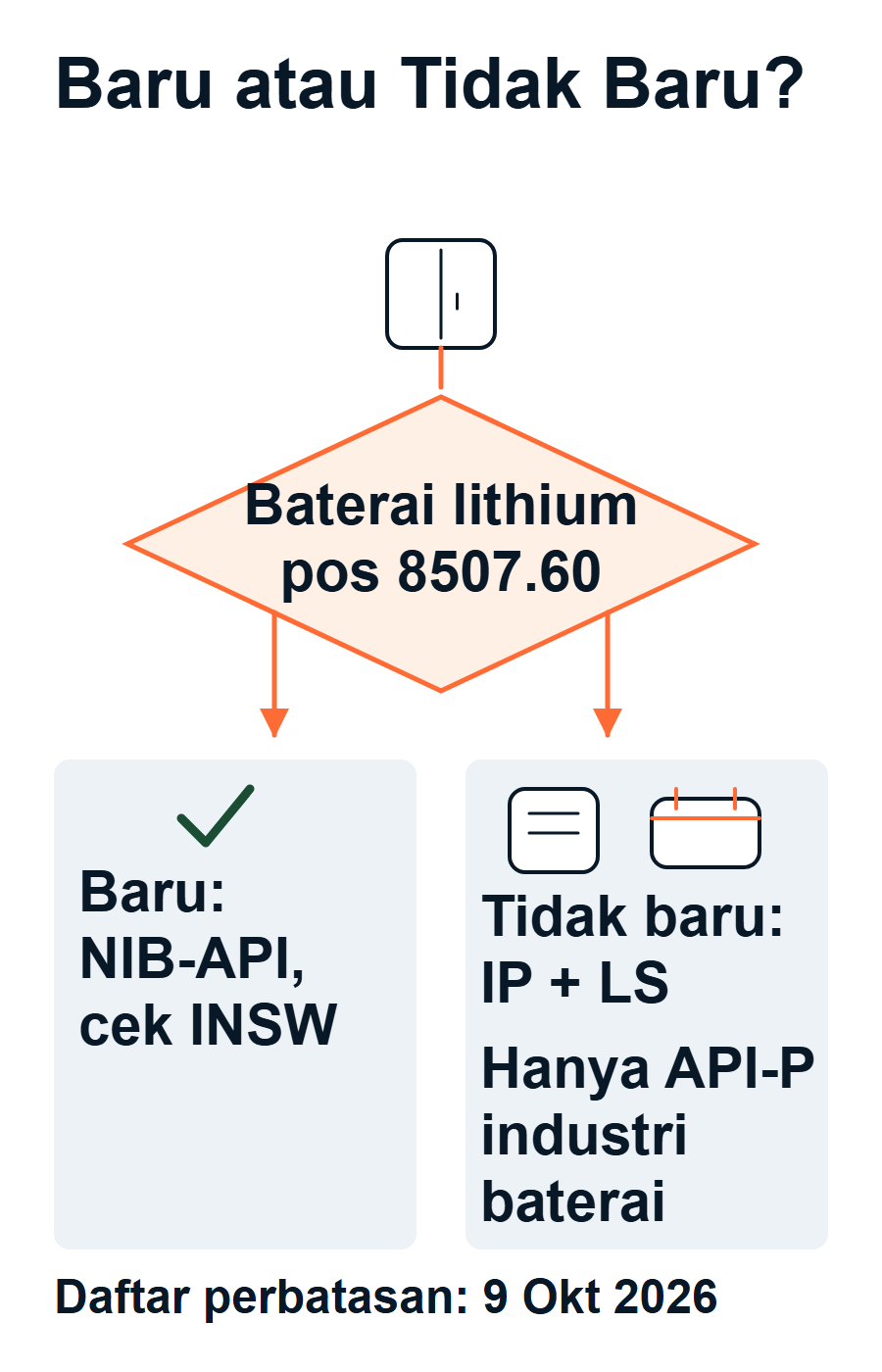
Short answer: Importers need an NIB that serves as the Importer Identification Number, API (Permendag 16/2025). For 8507.60, the Producer Importer (IP) and Surveyor Report (LS) requirement we found applies only to non-new lithium batteries, and these may only be imported by an API-P holder that is a lithium battery industry or a metal material recovery industry (Permendag 24/2025). New batteries are not listed in Appendix I of Permendag 21/2025 on electronics imports.
| Condition of goods | Requirement we found | Who may import | Source |
|---|---|---|---|
| New lithium batteries (cells, modules, cabinets) | Not listed in Appendix I of Permendag 21/2025 (that appendix contains no heading 85.07). Check the tariff line status in INSW before the PIB. | Importer with an NIB serving as API | Permendag 21/2025; Permendag 16/2025 |
| Non-new lithium batteries (whole secondary batteries that can no longer be used as intended; production remnants and scrap) | Producer Importer (IP) and Surveyor Report (LS); on the border list for ex 8507.60.31, .32, .33, .39 and .90 with a start date of 9 October 2026 | Only API-P holders that are a lithium battery industry and/or a metal material recovery industry | Permendag 24/2025 jo. Permendag 23/2026; KMK 74/MK.BC/2026 |
The practical impact for buyers: under the other provisions of Permendag 24/2025, the only non-new lithium batteries that may be imported are whole secondary batteries that can no longer be used as intended, plus production remnants and scrap, as raw material for the battery or metal recovery industry. Used or refurbished cells for installation as energy storage do not fall into that category. If a quotation does not state that the cells are new, ask in writing and request proof of the production date. How to check new versus used cells is covered in how to verify Grade A LiFePO4 cells.
Regulations we checked for this layer: Permendag 16/2025, Appendix I of Permendag 21/2025, Permendag 24/2025 jo. Permendag 23/2026, and KMK 74/MK.BC/2026. Indonesian-language labelling rules and other provisions outside that list are not covered here. The prohibition and restriction lists changed several times in 2025–2026, from Permendag 16/2025 replacing the older import rules to the 2026 amendment of Permendag 24/2025. So do not rely on old screenshots: open your tariff line in INSW in the same week as the shipment. Entry into free trade zones (KPBPB, for example Batam), special economic zones (KEK) and bonded storage areas is governed by separate provisions in Permendag 16/2025; this guide covers imports for use in the regular customs area.
Layer 3: Import Duty, Form E, VAT (PPN), and PPh 22
Short answer: Import duty is calculated on the customs value; VAT (PPN) and PPh 22 are calculated on the import value. ACFTA import duty is 0% for 8507.60.39 and 8507.60.90 with a valid Form E; VAT is 12% times 11/12 of the import value (11% effective); PPh 22 is 2.5% with an API or 7.5% without an API, for importers with an NPWP. Import VAT can be credited by a PKP, and import PPh 22 is not final.
| Charge | Rate | Calculated on | Article |
|---|---|---|---|
| Import duty with SKA Form E (ACFTA) | 0.00% for 8507.60.39 and 8507.60.90 | Customs value | PMK 46/PMK.010/2022, Appendix I; in force 1 April 2022 |
| Import duty without a valid Form E | General (MFN) BTKI rate; check the latest figure in INSW | Customs value | PMK 26/PMK.010/2022 and amendments |
| Import VAT (PPN) | 12% × 11/12 = 11% effective (goods not classed as luxury) | Import value | PMK 131 of 2024, Article 3(2) and (3); in force 1 January 2025 |
| Import PPh 22, with API | 2.5% | Import value | PMK 34/PMK.010/2017, Article 2(1)(a)(1)(d) |
| Import PPh 22, without API | 7.5% | Import value | PMK 34/PMK.010/2017, Article 2(1)(a)(1)(e) (without API) |
Four notes that are often missed:
- Import value (nilai impor) is the value used as the basis for import duty plus customs charges, excluding VAT and luxury goods sales tax (PPnBM) (Law 42/2009, Article 1 point 20). So with 0% import duty, the import value equals the customs value; if you pay the MFN rate, VAT and PPh 22 also rise because they are calculated on a larger value.
- Form E must be valid and consistent. Article 2 of PMK 46/2022 refers to a separate procedure for applying ACFTA rates, and paragraph (2) states that if the general rate is lower, the general rate applies. Make sure the goods name, tariff line, quantity and invoice number on the Form E match the shipping documents. Appendix II of the same PMK (reciprocity rates for goods originating from China) does not include 8507.60.39 or 8507.60.90.
- The PPh 22 specific-goods appendix (rates of 10% and 7.5% regardless of API) does not include heading 8507 in the original text of PMK 34/2017. That appendix has been replaced since 2017, including by PMK 41/PMK.010/2022, so ask your PPJK to check your tariff line against the appendix in force.
- Without an NPWP, the import PPh 22 rate is 100% higher than the rates above (PMK 34/2017, Article 2(4)).
Worked Example: Import Tax Calculation
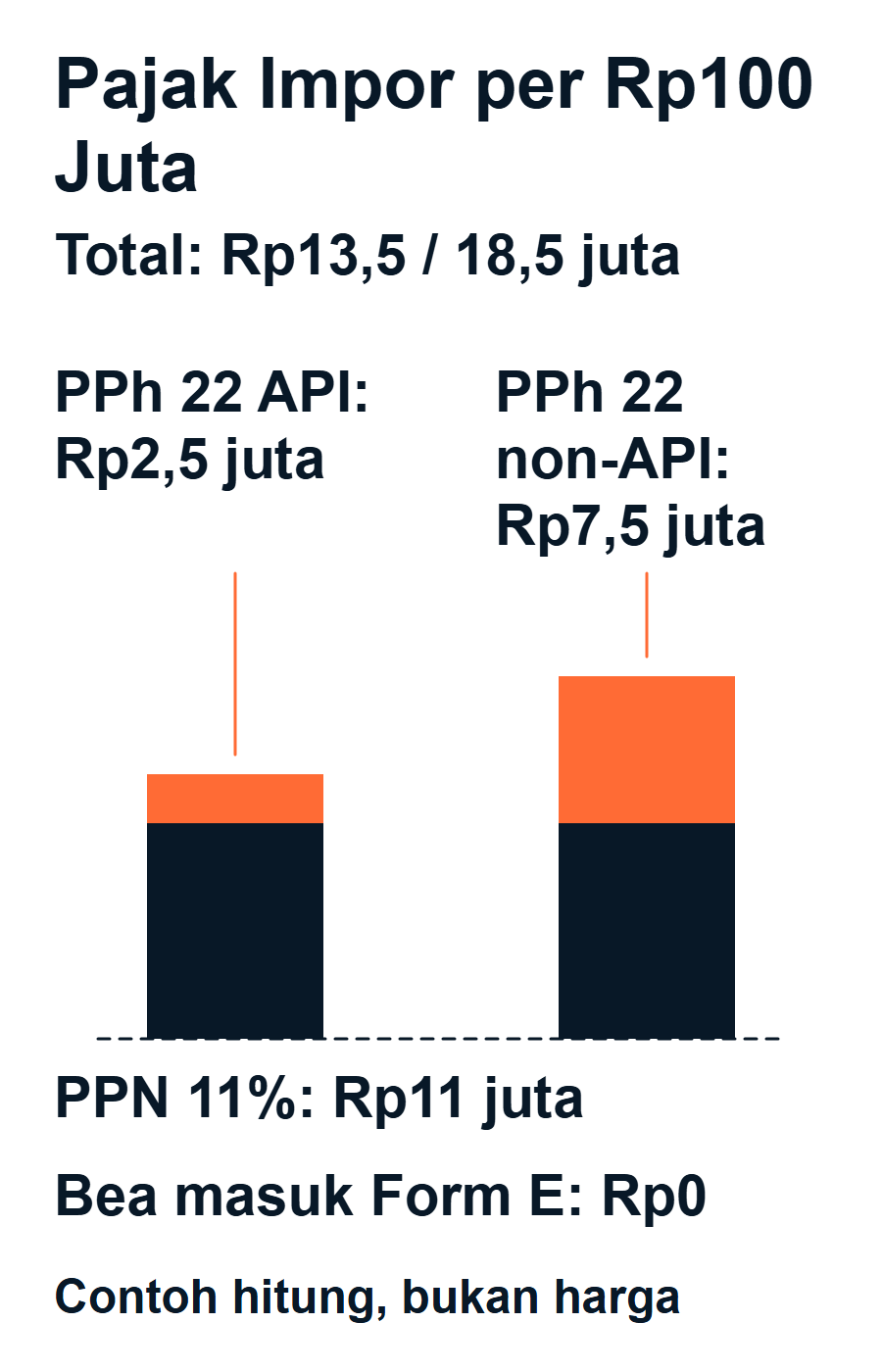
Short answer: For a customs value of Rp100,000,000 (IDR 100 million) with Form E (0% import duty): import VAT is Rp11,000,000 and PPh 22 is Rp2,500,000 if the importer uses an API, a total of Rp13,500,000. Without an API, PPh 22 becomes Rp7,500,000 and the total is Rp18,500,000. These figures are a calculation example, not a battery price.
| Line | With API | Without API | How it is calculated |
|---|---|---|---|
| Customs value (example) | Rp100,000,000 | Rp100,000,000 | Goods value + freight + insurance to the Indonesian port, converted to rupiah at the NDPBM customs exchange rate on the PIB date |
| Import duty (Form E, ACFTA 0%) | Rp0 | Rp0 | 0.00% × customs value |
| Import value | Rp100,000,000 | Rp100,000,000 | Customs value + import duty |
| Import VAT (PPN) | Rp11,000,000 | Rp11,000,000 | 12% × 11/12 × import value |
| Import PPh 22 | Rp2,500,000 | Rp7,500,000 | 2.5% or 7.5% × import value |
| Total import taxes | Rp13,500,000 | Rp18,500,000 | Excludes PPJK fees, port charges and inland transport |
The without-API column is shown for comparison; business importers must hold an NIB that serves as an API. If Form E is missing or rejected, replace the import duty line with your tariff line’s MFN rate times the customs value, then recalculate the import value; VAT and PPh 22 will rise proportionally. For a PKP, this import VAT can be credited as input tax (PMK 131/2024, Article 3(4)), and PPh 22 is counted as a prepayment of the current year’s income tax (PMK 34/2017, Article 9(1)). So the cash outlay at the port is larger than the final tax burden. For an indication of price per kWh before tax, see BESS price per kWh in Indonesia (Bahasa Indonesia).
Calculate the import for your model
Send the model, quantity and destination port. We send the datasheet, SDS, UN 38.3 report and an invoice goods description so your PPJK can settle the tariff line early.
Layer 4: Class 9 Dangerous Goods Shipping
Short answer: Lithium-ion batteries shipped on their own travel as UN 3480, Class 9. A BESS installed inside a container that only supplies power outside the container uses UN 3536 with special provision 389, which entered the UN Model Regulations in the 20th edition. Both routes require batteries that have passed UN 38.3 testing with a test summary available. A Safety Data Sheet is not required by the UN entry itself, but forwarders and shipping lines ask for it when booking cargo space.
| Goods | UN number | Class | Notes |
|---|---|---|---|
| Cells, rack modules, cabinets shipped as goods | UN 3480 Lithium ion batteries | 9 | Sea follows the IMDG Code; air follows the stricter IATA rules |
| Batteries installed inside a container (containerised BESS) | UN 3536 Lithium batteries installed in cargo transport unit | 9 | Special provision 389: batteries pass UN 38.3 and are secured in racks or cabinets; the container carries Class 9 placards |
Source: special provision 389 is in the UN Recommendations on the Transport of Dangerous Goods, Model Regulations (20th edition onward, Chapter 3.3) and the IMDG Code; UNECE document ST/SG/AC.10/C.3/2019/8 records that the UN 3536 entry and provision 389 entered the 20th edition. Class 9 for UN 3480 is also listed in the IATA Lithium Battery Guidance Document 2026 for air transport. Heavy energy storage modules are in practice shipped by sea; air freight is used for small samples and must follow IATA limits. What a UN 38.3 test summary contains and how to read it is covered in our UN 38.3 test summary buyer checklist.
Do Imported LiFePO4 Batteries Need SNI?
Short answer: The mandatory battery SNI (Indonesian National Standard) we found is Permenperin 69 of 2024, for primary batteries. We did not find a Permenperin making SNI mandatory for secondary lithium-ion batteries. TKDN (local content) is a requirement for PLN and government procurement, not an import requirement.
This means that for private purchases such as factories, island resorts, mines or telecom towers that do not go through a tender, the documents buyers ask for are international test reports per model, such as UN 38.3 for transport and IEC 62619 for industrial battery safety where available. For PLN projects and government procurement, TKDN decides who can take part. Procurement tiers and TKDN are covered in our SNI and TKDN guide for energy storage batteries (Bahasa Indonesia). If the battery is installed on rooftop solar connected to PLN, the extra requirements are in Indonesia rooftop solar battery rules under Permen ESDM 2/2024.
Documents to Request from the Factory in China
Short answer: Request six documents before the goods ship: commercial invoice, packing list, SKA Form E, Safety Data Sheet per model, UN 38.3 report with test summary, and the datasheet. The Bill of Lading and dangerous goods declaration are prepared at shipment. The model name must be identical on every document and on the battery label.
| Document | Purpose | What to check |
|---|---|---|
| Commercial invoice | Basis for customs value and classification | Full description: LiFePO4, voltage, kWh, energy storage function; Incoterm stated |
| Packing list | Physical inspection and weight | Number of units, net and gross weight per pallet |
| SKA Form E | ACFTA 0% rate | Tariff line, description, quantity and invoice number match the invoice |
| Safety Data Sheet (SDS) | Requested by forwarders and shipping lines for dangerous goods cargo | Model name and cell chemistry match the label |
| UN 38.3 report and test summary | Transport requirement for UN 3480 and UN 3536 | Tested model is the same as the shipped model; see the UN 38.3 checklist |
| Datasheet | Helps the PPJK set the tariff line; design basis | Nominal voltage, capacity, maximum current, communication protocol |
| Bill of Lading | Transport document | Issued by the shipping line after loading |
For project purchases, add a written warranty letter from the factory; what to check in it is covered in LiFePO4 battery warranty in Indonesia (Bahasa Indonesia). If you order under your own brand, the OEM process and documents are covered in our OEM LiFePO4 battery manufacturing guide.
Five Things to Check Before You Pay
Short answer: These five checks close the layers most often checked too late: goods description, new or non-new status, Form E, the importer’s API status, and matching model names on transport documents.
Tax figures can only be calculated once the tariff line and Form E status are clear. So when we prepare a quotation for a buyer in Indonesia, we ask for these five points to be confirmed first:
- The invoice description is enough for classification. State the cell chemistry, voltage, kWh and function. Send the draft invoice to your PPJK before the goods ship.
- New goods, in writing. Ask for a written statement that the cells and modules are new, with the production date. Non-new lithium batteries require IP and LS and may only be imported by an API-P battery or metal recovery industry.
- Form E is issued for this shipment. Confirm with the factory that Form E will be issued and that its data matches the invoice; without Form E, recalculate with the MFN rate.
- The importer’s NIB serves as an API. Business importers must hold an NIB-API, and PPh 22 with an API is 2.5% of the import value; also make sure the NPWP is active, because without an NPWP the rate is 100% higher.
- The model name is the same on the SDS, UN 38.3 report and label. A model name mismatch can lead the shipping line or forwarder to refuse the dangerous goods cargo.
If you are still comparing suppliers, the guide factory vs distributor for LiFePO4 batteries (Bahasa Indonesia) explains what changes when you buy direct from a factory, and the LFP BESS supplier list (Bahasa Indonesia) compares suppliers for C&I projects.
What We Prepare as the Factory
Short answer: Savolture manufactures LiFePO4 batteries in Shenzhen and ships to Indonesia from China; we have no warehouse or office in Indonesia. For each model we prepare a datasheet, Safety Data Sheet and UN 38.3 report. Form E and the Incoterm are confirmed per quotation. MOQ is 1 unit.
- 51.2 V rack modules for home, business and BTS solar systems: 48 V LiFePO4 battery.
- 314Ah 16.08 kWh cabinet: 314Ah LFP battery.
- 125 kW BESS (241–261 kWh) for factories and off-grid sites: 125 kW BESS (Bahasa Indonesia).
Wholesale purchasing for installers and distributors is explained in wholesale LiFePO4 battery supply, and a supplier map by project segment is in our BESS Indonesia guide (Bahasa Indonesia).
Why I write this: Savolture is a LiFePO4 battery factory in Shenzhen offering 51.2 V modules and BESS to importers, installers and EPC contractors in Indonesia. We do not handle customs clearance in Indonesia; that is the job of the importer and the PPJK. I wrote this guide because buyers who know the tariff line, Form E and required documents before ordering avoid costs and delays at the port, and the conversation with us becomes about specifications, not forms.
Send Model and Quantity via WhatsApp or use the contact page.
FAQ: Importing LiFePO4 Batteries from China to Indonesia
What is the HS code for lithium and LiFePO4 batteries in Indonesia?
Lithium-ion batteries, including LiFePO4, fall under subheading 8507.60 of BTKI 2022 (Indonesia’s customs tariff book). For battery packs there are four tariff lines: 8507.60.31 (laptops), 8507.60.32 (aircraft), 8507.60.33 (vehicles of Chapter 87) and 8507.60.39 (other). Line 8507.60.90 is “other” outside battery packs. Energy storage rack modules or cabinets are candidates for 8507.60.39, but final classification is decided by Indonesian Customs (Bea Cukai) based on the goods description and specifications.
What is the import duty on lithium batteries from China to Indonesia?
With a valid Certificate of Origin Form E (SKA Form E), the ACFTA (ASEAN-China Free Trade Area) rate for 8507.60.39 and 8507.60.90 is 0.00% (PMK 46/PMK.010/2022, Appendix I). Without a valid Form E, the general (MFN) BTKI rate applies. BTKI has been amended several times (including PMK 10 of 2024, PMK 62 of 2025 and PMK 50 of 2026), so check the MFN rate for your tariff line in INSW before filing the PIB (import declaration).
How much VAT (PPN) and PPh 22 apply to imported lithium batteries?
Import VAT (PPN) is 12% multiplied by an “other value” tax base of 11/12 of the import value, giving an effective rate of 11% for goods not classed as luxury goods (PMK 131 of 2024, Article 3). Article 22 income tax on imports (PPh 22) for goods not listed in the specific-goods appendix is 2.5% of the import value if the importer uses an API (importer identification number) and 7.5% if not (PMK 34/PMK.010/2017, Article 2). This PPh 22 is not final and can be credited as a prepayment of the current year’s income tax.
Do new lithium batteries need a special import licence in Indonesia?
In the regulations we checked (Appendix I of Permendag 21 of 2025, Permendag 24 of 2025 jo. Permendag 23 of 2026, and the border-control list KMK 74/MK.BC/2026), we found no Import Approval (Persetujuan Impor) or Producer Importer requirement for new lithium batteries under 8507.60. The listed requirements apply to non-new (tidak baru) lithium batteries: Producer Importer status (Importir Produsen, IP) and a Surveyor Report (Laporan Surveyor, LS), with a start date on the border list of 9 October 2026. Prohibition and restriction (Lartas) status can change, so check your tariff line in INSW before the goods ship.
Do imported LiFePO4 batteries need SNI certification?
The mandatory battery SNI we found is Permenperin 69 of 2024, and it applies to primary batteries. We did not find a Permenperin that makes SNI mandatory for secondary lithium-ion batteries. TKDN (local content) remains a requirement in PLN and government procurement. Ask your PPJK to confirm for your tariff line and import date.
What documents should I ask a Chinese battery factory for?
At minimum: a commercial invoice and packing list with model names matching the battery label, the Bill of Lading, SKA Form E if you want the ACFTA rate, the UN 38.3 test report and test summary, a Safety Data Sheet (SDS) per model as requested by forwarders and shipping lines, and the datasheet. For sea freight, the shipper also prepares a Class 9 dangerous goods declaration (UN 3480 for batteries shipped on their own).
Can I import batteries into Indonesia without an NIB or API?
Importers must hold an NIB (business identification number) that also serves as the Importer Identification Number, API (Permendag 16 of 2025). Under PMK 34/PMK.010/2017, PPh 22 on imports is 2.5% when the import uses an API and 7.5% when it does not; both rates apply to taxpayers with an NPWP (tax ID), and without an NPWP the rate is 100% higher (Article 2(4)). If you use another company that holds an NIB-API as the importer of record, confirm how customs and tax responsibilities are split with your PPJK and put it in a written agreement.
References
- INSW INTR: BTKI 2022 descriptions for 8507.60 (checked 10 November 2026).
- PMK 26/PMK.010/2022 on the goods classification system and import duty rates, with amendments (in Indonesian).
- PMK 46/PMK.010/2022 on ACFTA import duty rates, Appendix I (in Indonesian).
- PMK 131 of 2024, Article 3 (in Indonesian).
- PMK 34/PMK.010/2017 on PPh Article 22 collection, Articles 2 and 9; the specific-goods appendix was replaced, including by PMK 41/PMK.010/2022 (in Indonesian).
- Law (UU) 42 of 2009, Article 1 point 20 (definition of import value) (in Indonesian).
- Permendag 16 of 2025 on import policy and regulation (in Indonesian).
- Permendag 21 of 2025 on imports of electronic and telematics goods, Appendix I (in Indonesian).
- Permendag 24 of 2025 on imports of non-new goods and non-hazardous waste, jo. Permendag 23 of 2026 (in Indonesian).
- Appendix to KMK 74/MK.BC/2026: list of import-restricted goods under Permendag 24/2025 jo. Permendag 23/2026 (in Indonesian).
- Permenperin 69 of 2024 on mandatory SNI for primary batteries (in Indonesian).
- UN Recommendations on the Transport of Dangerous Goods, Model Regulations, Chapter 3.3, special provision 389; IMDG Code.
- UNECE ST/SG/AC.10/C.3/2019/8 (UN 3536 added in the 20th edition) and IATA Lithium Battery Guidance Document 2026 (UN 3480, Class 9, air transport).
Name: Marvin Zhou
Brand: Savolture
Country: China (factory, Shenzhen) · Serving: Indonesia
Model: B2B Factory-Direct LFP + C&I BESS
WhatsApp: +86 15543662225
Email: marvin@savolture.com
Website: savolture.com
Ready to size your system?
Get a free battery recommendation.
Tell us your load, location, and backup target — we will spec the right 48V LiFePO4 system for you.