

Savolture Technical Guide
How to Verify Grade A LiFePO4 Cells: 5-Layer Inspection Checklist & 4 Used-Cell Traps (2026 Installer Guide)
Quick Answer: Genuine Grade A LiFePO4 cells can be conclusively verified by solar installers, battery pack builders, and procurement engineers through a rigorous 5-Layer Buyer-S...
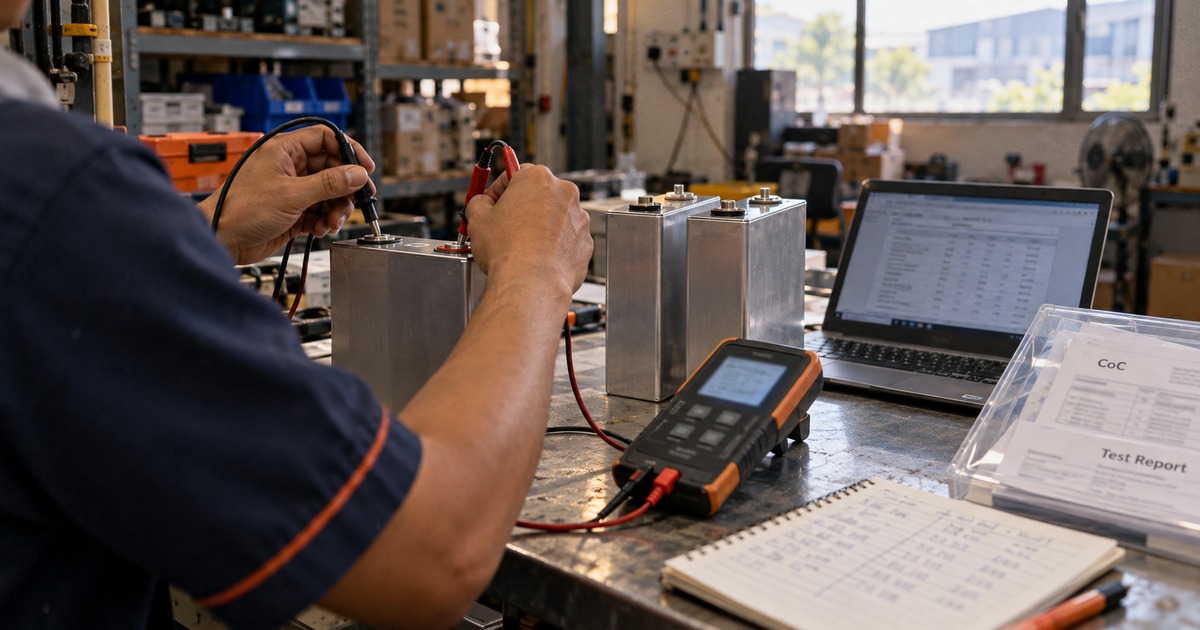
Quick Answer: Genuine Grade A LiFePO4 cells can be conclusively verified by solar installers, battery pack builders, and procurement engineers through a rigorous 5-Layer Buyer-Side Inspection: (1) Factory Documentation Layer — requiring unredacted manufacturer Certificate of Conformity (CoC), per-cell capacity sorting sheets, 1 kHz AC internal resistance (AC-IR) logs, and 24-hour Open Circuit Voltage (OCV) sorting reports; (2) Physical & QR Code Layer — laser-etched 24-digit DataMatrix QR code validation against manufacturer registries, pristine aluminum casing with zero deep gouges, flat vent valves, and clean laser-welded terminals free of black masking tape; (3) Actual Discharge Capacity Layer — delivering ≥ 98.0% of nameplate capacity under 0.5C/1C discharge at 25°C down to 2.5V cutoff; (4) Internal Resistance Layer — verified via a calibrated 1 kHz AC micro-ohmmeter (≤ 0.25 mΩ for 314Ah, ≤ 0.27 mΩ for 280Ah, ≤ 0.30 mΩ for 200Ah, ≤ 0.40 mΩ for 100Ah); and (5) Pack Consistency Layer — maximum delta voltage (ΔV) ≤ 5 mV and delta resistance (ΔIR) ≤ 0.05 mΩ across a 16S (51.2V) series string after a 24-hour rest. Engineered energy storage systems distributed by Savolture (such as our 16.08 kWh 314Ah server rack modules and 261 kWh commercial BESS platforms) exclusively integrate Tier-1 automotive-grade LFP cells certified to IEC 62619, UL 1973, and UN 38.3 with serialized factory traceability.
The 5-Layer Buyer-Side Inspection Checklist for Grade A LiFePO4 Cells
Key Takeaway: Never rely on manufacturer packaging labels alone. Over 70% of search results for “Grade A LFP cells” are published by trading houses promoting unverified stock. An authentic verification audit cross-checks documentation, physical integrity, actual C-rate capacity, electrochemical impedance, and string balance before cell batches are welded or connected to a Battery Management System (BMS).
Layer 1 — Factory Documentation & Traceability Layer
Every legitimate batch of Tier-1 prismatic LiFePO4 cells must be accompanied by four mandatory factory-issued test documents:
| Documentation Item | Mandatory Data Fields | Standard Reference |
|---|---|---|
| Certificate of Conformity (CoC) | Production lot number, manufacturing date code, cell model part number, nominal nameplate capacity, quality inspector stamp | ISO 9001 Quality System Traceability |
| Per-Cell Capacity Test Log | Individual cell serialized barcode, measured Ah capacity at 0.5C/1C discharge rate at 25°C, ambient humidity, cutoff voltage | IEC 62619:2022 clause 7.2 |
| AC Internal Resistance (AC-IR) Log | AC-IR measured at 1 kHz frequency (25°C) for each individual cell serial number | Standard Industrial Sorting Protocol |
| Open Circuit Voltage (OCV) Sorting Sheet | Rest voltage measured after minimum 24 to 72 hours of post-formation aging; maximum voltage deviation (ΔV) across batch | Grade A Criteria: ΔV ≤ 5 mV across batch |
Critical Red Flag: If a supplier provides only a generic marketing datasheet or a single-page aggregate certificate without cell-by-cell serialization data, the batch is either Grade B production runout or remanufactured surplus. Tier-1 automated cell manufacturing lines (CATL, EVE, Gotion, REPT, CALB) record automated optical inspection and grading data for 100% of manufactured units. For battery transport compliance, cross-reference documentation against our C&I BESS Vendor Selection Buyer Guide.
Layer 2 — Physical Construction & QR Code Layer
Physical inspection takes less than 15 minutes per batch and quickly uncovers cosmetic refinishing used to disguise degraded cells:
- Laser-Etched 24-Digit QR Code: Authentic prismatic cells feature a high-contrast laser-ablated DataMatrix 2D code located directly between the terminal posts. The code reveals the manufacturer ID, cell chemistry, factory location, production line, year, month, and day of manufacture. Scratched, re-lasered, or sanded QR surfaces indicate that factory scrap codes have been obliterated.
- Aluminum Canister & Vent Integrity: Pristine aluminum canisters should have zero bulging, deep scoring, or dents exceeding 0.2 mm. Inspect the explosion-proof pressure relief valve (the burst disk on top of the cell): it must be completely flat. A concave or bowed vent disk indicates internal gas generation or prior thermal over-pressurization.
- Pristine Terminal Posts: Original Grade A terminals (whether laser-welded M6/M8 female threaded studs or smooth laser-welding studs) must exhibit clean metallic luster. Dark oxidation, pitting, or grinding marks prove that busbars were previously welded and subsequently ground off to sell the cell as “new”.
- Absence of Black Masking Tape: Unscrupulous brokers frequently apply black electrical tape or secondary shrink wrap over the edges or top plastic insulators. This is often done to conceal bulged cell walls, acid micro-leaks around terminal seals, or altered manufacturer barcodes.
Layer 3 — Actual Discharge Capacity Testing Layer
Key Takeaway: A genuine Grade A prismatic cell must deliver ≥ 98.0% of its rated nameplate capacity under standard test conditions. For example, a 314Ah cell must deliver a minimum of 307.7 Ah during a controlled 0.5C or 1C discharge cycle at 25°C down to the 2.50V manufacturer cutoff. Any cell delivering less than 95.0% must be downgraded to Grade B or discarded as second-life stock.
Executing an on-site capacity audit on a 10% batch sample requires a precision battery cycler or calibrated DC electronic load tester following this standard test cycle:
- Constant Current / Constant Voltage (CC/CV) Charge: Charge the cell at 0.5C constant current up to 3.65V, then hold at 3.65V constant voltage until charging current tapers down to 0.05C.
- Thermal Stabilization Rest: Allow the cell to rest for 2 hours at 25°C ± 2°C to stabilize internal electrochemical equilibrium and dissipate charging heat.
- Constant Current Discharge: Discharge at 1C (or manufacturer-specified 0.5C rate) down to the absolute cutoff threshold of 2.50V.
- Integration & Calculation: Record total accumulated ampere-hours (Ah) and calculate capacity retention relative to nameplate.
Layer 4 — 1 kHz AC Internal Resistance (AC-IR) Layer
Internal resistance is the single most reliable electrochemical indicator of battery health and cannot be cosmetically faked. While capacity can be temporarily inflated by aggressive overcharging, internal resistance directly reflects the integrity of the cathode-electrolyte interphase and current collector foils. Measurements must be taken using a dedicated 1 kHz AC micro-ohmmeter (such as a Hioki BT3562 or RC3563), as standard multimeters measuring DC resistance lack the required milliohm resolution.
| Prismatic Cell Capacity | Grade A Max AC-IR (1 kHz, 25°C) | Grade B Typical Range | Reject / Used Cell Threshold |
|---|---|---|---|
| 100Ah Prismatic (LFP) | ≤ 0.40 mΩ | 0.41 – 0.60 mΩ | > 0.60 mΩ |
| 200Ah Prismatic (LFP) | ≤ 0.30 mΩ | 0.31 – 0.45 mΩ | > 0.45 mΩ |
| 280Ah Prismatic (LFP) | ≤ 0.27 mΩ | 0.28 – 0.40 mΩ | > 0.40 mΩ |
| 314Ah Prismatic (LFP) | ≤ 0.25 mΩ | 0.26 – 0.35 mΩ | > 0.35 mΩ |
In high-capacity utility-scale cells (such as the 314Ah format utilized in Savolture 314Ah Server Rack & C&I Battery Systems), an AC-IR exceeding 0.25 mΩ causes severe localized Joule heating ($I^2R$) under heavy 0.5C/1C cycling, accelerating thermal degradation and triggering premature BMS over-temperature cutoffs.
Layer 5 — String Consistency & Module Matching Layer
Key Takeaway: A battery pack is only as strong as its weakest cell. Even if sixteen individual cells meet Grade A criteria individually, placing mismatched cells together into a 16S (51.2V nominal) pack results in severe cell drift, forcing passive BMS balancers into continuous dissipation and shrinking the pack’s usable capacity by 5% to 15%.
For a standard 16S series string, Grade A module matching mandates the following thresholds after a 24-hour stabilization rest:
- Maximum Voltage Delta (ΔV): ≤ 5 mV across all 16 cells. (Grade B: 6–15 mV; Reject: > 15 mV).
- Maximum Internal Resistance Delta (ΔIR): ≤ 0.05 mΩ across all 16 cells. (Reject: > 0.10 mΩ).
- Capacity Matching Window: Maximum spread ≤ 1.5% between highest and lowest cell capacity.
Ensuring precision string matching prevents premature BMS cutoffs. To understand how balanced cell strings communicate seamlessly with solar inverters, review our technical guide on CAN 2.0 vs RS485 BMS Communication Protocols.
Four Critical Traps: Avoiding Deceptive Marketing & Recycled EV Cells
Key Takeaway: Unscrupulous battery brokers capitalize on information asymmetry. The four most pervasive scams in the global LiFePO4 market are: (1) unregulated “Grade A+ / AA” marketing labels; (2) counterfeit paperwork paired with physically refinished cells; (3) pricing that defies raw material economics; and (4) “EV factory surplus” stock suffering from severe calendar aging.
International battery standards (including IEC 62619:2022 and UL 1973) contain zero definitions for “Grade A+”, “Grade AA”, or “Tier-1 Premium”. These designations are purely marketing inventions created by brokers to justify premium markups on standard sorting yields. True classification must be judged strictly against measured electrochemical parameters (capacity, AC-IR, OCV retention), never on adjectives stamped on supplier invoices.
Forging a PDF test certificate takes minutes, but electrochemical degradation cannot be erased. Buyers frequently receive complete test sheets showing “0.21 mΩ and 102% capacity”, only to inspect the physical cells and find buffed weld spatter on terminals, secondary shrink sleeves, or polished aluminum casings. If physical indicators show signs of prior busbar welding, the batch is reconditioned Grade B/C stock regardless of what the documentation claims.
In the global 2026 lithium storage market, genuine Tier-1 314Ah Grade A prismatic cells trade within an established FOB China corridor of $55 to $75 per cell (~$55 to $75/kWh bare cell level, fluctuating with lithium carbonate market indexes). When an unfamiliar online vendor offers “Brand New Grade A 314Ah Cells” at $30 to $40 per unit, it is mathematically impossible for the product to be prime factory yield. Such offers invariably consist of rejected manufacturing lots, second-life EV pack teardowns, or relabeled lower-capacity (280Ah) cores.
Brokers frequently pitch “OEM excess stock from leading EV automotive programs”. Even if these cells were never placed in an EV pack, storing lithium iron phosphate cells at uncontrolled warehouse temperatures for 12 to 24 months causes significant calendar aging, solid electrolyte interphase (SEI) growth, and irreversible loss of active lithium ions (typically 2% to 5% capacity loss). Check the 24-digit laser QR code: genuine Grade A procurement mandates cell manufacture dates within ≤ 6 months of delivery.
Modeled Engineering Audit: 16-Cell 314Ah (51.2V / 16.08 kWh) Server Rack Pack
Consider an engineering procurement audit for a commercial solar-plus-storage installation: an electrical contractor audits a sample batch of sixteen 314Ah prismatic LFP cells destined for a 51.2V 16.08 kWh server rack battery cabinet paired with a 12 kW hybrid inverter. The table below illustrates the measured results across all five inspection layers:
| Inspection Layer | Measured Audit Results (16-Cell Batch) | Grade A Benchmark Criteria | Audit Status |
|---|---|---|---|
| 1. Documentation | Full factory CoC, serialized barcode test logs, 1 kHz AC-IR sheets, and IEC 62619 compliance verified. | 4 serialized documents minimum with matching batch lot codes | PASSED |
| 2. Physical Integrity | All 16 laser QR codes scanned successfully; pristine aluminum casing; flat vent disks; zero black tape. | Valid 24-digit DataMatrix; zero scratches > 0.2 mm; pristine terminals | PASSED |
| 3. Actual Capacity | Batch average: 309.4 Ah at 0.5C discharge rate (25°C), representing 98.53% of 314Ah nameplate. | ≥ 98.0% of nameplate rating at 0.5C/1C rate | PASSED |
| 4. Internal Resistance | Measured AC-IR (Hioki BT3562 at 1 kHz): range of 0.21 to 0.23 mΩ (Batch average: 0.22 mΩ). | ≤ 0.25 mΩ maximum for 314Ah prismatic cells | PASSED |
| 5. String Consistency | Post-24h rest: Maximum ΔV across 16 cells = 2.8 mV; Maximum ΔIR = 0.02 mΩ. | ΔV ≤ 5 mV; ΔIR ≤ 0.05 mΩ | PASSED |
Audit Outcome: Because all 5 layers passed strict Grade A thresholds, the batch is accepted for pack assembly. The cells are clamped under standard compression (300 to 400 kgf per cell stack) to prevent mechanical swelling during cycling, and wired with a high-current BMS capable of active cell balancing. Discover our complete engineered storage line at Savolture 48V LiFePO4 Batteries.
Batch Acceptance Decision Matrix: Accept, Downgrade, or Reject
Print and utilize this decision matrix as a standard operating procedure (SOP) on your warehouse receiving dock:
| Audit Scorecard | Procurement Decision | Required Operational Action |
|---|---|---|
| 5 / 5 Layers Passed | ACCEPT AS GRADE A | Proceed to cell compression, laser busbar welding, and BMS integration. |
| 4 / 5 Layers Passed (Marginal ΔV: 6–10 mV) | CONDITIONAL ACCEPTANCE | Re-sort cells into tighter capacity bins; mandate BMS with active balancers (≥ 1A balancing current). |
| Layer 1 or Layer 2 Failed | HOLD & RENEGOTIATE | Halt final wire transfer; demand unredacted factory serialization files; reject if physical refinishing is confirmed. |
| Layer 3 or Layer 4 Failed (AC-IR > Limit) | IMMEDIATE BATCH REJECTION | Issue formal RMA defect notice; demand full refund or immediate replacement batch; document test logs for credit insurance claims. |
Five Critical Verification Mistakes Solar Installers Must Avoid
- Relying Exclusively on Paperwork Without Physical Testing: Paperwork can be altered; electrochemical impedance cannot. Always test AC-IR and Open Circuit Voltage on at least 10% of received cells prior to assembly.
- Measuring Resistance with Standard Handheld Multimeters: Handheld digital multimeters measure DC resistance and inject test currents too small to capture micro-ohm impedance. Only calibrated 1 kHz AC micro-ohmmeters provide accurate grading data.
- Ignoring Layer 5 (String Consistency): Sixteeen individually acceptable Grade A cells with an uncontrolled 20 mV voltage spread will cause constant BMS balance throttling, artificially capping pack usable capacity by 5% to 10%.
- Falling for “Overcapacity” Claims: A cell marketed as “314Ah delivering 340Ah” is not a bonus — it indicates excessive formation electrolyte or altered measurement cutoffs that accelerate rapid capacity fading over the first 500 cycles.
- Failing to Archive Serial Logs for Warranty Claims: Tier-1 manufacturers require serialized test logs from initial commissioning to honor multi-year warranty claims. Retain your 5-layer audit documentation with project commissioning files. Learn more about bankable equipment supply in our Commercial Microgrid Solutions.
Frequently Asked Questions (FAQ)
What is the technical definition of a Grade A LiFePO4 cell?
A Grade A LiFePO4 cell is a prime-yield prismatic secondary lithium cell that meets 100% of the manufacturer’s published technical specifications across every measured parameter: actual discharge capacity ≥ 98.0% of nameplate rating at 0.5C/1C (25°C), AC internal resistance within specified milliohm limits (≤ 0.25 mΩ for 314Ah), pristine physical integrity with intact laser DataMatrix QR codes, and minimal voltage delta (≤ 5 mV) after post-production aging.
Are terms like “Grade A+” or “Grade AA” recognized by international battery standards?
No. Neither IEC 62619, UL 1973, nor UN 38.3 define terms like “Grade A+”, “Grade AA”, or “Grade A Premium”. These terms are proprietary marketing phrases utilized by battery brokers and distributors. Verification must be conducted against quantifiable engineering thresholds (actual discharge Ah, 1 kHz AC-IR, and string voltage spread), not promotional grade labeling.
Can a standard handheld digital multimeter measure cell internal resistance?
No. Standard handheld digital multimeters measure DC resistance and lack the sensitivity and test frequency needed for milliohm-level cell grading. Accurate cell internal resistance must be measured with a dedicated 1 kHz AC micro-ohmmeter (such as a Hioki BT3562 or RC3563) that isolates pure electrochemical impedance from contact resistance.
What does a scratched or ground-down QR code indicate?
A scratched, ground, or obliterated laser QR code indicates that the cell was rejected by the original vehicle or energy storage OEM and subsequently resold through scrap channels. Manufacturers intentionally deface the laser DataMatrix code to prevent defective, out-of-spec, or degraded cells from being traced back to their factory warranty liability.
Why is module string consistency (ΔV ≤ 5 mV) critical for 16S battery packs?
In a 16S series configuration (51.2V nominal), the overall pack capacity is restricted by the lowest-capacity cell during discharge and the highest-voltage cell during charge. A voltage spread exceeding 15 mV causes standard passive BMS balancers to dissipate heat continuously, prematurely cutting off charging cycles and reducing usable pack energy storage capacity by 5% to 15%.
How does Savolture ensure cell quality across its energy storage product lineup?
Savolture supplies commercial and residential energy storage systems engineered exclusively with Tier-1 automotive-grade prismatic LiFePO4 cells certified to IEC 62619, UL 1973, UL 9540, and UN 38.3. Every battery module integrates factory-matched cell strings with full serialization traceability, backed by integrated CAN 2.0 / RS485 smart BMS controllers and comprehensive manufacturer warranties.
References & Engineering Standards
- IEC 62619:2022 — Secondary cells and batteries containing alkaline or other non-acid electrolytes — Safety requirements for secondary lithium cells and batteries, for use in industrial applications (Clause 7.2 Capacity & Clause 8.2 Endurance).
- UL 1973:2022 — Standard for Batteries for Use in Stationary, Vehicle Auxiliary Power and Light Electric Rail Applications.
- UL 9540:2023 — Standard for Energy Storage Systems and Equipment. Underwriters Laboratories.
- UN 38.3 — Transport of Dangerous Goods — Manual of Tests and Criteria, Part III, subsection 38.3 (Lithium Metal and Lithium Ion Batteries).
- ISO 9001:2015 — Quality management systems — Requirements for serialized traceability in manufacturing.
- EVE Energy — LF314 Prismatic LiFePO4 Cell Technical Specification & Product Manual (2026 Edition).
- CATL — Energy Storage Prismatic LFP Cell Handling, Inspection, and Installation Guidelines.
Ready to size your system?
Get a free battery recommendation.
Tell us your load, location, and backup target — we will spec the right 48V LiFePO4 system for you.