

Savolture Technical Guide
Growatt Battery Compatibility (2026): Approved List, Protocols & Setup Codes
Most "Growatt compatible battery" pages you'll find are a straight copy of Growatt's own PDF — a brand list, a protocol column, and nothing else. That gets you halfway. The half...
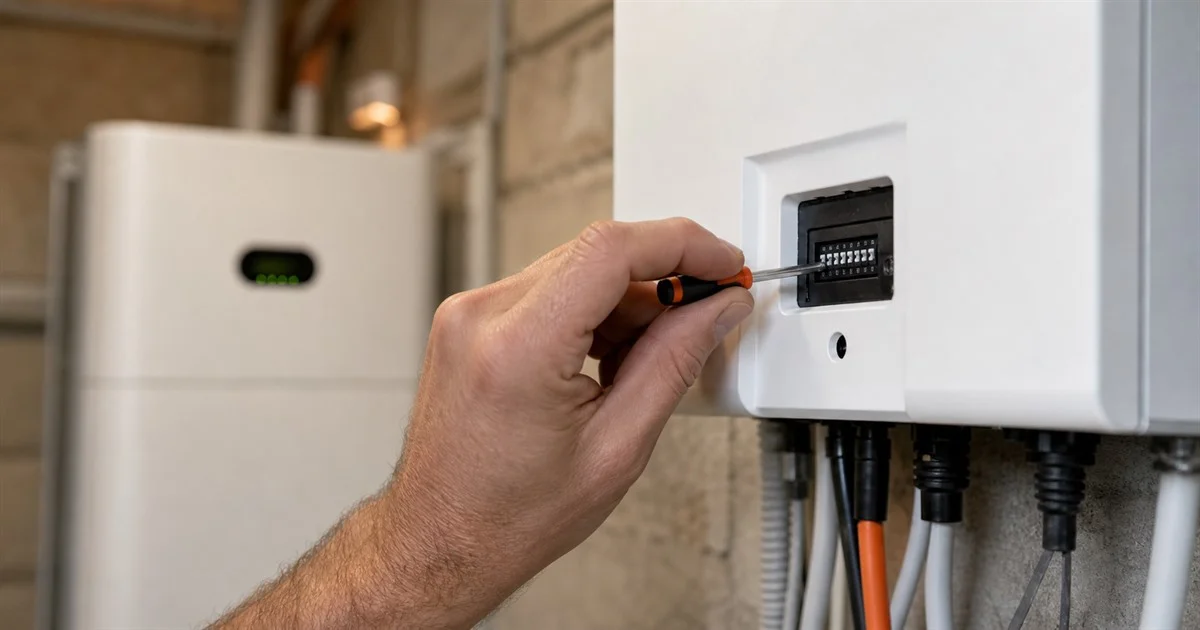
Most “Growatt compatible battery” pages you’ll find are a straight copy of Growatt’s own PDF — a brand list, a protocol column, and nothing else. That gets you halfway. The half that decides whether the system actually commissions is the column almost nobody explains: the Lithium Mode setup code the inverter needs for that specific battery. Right battery, right protocol, right wiring — wrong code, and the pack still won’t talk. This guide covers which batteries are approved for Growatt inverters, which protocol each one uses, and the setup code that goes with it.
Quick answer: Growatt runs an open battery ecosystem. Its hybrid inverters work with Growatt’s own Hope, ALP and AXE packs and with third-party LFP batteries from Pylontech, Dyness, Pytes, EG4, Raystech, Zetara, Topband, Enersys and Sacolar, over either CAN or RS485. Each approved battery has a matching Lithium Mode code (00–04) that must be set on the inverter — this is the step that most commissioning failures come down to. Growatt publishes these pairings per inverter model in its Approved Battery List (the matrix below is from version Growatt-LV48-0003, issued against the SPH 10000TL-HU family), and states that if a non-approved battery is used, it won’t be liable for communication faults. Always pull the list for your exact inverter model — brands carry over, codes don’t always.
Growatt Approved Battery List: Brands, Protocols and Setup Codes
Growatt is an open platform: you are not locked to Growatt-branded batteries. What you are locked to is the approved list — the specific model, the protocol, and the setup code that goes with it. The matrix below is Growatt’s official pairing table for the SPH 10000TL-HU family. Treat it as the template for how Growatt structures every list: the same brands recur across the range, but the Lithium Mode codes are assigned per inverter document, so confirm yours against the list issued for your model.
| Battery brand | Approved models (representative) | Protocol | Lithium Mode code |
|---|---|---|---|
| Growatt (own) | Hope 5.5L-A1, Hope 5.0L-B1, ALP 5.0L-E2-US, ALP 5.0L-E1, AXE 5.0L-C1 | RS485 CAN (Hope) |
00 01 |
| Pylontech | US2000B, US3000, US2000C, US3000C, US5000, UP5000, UF5000, Force L1, Force L2, Pelio-L | CAN | 04 |
| Dyness | DL2.5–DL5.0X, PowerBrick, Powerbox G2/Pro, PowerDepot H5B, B4850, A48100, B51100, BX51100 | RS485 | 00 |
| Pytes | V5, E-BOX-48100R | CAN RS485 |
01 00 |
| EG4 | EG4-LL, SR-48-100-LP4-IN-02, WM-48-100-IN-00, WM-48-280-LL-00 | CAN | 01 |
| Raystech | RT5427, RT10854, RT5000 LM, RT5000 B, RT5427-LV-RACK, RT5120M | CAN | 01 |
| Zetara | ZLES5000R, ZRLVESS5KR/10KR/14.3KW series, ZLES5000W | CAN | 01 |
| Sacolar | STR 5.5-A1 | CAN RS485 |
01 00 |
| Enersys | OGHB 1548-Li | CAN | 02 |
| Topband | TB48100F-T110AD | RS485 | 03 |
Per the Growatt Approved Battery List, version Growatt-LV48-0003, issued 5 November 2024 by Shenzhen Growatt New Energy, covering SPH 10000TL-HU-US(B) / SPH 10000TL-HU-US / SPH 10000TL-HU. Model coverage and codes change between document revisions — always check the current list for your exact inverter model before ordering.
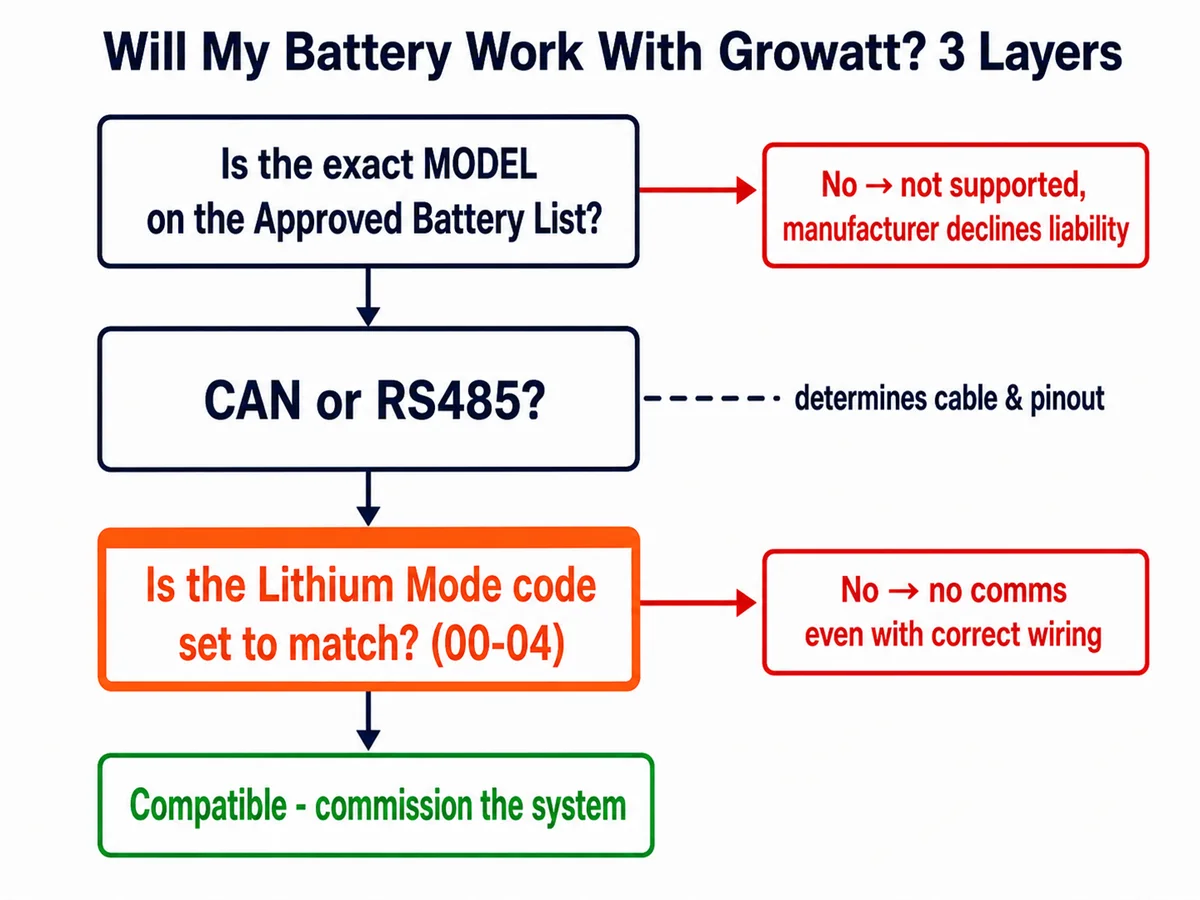
01 The exact battery model appears on the current Approved Battery List — not just the brand.
02 Which protocol that model uses: CAN or RS485 (it changes the cable and pinout).
03 The matching Lithium Mode code is set on the inverter — the step most failed commissionings miss.
The 3-Layer Growatt Pairing Check
“Will this battery work with my Growatt?” isn’t one question — it’s three, and they have to pass in order. Most guides answer only the first. Here’s the full check.
Layer 1 — Listed? (the model, not the brand)
Growatt’s approval is granted per model, not per brand. Pylontech is on the list — but that means US2000B, US3000C, US5000, Force L1/L2 and the other named models, not automatically whatever Pylontech released last quarter. The practical consequence sits in Growatt’s own note: the purchaser should confirm compatibility with the battery supplier, and Growatt will not be liable for failures caused by communication issues on batteries it hasn’t approved. If your model isn’t named, you’re carrying that risk yourself.
Layer 2 — Protocol? (CAN or RS485)
Growatt’s approved batteries split across two communication buses, and this decides your hardware. Pylontech, EG4, Raystech, Zetara and Enersys run over CAN. Dyness and Topband run over RS485. Pytes, Sacolar and Growatt’s own Hope packs are listed for either. CAN is generally the faster, more reliable handshake and is what most installers default to; RS485 typically needs more manual configuration. The two use different cable pinouts, so pick the protocol before you crimp anything.
Layer 3 — Setup code? (the one everybody skips)
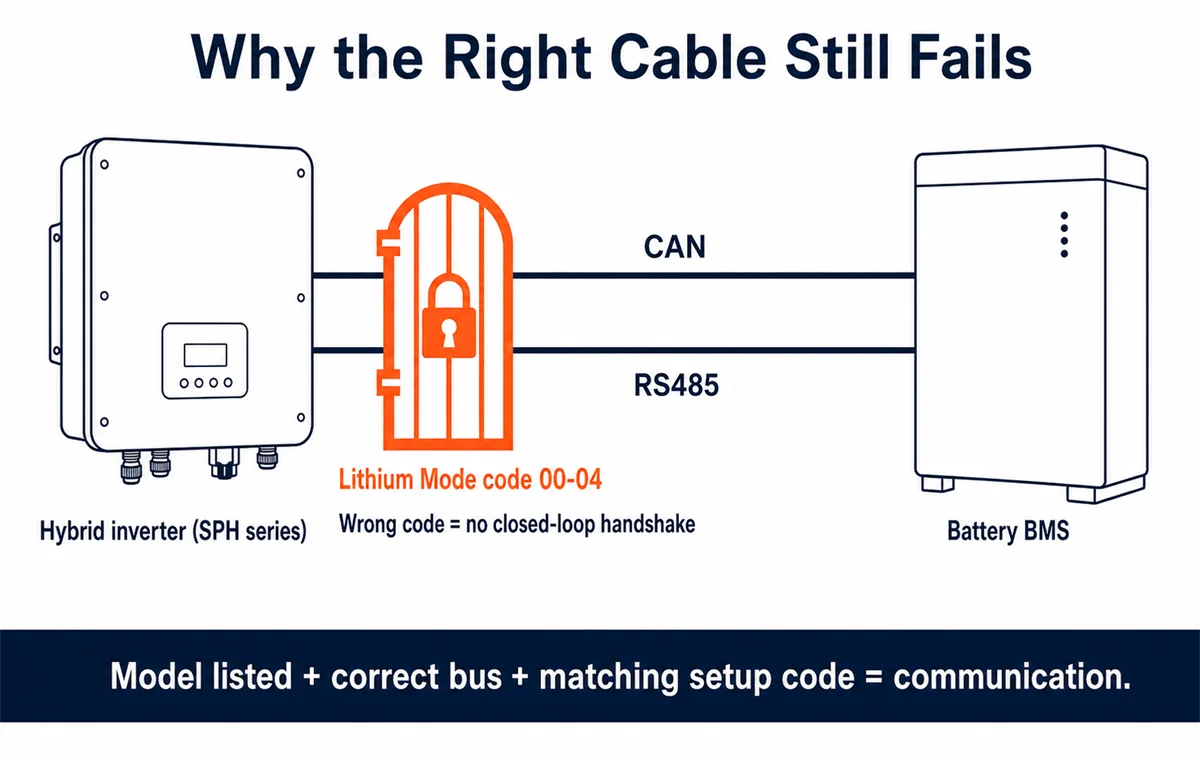
This is the layer that separates a working system from a two-hour site callback. Every approved battery maps to a Lithium Mode code that has to be entered on the inverter: 00 for Dyness and most RS485 packs, 01 for EG4, Raystech, Zetara and Pytes-over-CAN, 02 for Enersys, 03 for Topband, 04 for Pylontech. Set the Battery Mode to Lithium, then set the Lithium Mode to the code for that specific battery. Get this wrong and the symptom is misleading — the wiring is right, the protocol is right, and the pack still reports no communication.
Supply-side note: the LFP batteries we supply ship with CAN/RS485 BMS for exactly this kind of open inverter. But installers keep telling us the same thing trips up commissioning: the protocol is right and the wiring is right, and the pack still won’t talk — because the Lithium Mode code wasn’t set to match that battery. It’s a two-minute setting that costs a return visit.
“No Communication” on a Listed Battery: How to Triage It
Search the installer forums and you’ll find the same thread over and over: an approved battery, wired to an SPH, refusing to hand off to the inverter. The fault is almost never the battery. Work the three layers in reverse — start with the cheapest thing to check, not the hardest.
| Check, in this order | What you’re looking for | If it’s wrong |
|---|---|---|
| 1. Lithium Mode code | Battery Mode set to Lithium, and the Lithium Mode code matching that exact battery (00–04) | Set the correct code — this is the single most common cause and takes two minutes |
| 2. Bus mismatch | The battery is configured for the same bus the cable is on — CAN vs RS485 | A pack set to RS485 will not answer on a CAN port; switch the pack’s DIP/BMS setting or move the cable |
| 3. Cable pinout | The comms cable is pinned for this inverter/battery pair, not reused from another brand | Re-pin or use the cable supplied with the pack — CAN and RS485 use different pinouts |
| 4. Address / termination | On multi-pack stacks: unique addresses set, and the terminating resistor on the last unit | Duplicate addresses or missing termination will drop the whole bank off the bus |
| 5. Firmware & model listing | Inverter firmware current, and the pack’s exact model on the list for this inverter | If the model isn’t listed for your inverter, the pairing is unsupported — confirm with the battery supplier before going further |
Nine times out of ten it stops at line 1 or 2. The reason it feels mysterious is that the failure mode is identical whether the code is wrong, the bus is mismatched, or the pinout is off — the inverter simply reports no battery communication and gives you nothing else to work with.
Which Growatt Inverters Take a Battery?
Not every Growatt inverter manages storage. The hybrid and storage families do; the plain grid-tied string inverters don’t. In broad terms: SPH is the residential hybrid range with the widest battery support (the approved list above is issued against SPH models), SPF is the off-grid range typically paired with low-voltage packs, SPE is storage-focused, and WIT is the commercial hybrid line for larger banks. Growatt’s high-voltage grid-tied models such as the MIN XH-US take a different, much shorter battery list (Growatt’s own APX and ARO high-voltage packs, LG Prime and Enblock) — so a low-voltage 48V LFP pack that pairs happily with an SPH is not a candidate there.
If you’re still choosing the architecture rather than the battery, our low- vs high-voltage battery guide covers which class suits which job, and the hybrid inverter and battery pairing guide walks through the wiring and commissioning sequence. On the pack side, a 5.12 kWh 100Ah unit suits smaller stacks while a 10.24 kWh 200Ah unit is the common building block for whole-home backup.
Open Ecosystem: What Growatt Gives You (and What It Asks in Return)
Growatt sits on the open side of the industry split, and the trade is worth understanding before you commit to a platform.
| Factor | Open (Growatt, GoodWe, Deye) | Closed (e.g. Sungrow) |
|---|---|---|
| Battery choice | Own packs + many approved third-party brands | Inverter-maker’s battery only |
| Price competition | Shop and compare across approved models | Locked to one brand’s pricing |
| What you must verify | Model listed · protocol · setup code | Nothing — but no choice either |
| If something doesn’t talk | You own the integration risk | Single vendor owns it |
| Long-term flexibility | Swap or expand across brands | Tied to one vendor for system life |
That’s the honest deal: open platforms hand you leverage on price and choice, and hand you the verification work in exchange. It’s a good trade for anyone specifying more than one system a year. Australian installers have one more list to cross-check before ordering — whichever battery you pair, confirm it appears on the CEC approved battery list if the job needs to qualify for the federal rebate. For how the same split plays out elsewhere, see our guides to GoodWe compatibility (open, with its own 3-check test), Deye compatibility (open, and why the approved list isn’t the whole story), and Victron compatibility (open, and why “not on the tested list” still means full closed loop), and Sungrow compatibility (closed — useful as the contrast). The inverter–battery compatibility hub explains open vs closed communication in depth.
Common Mistakes With Growatt Battery Compatibility
1. Checking the brand instead of the model
Wrong: “Pylontech is approved, so this new Pylontech pack is fine.” Right: Approval is per model. Match the exact model name on the current list, then check the code that goes with it.
2. Skipping the Lithium Mode code
Wrong: Wiring CAN correctly and expecting comms to come up. Right: Set Battery Mode to Lithium, then set the Lithium Mode code for that specific battery (00–04).
3. Assuming a low-voltage pack fits any Growatt
Wrong: Pairing a 48V LFP bank with a high-voltage grid-tied model. Right: The HV grid-tied range takes a separate, much shorter HV battery list — check the family first.
4. Working from an old revision of the list
Wrong: Ordering off a 2022 compatibility sheet. Right: Codes and model coverage change between revisions — confirm against the current document for your inverter model.
Confirm This Pairing Before You Order
Being on — or off — Growatt’s list is only step one. Whether closed-loop actually works comes down to the protocol your exact inverter model speaks, and that is worth confirming in writing before a purchase order. Send us your Growatt model and we return the protocol setting, the pinout, and whether it runs closed-loop or voltage-following — for that specific unit.
Not sure what any of that means? Our explainer on what a BMS actually does covers why the protocol decides everything, and the closed-loop compatibility matrix shows the platforms we have confirmed.
Frequently Asked Questions
Which batteries are compatible with Growatt inverters?
Growatt’s own Hope, ALP and AXE packs plus approved third-party models from Pylontech, Dyness, Pytes, EG4, Raystech, Zetara, Topband, Enersys and Sacolar. Each is approved per model and mapped to a protocol (CAN or RS485) and a Lithium Mode code on the inverter.
Can I use a third-party battery with a Growatt inverter?
Yes — Growatt runs an open ecosystem and publishes an approved list of third-party batteries. The requirement is that your exact model is on the current list (or confirmed compatible by the supplier), that you use the right bus, and that the matching Lithium Mode code is set.
What is the Lithium Mode code on a Growatt inverter?
It’s a setting that tells the inverter which battery BMS protocol profile to use — 00, 01, 02, 03 or 04 depending on the battery. Growatt’s approved list assigns a code to each battery. If the code doesn’t match the pack, closed-loop communication won’t come up even with correct wiring.
Does Growatt support my battery if it isn’t on the approved list?
It may still communicate, but you carry the risk. Growatt’s own note states the purchaser should confirm compatibility with the battery supplier, and that Growatt won’t be liable for failures caused by communication issues in that case.
My battery is on the list but shows no communication — what now?
Work backwards from the cheapest check: confirm the Lithium Mode code matches that exact battery, then that the pack and the cable are on the same bus (CAN vs RS485), then the cable pinout, then addresses and termination on multi-pack stacks, and finally firmware and whether the model is listed for your specific inverter. Most cases resolve at the first or second step.
Which Growatt series works with 48V LFP batteries?
The SPH residential hybrid range is the main one, with SPF for off-grid and WIT/SPE for larger or storage-specific systems. High-voltage grid-tied models like the MIN XH-US use a separate high-voltage battery list instead.
Why We Wrote This
Search “Growatt compatible battery” and you mostly get the same PDF re-hosted on a dozen sites — a brand list with a protocol column and no explanation of the one field that decides whether the system commissions. We build and supply 48V LFP home storage for open inverter platforms, so this is the question we field constantly: not “is it on the list” but “why won’t it talk when it is”. Our batteries ship with CAN/RS485 BMS built for exactly this kind of open architecture — and we’d still tell any installer to check the model against Growatt’s current list and set the Lithium Mode code before commissioning day, whoever they buy the pack from. Savolture systems are built in our 1.8 GWh automated battery factory to UL 9540, UL 1973 and IEC 62619 requirements.
Country: China | Model: B2B wholesale & distribution (LFP home storage)
Email: info@savolture.com | Web: savolture.com
New to why protocol compatibility even matters? Start with what a BMS actually does — the communication side is what lets the Growatt inverter read true state of charge.
Ready to size your system?
Get a free battery recommendation.
Tell us your load, location, and backup target — we will spec the right 48V LiFePO4 system for you.