
Savolture Technical Guide
GoodWe Battery Compatibility (2026): Which Batteries Work With GoodWe Inverters
If Sungrow is the classic closed battery ecosystem, GoodWe sits at the other end of the scale — and for buyers who care about battery choice, that difference is the whole story....
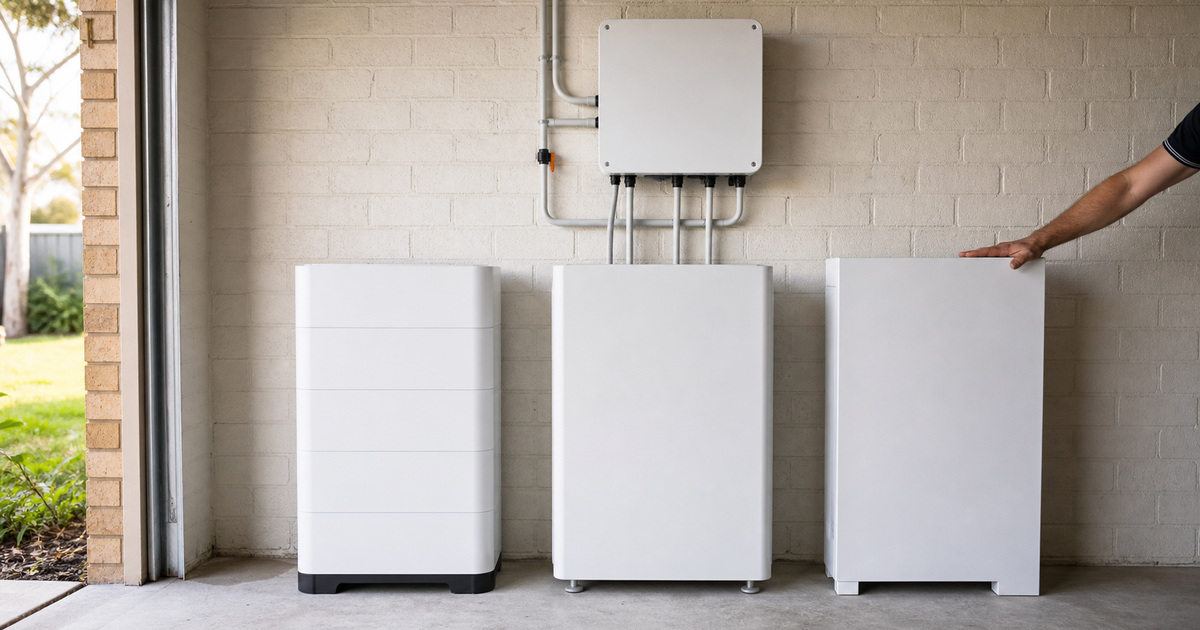
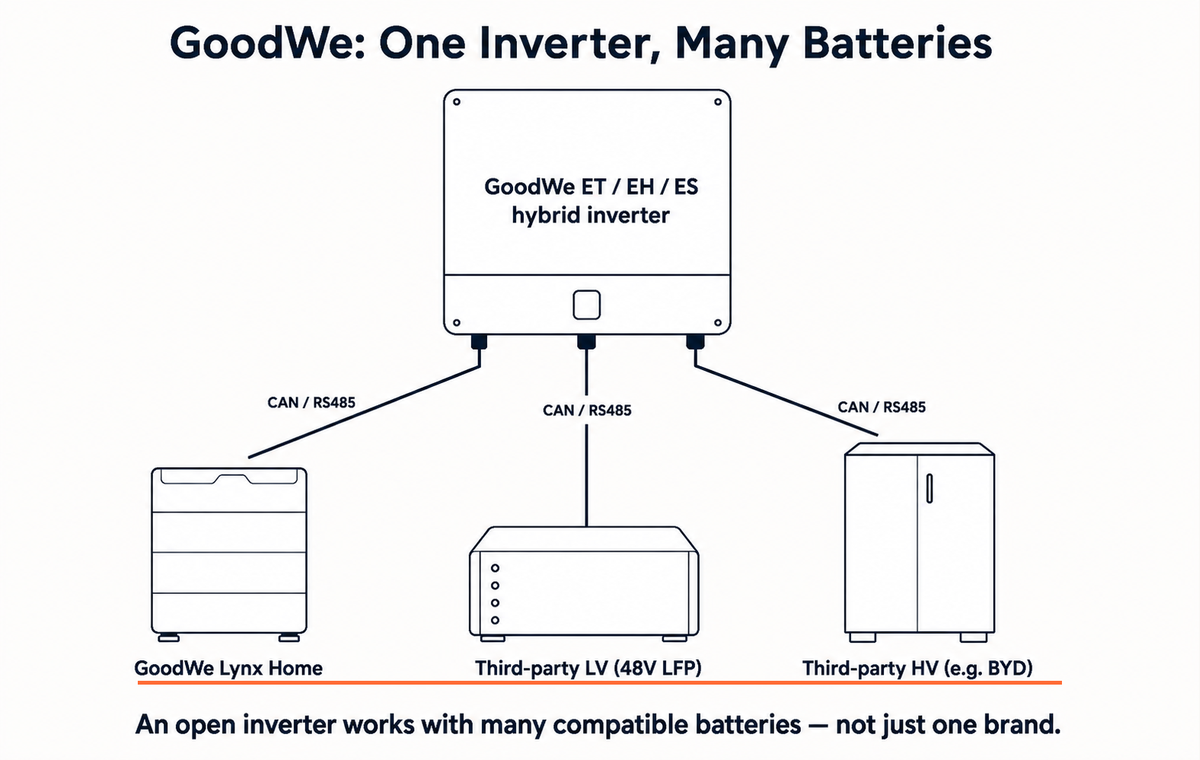
If Sungrow is the classic closed battery ecosystem, GoodWe sits at the other end of the scale — and for buyers who care about battery choice, that difference is the whole story. A GoodWe hybrid inverter will happily run GoodWe’s own batteries or a range of third-party packs, across both low-voltage and high-voltage systems. That flexibility is a genuine advantage, but it comes with one job the closed brands spare you: you have to confirm the pairing. This guide lays out exactly which batteries work with which GoodWe inverters, how to tell if a third-party battery will pair, and where that openness leaves you if you want to shop on price.
Quick answer: GoodWe’s hybrid inverters — the ET (three-phase), EH (single-phase) and ES (single-phase) series — support both GoodWe’s own Lynx Home batteries and a range of third-party batteries (such as BYD and Pylontech), across low-voltage and high-voltage systems. Compatibility runs over the CAN bus (default) or RS485. Unlike a closed ecosystem, you’re not locked to one battery brand — but you must confirm your battery is on GoodWe’s current compatibility list, or follows its CAN protocol, before you commit.
GoodWe Battery Compatibility at a Glance
GoodWe is an open ecosystem: its hybrid inverters are built to work with more than just GoodWe’s own batteries. Here’s the high-level picture for 2026, per GoodWe’s official Battery Compatibility Overview.
| GoodWe inverter | Type / phase | GoodWe Lynx battery | Third-party (CAN) | LV / HV |
|---|---|---|---|---|
| ET / ET PLUS+ | Hybrid · three-phase | ✓ Yes | ✓ Yes | LV & HV |
| EH | Hybrid · single-phase | ✓ Yes | ✓ Yes | LV & HV |
| ES / EM | Hybrid · single-phase | ✓ Yes | ✓ Yes | LV |
| Non-hybrid (PV-only) | String | ✗ No | ✗ No | — |
Per the GoodWe Battery Compatibility Overview, 2026. Exact battery models and firmware requirements vary by inverter and region — always confirm against the current official list before ordering.
01 Your inverter is a hybrid model (ET / EH / ES) — a PV-only string inverter takes no battery.
02 Low-voltage or high-voltage system? It decides which batteries are eligible.
03 Your battery is on GoodWe’s current list or follows its CAN protocol — verify, don’t assume.
Which Batteries Work With a GoodWe Inverter?
More than one brand — that’s the point. In an open GoodWe system your choice includes GoodWe’s own Lynx Home batteries and a set of approved third-party packs, provided they speak the right protocol. This is the freedom a closed ecosystem doesn’t give you.
GoodWe’s own batteries — the Lynx Home range
GoodWe makes its own LiFePO4 (LFP) batteries under the Lynx Home name, split by voltage class. The Lynx Home F, F PLUS+ and F G2 lines are high-voltage (models from roughly LX F6.6 up to LX F25.6), while the Lynx Home U and A lines are low-voltage. GoodWe backs the Lynx range with a 10-year product warranty (around 70% retained capacity, LFP rated for roughly 6,000 cycles). Pairing a GoodWe inverter with a GoodWe battery is the simplest route — one vendor, one support line — but it’s not your only option.
Third-party batteries — the open part
GoodWe’s official compatibility list also includes third-party batteries such as BYD (in both low- and high-voltage systems) and Pylontech, among others. Crucially, GoodWe states that batteries which follow its CAN communication protocol can work even when they aren’t individually listed — you confirm the match with GoodWe’s technical service. That’s what “open” really means: the inverter isn’t hard-wired to a single brand’s BMS.
Supply-side note: the LFP batteries we supply are built with CAN/RS485 BMS for exactly this kind of open inverter. We don’t claim to be on GoodWe’s printed list — installers still verify the protocol against GoodWe’s current compatibility overview before commissioning. But the whole reason open inverters like GoodWe exist is so you’re not forced to buy the inverter-maker’s battery.
Low-Voltage vs High-Voltage: Which GoodWe System?
GoodWe supports both, and it changes which batteries you can use. High-voltage systems (like the Lynx Home F series) are efficient for larger storage and higher output; low-voltage systems (Lynx Home U/A, and many third-party 48V LFP packs) are simpler, safer to work around, and common in smaller or retrofit installs. The choice is set by your inverter configuration, so decide LV vs HV before you shortlist batteries. Our low- vs high-voltage battery guide breaks down the trade-offs in full.
| Spec | Low-voltage GoodWe system | High-voltage GoodWe system |
|---|---|---|
| Example batteries | Lynx Home U/A, third-party 48V LFP | Lynx Home F / F G2, BYD HV |
| Typical use | Smaller homes, retrofits, DC 48V | Larger storage, higher output |
| Protocol | CAN / RS485 | CAN |
| Battery choice | Widest third-party range | Growing, HV-specific |
Battery classes per GoodWe documentation, 2026. Both HV and 48V LV LFP packs exist across the market — confirm your inverter’s supported class first.
For Australian buyers, one more check matters: rebate eligibility. The federal battery rebate applies only to batteries on the Clean Energy Council approved list, so whichever battery you pair with your GoodWe inverter, confirm its status on the CEC approved battery list before you order. Because GoodWe is open, you can weigh eligible batteries on price rather than take whatever one brand offers — see how battery pricing scales in our solar battery price by size guide, and how to shortlist in the best solar battery in Australia guide. If you’re still choosing the inverter itself, our hybrid inverter pairs with open-architecture LFP storage from the start.
The Open-Ecosystem Advantage (and Its One Catch)
Choosing an open inverter like GoodWe isn’t automatically better than a closed one — but the trade runs in your favour if battery choice matters. Here’s the honest balance.
| Factor | Open (GoodWe) | Closed (e.g. Sungrow) |
|---|---|---|
| Battery choice | GoodWe Lynx + many third-party | Inverter-maker’s battery only |
| Price competition | Shop and compare batteries | Locked to one brand’s pricing |
| Voltage classes | Low and high voltage | Often high voltage only |
| The catch | You must verify the pairing/protocol | Nothing to verify — but no choice |
| Long-term flexibility | Swap or expand across brands | Tied to one vendor for system life |
If you want a hands-off single-vendor system, closed is simpler — see how that plays out in our Sungrow compatibility guide. But if you want to shop batteries on price, keep the option to switch, or run a specific LFP pack, GoodWe’s openness is exactly the point — and it’s where our batteries fit. For another open example, our Deye compatibility guide, our Victron compatibility guide and the inverter–battery compatibility hub explain open vs closed communication in depth.
Will My Battery Work With GoodWe? A 3-Check Test
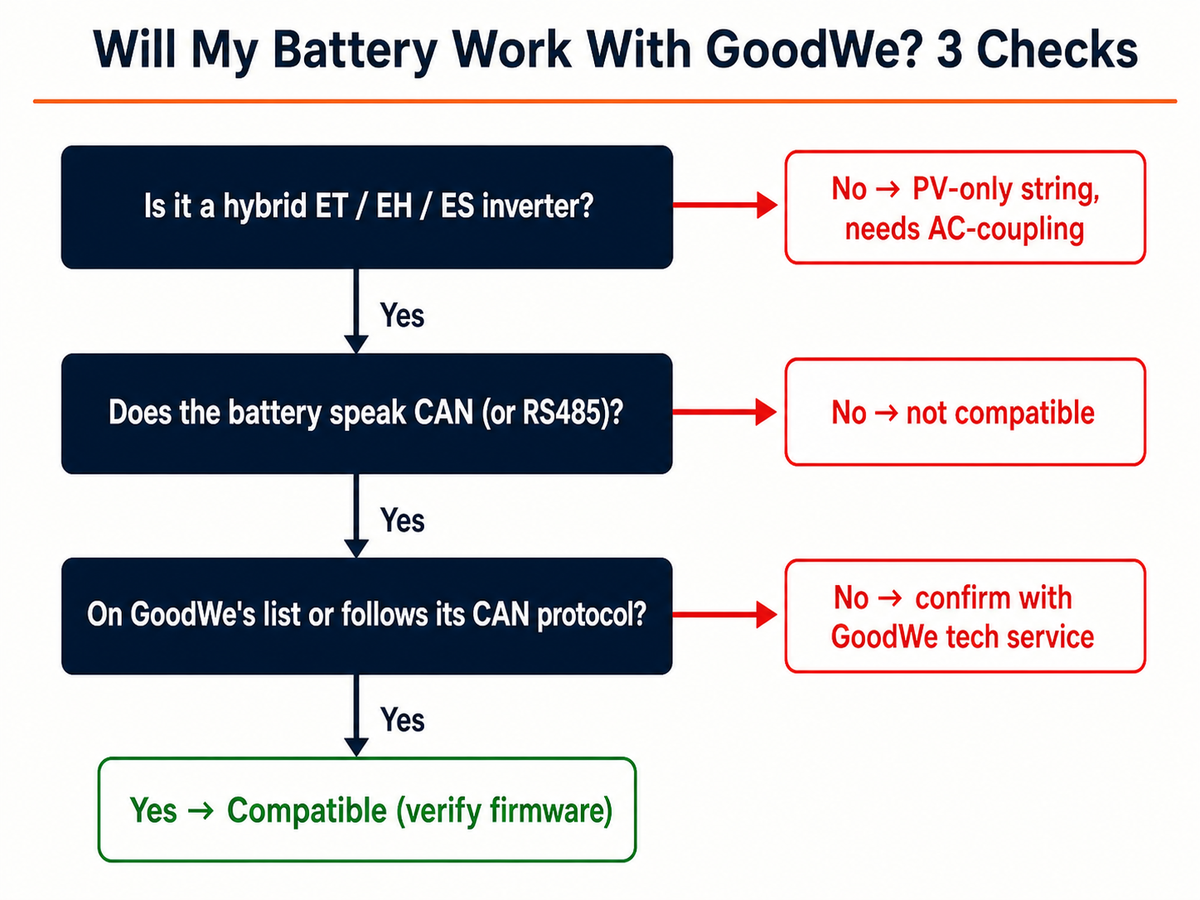
Before you commit, run three checks in order — most pairing mistakes fail at one of them. First, confirm it’s a hybrid ET/EH/ES inverter with a battery port (a PV-only string inverter needs AC-coupling instead). Second, confirm the battery BMS speaks CAN or RS485. Third, confirm the battery is on GoodWe’s current list or follows its CAN protocol — if you’re unsure, verify with GoodWe technical service before ordering. The flow below walks through it.
Common Mistakes With GoodWe Battery Compatibility
1. Assuming “open” means “any battery just works”
Wrong: “GoodWe is open, so I’ll bolt on any LFP pack.” Right: Open means broad choice, not zero checks — the battery must speak CAN/RS485 and be listed or CAN-compliant.
2. Mixing up low-voltage and high-voltage
Wrong: Pairing an HV battery to an LV-configured system. Right: Match the battery’s voltage class to your inverter’s supported class.
3. Trying to add a battery to a PV-only inverter
Wrong: Expecting a string GoodWe inverter to take a battery. Right: Only ET/EH/ES hybrids have a battery port; otherwise AC-couple.
4. Trusting an old compatibility sheet
Wrong: Ordering off a 2023 list. Right: Check GoodWe’s current Battery Compatibility Overview for your exact model and firmware.
Confirm This Pairing Before You Order
Being on — or off — GoodWe’s list is only step one. Whether closed-loop actually works comes down to the protocol your exact inverter model speaks, and that is worth confirming in writing before a purchase order. Send us your GoodWe model and we return the protocol setting, the pinout, and whether it runs closed-loop or voltage-following — for that specific unit.
Not sure what any of that means? Our explainer on what a BMS actually does covers why the protocol decides everything, and the closed-loop compatibility matrix shows the platforms we have confirmed.
Frequently Asked Questions
Which batteries are compatible with GoodWe hybrid inverters?
GoodWe’s own Lynx Home batteries (F/U/A series) plus third-party packs such as BYD and Pylontech, across low- and high-voltage systems, provided they follow GoodWe’s CAN protocol. Always check the current official compatibility list.
Can I use a third-party battery with a GoodWe inverter?
Yes — that’s the advantage of GoodWe’s open ecosystem. The battery must speak CAN (or RS485) and be on GoodWe’s list or follow its CAN protocol. This is very different from closed ecosystems that only accept the inverter-maker’s battery.
What’s the difference between GoodWe ET, EH and ES?
ET (and ET PLUS+) are three-phase hybrids; EH and ES are single-phase hybrids. All take a battery. ET/EH support both LV and HV systems; ES is low-voltage. Non-hybrid string inverters take no battery.
Does GoodWe support low-voltage and high-voltage batteries?
Yes. GoodWe supports both classes — high-voltage (e.g. Lynx Home F) for larger storage, and low-voltage (Lynx Home U/A and many 48V third-party LFP packs) for smaller or retrofit systems.
Is an open ecosystem like GoodWe better than a closed one?
It depends. Open gives you battery choice, price competition and flexibility, at the cost of verifying the pairing. Closed is simpler but locks you to one battery brand. Choose based on whether battery freedom matters to you.
Why We Wrote This
Most “GoodWe compatible battery” pages just reprint the Lynx model numbers and stop. What they rarely explain is why an open inverter matters: it keeps battery choice — and battery pricing — in your hands. As a supplier of LiFePO4 home-storage batteries built for open inverter systems, we won’t pretend our packs sit on GoodWe’s printed list; they don’t, and any installer should verify the CAN protocol against GoodWe’s current overview before commissioning. What we can say honestly is that our 48V LFP batteries are designed with CAN/RS485 BMS for exactly this kind of open architecture, where you choose the battery on merit — usable kWh, cycle life and price — not on whose logo is on the inverter. Savolture offers a lineup of LFP batteries built to IEC 62619 standards by our long-standing manufacturing partners.
Country: China | Model: B2B wholesale & distribution (LFP home storage)
Email: info@savolture.com | Web: savolture.com
Ready to size your system?
Get a free battery recommendation.
Tell us your load, location, and backup target — we will spec the right 48V LiFePO4 system for you.