
Savolture Technical Guide
Sungrow Battery Compatibility (2026): Which Batteries Work With Sungrow Inverters
If you've bought — or are quoting — a Sungrow hybrid inverter and you're trying to work out which battery you can pair with it, there's one fact that changes everything, and mos...
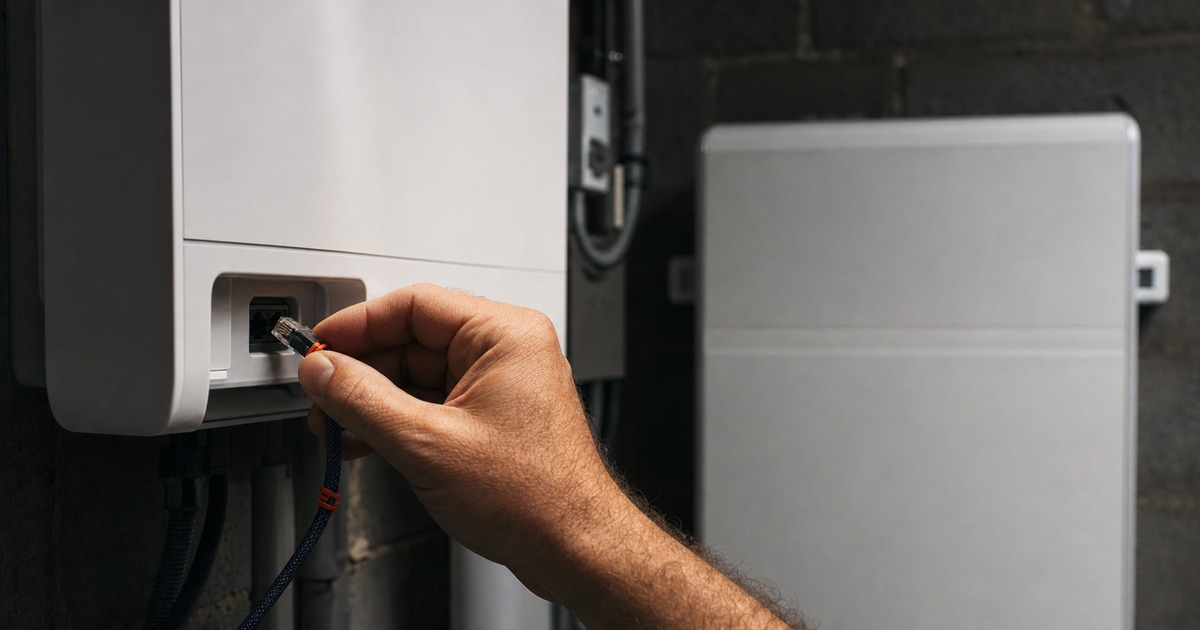
If you’ve bought — or are quoting — a Sungrow hybrid inverter and you’re trying to work out which battery you can pair with it, there’s one fact that changes everything, and most listings bury it: Sungrow runs a closed battery ecosystem. Its inverters are engineered to talk to Sungrow’s own batteries and nothing else. That’s not a flaw, but it has real consequences for what you can buy now and how much you’ll pay later. This guide lays out exactly which Sungrow inverters pair with which batteries, why third-party packs won’t closed-loop, and — if battery choice matters to you — what your honest options actually are.
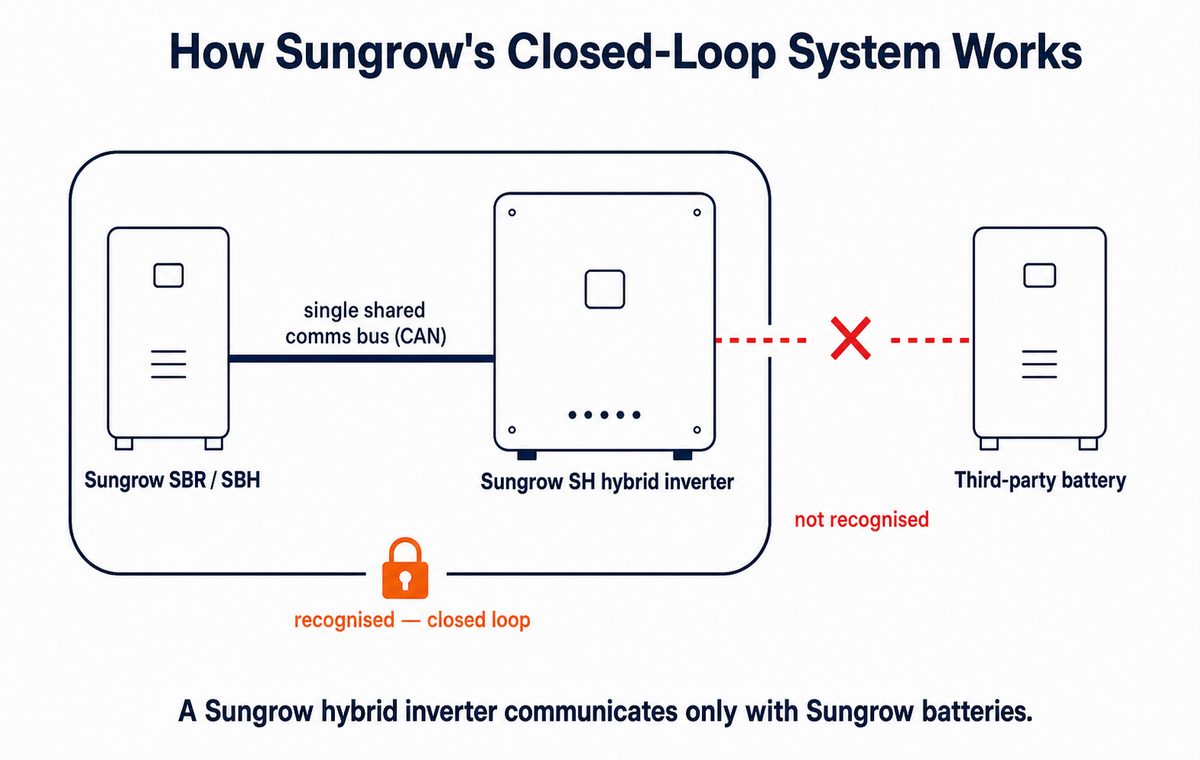
Quick answer: Sungrow hybrid inverters (the SH-series) are only compatible with Sungrow’s own high-voltage batteries — the SBR and SBH — in a closed-loop, DC-coupled setup. Third-party batteries are not supported in closed-loop with a Sungrow hybrid inverter, because the SH inverter and Sungrow battery share a single communication bus. Sungrow’s SG-series (string inverters) don’t connect a battery at all. If you want the freedom to choose or later switch batteries, that flexibility lives in open inverter ecosystems (such as Deye or Sol-Ark), not in Sungrow’s.
Sungrow Battery Compatibility at a Glance
Sungrow’s line splits into two families, and only one of them takes a battery. Hybrid (SH) inverters manage a battery; string (SG) inverters don’t. Here’s the compatibility matrix for 2026, per Sungrow’s official compatibility list.
| Sungrow inverter | Type / phase | SBR battery | SBH battery | Third-party battery |
|---|---|---|---|---|
| SH-RS (SH5.0/8.0/10RS) | Hybrid · single-phase | ✓ Yes | ✓ Yes* | ✗ No |
| SH-T (SH5.0T–SH10T) | Hybrid · three-phase | ✓ Yes | ✓ Yes | ✗ No |
| SG series | String (no battery port) | ✗ No | ✗ No | ✗ No |
Per the Sungrow Compatibility List (Public v4.3, 1 June 2026). *SBH compatibility with single-phase SH-RS was extended in 2026; confirm your exact inverter firmware and model against the current official list before ordering.
01 Is your inverter a hybrid SH model (takes a battery) or a string SG model (does not)?
02 Single-phase (SH-RS) or three-phase (SH-T)? It changes SBR vs SBH sizing.
03 Do you want the option to shop for or switch batteries later? If yes, a closed ecosystem is the wrong starting point.
Which Batteries Work With a Sungrow Inverter?
Only two, and both are made by Sungrow. In a closed-loop, DC-coupled Sungrow system, your battery choice is the SBR or the SBH — full stop. The reason is architectural: the SH inverter and the Sungrow battery communicate over one shared bus, so a third-party BMS simply isn’t recognised. This is by design, not a firmware gap you can work around.
Sungrow SBR — the mainstream home battery
The SBR is Sungrow’s high-voltage, modular LiFePO4 (LFP) battery for most homes. It’s built from 3.2 kWh stackable modules, 3 to 8 per unit, giving a usable range of roughly 9.6 to 25.6 kWh, and up to four units can run in parallel for around 100 kWh. Maximum charge/discharge current is 30 A. Each module weighs about 33 kg, so one person can handle it. The SBR pairs with both single-phase SH-RS and three-phase SH-T inverters, which makes it the default choice for typical Australian homes.
Sungrow SBH — the higher-output line
The SBH is the newer, higher-voltage LFP line built for larger storage and higher continuous output. It uses 5 kWh modules with a 50 A continuous current (versus the SBR’s 30 A). A full SBH400 stack is 8 × 5 kWh = 40 kWh at a nominal 563.2 V, and up to four units in parallel reach 160 kWh, with a round-trip efficiency of about 96–97%. It’s aimed at large homes and light commercial loads, primarily on three-phase SH-T inverters.
| Spec | Sungrow SBR | Sungrow SBH |
|---|---|---|
| Module size | 3.2 kWh | 5 kWh |
| Capacity per unit | 9.6 – 25.6 kWh (3–8 modules) | up to 40 kWh (8 modules) |
| Max parallel capacity | ~100 kWh (4 units) | ~160 kWh (4 units) |
| Max current | 30 A | 50 A |
| Chemistry | LFP (high voltage) | LFP (high voltage) |
| Warranty | 10-year product warranty | 10-year product warranty |
| Best for | Most homes, single or three phase | Large homes / light commercial, three phase |
Figures per Sungrow product documentation and Australian distributor specifications, 2026. SBR and SBH are both high-voltage batteries — see how that affects design in our low- vs high-voltage battery guide.
Both batteries carry a 10-year product warranty, and their LFP chemistry gives the long cycle life these systems are rated for. Both also appear on the Clean Energy Council approved battery list, so a compliant Sungrow install qualifies for the federal rebate — a point in the closed system’s favour. Just remember the rebate applies to whatever battery you choose, so it doesn’t offset the loss of price competition. For how battery pricing scales in Australia, see our solar battery price by size guide; to confirm any battery’s rebate status, check the CEC approved battery list. And if you’re still choosing a system, our best solar battery in Australia guide and hybrid inverter pairing guide cover selection end to end.
Can I Use a Third-Party Battery With a Sungrow Inverter?
Not in a closed-loop DC-coupled setup — no. A Sungrow hybrid inverter will not communicate with a non-Sungrow BMS, so a third-party high-voltage battery (BYD, Pylontech, a generic LFP stack, or ours) cannot be wired to the battery port and expected to work. This is the single biggest surprise for Sungrow owners.
Supply-side note: installers we supply tell us the number-one surprise for Sungrow owners is discovering they can’t shop for a cheaper battery later — the ecosystem is closed by design. If you buy a Sungrow hybrid inverter, you’ve effectively also chosen Sungrow as your battery supplier for the life of the system.
There is one honest workaround. An AC-coupled battery system operates independently of your existing solar inverter and works alongside almost any brand — including a home that already runs a Sungrow string (SG) inverter. Instead of connecting to the solar inverter’s battery port, an AC-coupled setup adds its own battery inverter/charger and ties in on the AC side. It’s a different design with its own cost, but it’s the route that keeps your battery choice open when your solar inverter is fixed or comes from a closed brand.
If you’re planning a fresh install and want that freedom from day one, the cleaner path is an open hybrid inverter paired with an independent LFP battery — the architecture where battery choice stays in your hands. This is exactly where our batteries fit: a 48V LFP pack such as our 10.24 kWh 200Ah battery is designed for open systems, not locked to a single inverter brand, so you can spec it on usable kWh, cycle life and price rather than on whose logo is on the wall. To see how an open inverter actually handles battery pairing in practice, our Deye compatibility guide walks through it.
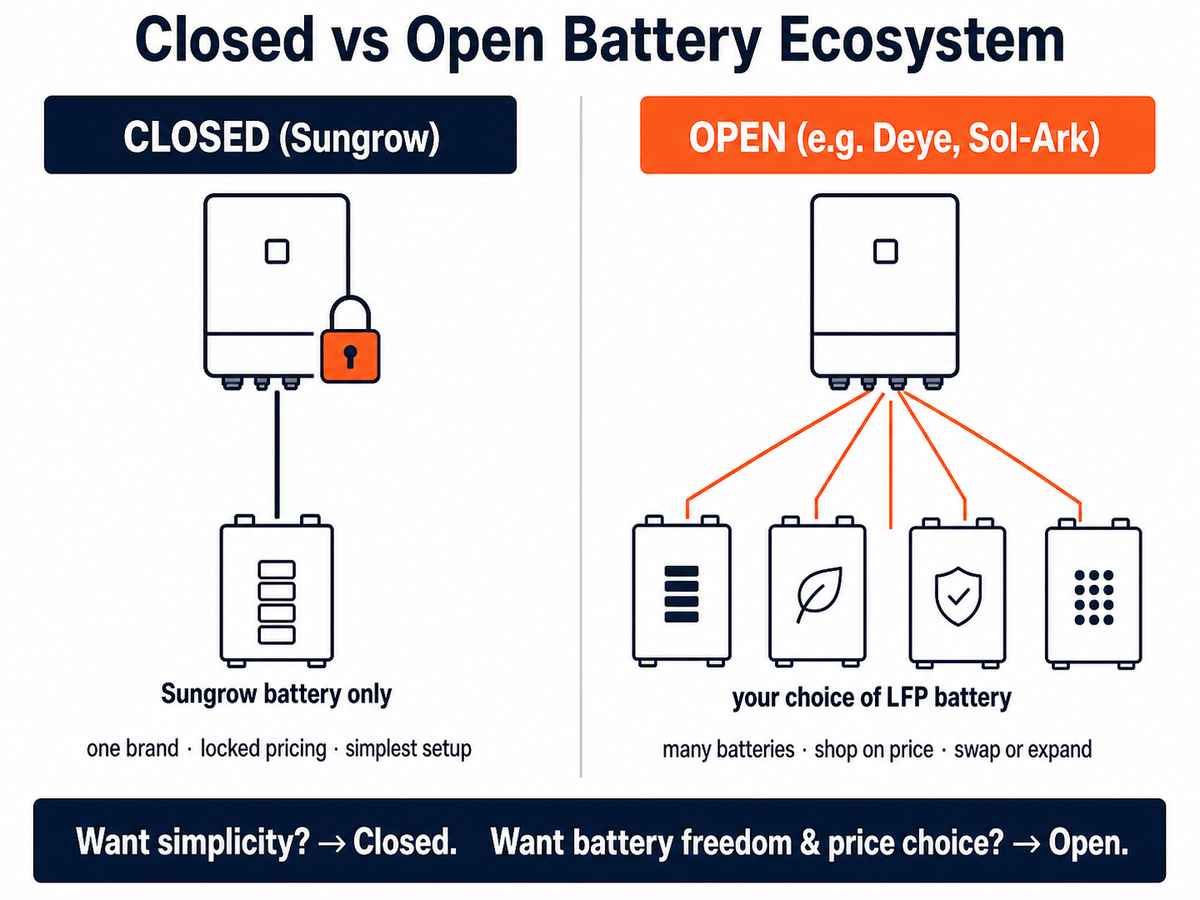
The Closed-Ecosystem Trade-off: Sungrow vs an Open System
Sungrow’s closed design isn’t automatically bad — but you should choose it with eyes open. Here’s the honest trade-off, because no spec sheet spells it out.
| Closed ecosystem (Sungrow) | Open ecosystem (e.g. Deye, Sol-Ark) | |
|---|---|---|
| Battery choice | Sungrow SBR / SBH only | Many compatible LFP batteries |
| Price competition | Locked to Sungrow pricing | Shop and compare batteries |
| Setup simplicity | Simplest — one brand, one bus | You must verify pairing |
| Warranty path | Single throat to choke | Two vendors (inverter + battery) |
| Long-term flexibility | Tied to Sungrow for the system’s life | Swap or expand batteries freely |
If you value a single-vendor, install-and-forget system and you’re happy with Sungrow’s battery pricing, the closed path is genuinely simpler. But if you want to shop batteries on price, keep the option to switch, or run a specific LFP pack, that freedom only exists in an open inverter ecosystem — which is where our batteries fit. Our Deye battery compatibility guide and our Victron battery compatibility guide show how open inverters handle battery choice, and the inverter–battery compatibility hub explains open vs closed communication in depth.
Which Path Fits You?
A quick router based on what you actually want:
| If you… | Then… |
|---|---|
| Already own a Sungrow SH hybrid inverter | Your battery is SBR or SBH — size it to your load and phase |
| Want the simplest single-vendor system and accept Sungrow battery pricing | Closed Sungrow path is fine — pick SBR (most homes) or SBH (large/3-phase) |
| Want to shop batteries on price or keep the option to switch | Choose an open inverter from the start — closed can’t be undone later |
| Have a Sungrow SG string inverter and want storage | Look at an AC-coupled battery that works with any inverter |
Common Mistakes With Sungrow Battery Compatibility
1. Assuming any high-voltage battery will work
Wrong: “It’s a HV battery, so it’ll pair with my SH inverter.” Right: Only Sungrow SBR/SBH closed-loop with SH inverters; third-party HV packs are not recognised.
2. Confusing the SG (string) inverter with the SH (hybrid)
Wrong: Expecting to add a battery to an SG inverter. Right: Only SH hybrid models have a battery port; SG needs AC-coupling to add storage.
3. Not realising the ecosystem is closed until after install
Wrong: Planning to add a cheaper third-party battery next year. Right: Decide open vs closed before you buy the inverter — it can’t be reversed cheaply.
4. Ordering off an old compatibility list
Wrong: Trusting a 2024 pairing chart. Right: Check the current official Sungrow compatibility list (v4.3, 2026) for your exact model and firmware.
Frequently Asked Questions
Which batteries are compatible with Sungrow hybrid inverters?
Only Sungrow’s own SBR and SBH high-voltage LFP batteries, in a closed-loop DC-coupled setup with an SH-series hybrid inverter. Third-party batteries are not supported in closed-loop.
Can I connect a non-Sungrow battery to a Sungrow inverter?
Not in closed-loop — the SH inverter won’t communicate with a third-party BMS. The only route to a non-Sungrow battery is an AC-coupled system, which runs independently of your existing inverter and works with almost any brand.
What’s the difference between the Sungrow SBR and SBH?
The SBR uses 3.2 kWh modules (9.6–25.6 kWh per unit, 30 A) and suits most homes on single or three phase. The SBH uses 5 kWh modules (up to 40 kWh, 50 A, ~563 V) for larger or three-phase systems.
Does a Sungrow SG inverter take a battery?
No. SG-series inverters are string (PV-only) inverters with no battery port. To add storage to an SG system you need an AC-coupled battery or a hybrid inverter.
Is Sungrow’s closed ecosystem a problem?
It depends on what you want. It’s simpler to install and support, but it locks you to Sungrow battery pricing for the life of the system. If you want to shop or switch batteries, an open inverter ecosystem is the better starting point.
Why We Wrote This
Most “Sungrow compatible battery” pages just list the SBR and SBH and stop there — they never tell you the ecosystem is closed, or what that means for your wallet down the track. As a supplier of LiFePO4 home-storage batteries that work in open inverter systems, we don’t pretend our batteries pair with Sungrow’s closed hybrids — they don’t. What we can do is explain the trade-off honestly, so you choose open or closed for the right reasons. Savolture offers a lineup of LFP batteries built to IEC 62619 standards by our long-standing manufacturing partners, designed for open architectures where battery choice stays in your hands.
Country: China | Model: B2B wholesale & distribution (LFP home storage)
Email: info@savolture.com | Web: savolture.com
Ready to size your system?
Get a free battery recommendation.
Tell us your load, location, and backup target — we will spec the right 48V LiFePO4 system for you.