

Savolture Technical Guide
10kW Solar Battery Price in Australia (2026): 5kW vs 10kW vs 20kW Cost Guide
Ask three Australian installers what a "10kW solar battery" costs and you can get three answers thousands of dollars apart: $3,700 from one, $16,000 from another. Neither is lyi...
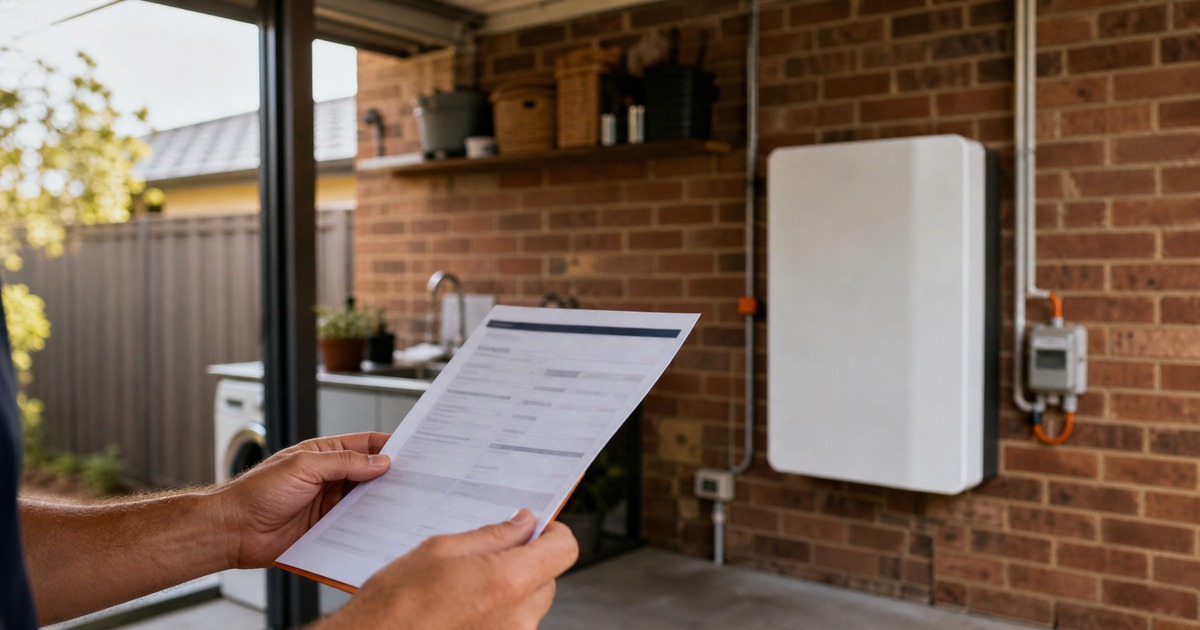
Ask three Australian installers what a “10kW solar battery” costs and you can get three answers thousands of dollars apart: $3,700 from one, $16,000 from another. Neither is lying. They’re quoting different things. One means the battery unit alone, another the whole installed system after the federal rebate, a third a premium brand with a hybrid inverter bundled in. This guide fixes that. We break the price down by system size — 5kW, 10kW and 20kW — and by the three cost layers that actually move the number, so you can read any quote and know exactly what you’re paying for and whether it’s fair.
Quick answer: In 2026, a fully installed home solar battery in Australia typically runs about $5,000–$9,000 for a 5kWh system, $8,000–$16,000 for a 10kWh system, and $16,000–$30,000 for a 20kWh system before rebates — falling to roughly $1,000/kWh installed once the federal Cheaper Home Batteries rebate (about $252 per usable kWh from May 2026) is applied. Price is driven by three things, in order: the battery cells and usable capacity, the inverter and installation, and rebates plus your state. The single biggest reason two “same size” quotes differ is usable versus nominal kWh — always compare on price per usable kilowatt-hour.
Solar Battery Price in Australia by Size (2026 at a Glance)
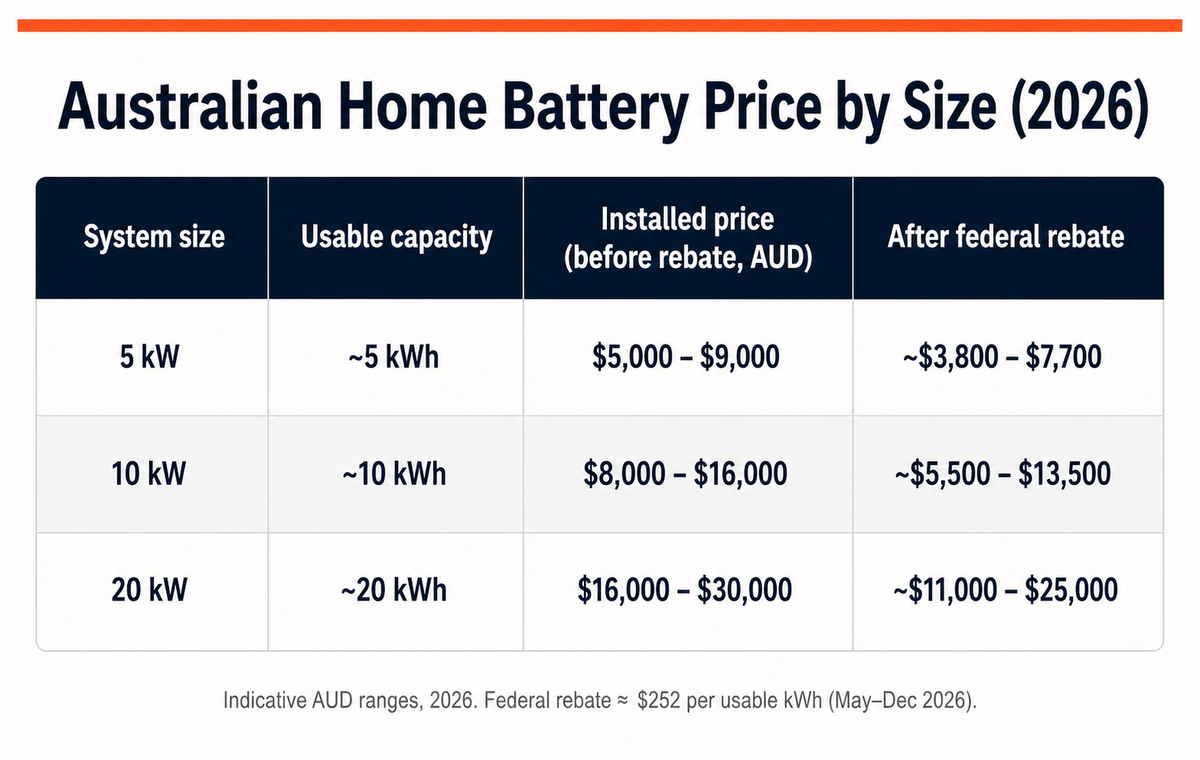
Here is the one-minute version. These are indicative fully-installed ranges for 2026, before the federal rebate, drawn from published Australian retailer and comparison pricing. Treat them as a sanity-check band, not a fixed quote; the layers below explain why any single job lands where it does.
Quick clarification — kW vs kWh: when Australians shop for a “10kW battery,” they almost always mean 10 kWh of storage capacity (energy), not 10 kW of power (output). We use the everyday “kW” labels below to match how quotes are worded, but the number that determines your price and overnight coverage is the usable kWh. Where the two matter separately, we say so.
| System size | Typical usable capacity | Installed price range (before rebate, AUD) | Approx. after federal rebate | Best suited to |
|---|---|---|---|---|
| 5kW | ~5 kWh | $5,000 – $9,000 | ~$3,800 – $7,700 | Small homes, apartments, evening load-shifting |
| 10kW | ~10 kWh | $8,000 – $16,000 | ~$5,500 – $13,500 | Medium–large family homes, most whole-home use |
| 20kW | ~20 kWh | $16,000 – $30,000 | ~$11,000 – $25,000 | Large homes, partial off-grid, small business |
Indicative AUD ranges for 2026, compiled from published Australian retailer and comparison-site pricing (Energy Matters, SolarQuotes, Solar National, Bluetti); actual prices vary by brand, install complexity and state. Rebate estimate applies the federal Cheaper Home Batteries STC value of ~$252/usable kWh (May–Dec 2026).
01 Is the price the battery unit only, or fully installed (inverter + labour + switchboard)?
02 Is the capacity quoted usable or nominal kWh? Divide price by usable to compare fairly.
03 Is the federal rebate already deducted, or still to come off? (It changes the number by thousands.)
The 3-Layer Battery Price Stack: What You’re Actually Paying For
Every Australian battery quote — no matter the brand on the box — is built from three stacked layers. Once you can see them separately, “why is this one $4,000 more?” stops being a mystery. We call it the 3-Layer Price Stack, and it’s the framework the rest of this guide hangs on.
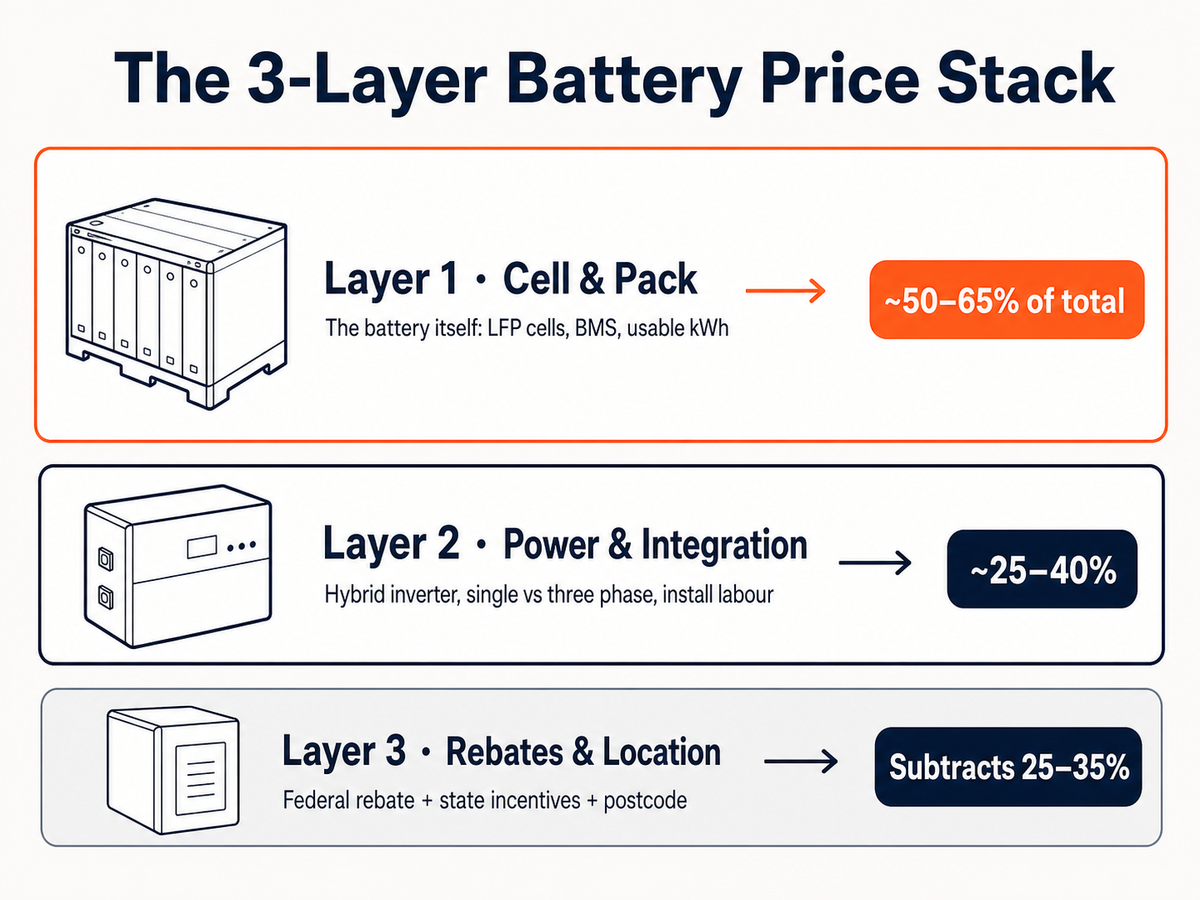
| Layer | What it is | What drives it up or down | Rough share of total |
|---|---|---|---|
| 1. Cell & Pack | The battery itself — cells, chemistry, BMS, usable capacity | LiFePO4 cell grade, cycle life, usable kWh, BMS quality | ~50–65% |
| 2. Power & Integration | Hybrid inverter, single vs three phase, labour, switchboard | Inverter brand, phase, roof/switchboard complexity | ~25–40% |
| 3. Rebates & Location | Federal rebate, state incentives, your postcode | Federal STC value, state top-ups, install region | Subtracts 25–35% |
Layer 1 — Cell & Pack: where the real cost lives
The battery unit itself is the largest single slice of the price, usually half to two-thirds. This is the layer buyers understand least and installers explain worst. Two batteries can both say “10kWh” on the label and differ by thousands because of what’s inside: the grade of the LiFePO4 (LFP) cells, the rated cycle life (2,000 cycles versus 6,000+ is a very different lifetime cost), the quality of the Battery Management System (BMS), and — critically — how much of that 10kWh is actually usable.
Supply-side note: installers we supply routinely ask us why two “10kW” quotes differ by $4,000. Nine times out of ten it isn’t the badge on the box — it’s usable-versus-nominal capacity and cell grade. A battery rated at 6,500 cycles that delivers 10.24 usable kWh is a fundamentally different asset from a 2,000-cycle pack that only gives you 8kWh usable, even if the sticker price looks similar.
This is why comparing on price per usable kWh — not price per nominal kWh, and not sticker price — is the only honest way to line quotes up. A quality LFP home battery pack lands somewhere around $500–$900 per usable kWh at the unit level in 2026; the rest of the installed price is Layers 2 and 3.
Layer 2 — Power & Integration: the inverter and the install
A battery can’t do anything on its own — it needs a hybrid inverter to charge and discharge, plus the labour to wire it in. This layer is where “same battery, different total” often comes from. The biggest single variable is single-phase versus three-phase: a 10kW single-phase hybrid inverter runs around $3,600, while the three-phase equivalent is closer to $4,500, per published Australian pricing. Add switchboard upgrades, backup circuits, and roof or access complexity, and Layer 2 can swing the total by several thousand dollars on an otherwise identical battery.
If you already have a compatible hybrid inverter, an AC-coupled or DC-coupled battery-only add-on skips much of this layer. Whether your inverter and battery actually talk to each other (closed-loop over CAN/RS485) is a separate question worth confirming before you commit — see our hybrid inverter and battery pairing guide and the low- versus high-voltage battery comparison, since architecture affects both compatibility and price.
Layer 3 — Rebates & Location: what comes back off the top
From 1 May 2026, the federal Cheaper Home Batteries Program discounts roughly 30% of a battery’s installed cost, worth about $252 per usable kWh (down from ~$311/kWh in the January–April 2026 window, as the STC factor stepped from 8.4 to 6.8). It applies to usable capacity up to 50kWh and requires a Clean Energy Council–accredited installer and CEC-listed equipment, administered through the Clean Energy Regulator’s small-scale scheme. On a 10kWh battery that’s roughly $2,500 off; on a 20kWh system, around $5,000.
State-level incentives stack on top in some regions and change often. Because rebate policy shifts through the year, we keep the full breakdown in a dedicated guide rather than repeat figures that date quickly — see the Australian solar battery rebate guide for federal plus state-by-state detail. The takeaway for pricing: always ask whether a quoted number is before or after the rebate, because it moves the figure by thousands.
How Much Does a 5kW Solar Battery Cost in Australia?
A 5kWh home battery installed in Australia costs roughly $5,000–$9,000 before rebate, or about $3,800–$7,700 after the federal discount. It’s the entry point — enough to shift a modest home’s evening load off the grid and cover short outages, but not to run a large all-electric household through the night. For apartments, small homes, or households whose main goal is dodging peak evening tariffs, 5kWh is often the best value per dollar. A single stackable unit like a 5.12kWh 100Ah LFP battery sits in this bracket and can be expanded later rather than replaced.
How Much Does a 10kW Solar Battery Cost in Australia?
A 10kWh battery — the most popular size for Australian family homes — runs about $8,000–$16,000 installed before rebate, dropping to roughly $5,500–$13,500 after the federal rebate. This is the sweet spot for whole-home overnight backup on a typical 3–4 bedroom house. The wide range is almost entirely Layers 1 and 2: budget brands (Alpha ESS, Sungrow, BYD) start near $9,000–$11,000, while premium units (Tesla Powerwall, sonnen) sit at the top. Compared on price per usable kWh, a mid-tier 10.24kWh 200Ah LFP battery rated for 6,500 cycles often beats a pricier badge on lifetime cost. This is the size where the usable-versus-nominal trap costs people the most money, so scrutinise Layer 1 hardest here.
How Much Does a 20kW Solar Battery Cost in Australia?
A 20kWh system costs approximately $16,000–$30,000 installed before rebate, or about $11,000–$25,000 after. This is large-home and partial-off-grid territory — enough to run an all-electric household, a home with an EV, or a small business through the evening and most of the night. At this size, buyers almost always move to a modular, stackable architecture (multiple high-capacity packs such as a 314Ah LFP module) rather than one large fixed unit, because it spreads cost, eases installation, and lets capacity grow. Per-kWh pricing usually improves slightly at this scale, but Layer 2 (three-phase inverters, switchboard work) grows, so the total still climbs steeply.
Why Two “Same Size” Quotes Differ by Thousands
If you’ve gathered quotes and they’re all over the map, it’s almost always one of a handful of causes. Here are the ones that move the number most:
| Price driver | Why it changes the number | What to ask |
|---|---|---|
| Usable vs nominal kWh | An “10kWh” pack may only deliver 8kWh usable; $/kWh math breaks | “What’s the usable capacity and depth of discharge?” |
| Cell grade & cycle life | 2,000 vs 6,500 cycles is a 3× difference in lifetime value | “Rated cycle life and warranty years?” |
| Battery-only vs full system | Quote may or may not include the hybrid inverter | “Does this include a compatible inverter?” |
| Single vs three phase | Three-phase inverters cost ~$900+ more | “Which inverter and phase is quoted?” |
| Rebate shown or not | Federal rebate is thousands off the total | “Is this before or after the rebate?” |
For a deeper cost model that goes beyond size and into lifetime dollars per usable kilowatt-hour, see our companion guide on solar battery price and lifetime cost in Australia. To narrow down which battery is right before you price it, the best solar battery in Australia guide and the CEC approved battery list cover selection and compliance. For a US cost comparison point, see solar battery storage cost.
Common Mistakes When Comparing Battery Prices
1. Comparing sticker prices instead of price per usable kWh
Wrong: “This 10kWh is $1,000 cheaper, so it wins.” Right: Divide each price by usable kWh and factor cycle life — the cheaper sticker often costs more per stored kilowatt-hour over its life.
2. Forgetting the inverter
Wrong: Assuming a battery-only price is the whole job. Right: Confirm whether a hybrid inverter is included; if not, add $3,600–$4,500.
3. Treating the rebate as guaranteed and fixed
Wrong: Budgeting on this year’s rebate for a next-year install. Right: The federal value steps down on a schedule — lock in the current figure and timeline.
4. Buying more capacity than your load uses
Wrong: “20kWh must be better.” Right: Size to your evening/overnight load; oversizing wastes capital that never cycles.
Frequently Asked Questions
How much does a solar battery cost in Australia in 2026?
Fully installed, expect roughly $5,000–$9,000 for a 5kWh system, $8,000–$16,000 for 10kWh, and $16,000–$30,000 for 20kWh before rebates. After the federal Cheaper Home Batteries rebate (~$252 per usable kWh from May 2026), installed cost falls toward roughly $1,000 per usable kWh.
What is the price per kWh of a home battery in Australia?
Installed, quality LFP home storage lands around $1,000 per usable kWh after the federal rebate in 2026; at the battery-unit level (before inverter and install) the cells and pack are roughly $500–$900 per usable kWh. Always confirm whether a figure uses usable or nominal capacity.
Is a 5kW or 10kW battery better value?
For most family homes, 10kWh offers the best balance of overnight coverage and price per kWh. 5kWh is better value for apartments, small homes, or pure peak-tariff shifting. Size to your actual evening and overnight load rather than to headline capacity.
Does the federal rebate apply to any battery?
No. The Cheaper Home Batteries rebate requires the battery to be on the Clean Energy Council approved battery list and installed by a CEC-accredited installer, for usable capacity up to 50kWh. Check the CEC approved battery list before buying.
Is a home battery worth it in Australia, and what’s the payback?
With the federal rebate lowering upfront cost and rising evening tariffs, typical payback in 2026 sits in the ballpark of 7–12 years, depending on your usage, tariff, and how much self-consumption you shift. Payback is driven by lifetime dollars per usable kWh, not sticker price — our lifetime cost per usable kWh guide models this in detail.
Why are the price quotes I’m getting so different?
Usually one of five reasons: usable vs nominal kWh, cell grade and cycle life, whether an inverter is included, single vs three phase, and whether the rebate is already deducted. Ask each installer to itemise these and the quotes usually line up.
Why We Wrote This
Battery pricing in Australia is confusing on purpose — a lot of quotes blur the line between the battery unit, the full installed system, and the after-rebate figure. As a battery supply brand working with installers and distributors, we sit on the supply side of that equation, so we wrote this to make the cost layers visible: what the cells and pack actually cost, what the inverter and install add, and what the rebate takes back off. Savolture offers a lineup of LiFePO4 home storage batteries built to IEC 62619 standards by our long-standing manufacturing partners; we don’t quote installed prices as a local installer, and the ranges here are compiled from published Australian market pricing so you can pressure-test any quote you’re given.
Country: China | Model: B2B wholesale & distribution (LFP home storage)
Email: info@savolture.com | Web: savolture.com
Ready to size your system?
Get a free battery recommendation.
Tell us your load, location, and backup target — we will spec the right 48V LiFePO4 system for you.