

Savolture Technical Guide
Fabricant de batterie OEM LiFePO4 : ce qu’il faut vérifier avant de vous engager | Savolture
Presque chaque page classée pour cette recherche est une usine qui se présente. Vingt ans d'activité, quarante mille mètres carrés, deux mille salariés, un mur de logos de certi...
body.sv-lang-fr { line-height: 1.55; }
.svba-direct-answer{background:#f0f4f8;border-left:5px solid #ff6b35;padding:16px 20px;margin:20px 0;border-radius:4px;font-size:15.5px;line-height:1.65}
.svba-checklist-box{background:#fff8f3;border:1px solid #ffd9c2;border-radius:6px;padding:16px 20px;margin:20px 0}
.svba-checklist-box strong{color:#c2410c}
table.svba-ref{width:100%;border-collapse:collapse;margin:20px 0;font-size:14.5px}
table.svba-ref th,table.svba-ref td{border:1px solid #d4d8de;padding:10px 12px;text-align:left;vertical-align:top}
table.svba-ref th{background:#081827;color:#fff;font-weight:600}
table.svba-ref tr:nth-child(even){background:#f7f9f8}
table.svba-ref td.navy{background:#081827;color:#fff;font-weight:600;text-align:center}
table.svba-ref td.code{font-family:ui-monospace,Menlo,Consolas,monospace;font-weight:700;color:#c2410c;text-align:center}
table.svba-ref td.win{background:#f0f7f2;font-weight:600;color:#1a6b3a}
.svba-protip{background:#081827;color:#eef2f6 !important;padding:16px 20px;border-radius:6px;margin:20px 0;font-size:14.5px}
.svba-protip strong{color:#ff9a6b !important}
.svba-protip em{color:#eef2f6 !important}
.svba-warn{background:#fef2f2;border:1px solid #fecaca;border-left:5px solid #dc2626;padding:16px 20px;margin:20px 0;border-radius:4px;font-size:14.5px}
.svba-warn strong{color:#b91c1c}
.svba-mistakes{border:1px solid #e2e6ea;border-radius:6px;padding:6px 18px;margin:14px 0;background:#fafbfc}
.svba-mistakes h4{margin:14px 0 6px;font-size:16px;color:#081827}
.svba-mistakes .wrong{color:#b91c1c;font-weight:700}
.svba-mistakes .right{color:#1a6b3a;font-weight:700}
.svba-srcnote{font-size:12.5px;color:#777;font-style:italic;margin:-12px 0 18px}
.svba-cta-grid{display:grid;grid-template-columns:repeat(auto-fit,minmax(240px,1fr));gap:14px;margin:24px 0}
.svba-cta-card{background:#1a4d33;color:#fff;padding:18px;border-radius:6px;text-align:center}
.svba-cta-card a{color:#fff;text-decoration:none;font-weight:600;display:block}
.svba-cta-card small{display:block;margin-top:6px;font-weight:400;opacity:.85;font-size:13px}
.svba-faq h3{margin-top:22px;font-size:17px;color:#1a4d33}
.svba-sources{font-size:13.5px;color:#555;background:#fafafa;padding:14px 18px;border-radius:4px;margin-top:30px}
.svba-about{border:1px solid #e2e6ea;border-radius:8px;padding:4px 22px 18px;margin:34px 0 10px;background:#fbfcfd}
.svba-about h2{margin-bottom:4px}
.svba-profile{background:#081827;color:#eef2f6 !important;border-radius:6px;padding:16px 20px;margin:14px 0;font-size:14px;line-height:1.7}
.svba-profile strong{color:#ff9a6b !important}
.svba-faultline{border-left:4px solid #ff6b35;padding:2px 0 2px 18px;margin:28px 0 18px}
.svba-faultline h2{margin-top:6px}
.svba-ask{background:#f0f4f8;border-radius:6px;padding:14px 18px;margin:16px 0;font-size:14.5px}
.svba-ask strong{color:#081827}
.svba-figure{margin:26px 0}
.svba-figure img{width:100%;height:auto;border-radius:6px}
.svba-figure figcaption{font-size:13.5px;color:#5a6470;margin-top:8px;line-height:1.55}
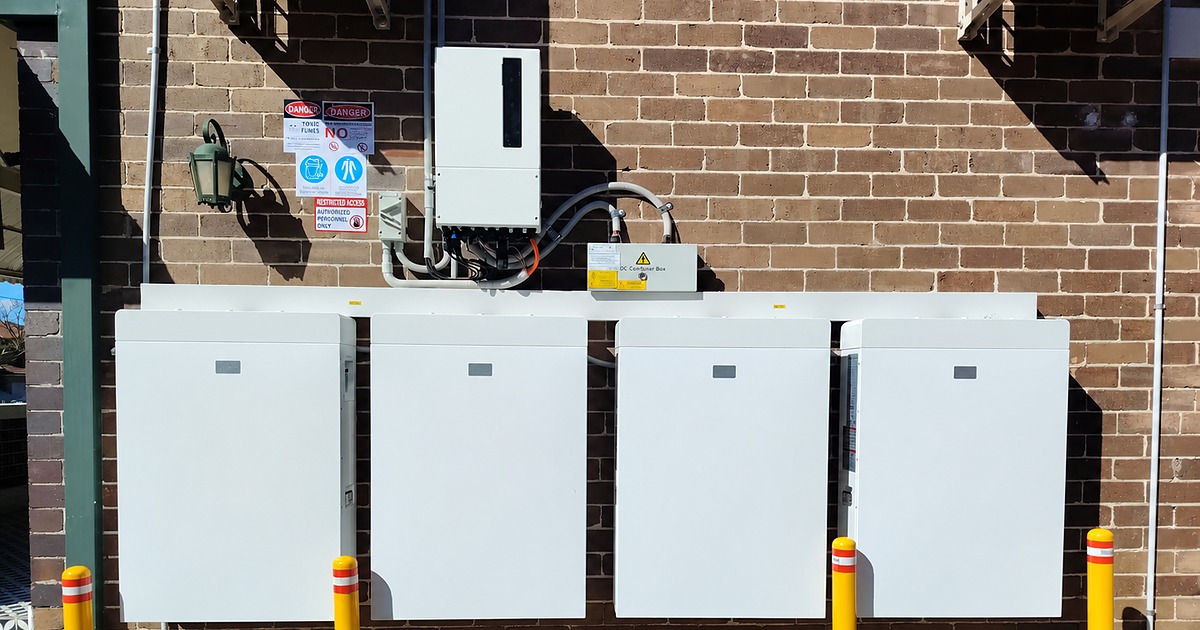
Presque chaque page classée pour cette recherche est une usine qui se présente. Vingt ans d’activité, quarante mille mètres carrés, deux mille salariés, un mur de logos de certification. Tout cela est peut-être vrai. Rien de tout cela ne répond à la question que se pose réellement un acheteur de marque privée, qui est plus étroite et beaucoup plus difficile : si j’applique ma marque sur ce produit, de quoi suis-je exactement responsable et qu’est-ce qui reste avec l’usine ?
Cette question a une réponse spécifique, et ce n’est pas celle à laquelle s’attendent la plupart des acheteurs. La version courte est que votre logo bouge et pas le certificat. Comprendre pourquoi s’avère expliquer l’essentiel de la confusion dans l’achat de batteries OEM, y compris plusieurs choses que les fournisseurs sont souvent accusés de cacher lorsqu’ils décrivent simplement un système dont l’acheteur n’a pas été informé.
alimentation en gros de batteries LiFePO4
Ce guide couvre les éléments qui déterminent si un programme de marque privée fonctionne : quels sont réellement les trois niveaux de travail OEM, qui détient le certificat et combien coûte son déplacement, comment distinguer une installation de production d’une société commerciale en quatre questions environ, et comment la quantité minimale de commande est réellement structurée. Nous publions les chiffres des coûts de certification qui nous ont été cités, car leur ampleur explique plus que n’importe quelle quantité de photographies d’usine.
“OEM” décrit trois transactions différentes
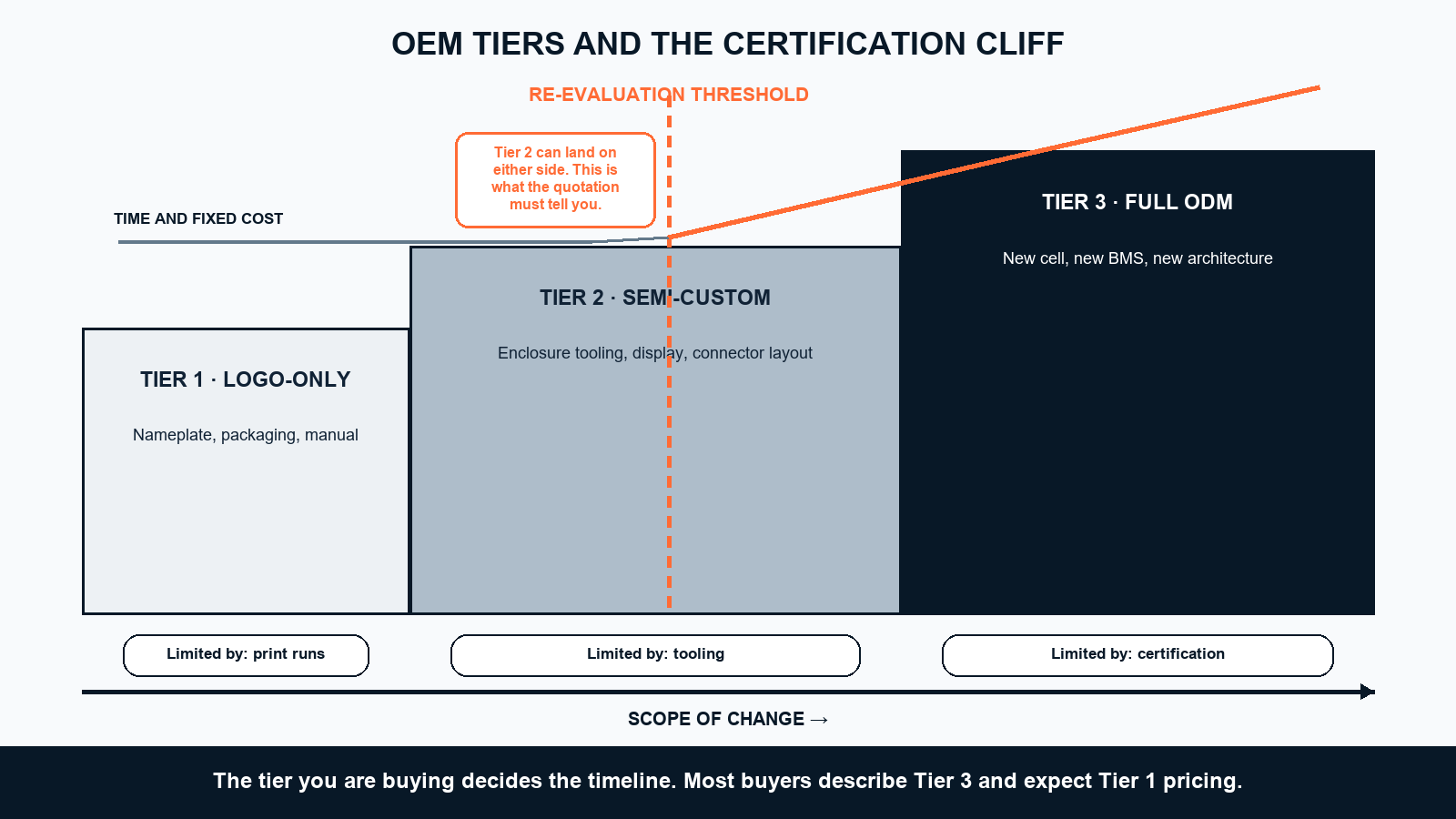
Le terme est utilisé pour désigner des arrangements qui n’ont presque rien en commun en termes de coût, de délai ou de risque. Un fournisseur citant le niveau 1 et un acheteur imaginant le niveau 3 auront une conversation productive et parviendront à des conclusions complètement différentes sur le prix.
| Niveau | Quels changements | Impact des certifications | Pilote MOQ typique |
|---|---|---|---|
| 1 Logo uniquement |
Plaque signalétique, emballage, manuel, parfois couleur du boîtier | Aucun à l’évaluation électrique. Le certificat continue de nommer l’installation et la configuration d’origine. | Tirages d’étiquettes et de cartons. Point d’entrée le plus bas. |
| 2 Semi-personnalisé |
Outillage du boîtier, affichage, disposition des connecteurs, marque du micrologiciel, variante de capacité au sein d’une famille existante | Cela dépend entièrement de ce qui a bougé. Les changements esthétiques survivent généralement. Tout ce qui touche à l’intégrité de l’enceinte, à la ventilation, à l’espacement ou au BMS peut nécessiter une réévaluation. | Amortissement des outillages d’injection ou de tôlerie. |
| 3 ODM complet |
Nouveau format ou fournisseur de cellule, nouveau BMS, nouvelle architecture mécanique, nouvelle topologie | Une nouvelle évaluation. Il s’agit d’un nouveau produit, et le calendrier et le coût en tiennent compte. | Lot d’achat de cellules plus un programme de certification complet. |
La plupart des acheteurs recherchant un fabricant de batteries OEM LiFePO4 souhaitent le niveau 1 ou le niveau 2 et le décrivent dans un langage de niveau 3. Être précis sur celui dont vous avez besoin raccourcit considérablement la première conversation, car les trois niveaux ont des goulots d’étranglement différents : le niveau 1 est limité par les tirages, le niveau 2 par l’outillage, le niveau 3 par la certification.
Qui détient le certificat et peut-il être transféré à ma marque ?
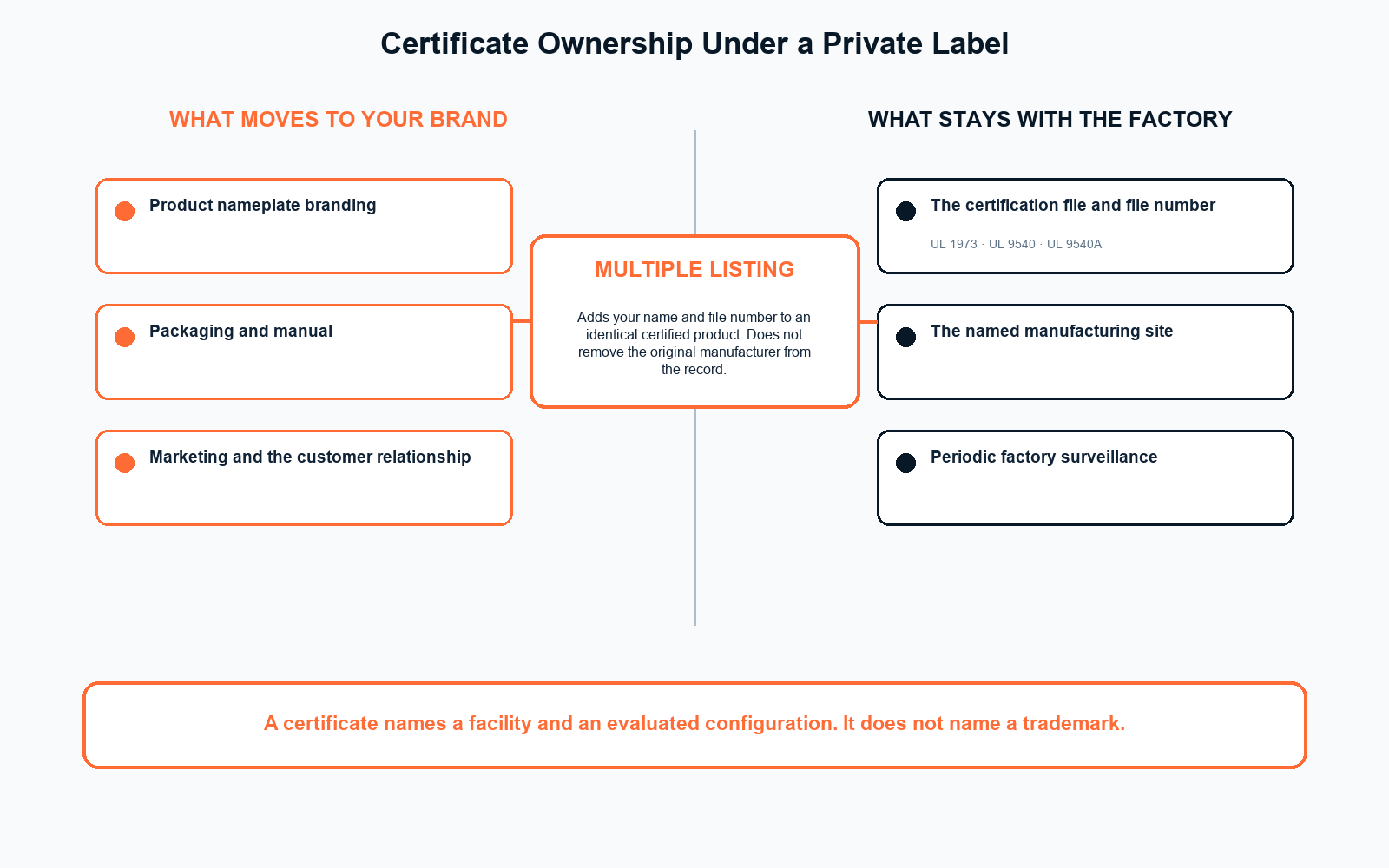
Réponse directe : Le certificat reste la propriété de l’établissement qui a fabriqué et testé le produit. Un acheteur de marque privée peut commercialiser sous sa propre marque, mais le fichier UL 1973 ou UL 9540 continue de nommer le site de production d’origine. Les organismes de certification certifient une usine, une configuration et un processus de fabrication, pas une marque.
Il s’agit du point le plus mal compris de la catégorie, et il produit un débat prévisible environ trois semaines après le début d’une première commande. L’acheteur demande le certificat réémis à son nom. Le fournisseur dit que cela ne fonctionne pas de cette façon. L’acheteur conclut que le fournisseur est évasif ou que le certificat n’a jamais été réel.
Le fournisseur a généralement raison. Voici le mécanisme.
Une certification de sécurité est une déclaration concernant un produit spécifique construit sur un site spécifique dans le cadre d’un programme de surveillance. L’organisme de certification inspecte périodiquement ce site pour confirmer que le produit correspond toujours à ce qui a été évalué. Le document identifie un fabricant, un modèle et une construction. Votre nom de marque ne fait pas partie de ce qui a été testé, et son ajout ne transfère pas la preuve sous-jacente à une autre entité juridique.
Il existe un chemin légitime et il porte un nom. UL Solutions exploite un Service de référencement multiple précisément pour cette situation : il permet d’utiliser la marque UL sur des produits certifiés identiques sous des noms de marque différents. La partie qui en fait la demande devient un « inscrit multiple » avec son propre nom et numéro de dossier, tandis que le fabricant d’origine et l’évaluation originale restent dans le dossier. Il s’agit d’un vrai document avec un véritable processus derrière lui. Ce n’est pas non plus gratuit et cela ne fait pas disparaître l’installation d’origine de la paperasse.
Notez ce que cette phrase vous donne en tant qu’acheteur. Si un fournisseur affirme que le certificat peut porter votre marque, la question à suivre est de savoir s’il s’agit d’une inscription multiple et, si oui, qui sera l’inscrit et qui paiera pour cela. Un fournisseur qui reconnaît le terme décrit quelque chose de réel. Un fournisseur qui ne le fait pas improvise.
Pour connaître la différence entre une liste au niveau du système et la méthode de test qui l’alimente, notre explicatif sur UL 9540 vs UL 9540A couvre les portées en détail. Si le marché final est résidentiel nord-américain, le guide de l’installateur pour la certification UL 9540 couvre ce qu’un inspecteur recherche sur site.
Ce que coûte réellement votre propre certification
Réponse directe : les organismes de certification ne publient pas de listes de prix et les totaux varient en fonction de la portée et du nombre de modèles. Les chiffres qui nous ont été cités pour notre propre travail de certification situent un programme nord-américain UL 1973 entre 30 000 et 40 000 dollars américains et un système UL 9540 entre 50 000 et 60 000 dollars américains. Les approbations régionales pour de nombreux marchés asiatiques, africains et latino-américains sont inférieures à 1 500. Une cotation secondaire sous votre propre marque, faisant référence à une évaluation existante, s’élève généralement à plusieurs milliers.
Nous les publions parce que l’ampleur est toute l’explication. Presque toutes les questions que les acheteurs posent sur la certification des marques privées sont résolues une fois que le chiffre est sur la table.
| Parcours certifiant | Coût indicatif | Ce que vous obtenez |
|---|---|---|
| Homologations régionales (divers marchés asiatiques, africains, latino-américains) | moins de 1 500 $ | Accès au marché lorsque l’exigence est documentaire plutôt que d’un programme d’évaluation complet |
| Annonce secondaire/multiple sous votre marque | ~3 000 à 12 000 $ | Votre marque sur un certificat qui fait toujours référence au fabricant d’origine et à l’évaluation |
| UL 1973 (sous-système batterie) | ~30 000 à 40 000 $ | Une évaluation à votre nom couvrant les cellules, modules et racks |
| UL 9540 (système complet) | ~50 000 à 60 000 $ | Une liste au niveau du système pour une configuration évaluée de batterie et d’onduleur |
Les chiffres sont des devis reçus pour notre propre travail de certification et non des tarifs publiés. Le coût réel dépend du nombre de modèles, de la complexité de la construction, de la possibilité de référencer les données de test existantes et de l’organisme de certification. Traitez-les comme des ordres de grandeur.
Regardez maintenant ce que ces chiffres impliquent. Un programme au niveau du système en votre propre nom représente un coût fixe à cinq chiffres encouru avant l’expédition d’une seule unité, et il se reproduit en partie grâce à une surveillance continue. Comparez-le au bénéfice brut que votre première commande est censée produire. Pour la plupart des acheteurs entrant dans une catégorie, la certification la dépasse, ce qui explique pourquoi le certificat reste là où il se trouve. C’est également la raison pour laquelle un fournisseur proposant d’en rééditer un à votre nom moyennant des frais modestes décrit soit une inscription multiple de manière imprécise, soit décrit quelque chose qui ne survivra pas au contact avec un bureau des permis.
Le calcul change avec le volume et le point de croisement est spécifique à votre marge et à la cadence de vos commandes plutôt qu’à une règle empirique. Exécutez-le de manière arithmétique : divisez le coût de la certification par le bénéfice brut par conteneur que vous attendez réellement, et vous obtenez le nombre de conteneurs nécessaires pour payer la propriété de la marque du document. Si ce nombre est supérieur à ce que vous envisagez d’expédier au cours des premières années, la question répond d’elle-même. Ce calcul, plutôt qu’une préférence pour la possession de vos certificats, est ce qui devrait guider la décision.
Si le certificat nomme l’usine, qui est responsable en cas de panne ?
Réponse directe : Vous l’êtes, pour votre client. Apposer votre marque sur un produit fait généralement de vous la partie responsable sur votre propre marché, quel que soit le nom qui figure sur le dossier de certification. Le certificat établit que le produit a été évalué. Il ne transfère pas vos obligations au fabricant et ne décide pas contre qui une réclamation est déposée.
C’est la conséquence de l’accord de certification que les acheteurs élaborent en dernier lieu et devraient l’être en premier. Votre marque est le nom qu’un client connaît, le nom sur la facture et, dans la plupart des juridictions, le nom de l’entité qui met le produit sur le marché. Le certificat de l’usine est une preuve que vous pouvez citer. Ce n’est pas un bouclier derrière lequel vous vous tenez.
Trois choses s’ensuivent, et elles valent la peine d’être réglées dans le contrat plutôt que d’être découvertes au cours de la deuxième année.
L’exécution de la garantie nécessite une partie désignée sur votre marché. Une garantie de dix ans sur une fiche technique est une déclaration sur la durée de vie attendue. Cela ne devient un engagement opérationnel que lorsque quelqu’un précise qui inspecte une unité défaillante, qui expédie le remplacement, qui paie le fret et combien de temps prend le processus. Si la réponse est que tout retourne en Asie, votre garantie est réelle mais lente, et vous devriez évaluer la différence dans ce que vous facturez plutôt que de la découvrir lors d’une réclamation.
La disponibilité des pièces de rechange dépasse la production. Les programmes de marque privée sont exposés à l’arrêt du modèle d’une manière que les revendeurs d’une marque connue ne le sont pas, car votre client ne peut pas acheter un module compatible auprès de quelqu’un d’autre. Demandez par écrit une fenêtre de support de production et de pièces de rechange indiquée et demandez ce qui arrive si le modèle est remplacé. Un fournisseur qui s’engage sur un chiffre dans un e-mail vous dit quelque chose d’utile sur la façon dont il planifie.
Documentation dont vous aurez besoin avant la première expédition. Deux éléments sont généralement demandés tardivement et entraînent des retards évitables : le résumé du test UN 38.3 pour la configuration exacte de la cellule et du pack expédié, et la fiche de données de sécurité. Les transitaires et certaines autorités douanières le demanderont, et un résumé faisant référence à une révision de cellule différente de celle du conteneur est un problème découvert au pire moment.
La structure de paiement appartient à la même conversation. Les conditions de dépôt contre solde sont standard, et le déclencheur de solde est la partie qui mérite d’être négociée : le paiement contre les documents d’expédition plutôt que contre l’achèvement de la production vous donne un document à inspecter avant le déplacement des fonds. Cela compte plus au premier ordre qu’au dixième, et le demander est normal plutôt que contradictoire.
Cette section décrit la pratique commerciale et non les conseils juridiques. La responsabilité du fait des produits et les obligations de placement sur le marché diffèrent selon les juridictions. Confirmez votre position auprès d’un conseiller qualifié sur le marché sur lequel vous vendez avant de vous engager dans un programme de marque privée.
Site de production ou société commerciale ? Cinq signaux
Les deux existent, les deux peuvent être légitimes et tous deux se décriront comme fabricant. Une société commerciale ayant de bonnes relations avec l’usine n’est pas un problème en soi. Ne pas savoir à qui vous parlez.
La copie du site Web ne réglera pas le problème. Ces cinq signaux le seront, et aucun d’entre eux ne nécessite une visite sur place.
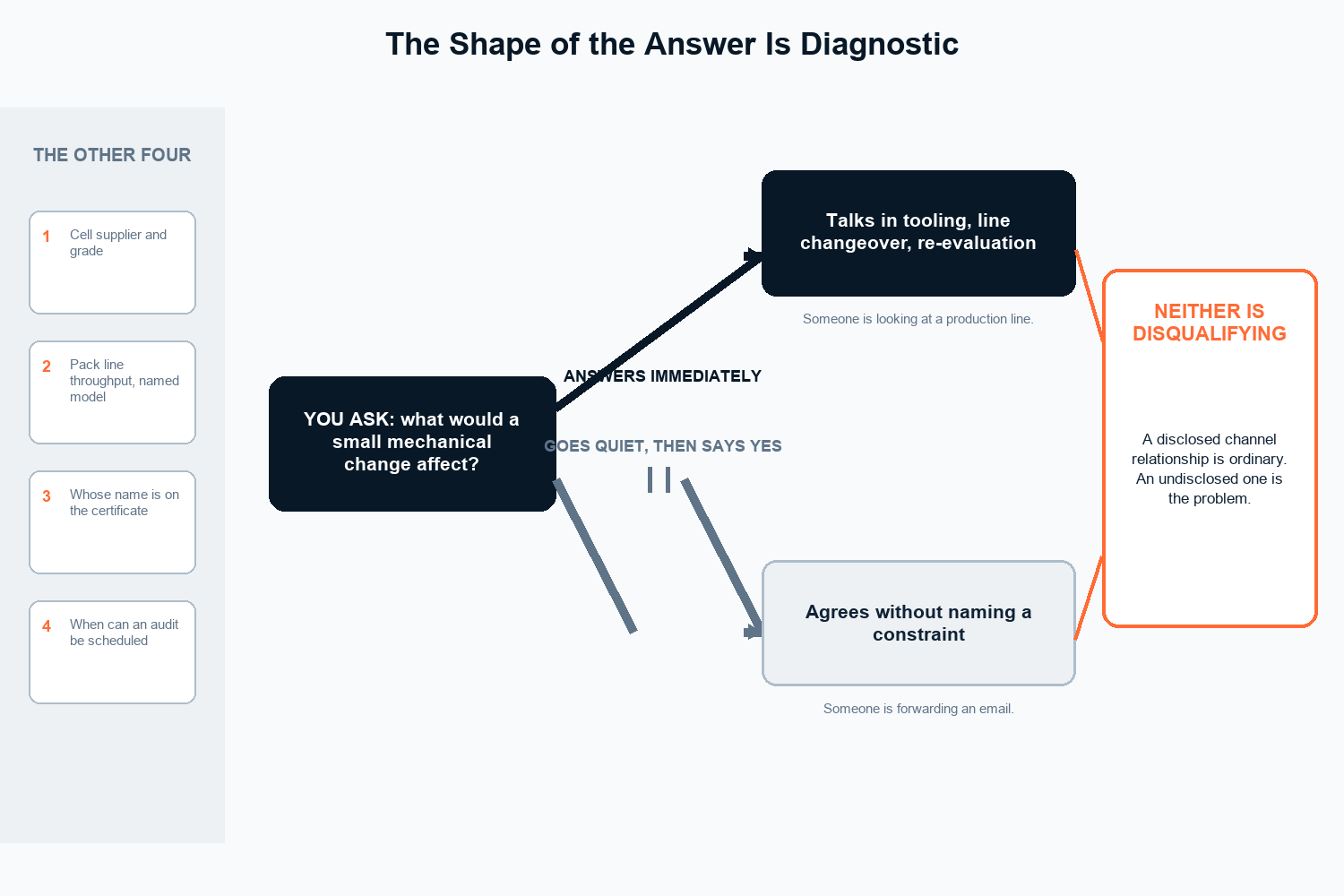
2. Débit de la ligne d’emballage. Ask for daily or monthly pack assembly capacity, stated as units of a specific model. Cell manufacturing capacity and pack assembly capacity are different things, and a company that conflates them when asked directly is telling you something.
3. Nom du titulaire du certificat. Request the full certificate PDF and read whose name is on it. If the company you are talking to does not appear on the document, they are selling a product certified to someone else’s name. That is not automatically a problem, and the binary of “factory or middleman” is too crude to be useful here: fabricant direct d’usines operating on a disclosed factory relationship are ordinary in this industry, and a multiple listing is the formal version of the same thing. The signal worth reading is whether they told you before you asked. A supplier who volunteers the relationship and offers the plant for audit is describing their business. One who lets you discover it from a PDF is managing an impression.
4. Réponse à une demande de changement. Propose a small mechanical change and ask what it affects. A facility answers in terms of tooling, line changeover and re-evaluation. A trading company goes quiet for a day and comes back with a yes.
5. Planification des audits. Ask when you could visit and who would host. Real production sites treat this as ordinary. The answer arrives with a name and a location, not enthusiasm without specifics.
Le signal 4 est celui que nous conserverions si nous étions obligés de choisir. La rapidité et la forme de la réponse à une demande de changement révèlent si quelqu’un regarde une ligne de production ou transfère un e-mail.
MOQ n’est pas un nombre
Réponse directe : La quantité minimale de commande pour les travaux sur batteries OEM est définie par la contrainte qui s’impose en premier, et il y en a généralement trois : le lot d’achat de cellules, l’amortissement de l’outillage et la portée de la certification. Un MOQ coté qui ne précise pas de quelle contrainte il provient ne peut pas être négocié intelligemment, car vous ne savez pas contre quoi vous négociez.
Les trois contraintes se comportent différemment.
Lot de cellules. Les cellules sont achetées par lots de production. Un constructeur de packs commandant un modèle de cellule spécifique pour votre programme s’engage sur une taille de lot qui n’a rien à voir avec votre commande. Cette contrainte est réelle et pour la plupart inamovible, même si elle disparaît parfois complètement si la cellule demandée fonctionne déjà pour d’autres clients. Cela vaut toujours la peine de demander, et cela vaut la peine de demander sous la forme « lequel de vos modèles existants utilise cette cellule ? » Un programme construit autour d’une cellule déjà en production pour quelque chose comme un module mural de 200 Ah hérite de ce calendrier d’approvisionnement au lieu d’en créer un nouveau.
Outillage. Si votre programme a besoin d’un nouveau boîtier, un moule existe et quelqu’un le paie. Le coût de l’outillage est une somme fixe amortie sur plusieurs unités, de sorte que le MOQ du fournisseur est en réalité une déclaration sur la rapidité avec laquelle il souhaite le récupérer. Celui-ci est véritablement négociable, souvent en payant l’outillage séparément plutôt que de l’enterrer dans un prix unitaire. Cela clarifie également à qui appartient l’outil, ce qui compte plus tard.
Certification. Si la portée nécessite une réévaluation, ce coût est fixe quelle que soit la taille de la commande et produit le MOQ le plus élevé des trois. C’est aussi celui qui est le plus souvent invisible dans une citation, apparaissant comme un minimum inexpliqué qui semble arbitraire.
Les acheteurs qui demandent cela obtiennent un devis différent de ceux qui demandent une remise. Il est possible de répondre à la première question. La seconde invite à déplacer un numéro pour des raisons indépendantes du coût, ce qui constitue rarement une bonne base pour une relation longue.
Le test de transparence : sept questions
Ceux-ci sont commandés délibérément. Chacun est facile pour une installation de production avec une discipline documentaire et de plus en plus difficile pour une entreprise qui improvise.
2. Whose name is on each certificate, and may I have the full PDF including scope pages?
3. What is your pack assembly capacity per month for this specific model?
4. If I change the nameplate and enclosure colour, what happens to the certification marking?
5. Is MOQ driven by cell batch, tooling or certification, and what is each as a separate figure?
6. Will the sample come off the production line or from finished stock, and can it carry the serial number?
7. When could an audit be scheduled, and who would host it?
La question 4 est l’instrument le plus pointu de cette liste. Un fournisseur qui affirme qu’un changement de plaque signalétique n’a aucun effet sur la certification n’y a pas réfléchi ou vous dit ce que vous voulez entendre. La bonne réponse implique les exigences de marquage et l’identification du fabricant d’origine, et nécessite plus d’une phrase.
La question 6 aborde un problème différent. Les échantillons extraits du stock fini sont parfois assemblés à la main par des ingénieurs plutôt que produits sur la chaîne, ce qui en fait un mauvais indicateur de ce qui arrive dans le conteneur.
À quoi ressemble une chronologie réaliste
Les délais constituent la deuxième source de friction la plus courante après la certification, généralement parce que l’acheteur mesure à partir d’un mauvais point de départ. Le délai de production correspond au devis des fournisseurs de pièces. C’est rarement la pièce qui détermine la date d’arrivée du produit.
| Scène | Niveau 1 avec logo uniquement |
Niveau 2 semi-personnalisé |
Niveau 3 ODM complet |
|---|---|---|---|
| Spécification et devis | 1 à 2 semaines | 2 à 4 semaines | 4 à 8 semaines |
| Outillage | aucun | 4 à 8 semaines | 8 à 12 semaines |
| Échantillon et approbation | 2 à 3 semaines | 3 à 5 semaines | 6 à 10 semaines |
| Travaux de certification | aucun | 0 à 12 semaines en fonction de la portée |
12 à 24 semaines |
| Fabrication | 3 à 5 semaines | 4 à 6 semaines | 5 à 8 semaines |
| Fret maritime (Asie vers États-Unis/UE) | 4 à 6 semaines | 4 à 6 semaines | 4 à 6 semaines |
Fourchettes indicatives à des fins de planification. La durée de la certification, en particulier, varie considérablement en fonction de la portée, de la position dans la file d’attente au laboratoire de test et de la possibilité de référencer les données existantes.
La ligne de certification est celle qui ruine les plannings. Il s’agit également de la ligne la plus souvent omise dans un devis de niveau 2, car son application dépend de détails qui n’ont pas été réglés lors de la rédaction du devis. Si votre programme présente des caractéristiques de niveau 2 et que le calendrier ne montre aucune ligne de certification, cet écart est une question et non une absence.
Les expéditions de lithium atteignent également les limites de poids avant les limites de volume avec une certaine régularité, de sorte qu’un plan de conteneur basé sur les dimensions du produit plutôt que sur le poids du carton emballé a tendance à être optimiste. Demandez la liste de colisage tôt.
Questions de spécification qui méritent d’être réglées avant le premier échantillon
Ce sont des détails qui se transforment en litiges de garantie s’ils sont convenus de manière vague. Aucun d’entre eux n’est difficile à cerner par écrit au stade de l’offre, et tous sont difficiles à renégocier après l’expédition d’un conteneur.
La durée de vie du cycle a besoin de ses conditions. Un comptage de cycles n’a aucun sens sans la profondeur de décharge, la température et le seuil de fin de vie par rapport auquel il a été mesuré. Nous utilisons 80 % de DoD comme chiffre quotidien et traitons 90 à 95 % comme une limite technique plutôt que comme un rapport cyclique. Un chiffre publié tel que les 8 500 cycles à 80 % de DoD sur notre module au sol de 314 Ah ne signifie que quelque chose à côté de ces trois qualificatifs, et une citation qui les omet n’est pas comparable à une citation qui les inclut. Notre note sur la combien de temps durent les batteries LiFePO4 explique pourquoi le vieillissement calendaire et le vieillissement cyclique produisent des réponses différentes à la même question.
Le protocole de communication nécessite un modèle testé, pas une marque. « Compatible avec les principaux onduleurs » est une affirmation de catégorie. Demandez quels modèles d’onduleurs ont été mis en service en boucle fermée, sur quel firmware et avec quel paramètre de protocole. Notre hub de compatibilité des onduleurs et des batteries couvre ce dont la boucle fermée a réellement besoin.
Fenêtre de fonctionnement et déclassement. Les limites de température de charge et de décharge diffèrent, et la limite de charge est généralement la limite contraignante. Demandez si l’auto-chauffage est installé et à quel seuil il s’enclenche.
Configuration de tension. Confirmez que les valeurs nominales et de fenêtre sur le devis correspondent aux attentes de votre onduleur. Notre tableau de tension LiFePO4 48 V donne la relation entre l’état de charge pour un système nominal de 51,2 V.
Ce qui est livré avec. Les câbles, les jeux de barres, les cache-bornes, le matériel de montage et les câbles de communication sont parfois inclus et parfois non, et la différence représente un coût réel. Le dimensionnement des conducteurs au courant de décharge maximal du système est défini par les spécifications et non par préférence : notre tableau des tailles de câbles 48 V couvre la méthode.
Si votre programme implique des modules parallèles à des banques plus grandes, les questions d’architecture de notre guide pour évaluer un fournisseur de batteries LiFePO4 empilables s’appliquent également ici et doivent être réglées avant l’outillage plutôt qu’après.
Cinq erreurs que nous voyons le plus souvent
1. En supposant que le certificat suive la marque
Faux : planifiez un lancement de marque privée en supposant que le fichier UL sera réédité au nom de votre entreprise. À droite : le certificat nomme une installation et une configuration. Prévoyez une liste multiple si la propriété de la marque du document est importante sur le plan commercial, et fixez-en le prix dès le départ.
2. Considérer un changement de plaque signalétique comme cosmétique
Faux : remplacez la plaque signalétique complète par votre propre illustration car il ne s’agit que de “juste un autocollant”. À droite : la plaque signalétique porte le marquage de certification et l’identification du fabricant. Marquez-le, mais conservez ce qui est exigé dans le dossier de certification et demandez au fournisseur de confirmer la mise en page par écrit.
3. Négocier un MOQ sans savoir quelle contrainte le fixe
Faux : demandez que le minimum soit réduit de moitié. Bien : demandez lequel du lot de cellules, de l’outillage ou de la certification est contraignant. L’outillage est souvent séparable et négociable. Ce n’est généralement pas le cas d’un lot de cellules. La distinction vaut plus que la réduction.
4. Approuver un échantillon fabriqué à la main comme représentatif
Faux : approuvez un échantillon assemblé par des ingénieurs et attendez-vous à ce que le cycle de production corresponde. Bien : demandez une unité produite en série avec son numéro de série et conservez-la. C’est votre référence si un envoi ultérieur diffère.
5. Acheter un niveau que vous n’aviez pas l’intention d’acheter
Faux : décrivez une vision de niveau 3, acceptez un prix de niveau 1 et découvrez l’écart au stade de l’échantillonnage. Droit : nommez explicitement le niveau dans le premier e-mail. C’est le moyen le plus rapide de faire un devis comparable à un autre devis.
Questions fréquemment posées
Un fabricant de batteries OEM LiFePO4 peut-il mettre la certification UL dans mon nom de marque ?
Pas en transférant le certificat existant. Les fichiers UL identifient l’usine de fabrication et la configuration évaluée, et le fabricant d’origine reste enregistré. La voie légitime est un listing multiple ou secondaire, où l’organisme de certification délivre un fichier supplémentaire portant votre marque tout en faisant référence à l’évaluation originale. Cela coûte de l’argent et prend du temps, mais il s’agit d’un véritable document plutôt que d’une solution de contournement.
Quelle est la différence entre OEM et ODM pour les batteries ?
Dans la pratique, OEM signifie généralement la conception existante de l’usine portant votre marque, avec des modifications limitées à l’étiquetage, à l’emballage et parfois à l’apparence du boîtier. ODM signifie que le travail de conception est effectué pour votre programme : sélection des cellules, BMS, architecture mécanique. La conséquence pratique est la certification. L’OEM au sens étroit ne déclenche généralement pas de réévaluation. ODM le fait toujours, et le calendrier et la commande minimale le reflètent.
Quel est un MOQ typique pour les batteries OEM LiFePO4 ?
Il n’existe pas de chiffre unique, car la quantité minimale de commande est fixée par la première des trois contraintes qui s’imposent : le lot d’achat de cellules, l’amortissement de l’outillage ou la portée de la certification. Un programme utilisant uniquement un logo et utilisant un produit certifié existant peut démarrer à bas prix, parfois avec un conteneur partiel. Un programme nécessitant un nouvel outillage ou une réévaluation affichera un minimum beaucoup plus élevé, et la raison en est un coût fixe récupéré plutôt qu’une politique.
Comment puis-je vérifier qu’un fabricant chinois de batteries est une véritable usine ?
Quatre questions le règlent sans visite sur site : quel fournisseur et quelle qualité de cellules, capacité mensuelle d’assemblage de packs pour un modèle nommé, dont le nom apparaît sur le PDF du certificat, et ce qu’une petite modification mécanique affecterait. Un outil de production répond immédiatement aux trois premières et à la quatrième en termes d’outillage et de réévaluation. Une société commerciale répond oui après un certain temps à la quatrième question.
Le changement de l’étiquette de la batterie annule-t-il la certification ?
Changer le nom de la marque sur un produit ne le rend pas dangereux ni n’invalide rétroactivement l’évaluation. Ce qu’il peut casser, c’est le marquage : des marques de certification apparaissent sur la plaque signalétique à côté du numéro de dossier et de l’identification du fabricant, ainsi qu’une plaque signalétique de remplacement qui omet celles qui ne correspondent plus au dossier de certification. L’évaluation existe toujours. La chaîne suivie par un responsable des permis a été interrompue.
Combien de temps prend un programme de batterie OEM entre la première demande et la livraison ?
Un programme avec logo uniquement utilisant un produit certifié existant dure généralement de 10 à 16 semaines, fret maritime compris. Un programme semi-personnalisé doté de nouveaux outils dure de 18 à 30 semaines, et considérablement plus longtemps si les changements déclenchent une réévaluation. Il est préférable de planifier un programme ODM complet nécessitant sa propre certification entre 9 et 15 mois. Le temps d’attente pour la certification est l’élément le moins prévisible des trois.
Si le certificat est au nom de l’usine, qui est responsable d’un produit de marque privée ?
Vous l’êtes, pour votre client. Apposer votre marque sur un produit fait généralement de vous le responsable de celui-ci sur votre propre marché, quel que soit le nom qui figure sur le dossier de certification. Le certificat constitue la preuve que le produit a été évalué et non un transfert de vos obligations. Réglez trois choses dans le contrat avant la première commande : qui exécute la garantie sur votre marché et dans quel délai, à quelle fenêtre de production et de support des pièces de rechange le fournisseur s’engagera, et qui fournit le résumé des tests UN 38.3 et la fiche de données de sécurité pour la configuration exacte expédiée.
Les acheteurs qui évaluent une unité scellée de marque par rapport à un approvisionnement direct en usine partent souvent de notre page Alternative Tesla Powerwall.
Pourquoi nous avons écrit ceci
Savolture est une marque de stockage d’énergie LiFePO4 directement en usine au service des installateurs, des entrepreneurs EPC et des distributeurs. Nous produisons des modules LFP de classe 48 V qui sont mis en parallèle dans des banques plus grandes, jusqu’à 16 unités sur notre système de 14,34 kWh, avec des produits construits selon les exigences UL 9540, UL 9540A et UL 1973. Les audits d’usine sont les bienvenus pour les acheteurs évaluant une première commande.
Nous avons écrit ceci parce que la question de certification nous parvient la plupart des semaines, généralement formulée comme une demande que nous ne pouvons pas satisfaire sous la forme où elle nous parvient. Expliquer pourquoi prend plus de temps qu’une réponse ne le permet, et l’explication est plus utile que le refus. Les chiffres de coûts ci-dessus sont les nôtres. Les publier est la réponse honnête la plus courte à la raison pour laquelle le certificat sur nos produits nomme l’installation qui les a construits et testés plutôt que notre marque, et pourquoi nous pensons qu’un numéro de dossier que vous pouvez rechercher indépendamment a plus de valeur pour vous qu’un document portant notre nom.
Avant de présélectionner un partenaire OEM, il est utile de savoir quel niveau de fabricant vous proposera. Notre tour d’horizon des fabricants de batteries LiFePO4 pour les installateurs et les distributeurs trie le marché en fonction de son accessibilité plutôt que de sa taille.
Avant de vous engager auprès d’un partenaire OEM, effectuez la demande de certification via les les cinq contrôles de vérification : le réétiquetage est le contrôle cinq, et c’est celui qui surprend le plus souvent les gens.
Servir : Installers, EPC contractors, distributors and OEM programmes
Courriel : info@savolture.com · Réponse : Quotes and documents within 24 hours
Audits d’usine : Welcome — arranged on request for buyers evaluating a first order
· UL Solutions — Service de référencement multiple pour les produits certifiés UL (the mechanism by which identical certified products carry different brand names)
· UL Solutions — FAQ sur la soumission de produits (private-labelled products manufactured by another certified company)
· UL Solutions — Test et certification des systèmes de stockage d’énergie (scope of UL 9540 and its relationship to UL 1973)
· UL Standards — UL 1973, Batteries pour utilisation dans les applications d’alimentation auxiliaire stationnaires et motrices (scope of the battery subsystem standard)
· IATA — Piles au lithium : exigences d’expédition et documentation (UN 38.3 test summary and transport documentation)
Certification cost figures are quotations received for our own certification work and are indicative only. Product figures are from Savolture datasheets available on the linked product pages.
{“@context”:”https://schema.org”,”@graph”:[{“@type”:”BlogPosting”,”@id”:”https://savolture.com/fr/blog/oem-lifepo4-battery-manufacturer/#webpage”,”url”:”https://savolture.com/fr/blog/oem-lifepo4-battery-manufacturer/”,”name”:”Fabricant de batterie OEM LiFePO4 : ce qu’il faut vérifier avant de vous engager”,”description”:”Guide technique complet : Fabricant de batterie OEM LiFePO4 : ce qu’il faut vérifier avant de vous engager. Spécifications, protocoles et conseils d’ingénierie pour professionnels du solaire.”,”inLanguage”:”fr”,”author”:{“@id”:”https://savolture.com/#organization”},”publisher”:{“@id”:”https://savolture.com/#organization”},”headline”:”Fabricant de batterie OEM LiFePO4 : ce qu’il faut vérifier avant de vous engager”,”mainEntityOfPage”:”https://savolture.com/fr/blog/oem-lifepo4-battery-manufacturer/”},{“@type”:”Organization”,”@id”:”https://savolture.com/#organization”,”name”:”Savolture”,”url”:”https://savolture.com/”,”inLanguage”:”fr”}]}
Ready to size your system?
Get a free battery recommendation.
Tell us your load, location, and backup target — we will spec the right 48V LiFePO4 system for you.