

Savolture Technical Guide
Liste des batteries approuvées par Deye (2026) : versions, codes de configuration et réalité hors liste | Savolture
Deye publie sa liste de batteries approuvées au format PDF. C'est toute l'expérience utilisateur : un document numérisé, des dizaines de marques dans un petit tableau, deux fich...
body.sv-lang-fr { line-height: 1.55; }
.svba-direct-answer{background:#f0f4f8;border-left:5px solid #ff6b35;padding:16px 20px;margin:20px 0;border-radius:4px;font-size:15.5px;line-height:1.65}
.svba-checklist-box{background:#fff8f3;border:1px solid #ffd9c2;border-radius:6px;padding:16px 20px;margin:20px 0}
.svba-checklist-box strong{color:#c2410c}
table.svba-ref{width:100%;border-collapse:collapse;margin:20px 0;font-size:14.5px}
table.svba-ref th,table.svba-ref td{border:1px solid #d4d8de;padding:10px 12px;text-align:left;vertical-align:top}
table.svba-ref th{background:#081827;color:#fff;font-weight:600}
table.svba-ref tr:nth-child(even){background:#f7f9f8}
table.svba-ref td.navy{background:#081827;color:#fff;font-weight:600;text-align:center}
table.svba-ref td.code{font-family:ui-monospace,Menlo,Consolas,monospace;font-weight:700;color:#c2410c;text-align:center}
.svba-protip{background:#081827;color:#eef2f6 !important;padding:16px 20px;border-radius:6px;margin:20px 0;font-size:14.5px}
.svba-protip strong{color:#ff9a6b !important}
.svba-protip em{color:#eef2f6 !important}
.svba-warn{background:#fef2f2;border:1px solid #fecaca;border-left:5px solid #dc2626;padding:16px 20px;margin:20px 0;border-radius:4px;font-size:14.5px}
.svba-warn strong{color:#b91c1c}
.svba-mistakes{border:1px solid #e2e6ea;border-radius:6px;padding:6px 18px;margin:14px 0;background:#fafbfc}
.svba-mistakes h4{margin:14px 0 6px;font-size:16px;color:#081827}
.svba-mistakes .wrong{color:#b91c1c;font-weight:700}
.svba-mistakes .right{color:#1a6b3a;font-weight:700}
.svba-srcnote{font-size:12.5px;color:#777;font-style:italic;margin:-12px 0 18px}
.svba-cta-grid{display:grid;grid-template-columns:repeat(auto-fit,minmax(240px,1fr));gap:14px;margin:24px 0}
.svba-cta-card{background:#1a4d33;color:#fff;padding:18px;border-radius:6px;text-align:center}
.svba-cta-card a{color:#fff;text-decoration:none;font-weight:600;display:block}
.svba-cta-card small{display:block;margin-top:6px;font-weight:400;opacity:.85;font-size:13px}
.svba-faq h3{margin-top:22px;font-size:17px;color:#1a4d33}
.svba-sources{font-size:13.5px;color:#555;background:#fafafa;padding:14px 18px;border-radius:4px;margin-top:30px}
.svba-about{border:1px solid #e2e6ea;border-radius:8px;padding:4px 22px 18px;margin:34px 0 10px;background:#fbfcfd}
.svba-about h2{margin-bottom:4px}
.svba-profile{background:#081827;color:#eef2f6 !important;border-radius:6px;padding:16px 20px;margin:14px 0;font-size:14px;line-height:1.7}
.svba-profile strong{color:#ff9a6b !important}
Deye publie sa liste de batteries approuvées au format PDF. C’est toute l’expérience utilisateur : un document numérisé, des dizaines de marques dans un petit tableau, deux fichiers distincts en fonction de votre onduleur et un numéro de version dans le coin qui change plusieurs fois par an. Si vous tenez une batterie spécifique et essayez de répondre à une question – est-ce sur la liste et que dois-je régler sur l’onduleur – le PDF vous fait travailler pour elle. Ce guide transforme ce document en quelque chose que vous pouvez réellement lire et répond aux trois questions auxquelles il ne répond jamais.
Réponse rapide : Deye tient à jour deux listes de batteries approuvées : une liste basse tension pour les systèmes 48 V (version actuelle DY-LV48-0109, publiée le 24 juillet 2025) et une liste haute tension distincte pour les onduleurs de la série SG01HP3 (DY-HV(160-800)-021). La liste LV contient plus de 80 marques approuvées, dont BYD, LG, Pylontech, Dyness, PYTES, Weco, JINKO, Fox ESS et les propres packs de Deye. Presque toutes les entrées communiquent via CAN avec le code de configuration de l’onduleur 00 — Deye utilise une valeur de configuration dans la liste plutôt qu’un code par marque. Si votre modèle exact n’est pas imprimé sur la liste, cela ne signifie pas automatiquement qu’il ne fonctionnera pas, mais cela signifie que le risque d’intégration incombe à vous plutôt qu’au fabricant.
Trois questions auxquelles le PDF ne répond pas
Chaque exemplaire de la liste Deye répond à la même question implicite : cette marque est-elle imprimée sur la page. Il ne répond pas aux trois questions que les gens posent réellement à leur arrivée, dans l’ordre où ils en ont réellement besoin.
Question 1 : Laquelle des deux listes s’applique à moi ?
C’est le premier endroit où les gens perdent du temps. Deye publie des documents distincts pour ses familles d’onduleurs basse tension et haute tension, et télécharger le mauvais vous envoie à la recherche d’une batterie qui n’y figurera jamais.
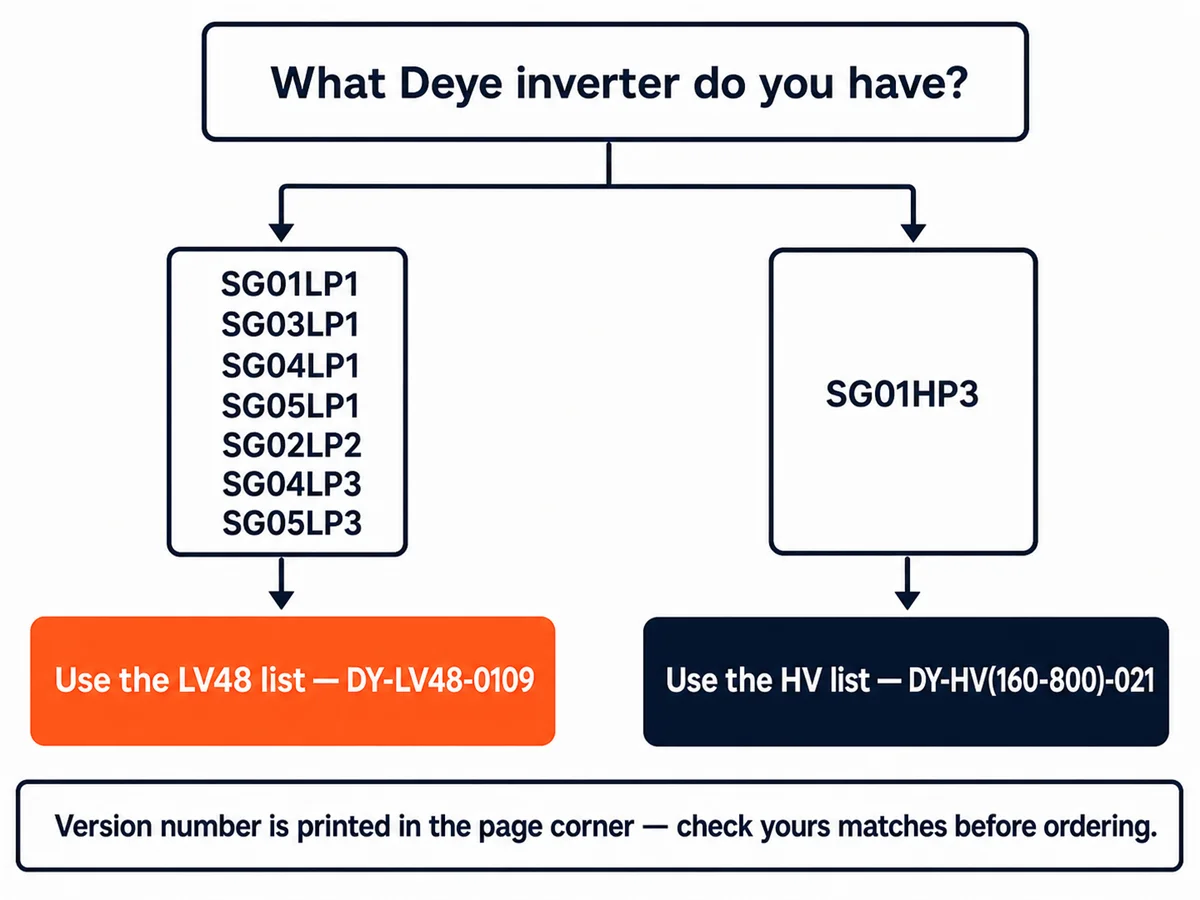
| Votre onduleur | Quelle liste | Version actuelle vue |
|---|---|---|
| Hybride 48 V SG01LP1 / SG03LP1 / SG04LP1 / SG05LP1 / SG02LP2 / SG04LP3 / SG05LP3 |
Liste basse tension (LV48) | DY-LV48-0109 24 juillet 2025 |
| Triphasé haute tension Série SG01HP3 |
Liste haute tension (HT) | DY-HV(160-800)-021 21 août 2023 |
Versions par Deye a publié des documents de liste de batteries approuvés, Ningbo Deye Inverter Technology Co., Ltd. La série LV48 est révisée fréquemment : les versions 0037, 0076, 0103, 0109 et 0126 sont toutes en circulation sur des sites tiers, alors confirmez le numéro de version imprimé sur la page que vous lisez.
01 Vérifiez le numéro de version dans le coin de la page : les sites tiers hébergent des révisions vieilles de plusieurs années.
02 Vérifiez qu’il s’agit de la bonne famille : LV48 pour les hybrides 48 V, HV pour SG01HP3.
03 Vérifiez que votre modèle exact d’onduleur apparaît dans le bloc d’en-tête, pas seulement un modèle similaire.
Les deux documents couvrent du matériel véritablement différent. La liste LV48 s’applique à la gamme hybride 48 V de Deye : SUN-3.6/5/6/7.6/8K-SG01LP1-EU, SUN-5/6/7.6/8K-SG01LP1-US, SUN-3.6/5/6K-SG03LP1-EU, SUN-3/3.6/5/6K-SG04LP1-EU, SUN-3.6/5/6/7.6/8K-SG05LP1-EU, SUN-5/6/8/10/12K-SG04LP3-EU, SUN-12/14/16K-SG01LP1-EU, SUN-8K-SG02LP2-US et SUN-14/15/16/18/20K-SG05LP3-EU/AU-SM2. La liste HV couvre plutôt la famille triphasée SG01HP3 : SUN-5/6/8/10/12/15/20K-SG01HP3-EU-AM2, SUN-29.9/30/35/40/50K-SG01HP3-EU-BM3/4, SUN-30K-SG01HP3-US-BM3/4 et SUN-60K-SG01HP3-US-BM3/4. Si votre modèle d’onduleur ne figure dans aucune des listes ci-dessus, vous lisez probablement le mauvais document pour votre matériel.
La dérive de version mérite d’être prise au sérieux plutôt que d’être traitée comme une note de bas de page. Sur les sites qui hébergent des copies de la liste de Deye, nous avons trouvé cinq révisions distinctes du LV48 toujours en circulation : 0037, 0076, 0103, 0109 et 0126. Une batterie véritablement manquante dans une copie 0037 de l’ère 2023 peut apparaître dans la révision 0109 actuelle, et l’inverse se produit également lorsqu’un modèle est abandonné. L’habitude pratique : ne pas ajouter un PDF à vos favoris. Vérifiez à nouveau la version actuelle chaque fois qu’une décision de couplage est réellement importante, car la page que vous avez enregistrée il y a six mois n’est très probablement pas la page que Deye publie aujourd’hui.
Question 2 : Mon modèle est-il réellement présent ?
La compatibilité entre batterie et onduleur doit être vérifiée par modèle, firmware, liste actuelle, documentation de communication et conditions de garantie. Ni le 48 V ni CAN/RS485 ne prouvent à eux seuls une communication en boucle fermée.
| Marque | Modèles approuvés (tels qu’imprimés) | Protocole | Configuration |
|---|---|---|---|
| BYD | Boîtier de batterie LV Flex Lite, LV5.0 | PEUT | 00 |
| LG | RESU6.5 (blocage C6.5), RESU10 (C10), RESU12 (C12) | PEUT | 00 |
| Pylônetech | US2000B, US3000, US2000C, US3000C, UP5000, US5000, Force L1, Force L2 | PEUT | 00 |
| Dysse | B4850, A48100 | PEUT | 00 |
| Weco | 4K4 BT, 5K3 BT | PEUT | 00 |
| PYTES Énergie | BOITE ELECTRIQUE 48100R | PEUT | 00 |
| Alpha-ESS | M4856-P, SOURIRE CHAUVE-SOURI | PEUT | 00 |
| JINKO | JKS-B51100-GI, JKS-B51100-II, JKS-B48100-GI | PEUT | 00 |
| Renard ESS | LD-48100P | PEUT | 00 |
| Deye (propre) | SE-G5.1, SE-G5.3, SE-F5, SE-F12, SE-F16, RW-M5.3, RW-F10.2, RW-F16, RW-L5.1, AI-W5.1 et autres | PEUT | 00 |
| Weco | 4K4 BT, 5K3 BT | PEUT | 00 |
| Hubble | AM-2 5,5KW, AM-5 51,2V 100AH | PEUT | 00 |
| UZ Énergie | L051100-A, L051100-A1, L051100-B, L051100-D, PLPA-L1-5K1, PLPA-L1-10K2 | PEUT | 00 |
| Narada | 48NPFC80, 48NPFC100, 48NPFC150, 48NPFC200 | PEUT | 00 |
| Soluna | Pack 4K, Pack 5K, Pack EOS-5K, Pack Franz 9,6K | PEUT | 00 |
| DMEGC | L01-48100, L02-48100 | PEUT | 00 |
| GÉN2 | P48200-7, P48100-7, P48150-1 | PEUT | 00 |
| Livoltek | BLF48100, BLF51-5 | PEUT | 00 |
| RENON | R-EB005160, R-XC005161, R-XL015031 | PEUT | 00 |
| Sunwoda | SunESS, Atrix, Atrix basique, MonaWall | PEUT | 00 |
| Également répertorié | REVOV, Batterich/Greenrich, TOPBAND, Shoto, KODAK, Batali, Uhome, Rosen Solar Energy, BALANCELL, UFO, Robuste, LBSA, Vestwoods, LEMAX, EVO, VOLTA, Kon-TEC et plus de 40 marques supplémentaires | PEUT | 00 |
Entrées de la liste des batteries approuvées par Deye DY-LV48-0109 (24 juillet 2025). Le document répertorie plus de 80 marques sur plusieurs pages ; le tableau ci-dessus couvre les noms les plus fréquemment recherchés ainsi qu’une répartition représentative du reste. Les orthographes du modèle suivent exactement le document source, y compris les majuscules incohérentes là où le propre PDF de Deye est incohérent.
Question 3 : Que dois-je régler réellement sur l’onduleur ?
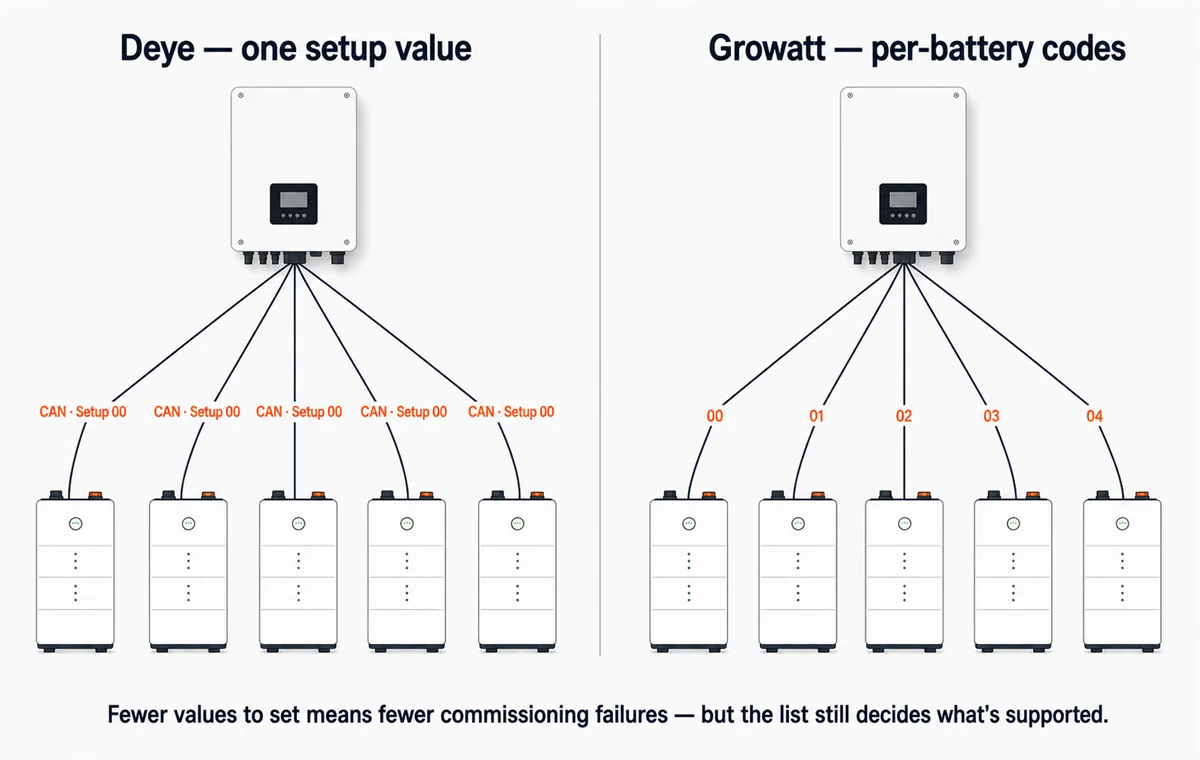
Voici le détail à connaître avant de vous lancer dans la chasse dans les menus. Sur la liste LV48, pratiquement toutes les batteries approuvées sont configurées de la même manière : Communication CAN, valeur de configuration de l’onduleur 00. Deye n’attribue pas de code de profil différent par marque de batterie.
C’est vraiment différent du fonctionnement de certaines autres plateformes. Growatt, par exemple, mappe chaque batterie approuvée à son propre code de mode Lithium – 00 pour certains packs, 01, 02, 03 ou 04 pour d’autres – et le réglage d’une mauvaise batterie est une cause fréquente d’une batterie qui se connecte correctement et refuse toujours de communiquer. Nous avons couvert cela en détail dans le Guide de compatibilité des batteries Growatt. GoodWe se situe quelque part entre les deux, avec sa propre liste approuvée et ses propres exigences de protocole, couvertes dans le guide de compatibilité GoodWe. Sur Deye, ce mode d’échec particulier est beaucoup moins probable, car il n’y a qu’une seule valeur à corriger.
Remarque concernant l’offre : les batteries que nous fournissons sont livrées avec un BMS CAN/RS485 conçu exactement pour ces plates-formes ouvertes. La question que nous posons le plus souvent n’est pas “est-ce compatible” mais plutôt “mon modèle n’est pas imprimé sur le PDF, et maintenant”. C’est une question légitime et elle mérite une réponse directe plutôt qu’un haussement d’épaules, ce à quoi sert la section suivante.
Votre batterie n’est pas sur la liste. Et maintenant ?
Il s’agit du scénario réel le plus courant et c’est la raison pour laquelle les gens recherchent en premier lieu des numéros de modèle spécifiques. Un exemple concret : BALF-512314-V2 est un modèle que les gens consultent régulièrement sur la liste de Deye. Il n’apparaît ni sur la liste LV48 actuelle (DY-LV48-0109), ni sur la liste haute tension (DY-HV(160-800)-021). C’est une réponse factuelle, pas un verdict sur la batterie.
Ce que signifie réellement être hors liste, par ordre d’importance pratique :
| Ce que cela signifie | Ce que ça ne veut pas dire |
|---|---|
| Deye n’a pas validé le BMS de ce pack spécifique par rapport à ses onduleurs | Que la batterie est dangereuse ou de mauvaise qualité |
| La communication en boucle fermée peut ne pas négocier correctement | Que ça ne marchera certainement pas du tout |
| Le risque d’intégration est transféré à vous et à votre fournisseur | Qu’il n’y a pas de voie à suivre |
| Les conversations d’assistance deviennent plus difficiles si quelque chose se comporte mal | Cette opération de suivi de tension est impossible |
La solution pratique lorsque votre modèle n’est pas imprimé : demandez directement au fournisseur de batterie si son BMS implémente le protocole Deye CAN et s’il a des couplages sur le terrain avec votre modèle exact d’onduleur. Un fournisseur qui l’a effectivement fait vous répondra avec des détails : modèles d’onduleurs, micrologiciels, paramètres. Celui qui ne l’a pas fait répondra “ça devrait marcher”. Cette différence vous indique l’essentiel de ce que vous devez savoir. Notre guide de ce que signifie réellement la liste approuvée de Deye approfondit la distinction entre boucle fermée et suivi de tension, et le guide d’appairage LFP 48 V couvre la séquence de câblage et de mise en service une fois l’appairage effectué. réglé.
Ce que la liste vous dit sur la plateforme
Prenez du recul par rapport aux numéros de modèle individuels et la liste dit quelque chose d’utile sur les décisions d’achat. Approuver plus de 80 marques tierces, sur un seul protocole, avec une seule valeur de configuration, est le comportement d’une plate-forme qui attend de vous que vous apportiez votre propre batterie. C’est le contraire d’un écosystème fermé, où l’onduleur ne communique qu’avec les propres packs du fabricant — consultez notre guide de compatibilité Sungrow pour savoir comment cela se déroule.
Pour un installateur ou un distributeur, une liste ouverte est un levier : vous pouvez comparer les packs en termes de capacité utilisable, de durée de vie et de coût au débarquement plutôt que de prendre ce que vend la marque de l’onduleur, qu’il s’agisse d’une unité de 5,12 kWh 100 Ah pour des piles plus petites ou d’un module plus grand pour le travail dans toute la maison. Cela signifie également que le travail de vérification vous appartient. Les deux choses sont vraies à la fois. Le hub de compatibilité onduleur-batterie explique en quoi les plates-formes ouvertes et fermées diffèrent au niveau du protocole, et le guide basse et haute tension explique le choix d’architecture qui décide quelle liste Deye vous finirez par lire en premier lieu.
Erreurs courantes lors de l’utilisation de la liste Deye
1. Lire une ancienne révision
Faux : En téléchargeant le premier PDF “Liste des batteries approuvées par Deye”, une recherche renvoie. Droite : Vérifiez le numéro de version et la date de publication imprimés sur la page : plusieurs révisions sont en circulation sur des sites tiers.
2. Vérifier complètement la mauvaise liste
Faux : Vous recherchez un pack 48 V sur la liste haute tension. Droite : LV48 pour les hybrides 48 V de type SG01LP1, HV pour la série SG01HP3.
3. Correspondant à la marque mais pas au modèle
Faux : “Pylontech est approuvé, donc ce pack Pylontech convient.” Droit : L’approbation se fait par modèle. L’US3000C répertorié ne dit rien sur un modèle qui ne l’est pas.
4. Supposer que hors liste signifie inutilisable
Faux : Jeter une batterie en bon état car elle n’est pas imprimée. Bien : Cela signifie non validé et non dangereux : demandez au fournisseur une preuve d’appariement sur le terrain avec votre modèle d’onduleur.
Foire aux questions
Quelle est la version actuelle de la liste des batteries approuvées par Deye ?
Pour les onduleurs hybrides 48 V, la liste basse tension est DY-LV48-0109, publiée le 24 juillet 2025. Pour les onduleurs haute tension de la série SG01HP3, la liste distincte est DY-HV(160-800)-021. La série LV48 est révisée plusieurs fois par an, alors vérifiez la version imprimée sur l’exemplaire que vous lisez.
Quel est le code de configuration du mode lithium / onduleur Deye ?
Sur la liste approuvée LV48, les batteries communiquent via CAN avec la valeur de configuration de l’onduleur 00. Deye applique la même valeur de configuration pour toutes les marques répertoriées plutôt que d’attribuer un code différent par batterie, ce qui est différent des plates-formes comme Growatt qui mappent chaque pack à son propre code de profil.
Le BALF-512314-V2 figure-t-il sur la liste des batteries approuvées par Deye ?
Il n’apparaît pas sur la liste actuelle basse tension (DY-LV48-0109) ni sur la liste haute tension (DY-HV(160-800)-021). Être absent signifie que le couplage n’a pas été validé par Deye, et non que la batterie n’est pas sûre – vérifiez auprès du fournisseur de batterie si son BMS implémente le protocole Deye CAN et s’il dispose de couplages sur le terrain avec votre modèle d’onduleur.
Combien de batteries y a-t-il sur la liste approuvée par Deye ?
La liste LV48 comprend plus de 80 marques, dont beaucoup avec plusieurs modèles chacune, dont BYD, LG, Pylontech, Dyness, Weco, PYTES, JINKO, Fox ESS, Alpha ESS et les propres packs de Deye, ainsi qu’une longue queue de fabricants régionaux.
Puis-je utiliser une batterie qui ne figure pas sur la liste de Deye ?
Souvent oui, mais le risque d’intégration se déplace vers vous. La communication en boucle fermée peut ne pas négocier correctement et le soutien devient plus difficile si quelque chose se comporte mal. Demandez au fournisseur des couplages de terrain spécifiques avec votre modèle exact d’onduleur plutôt qu’une assurance générale.
Pourquoi nous avons écrit ceci
Chaque page classée dans la « Liste des batteries approuvées par Deye » est soit le PDF lui-même, soit une copie de celui-ci hébergée ailleurs. Aucun d’entre eux ne répond aux questions que les gens se posent réellement : laquelle des deux listes s’applique à mon onduleur, cette version est-elle actuelle, que dois-je configurer et que se passe-t-il si mon modèle n’est pas imprimé. Nous construisons et fournissons des batteries LFP 48 V pour les plates-formes d’onduleurs ouvertes, nous avons donc intérêt à ce que vous compreniez comment fonctionnent ces listes – et la version honnête de cela inclut de dire clairement que l’absence d’un modèle dans une liste est une véritable considération, pas quelque chose à écarter. Les systèmes Savolture sont construits dans notre usine automatisée de batteries de 1,8 GWh conformément aux exigences UL 9540, UL 1973 et CEI 62619.
Pays : China | Modèle : B2B wholesale & distribution (LFP home storage)
Courriel : info@savolture.com | Internet : savolture.com
{“@context”:”https://schema.org”,”@graph”:[{“@type”:”BlogPosting”,”@id”:”https://savolture.com/fr/blog/deye-approved-battery-list-2026/#webpage”,”url”:”https://savolture.com/fr/blog/deye-approved-battery-list-2026/”,”name”:”Liste des batteries approuvées par Deye (2026) : versions, codes de configuration et réalité hors liste”,”description”:”Guide technique complet : Liste des batteries approuvées par Deye (2026) : versions, codes de configuration et réalité hors liste. Spécifications, protocoles et conseils d’ingénierie pour professionnels du solaire.”,”inLanguage”:”fr”,”author”:{“@id”:”https://savolture.com/#organization”},”publisher”:{“@id”:”https://savolture.com/#organization”},”headline”:”Liste des batteries approuvées par Deye (2026) : versions, codes de configuration et réalité hors liste”,”mainEntityOfPage”:”https://savolture.com/fr/blog/deye-approved-battery-list-2026/”},{“@type”:”Organization”,”@id”:”https://savolture.com/#organization”,”name”:”Savolture”,”url”:”https://savolture.com/”,”inLanguage”:”fr”}]}
Ready to size your system?
Get a free battery recommendation.
Tell us your load, location, and backup target — we will spec the right 48V LiFePO4 system for you.